
Short answer: if the knife touches food, use food grade mineral oil. If it never touches food, a light machine oil works and lasts longer. Do not use cooking oils from your kitchen cupboard, and do not use WD-40 as a protective coating.
Food grade mineral oil
This is the default answer for kitchen knives, and for any carbon steel blade that might touch food. It is sold as food grade mineral oil, butcher block oil, or in a pharmacy as light mineral oil. All the same thing.
It is odourless, tasteless, does not go rancid, and it is safe on wooden handles and cutting boards as well as steel. A bottle costs a few dollars and lasts years.
Do not use kitchen cooking oils
Olive, vegetable, canola and sunflower oil all go rancid. They oxidise, turn sticky, smell sour and can leave a gummy film that traps moisture against the steel. That is worse than no oil at all.
 BLACK MAMBA KNIVES Fallen 3 Inches Blade Damascus Folding Pocket Knife Hunting Tool USA Made | BMK-120
 Dugite 7.2″ Long 3.2″ Blade” 5oz Damascus Pocket Knife Handmade Damascus Pocket Folding Knife Black Mamba Hand Made World Class Knives | BMK-416
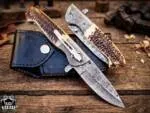 Queen Snake 8.5" Long Damascus Pocket Knife Damascus Hunting Knife Stag Antler Handle Pocket Clip Knife with Leather Sheath USA Made | BMK-445
The exception people ask about is camellia oil, which is the traditional Japanese blade oil. It genuinely works and does not go rancid quickly, but it costs more than mineral oil and does the same job.
Non food knives
For a folder, an EDC blade or a hunting knife that will not touch food, a light machine oil, a dedicated knife oil, or a corrosion inhibiting oil lasts longer than mineral oil and protects better against humidity.
For long term storage a rust preventative such as a light gun oil is the strongest option, but wipe it off before the knife goes near anything you will eat.
Where WD-40 fits, and where it does not
WD-40 is a water displacer. It is genuinely useful for flushing a gritty pivot or driving water out of a knife that got soaked. It is not a protective coating: it evaporates and leaves a thin residue that attracts dust. Use it to clean, then oil the knife properly afterwards.
How much, and how often
Far less than people think. A few drops on a cloth, wiped over the blade until it looks barely damp. If you can see wet oil sitting on the steel, wipe more off.
| Kitchen knife | Wipe after washing. Oil monthly. |
| Carry folder | Blade monthly, one drop on the pivot. |
| Hunting knife | After every use, then before it goes away. |
| Long term storage | Oil well, wrap in paper not plastic, and never leave it in a leather sheath. |
The sheath problem
Leather is tanned with acidic compounds and it holds moisture. A carbon blade left in a leather sheath for a season will come out spotted no matter how well you oiled it. Store the knife out of the sheath, every time.
Best oil for pocket knives and folding knives
The best oil for folding knives, and the best oil for pocket knives, is a light machine oil or a dedicated knife pivot oil, applied one drop at a time. A folder is not a fixed blade. It has four places that matter, and they do not want the same treatment.
- The pivot. The only part that needs a true lubricant. One drop where the blade tang meets the washers, then open and close the knife ten or fifteen times so it spreads. Wipe away whatever creeps out of the joint.
- The blade. This wants corrosion protection, not lubrication. An oiled cloth wiped along the flats until the steel looks barely damp.
- The lock. A liner or frame lock face, or the underside of a lockback bar, takes a trace of oil on a cotton bud. Flood it and the lock feels vague and can stick when you release it.
- The detent. Leave it alone. Oil on the detent ball softens the click that holds the blade shut in your pocket. What migrates there from the pivot is enough.
Clean before you oil, every time. Oil dropped onto pocket lint and dust makes an abrasive paste that wears washers faster than running the knife dry. Flush the pivot with hot water or a solvent, shake it out, let it dry, then oil. Full method in how to clean a pocket knife.
Over-oiling is the common mistake. A pocket is full of grit, and a wet pivot holds that grit against the washers. One drop, worked in, excess wiped off. If the knife marks your thumb, you used too much.
After the knife gets wet, treat it as urgent, salt water especially. Rinse in fresh water, work the blade under the tap to flush the joint, shake it out, then drive the rest out with a water displacer or compressed air. Dry it, and only then oil the pivot and wipe the blade. A folder put away damp rusts from the inside, where you cannot see it.
The four kinds of knife oil, and what each is good at
Almost every product sold as knife oil falls into one of four categories, and the category matters far more than the brand on the bottle.
- Light machine oil. Sewing machine oil, 3-IN-ONE and similar. Cheap, easy to find, thin enough to reach into a pivot, and the default answer for non-food blades. Not food safe, and it picks up dust if you use too much.
- Dedicated knife and pivot oils. Products such as Knife Pivot Lube, Benchmade BlueLube and Nano-Oil are made for small, lightly loaded joints and usually come with a needle applicator, which is genuinely useful for placing one drop. Expect a cleaner application, not a different physical law.
- Dry PTFE lubricants. A solid film in a carrier that evaporates, leaving nothing wet to collect grit, which suits dusty or sandy carry. The trade-off is a thin film that needs reapplying more often and gives less rust protection on bare carbon steel than oil does.
- Food grade mineral oil. The safe choice anywhere food is involved, and fine on a pivot too. It thickens in cold weather and wipes away sooner than machine oil, so a working folder needs it more often.
Knife oil types compared
| Oil type | Food safe? | Best for | How often |
| Food grade mineral oil | Yes | Kitchen knives, boards, wooden handles, carbon blades near food | Monthly, and after washing |
| Light machine oil | No | Folder pivots, EDC blades, hunting knives, tools | Pivot every month or two, blade monthly |
| Dedicated knife or pivot oil | Only if labelled | Folder pivots and lock faces, where placement matters | When the action drags |
| Dry PTFE lubricant | No | Dusty, sandy or beach carry | Roughly monthly |
| Camellia oil | Yes | Japanese kitchen knives and carbon blades | Monthly |
| Gun oil or rust preventative | No | Long term storage of carbon steel | Once, before storage |
What is knife oil made of
Most knife oil is refined petroleum distillate. Mineral oil, machine oil and most gun oils start as the same thing: crude fractions distilled and treated to strip out the reactive compounds, leaving a stable, odourless liquid that will not oxidise into a gum the way plant oils do. That stability is the point, and it is why cooking oil is the wrong tool.
What separates the grades is refinement and additives. Food grade mineral oil is sold to a USP pharmaceutical standard, or as an NSF H1 registered lubricant, cleared for incidental food contact. That is the wording to look for when you want a genuinely food safe knife oil rather than one merely marketed as harmless.
Machine and gun oils take the same base and add to it: corrosion inhibitors that cling to bare steel, anti-wear additives, detergents that hold dirt in suspension, sometimes PTFE. Those additives are why the oil lasts longer, and exactly why it should not go near food. Camellia oil is the exception to the petroleum rule, a pressed plant oil stable enough to use.
Best oil for knife handles
The best oil for knife handles in wood, bone, stag or horn is the same food grade mineral oil you use on the blade. All four are porous and will dry, shrink and eventually crack in heated indoor air. A thin coat once or twice a year, rubbed in and left twenty minutes before wiping off the excess, keeps them fed.
Micarta, G10, carbon fibre and moulded polymer need nothing. They are not porous, cannot dry out, and oil on them only attracts dust. Do not oil the inside of a leather sheath either: oiled leather holds more moisture against a blade, not less.
Best oil for Damascus steel
The best oil for Damascus steel is food grade mineral oil for anything near a kitchen, and a light machine oil for a Damascus folder or hunter that never sees food. Our Damascus blades are 1095 and 15N20, forge welded and heat treated to 58 to 60 HRC. Both layers are high carbon, so the whole blade rusts if you let it, faster than a stainless knife sitting beside it.
Oil matters more on Damascus than on any other blade we make, because the acid etch that reveals the pattern leaves a slightly more reactive surface. Oil after every use, wipe dry before it goes away, and never store it in a sheath. The etch is not harmed by oil. What kills a pattern is abrasive polishing and rust pitting, both of which oiling prevents. More in Damascus knife care.
Questions people ask
Do stainless knives need oil?
Stainless resists rust, it is not immune. 440C and D2 both spot in humidity or salt air. Oil them less often, not never.
Does oil affect the Damascus pattern?
No. The pattern is forged through the steel and the etch sits in the surface. Oil protects it. What fades an etch is abrasive polishing, not oil.
What about the handle?
Wood, bone, stag and horn all benefit from the same mineral oil once or twice a year. Micarta and G10 need nothing.
My blade has already spotted
See how to remove rust from a knife, then start the oiling routine above.
What is the best oil for knives overall?
If you want one bottle for everything, food grade mineral oil. It is safe on food, safe on wood, and it will not go rancid. If the knife never touches food, a light machine oil protects better and lasts longer between applications. Most of the best knife oils are one of those two things under a different label, so buy on the grade rather than the branding.
What is the best oil for kitchen knives?
Food grade mineral oil, and nothing else. A kitchen knife oil has to be tasteless, odourless and stable, because whatever is on the blade ends up on the food. Wipe the blade dry after washing, then wipe it over with an oiled cloth roughly once a month. Carbon steel kitchen knives need it far more urgently than stainless ones do.
Is food grade oil for knives the same as mineral oil for knives?
Usually, yes. Food grade oil for knives is nearly always mineral oil that has been refined to a USP pharmaceutical standard, or registered NSF H1 for incidental food contact. The mineral oil for knives sold as butcher block oil or blade oil is the same liquid in a smaller bottle. What you must not buy is a machine oil that happens to be labelled mineral oil based, because the additives are not food safe.
What is the best oil for knife blades going into long term storage?
A rust preventative or a light gun oil. Both leave a heavier, longer lasting film than mineral oil, which matters when nobody is going to touch the knife for months. Oil the blade properly, wrap it in paper rather than plastic, keep it out of its sheath, and wipe the oil off before the knife is used again near food. See how to store knives.
Does oiling knives leave a taste on food?
Food grade mineral oil does not. It is tasteless and odourless by definition, and the film left after a proper wipe is measured in microns. What does leave a taste is a cooking oil that has started to turn, or a machine oil used on a blade that later meets food. If in doubt, wash the knife before cooking with it.
Can I use gun oil in a folding knife pivot?
Yes, and plenty of people do. Gun oils are light, carry corrosion inhibitors and are designed for exactly this kind of small metal joint. Two cautions. Use one drop, not a squirt, because the excess collects pocket lint. And keep it away from anything that will cut food, since gun oil additives are not food safe.
Do bearing pivots need different oil to washer pivots?
Slightly. Caged ball bearings run best on a thin oil that can flow between the balls and the races, so a very light machine oil or a needle-applied pivot oil suits them. Bronze or phosphor bronze washers tolerate a slightly heavier oil and hold it longer. Either way the amount is the same: one drop, worked through the action, excess wiped away. Browse our folding pocket knives for what runs on what.
Shop the knives
BLACK MAMBA KNIVES Fallen 3 Inches Blade Damascus Folding Pocket Knife Hunting Tool USA Made | BMK-120Dugite 7.2″ Long 3.2″ Blade” 5oz Damascus Pocket Knife Handmade Damascus Pocket Folding Knife Black Mamba Hand Made World Class Knives | BMK-416Queen Snake 8.5" Long Damascus Pocket Knife Damascus Hunting Knife Stag Antler Handle Pocket Clip Knife with Leather Sheath USA Made | BMK-445 Taipan 7″ Long 3″ Blade” 5oz Damascus Steel Pocket Clip Knives Handmade Damascus Pocket Folding Knife Black Mamba Hand Made World Class Knives USA Made | BMK-406
More from the workshop

Fixed Blade Bevels Explained
Convex vs sabre grind on a hunting or outdoor fixed blade, and what actually survives hard use.
Balisong History and Origins
Batangas, the disputed origin, what balisong really means, and how to tell a traditional knife from a modern one.
How to Choose an EDC Knife
Weight is why people stop carrying. Buy for Tuesday, not for the emergency.
