
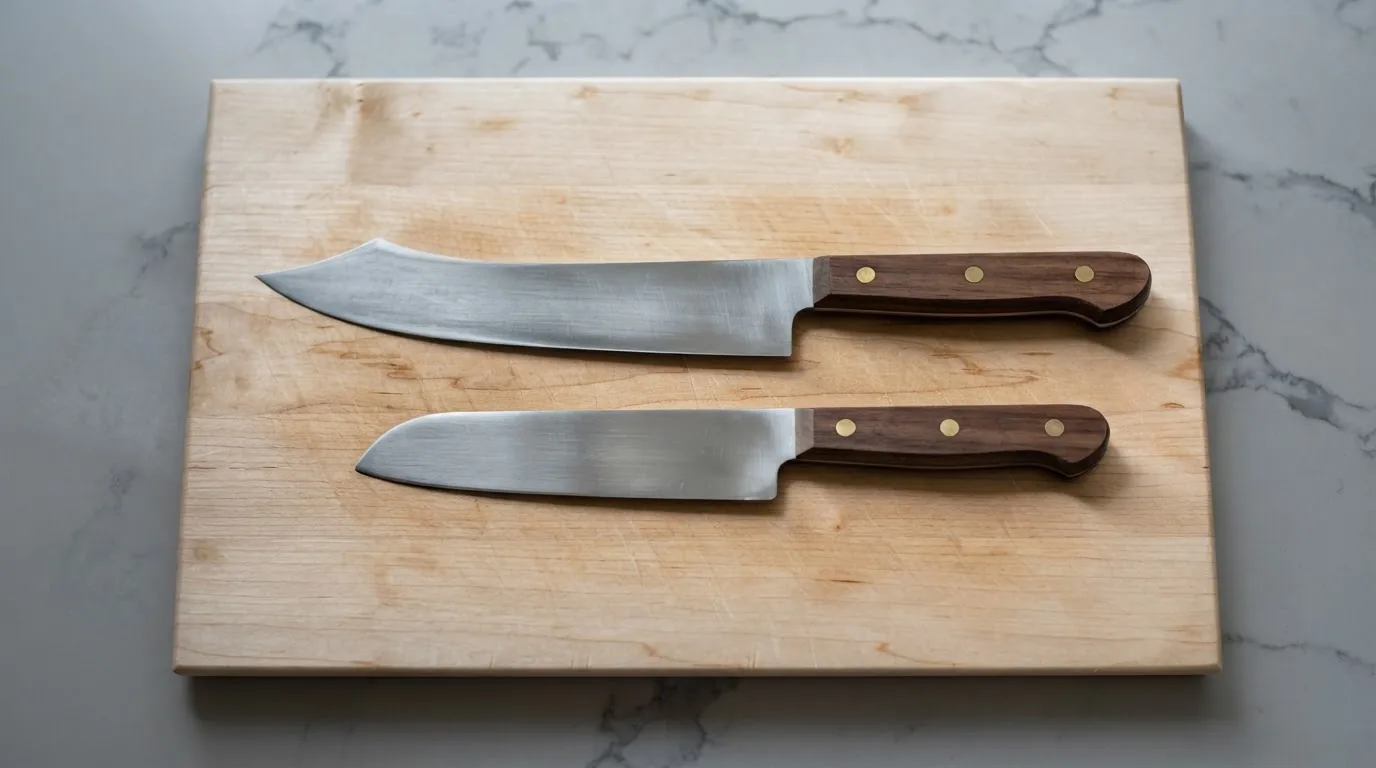
Short answer. A chef knife is longer, taller at the tip and has a curved belly built for rocking. A santoku is shorter, flatter along the edge and has a dropped, rounded tip built for a straight push cut. On the same board, with the same steel and the same grind, the difference in speed between them is small. The difference most cooks actually feel is not the silhouette at all. It is how thin the blade is behind the edge, how hard the steel is, and whether the maker ground a real distal taper into it. Buy on geometry and heat treat, then pick the profile that matches how your wrist already moves.
What each knife actually is
The chef knife is the western general purpose blade. It descends from the French and German butcher patterns, it runs 8 to 10 inches in most kitchens, and the whole shape is organised around a pivot. The edge curves upward from the heel to the tip so that the tip can stay planted on the board while the heel lifts and falls. That is the rocking cut, and everything about a chef knife, including its weight and its balance point, exists to support it.
The santoku is the Japanese answer to the same problem, and the name translates roughly as three virtues, meaning meat, fish and vegetables. It runs shorter, usually 5 to 7 inches, sits flatter along the edge, and finishes in a dropped tip that curves down to meet the edge in what cutlery people call a sheepsfoot or a lamb's foot. Flat edge, dropped tip, thinner stock. It is built for a push cut where the blade goes down and forward and comes fully off the board on every stroke.
Those are the honest definitions, and most pages on this comparison stop there. The interesting part starts afterwards, because two knives with those silhouettes can perform completely differently depending on things the silhouette does not show.
Blade length, and why 7 inches is the crossover
A longer blade gives a longer stroke, so fewer strokes through a large item, and usually more knuckle clearance because a longer blade is a taller blade. A shorter blade gives more control at the tip and changes direction faster.
Seven inches is where the categories overlap, and at that length the profile becomes the deciding factor. Below 7 inches you are in santoku and utility territory whatever you call it. Above 8 inches the rocking geometry starts to pay for itself, because a long flat edge is awkward to keep in contact with a board that is never perfectly flat.
| Measure | Typical chef knife | Typical santoku | What it changes |
|---|---|---|---|
| Blade length | 8 to 10 in | 5 to 7 in | Stroke length and strokes per item |
| Edge profile | Continuous curve, belly rises to tip | Flat for most of its length | Rocking against push cutting |
| Tip | Raised and pointed | Dropped and rounded | Piercing and fine tip work |
| Height at heel | Roughly 45 to 55 mm on an 8 in | Roughly 42 to 50 mm on a 7 in | Knuckle clearance and scooping |
| Included edge angle | Commonly 30 to 40 degrees total | Commonly 24 to 30 degrees total | Keenness against chip resistance |
Those ranges are what the pattern conventionally means, not a promise about any single knife. Treat the table as vocabulary, not as a spec sheet.
The belly, and what curve does to your cut
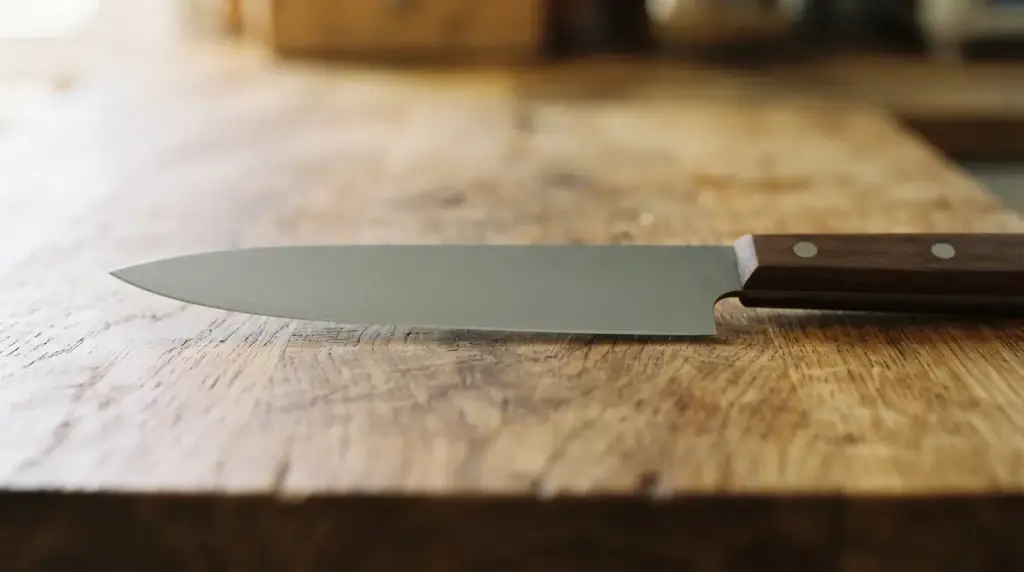
Belly is the curvature of the cutting edge seen from the side. It is the most consequential difference between these two knives, and it is worth understanding mechanically rather than as a style preference.
A curved edge only ever touches the board at one point. As you rock the knife, that point travels along the edge. This means the force you apply is concentrated on a small contact patch, which is why rocking feels efficient, and it means the blade shears through the food rather than pressing straight down. That is genuinely useful for herbs, garlic and anything you want to reduce to a fine mince without bruising.
A flat edge touches the board along its whole length at once. It cannot rock, so you have to lift it. But when it lands, everything under it is cut cleanly through in a single motion, which is why a santoku is better at the boring job of turning a pile of vegetables into a pile of slices. On a chef knife with strong belly, the last quarter inch nearest the heel often fails to make contact, and you get the accordion effect: onion slices still joined at one end. Every cook who has sworn at a half cut onion has met that problem.
The trade is symmetrical. Curve buys rocking and costs board contact. Flat buys board contact and costs rocking. Nobody has solved it, and the knives that claim to are usually mediocre at both.
Heel height, knuckle clearance and board contact
Height at the heel is the measurement almost nobody publishes and everybody feels. It determines whether your knuckles clear the board when the edge is flat on it. Too short at the heel and you either bruise your fingers or learn to cut with the knife tilted, which wears one side of the edge unevenly.
A santoku is usually a touch shorter at the heel than a chef knife of the same length, though tall flat sided vegetable styles can beat an 8 inch chef knife. If clearance is your issue, measure the heel, not the blade. A cook with large hands wants 50 mm or more. A cook with small hands is often better served by less, because a tall blade puts weight above the pivot and makes tip work feel remote.
Edge angle, and the number everyone quotes wrong
Search this comparison and you will read that a chef knife is sharpened to 20 degrees and a santoku to 15, or that a chef knife has a 26 degree edge. Those numbers are quoted inconsistently, and the confusion costs people money at the sharpening stage.
There are two ways to state an angle. Per side is the angle between the stone and one face of the blade. Included, or total, is the sum of both sides. A knife sharpened at 15 degrees per side has a 30 degree included angle. When a cookware brand says 26 degrees it means included, which is 13 per side. When a Japanese knife shop says 15 degrees it means per side, which is 30 included. Those two knives have almost the same edge, described in ways that sound twice as different as they are.
| Per side | Included | Behaviour | Suits |
|---|---|---|---|
| 10 to 12 deg | 20 to 24 deg | Very keen, chips on bone or frozen food | Hard steel, vegetable work, careful cook |
| 15 deg | 30 deg | Keen and reasonably tough | Most Japanese style kitchen knives |
| 17 to 20 deg | 34 to 40 deg | Durable, less keen, forgiving | German style chef knives, heavy use |
| 22 deg and up | 44 deg and up | Blunt feeling, very tough | Cleavers and knives that meet bone |
The angle is not fixed by the pattern. You choose it on the stone. A santoku sharpened at 20 per side will feel dull, and a chef knife taken down to 12 will feel astonishing until the day it meets a chicken bone.
Grind is the difference you actually feel
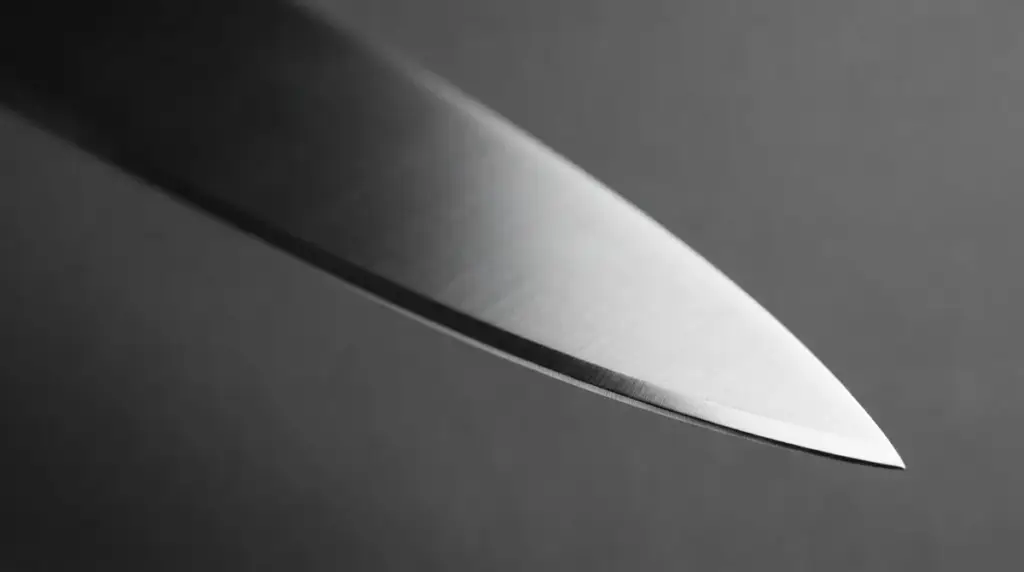
Here is what every generalist page on this comparison leaves out, and it decides whether you enjoy using a knife. Sharpness is the edge. Cutting is the whole blade. When you slice a potato, the edge parts it in the first thousandth of an inch and then the rest of the blade has to push the two halves apart and slide between them. How much force that takes depends on how thick the blade is a few millimetres up from the edge, and on how the sides are shaped. That is the grind, and it is where hand work shows.
A full flat grind tapers from spine to edge in one straight line, thin behind the edge and reasonable at releasing food. A convex grind bulges slightly, which is stronger and pushes food away harder, so it sticks less but wedges more in dense root vegetables. A hollow grind scoops the sides concave, which is very thin behind the edge and very good at slicing, and much weaker if you twist it. Most factory kitchen knives are a shallow flat grind with a thick zone behind the edge, because thick behind the edge survives shipping, the dishwasher and the customer who levers a squash apart with it.
Distal taper is the second half of it. A good blade gets thinner from heel to tip as well as from spine to edge, which moves balance back toward your hand and makes the tip feel alive. Check it in thirty seconds with a cheap caliper: measure the spine at the heel and again an inch back from the tip. If the two numbers match, the maker skipped the step. This is why a hand ground 7 inch blade can outcut a 10 inch factory chef knife. It is not the silhouette. It is the cross section.
Hardness and heat treat, the part no cookware page mentions
Every cookware brand page on this comparison names a steel and stops. The steel is the ingredient list. The heat treat is the cooking.
Hardness is measured on the Rockwell C scale. Below about 56 HRC a kitchen blade goes blunt quickly and takes a burr you cannot remove cleanly. Around 58 to 61 you get an edge that holds and can still be brought back on a stone at home. Above 62 you get remarkable edge retention and a blade that chips if you twist it, hit a bone or drop it on tile. None of this is set by the pattern. A santoku is not intrinsically harder than a chef knife. Makers who choose santoku profiles simply choose harder steel more often, which is where the reputation came from.
Our pattern welded Damascus kitchen blades are held to 58 to 60 HRC. That is a deliberate compromise: soft enough to sharpen on a basic waterstone without a diamond plate, and soft enough to survive going off the counter. It is also soft enough that a 63 HRC powder steel Japanese blade will hold a fine edge longer than ours. If maximum edge retention is your only criterion, we are not the answer, and we would rather say so here than have you find out in your kitchen.
Tang, handle and where the weight sits
Tang is the steel that runs into the handle. A full tang runs the whole length and width, visible as a strip between the scales. A hidden tang is a narrower tongue that goes into a drilled handle. A partial tang stops part way and is the one to avoid in a kitchen knife, because the joint sits where the leverage is highest.
Western chef knives are conventionally full tang with riveted scales and a bolster, the thick collar of steel between blade and handle. That bolster adds weight forward of your hand and is part of why a German chef knife feels the way it does. Traditional Japanese handles are hidden tang, usually octagonal or D shaped, and lighter. Neither is stronger in a way that matters in a home kitchen. The difference is balance, and balance is preference.
An inconvenient admission about our own listings: of the 44 knives currently in our kitchen and chef category, only 3 state the tang construction in the description. That is a documentation failure on our side, not a construction one, and we are fixing it. Until we have, if tang matters to you, ask before you order rather than assuming.
The dimples, and whether they do anything
Those oval scallops along the side of many santoku are called a granton edge or kullenschliff. The claim is that they trap air and stop food sticking. They help a little, mostly with wet starchy things like potato, and nothing at all with onion, tomato or herbs.
What actually stops food sticking is geometry and surface finish. A thin blade with a slightly convex face releases better than a thick flat one with rows of dimples in it. Dimples on a thick blade treat a symptom.
What our own kitchen line measures
We do not sell a knife labelled santoku. Not one of the 609 products on this site carries that name, and there is no nakiri either. What we do have is 44 knives in the kitchen and chef category, and their measurements say something useful about where hand forged kitchen blades sit.
| Figure | Our kitchen and chef category |
|---|---|
| Products in the category | 44 |
| Listings that publish a blade length | 36 of 44 |
| Median published blade length | 7.0 in |
| Blade length range | 3 in to 12 in |
| Blades between 7 and 8.2 in | 24 of the 36 |
| Blades 9 in or longer | 4 of the 36 |
| Median overall length | 13 in |
| Price floor, median, ceiling | $90, $142, $694 |
| Listings naming Damascus in the title | 30 of 44 |
That says our kitchen line lives at the crossover. Seven inches is the median, two thirds of the blades sit between 7 and 8.2 inches, and only four are long enough to be a classic 9 or 10 inch chef knife. A forge that grinds by hand gravitates to the length where the two patterns meet, because that length does most jobs without asking the smith to fight a long thin blade through a heat treat. Figures pulled from the live catalogue on 30 August 2026.
Which one to buy, honestly
Buy a chef knife if you cut a lot of herbs and aromatics, butcher poultry at home and want a tip you can drive between joints, have large hands, or already rock without thinking about it. Eight inches is the right first size.
Buy a santoku if your board work is mostly vegetables, if you push cut rather than rock, if you have smaller hands, or if you found an 8 inch chef knife unwieldy the last time you used one. Seven inches is the right first size.
Buy neither on the profile alone. Ask how thick the blade is behind the edge, what hardness it is finished at, and whether it has a distal taper. If nobody at the company can answer those three questions, the knife was not made by anyone thinking about them. A well ground santoku beats a badly ground chef knife, and the reverse is equally true.
Questions people ask
Is a santoku better than a chef knife?
Neither is better. A santoku is better at straight push cutting and at control in a smaller hand. A chef knife is better at rocking, at reaching through a large item in one stroke, and at tip work like boning a chicken. On identical steel, grind and heat treat the gap is small.
Can a santoku replace a chef knife entirely?
For most home cooking, yes. The two jobs a santoku genuinely struggles with are piercing, because the dropped tip is not pointed, and rocking a pile of herbs, because the flat edge cannot pivot. If neither of those is a regular part of your cooking, a good santoku will handle everything else.
What size santoku should I buy first?
Seven inches. Five and six inch santoku are pleasant for small hands and small boards, but seven gives enough reach for a cabbage and enough heel height for clearance. Our own kitchen line has a median published blade length of 7.0 inches, which is not a coincidence.
Why does my knife leave onion slices joined at one end?
Because the curved section near the heel is not reaching the board. That is a belly problem, and it is the most common complaint about chef knives. Either finish the cut with a forward push instead of a straight downward press, or use a flatter profile.
What edge angle should I sharpen a santoku to?
Fifteen degrees per side, which is 30 degrees included, is a safe default for most santoku in the 58 to 61 HRC range. Go to 12 per side only if the steel is hard and you never let the knife meet a bone. Watch the two ways of stating the angle: per side and included differ by a factor of two, and confusing them is the single commonest sharpening mistake.
Do the dimples on a santoku stop food sticking?
A little, and mostly with wet starchy food like potato. They do nothing measurable for onion, tomato or herbs. A thin, well ground blade releases food better than a thick dimpled one. Do not choose a knife on the dimples.
Is a hand forged kitchen knife sharper than a factory one?
Not out of the box, necessarily. A good factory knife arrives with a very consistent machine ground edge. What hand work buys you is geometry: thinner behind the edge, a real distal taper, and a grind adapted to the individual blade. What it costs you is consistency between examples, and a higher price for the same steel.
What hardness are your Damascus kitchen knives?
We hold our 1095 and 15N20 pattern welded Damascus to 58 to 60 HRC. That is deliberately below the 62 to 64 HRC used by some Japanese powder steel makers. Ours are easier to sharpen at home and less likely to chip. They will not hold a fine edge as long. Both halves of that sentence are true.
Do you sell a santoku?
No. There is no knife on this site named santoku and none named nakiri. Our kitchen and chef category holds 44 knives, most of them western chef and utility profiles with a median published blade length of 7.0 inches. If you specifically want a santoku silhouette, buy it from a maker who grinds one.
Chef knife or santoku for someone with small hands?
Usually a 7 inch santoku or a 6 inch chef knife. The deciding measurement is the height at the heel, because a tall blade puts weight above your grip and makes the tip feel distant. Measure the heel of anything you are considering and compare it against a knife you already like.
More guides. Read chef knife bevels explained for the grind detail, carbon against stainless kitchen knives for the steel decision, knife blade shapes for the wider vocabulary, and our cleaver guide if you are considering a third profile. Or browse kitchen and chef knives. Please check your local law before ordering.
More from the workshop
Balisong History and Origins
Batangas, the disputed origin, what balisong really means, and how to tell a traditional knife from a modern one.
Knife Anatomy: Parts of a Knife Explained
Tip to butt, plus folder and sheath parts - the reference table for ricasso, choil, swedge, tang and the rest.
How to Choose an EDC Knife
Weight is why people stop carrying. Buy for Tuesday, not for the emergency.
