
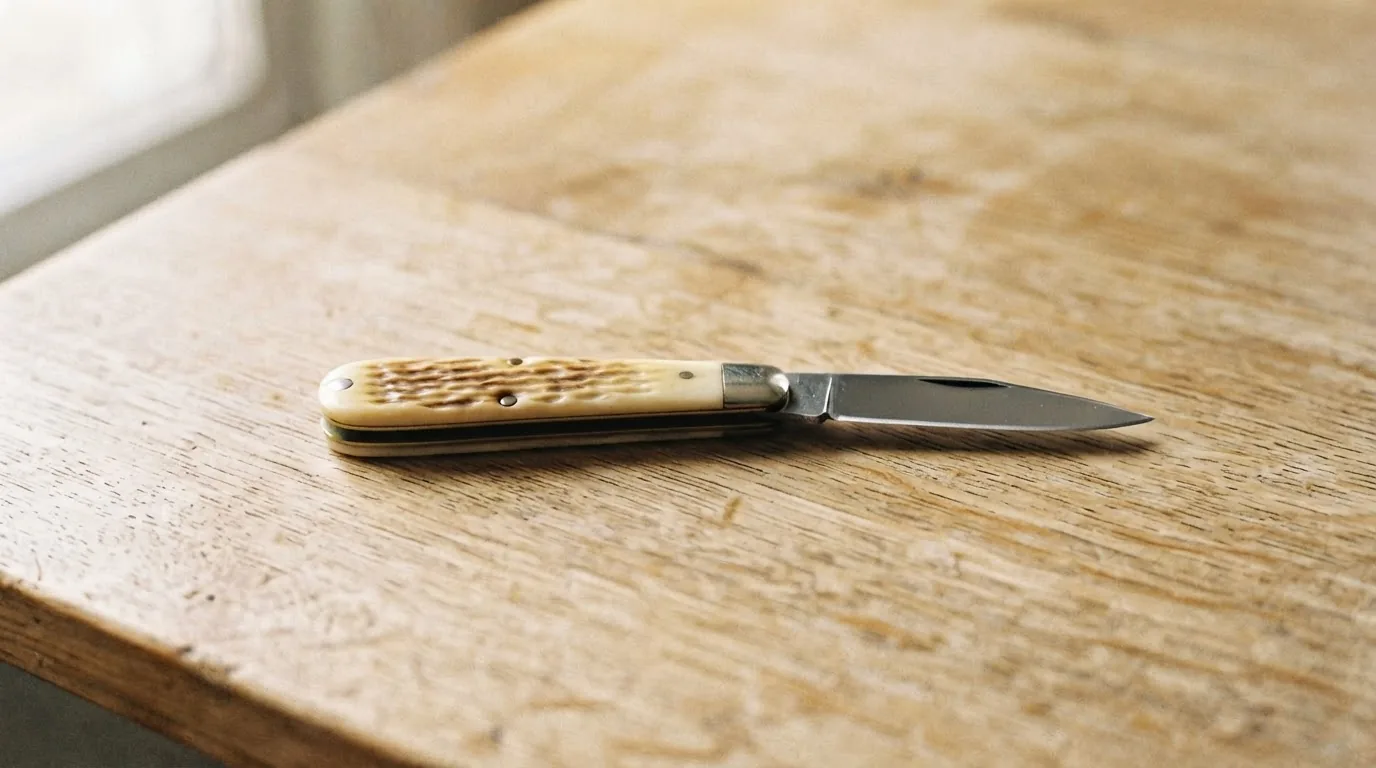
Short answer: In most of the United States a plain folding pocket knife with a blade around three inches is legal to own and legal to carry. What gets people charged is the opening mechanism, whether the knife is concealed, and the building or city they are standing in, not the blade length. A permissive state can sit underneath a much stricter city.
How to read a knife law: four questions and three kinds of rule
Most knife-law articles treat "is this knife legal" as one question. It is four, and a knife can pass three and fail the fourth.
- Can you own it at home? Very few knives are illegal to possess on your own property. Ballistic knives are the exception.
- Can you carry it openly? Some states that permit ownership still restrict carrying certain mechanisms.
- Can you carry it concealed? Where most statutes bite. Several states set no rule for open carry and a hard number for concealed carry.
- What does your city say? Unless your state has preemption, a municipal ordinance can be stricter than state law, and it is enforceable.
Three kinds of rule answer those questions. Blade-length rules are the ones everyone quotes and the ones that matter least, because a number is usually attached to a definition rather than a ban. Georgia does not ban knives at four inches; its code defines "knife" as a blade greater than twelve inches, so a folder is not the regulated object.
Mechanism rules are what catches people. A statute silent on length can still make an automatic, a gravity knife or a ballistic knife unlawful outright, and those bans sit in definition sections where they are easy to miss. Intent and "dangerous weapon" statutes are the widest net. Illinois makes it an offence to carry a dagger, dirk or "dangerous knife" with intent to use it unlawfully. Ohio defines a deadly weapon as anything capable of inflicting death that is designed, adapted, possessed, carried or used as a weapon. A legal knife becomes a weapon the moment a prosecutor can show how you were treating it.
This page is general information, not legal advice. Check your own current state and local law before relying on it.
Verified blade-length limits, last verified August 2026
Every line below was read this month in the statute text, on a state legislature site, Justia, public.law or Cornell's Legal Information Institute. Every other state we verified sets no statewide limit for an ordinary folder.
| Rhode Island | 3 inches concealed. RIGL 11-47-42(a). |
| Colorado | 3.5 inches concealed, with exceptions for your own home, business or property and for permit holders. CRS 18-12-101(1), 18-12-105. |
| Delaware | 3.75 inches. An "ordinary pocketknife" is a blade of not more than 3.75 inches carried closed. 11 Del. C. 222. |
| Connecticut | 4 inches. An edged portion of 4 inches or more is a class E felony to carry. CGS 53-206(a). |
| Texas | 5.5 inches. A "location-restricted knife" is a blade over 5.5 inches, legal at 18 or over but barred from listed places. Penal Code 46.01(6), 46.03. |
| North Dakota | 6 inches. "Dangerous weapon" covers a blade of 6 inches or more, plus switchblades and gravity knives. NDCC 62.1-01-01(1). |
| Georgia | 12 inches. "Knife" means a blade greater than 12 inches; below that the carry statute does not apply. OCGA 16-11-125.1. |
| California | 2 inches, mechanism only. No general limit, but a switchblade of 2 inches or more may not be carried on the person or in a vehicle's passenger area. Penal Code 17235, 21510. |
| Massachusetts | 1.5 inches, mechanism only. Automatics over 1.5 inches, double-edged blades, dirk knives and stilettos are named, but the switchblade clause fell in 2024. MGL c.269 s.10(b). |
| New York City | 4 inches. A city rule, not a state one: no blade of 4 inches or more in public, and none in open view unless in lawful use. NYC Admin. Code 10-133. |
| Federal facilities | 2.5 inches. A pocket knife under 2.5 inches is excluded from "dangerous weapon". 18 U.S.C. 930(g). |
We read statutes in twenty-eight states: Arizona, California, Colorado, Connecticut, Delaware, Florida, Georgia, Hawaii, Illinois, Indiana, Massachusetts, Minnesota, New Hampshire, New Mexico, New York, North Dakota, Ohio, Oklahoma, Oregon, Pennsylvania, Rhode Island, Tennessee, Texas, Utah, Vermont, Virginia, Washington and Wisconsin.
We could not verify these twenty-two states, and publish nothing about them: Alabama, Alaska, Arkansas, Idaho, Iowa, Kansas, Kentucky, Louisiana, Maine, Maryland, Michigan, Mississippi, Missouri, Montana, Nebraska, Nevada, New Jersey, North Carolina, South Carolina, South Dakota, West Virginia and Wyoming. If your state is on that list, treat any number you find elsewhere as unconfirmed until you read the statute.
Mechanism categories and why the mechanism usually decides
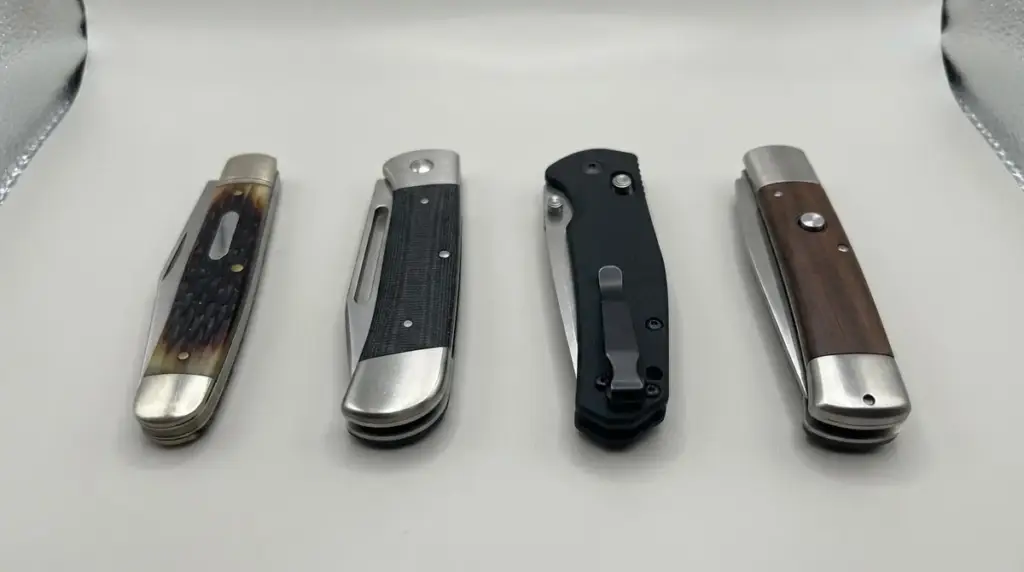
Statutes regulate how a blade opens far more aggressively than how long it is. Our guide to knife types covers the engineering; this is the legal shorthand.
- Slipjoint. No lock, held open by spring tension. The least regulated category.
- Lockback and liner lock. Treated like a slipjoint almost everywhere, with one trap: California counts a folder as a dirk or dagger once the blade is exposed and locked, so carrying one open and concealed falls under Penal Code 21310.
- Assisted opening. California's switchblade definition excludes a knife opened by thumb pressure where a detent or bias toward closure must first be overcome, and Washington's RCW 9.41.250 is similar. The detent is the dividing line.
- Automatic and switchblade. Still restricted in Minnesota under Minn. Stat. 609.66 and New Mexico under NMSA 30-7-8, which reaches mere possession. New York allows one for a licensed hunter or angler under Penal Law 265.20(6).
- Gravity and butterfly. North Dakota names gravity knives as dangerous weapons, and New Mexico covers a blade ejected by gravity or centrifugal force. Balisongs have their own rules: see our butterfly knife laws guide.
- Ballistic. A blade fired from the handle, and the one near-universal ban. See the most illegal knife in the US.
Preemption and the cities that sit above their state
Preemption means the state has reserved knife regulation to itself and voided conflicting local ordinances. Arizona's ARS 13-3120 bars any political subdivision from regulating knife possession, carry, sale or transport and declares conflicting ordinances null and void. Texas Local Government Code 229.001 lists knives among the things a municipality may not regulate. Tennessee's TCA 39-17-1314(f) says no local government shall occupy any part of the field. Oklahoma's 21 O.S. 1289.24 preempts the entire field touching firearms and knives. New Hampshire's RSA 159:26 and Wisconsin's 66.0409 do the same.
Without preemption, cities go further. New York City is the clearest case: the state removed gravity knives from its penal law in 2019, but NYC Administrative Code 10-133 still bans any blade of four inches or more in public. The American Knife and Tool Institute names Cleveland, Akron, Canton, Denver, Boulder, Colorado Springs, Detroit, Lansing, Philadelphia and Los Angeles as stricter than their states. We did not read those municipal codes, so treat that as a prompt to check rather than a citation.
Work, schools, government buildings, parks and airports
Work. An employer policy is a condition of employment, not a criminal statute. It cannot make you a criminal, only unemployed.
Schools. Indiana Code 35-47-5-2.5 makes possessing a knife on school property or a school bus an offence that rises to a felony if injury results. Texas Penal Code 46.03 puts school and postsecondary premises first on its list. Tennessee restricts nothing elsewhere, but treats a knife on school grounds as a felony.
Government buildings. 18 U.S.C. 930 excludes a pocket knife under 2.5 inches from "dangerous weapon", and that number applies nationwide. Texas Penal Code 46.03 separately bars a location-restricted knife from courts, polling places, correctional facilities, hospitals, racetracks, secured airport areas and open government meetings.
National parks. The prohibition in 36 CFR 2.4 applies to a "weapon", and the definition in 36 CFR 1.4 lists firearms, air and spring powered guns, bows, crossbows, blowguns, spearguns, spears, slingshots, irritant gas and explosive devices, and implements designed to discharge missiles. Knives are not in that list. It does sweep in anything prohibited under state law, so a knife illegal in the surrounding state is illegal in the park.
Airports. 49 CFR 1540.111 bars a weapon on your person or in accessible property once screening has begun, in a sterile area, or when boarding. Your knife goes in checked baggage or in the bin, and the bin is not a return service.
What changed recently that most guides get wrong
- New York, 2019. A.5944, signed 30 May 2019, removed "gravity knife" from the penal law. Penal Law 265.01 no longer contains the term.
- Colorado, 2017. CRS 18-12-102 now lists only a blackjack, gas gun, ballistic knife and metallic knuckles as illegal weapons. The 3.5-inch concealed rule survives.
- Ohio, 2021. Senate Bill 140 removed the statewide restriction on automatic knives. ORC 2923.20 now contains no knife provisions.
- Pennsylvania, 2023. HB 1929, effective 2 January 2023, removed the automatic-opening clause from the prohibited offensive weapons statute. 18 Pa.C.S. 908 no longer mentions knives.
- Virginia, 2022. Switchblades were dropped from the concealed weapons list in Va. Code 18.2-308(A), which now names dirks, bowie knives, stilettos, ballistic knives, machetes and razors.
- Massachusetts, 2024. In Commonwealth v. Canjura, SJC-13432, decided 27 August 2024, the Supreme Judicial Court held switchblades are protected arms and struck down MGL c.269 s.10(b) insofar as it bans them.
- Vermont, 2025. S.109, signed 16 June 2025 and effective 2 July, removed the switchblade ban from 13 V.S.A. 4013. That section now covers zip guns only.
- Delaware, 2025. The "ordinary pocketknife" allowance in 11 Del. C. 222 rose from 3 to 3.75 inches.
What a normal person carrying a three-inch slipjoint needs to know
If you carry a traditional folder or a plain lockback with a blade around three inches and use it to open boxes and cut cord, you are inside the law in every state we verified.
Stay under 2.5 inches if you ever walk into a federal building. Treat schools and courthouses as absolute. Look up your city's ordinance if you are not in a preemption state, because that is where the risk sits. If you buy an automatic, check the mechanism against your state's definition section, not a blade-length chart. And carry the knife like a tool, because intent statutes are broad enough that behaviour matters more than steel. Our EDC knife guide covers blade length and lock type, our folding pocket knives sit well inside these limits, and our other knife guides cover steel and care.
Questions people ask
Is it legal to carry a pocket knife in the United States?
In every state we verified, yes, for an ordinary folder of about three inches. There is no federal blade-length rule for public carry. What varies is concealed carry, mechanism and location. Federal buildings apply a 2.5-inch line under 18 U.S.C. 930(g).
What blade length is legal to carry?
There is no national number. Of the twenty-eight states we read, six set one: Rhode Island at 3 inches concealed, Colorado at 3.5 concealed, Delaware at 3.75, Texas at 5.5, North Dakota at 6 and Georgia at 12 inches.
Is concealed carry of a knife different from open carry?
Often yes, and it is the difference that catches people out. Colorado, Rhode Island, Oregon, Hawaii and California all build their main knife offence around concealment, not possession. A knife that is legal clipped visibly can be an offence in a pocket.
Are automatic knives legal now?
In most of the country, yes, and that is recent. Ohio removed its restriction in 2021, Virginia in 2022, Pennsylvania in 2023, Massachusetts by court decision in 2024 and Vermont in 2025. Minnesota and New Mexico still restrict them; California limits carry at 2 inches or more.
Can my city ban a knife my state allows?
Yes, unless your state has knife preemption. We read preemption statutes in Arizona, Texas, Tennessee, Oklahoma, New Hampshire and Wisconsin. Everywhere else a municipal ordinance can be stricter and is enforceable. New York State repealed its gravity knife ban in 2019; New York City's four-inch limit stands.
Can I carry a pocket knife into a courthouse or federal building?
Under 18 U.S.C. 930(g) a pocket knife with a blade of less than 2.5 inches is not a dangerous weapon for federal facility purposes. At 2.5 inches or more it is. State courthouses set their own rules and are usually stricter. Assume no and leave it in the car.
Does a locking folder count as a dagger?
In California it can. Penal Code 16470 defines a dirk or dagger as an instrument capable of ready use as a stabbing weapon, and says a folding knife qualifies only if the blade is exposed and locked into position. Carried closed it is not a dirk. Carried open and locked under a jacket, it falls under Penal Code 21310.
What should I do if an officer asks about my knife?
Stay calm, keep your hands visible, say where the knife is rather than reaching for it, and describe it as a tool. Intent statutes such as 720 ILCS 5/24-1(a)(2) and Ohio's deadly weapon definition in ORC 2923.11(A) turn on how a knife is carried and used.
Shop the knives
 BLACK MAMBA KNIVES Fallen 3 Inches Blade Damascus Folding Pocket Knife Hunting Tool USA Made | BMK-120
 Dugite 7.2″ Long 3.2″ Blade” 5oz Damascus Pocket Knife Handmade Damascus Pocket Folding Knife Black Mamba Hand Made World Class Knives | BMK-416
 Tsetse Fly 3.5″ Long 1.5″ Blade” 2oz Damascus Neck Knives Handmade Damascus Pocket Folding Knife with Mammoth Tooth Handle Black Mamba Hand Made World Class Knives USA Made | BMK-415
Check the law in your state and city before you order.
More from the workshop
Damascus vs D2 vs 440C vs VG10: Which Steel
Damascus, D2, 440C and VG10 compared by what each one is actually good at.
Damascus Pocket Knives: What You Get and What You Give Up
What a Damascus folder is, what 111 of our own listings show, and what it does worse than stainless.
How to Store Knives Properly
Contact and moisture are what ruin stored knives. Both are easy to avoid.
