
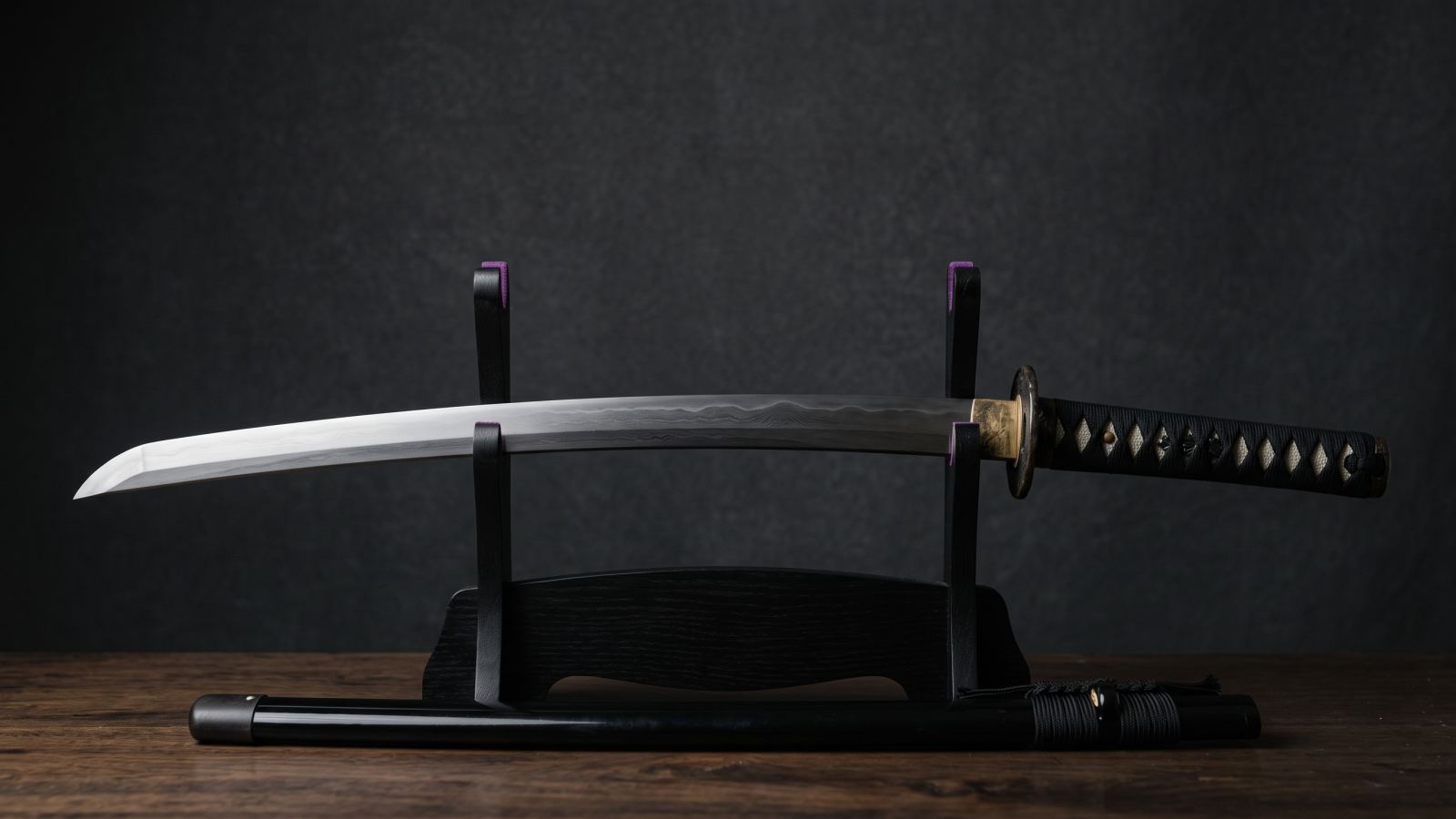
Short answer: a "Damascus katana" is a katana whose blade is pattern welded — two steels, usually a high carbon steel and a nickel bearing steel, forge welded and folded so the layers show after etching. It is not the same thing as a traditional Japanese blade, and the pattern does not make it cut better. Expect $200 to $1,500 for a functional one, $40 to $200 for a stainless display piece that must never be swung at anything, and $6,500 upward for a newly forged blade by a licensed smith in Japan. The thing to check before you buy is the tang, not the pattern.
What "Damascus" means on a katana
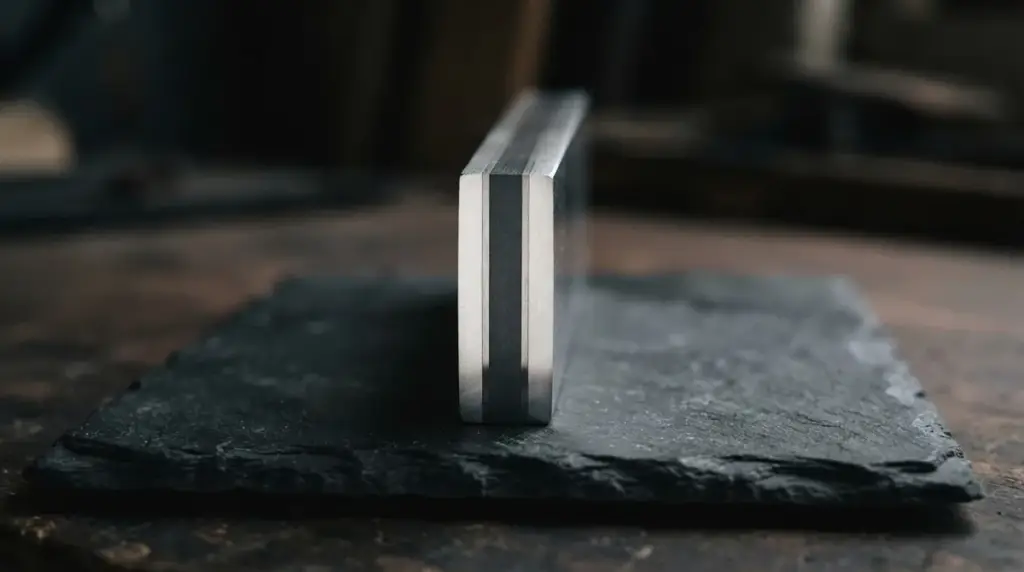
Modern Damascus is pattern welding. Two or more steels with different alloy content — commonly 1095 for hardness and 15N20 for its nickel, which resists the etchant and stays bright — are stacked, forge welded, drawn out, folded and welded again. Etch the finished blade and the nickel bearing layers stand out against the darkened carbon layers. That is where the pattern comes from.
The word gets used loosely because it sells. It is applied to genuinely well forged blades and to $90 wall hangers with the pattern acid stencilled onto the surface, and the listing photo often looks similar. On a folded blade the pattern goes all the way through the steel and reappears when you sharpen it. On a stencilled blade it sits on the surface and vanishes at the edge.
Why a real Japanese blade's grain is not Damascus
This confuses almost everybody, because both processes involve folding steel and the marketing language is identical. The purposes are opposite.
A traditional Japanese sword starts from tamahagane, "jewel steel", smelted from iron sand in a clay tatara furnace over about a week. The yield is brutal: roughly 9 tonnes of iron sand and 11 tonnes of charcoal produce under a tonne of steel, and only about a third of that is good enough for blades. It is smelted three or four times a year and sold only to licensed smiths.
The smith then folds that steel eight to sixteen times. The reason is not decoration. Folding drives out slag and evens out the wildly inconsistent carbon content of the raw bloom. The surface grain that results, called the hada, is a by-product — it happens to be beautiful, and connoisseurs read it to identify period and maker, but nobody set out to make a pattern. Past about twenty folds the carbon diffuses evenly and further folding achieves nothing at all, which is why "one million layers" claims are a red flag rather than a boast.
Damascus does the opposite. It deliberately combines two dissimilar steels precisely so the contrast will show. One process is metallurgical cleanup; the other is metallurgical decoration. Both are legitimate. They are not the same thing, and a seller who tells you their pattern welded export katana is "made the traditional Japanese way" is either confused or hoping you are.
The other thing that separates a Japanese blade is yaki-ire, differential hardening. Clay slurry goes on thick along the spine and thin along the edge, and the blade is quenched edge down. The edge cools fast into hard martensite; the spine cools slowly into softer pearlite. The uneven contraction is what puts the curve in the blade, and the visible boundary between the two is the hamon. A real hamon is a hardening line. A "hamon" that is a straight wire brushed band applied for looks is not.
The steel table
| Blade steel | Typical price | What it is honestly for |
|---|---|---|
| Stainless (420, 440) | $40 – $200 | Display only. See the warning below. |
| 1045 carbon | $70 – $200 | Entry level, soft, light backyard use at best |
| 1060 carbon | $150 – $600 | The sensible first functional sword. Tough, forgiving. |
| 1095 carbon | $250 – $900 | Harder, holds an edge better, less forgiving of bad technique |
| T10 tool steel | $300 – $1,200 | The cutting community's favourite. Excellent edge retention. |
| Damascus / pattern welded | $200 – $1,500 | Appearance first. Performance depends entirely on the underlying steels and heat treat. |
| Tamahagane, made in Japan | $6,500 – $50,000 | A licensed smith's work. A different market entirely. |
Worth stating plainly, because we sell Damascus and it argues against us: at the same price, a well made monosteel blade will usually outcut a Damascus one. Pattern welding adds labour, and the labour comes out of the budget somewhere. A $300 T10 blade with proper clay hardening beats a $300 Damascus blade at cutting, most times. Buy Damascus because you want to look at it, which is a perfectly good reason for an object that will spend most of its life on a stand.
The stainless warning, which is not marketing
Stainless steel is excellent in a kitchen knife and wrong in a sword. The chromium content that makes it corrosion resistant also makes it brittle, and above roughly twelve inches of blade that brittleness becomes a genuine hazard. A stainless katana is a display object. It is not a weakened version of a real sword; it is a different category of thing.
If you strike anything with one — a tatami mat, a water bottle, a tree branch, a friend's sword in a demonstration — it can snap. And a broken sword blade does not fall to the ground politely. It travels. This is the single most repeated safety point in the sword community and it is repeated because people keep ignoring it.
So: if a listing says stainless, or lists no steel at all, or the price is under about $150 for something claiming to be functional, treat it as decoration. Hang it. Do not cut with it. We would rather lose the sale than read about the alternative.
The tang is the whole safety story
In a Japanese sword the tang is the nakago: a full width continuation of the blade itself, running the length of the handle and held in place by one or two bamboo pegs, the mekugi, driven through a hole in the tang. Nothing is welded, nothing is glued, and the whole assembly is designed to be taken apart so the tang can be inspected. That inspection is how blades are authenticated, and it is why a sword you cannot disassemble is a sword you cannot verify.
A "rat-tail" tang is a thin rod, much narrower than the blade, running back into the handle and secured with a threaded pommel nut. On cheap production swords that rod is often joined to the blade rather than forged continuous with it. Under the shock of a cut — or worse, a miss — that joint is the failure point, and the blade separates from the handle while travelling at speed.
So the buying question is not "is it Damascus". It is: can I remove the mekugi and see the tang, and is the tang the full width of the blade? If the answer is no to either, it is a display sword whatever the listing says. Our note on full tang versus partial tang covers the same principle on knives, where the consequences are smaller but the physics are identical.
What things actually cost
Two separate markets get confused constantly. The export production market runs from $40 to about $5,000. The Japanese sword market — nihonto, antique and newly made licensed blades — starts where the other one ends.
| Tier | Range |
|---|---|
| Stainless display piece | $40 – $200 |
| Functional production carbon steel | $150 – $1,200 |
| Damascus / pattern welded production | $200 – $1,500 |
| Custom production steels (L6, differentially hardened) | $1,500 – $5,000 |
| Newly forged in Japan by a licensed smith | $6,500 – $45,000, most commissions $9,500 – $19,000 |
| Antique with entry level certification papers | Low four figures upward; dealers quote anywhere from $800 to $15,000 |
| Higher certification (Tokubetsu Hozon, Juyo) | $15,000 – $100,000+ |
| Work by a Living National Treasure smith | $150,000 – $300,000 |
Two facts explain the gap. Japanese law restricts a licensed smith to no more than two swords a month, twenty-four a year, and there are only a few hundred licensed smiths, of whom only a few dozen do it full time. Supply is capped by statute. Second, on the antique side, certification is the dominant price driver — the same blade with and without papers from the recognised appraisal body can differ by multiples.
The parts, with the right names
| Term | What it is |
|---|---|
| Tsuka | The handle |
| Ito | The cord wrapping the handle — silk traditionally, usually cotton today |
| Same / samegawa | The rayskin under the wrap. Its pebbled texture is what stops the ito sliding. |
| Tsuba | The hand guard |
| Habaki | The wedge shaped collar at the base of the blade that locks it into the scabbard |
| Seppa | Washers either side of the tsuba that tighten the assembly |
| Saya | The scabbard, traditionally lacquered wood |
| Kissaki | The point section, divided from the body by a line called the yokote |
| Nakago | The tang — the unpolished part hidden inside the handle |
| Mekugi | The peg, traditionally bamboo, holding handle to tang |
| Hamon | The hardening line between the hard edge and the softer body |
| Hada | The surface grain of the folded steel |
| Shinogi | The ridge running along the side of the blade |
| Mune | The back of the blade, opposite the edge |
| Fuchi and kashira | The collar at the front of the handle and the cap at the end |
One correction while we are here. The long groove down the side of some blades is a bo-hi. It is not a blood groove. It lightens the blade and stiffens it in the same way an I-beam works, and it makes the sword sing when the cut is straight, which is genuinely useful feedback when you are learning.
A short buying checklist
- Steel named, or walk away. "High carbon steel" is not a steel. 1060, 1095, T10, or a named Damascus combination is.
- Full tang, removable mekugi. If you cannot inspect it, assume the worst.
- Ask whether the hamon is real. A differentially hardened blade has one. A wire brushed line is cosmetic and does not indicate a hardened edge.
- Check the fittings are pinned and tight. A tsuka that rattles will get worse.
- Decide honestly whether you will cut with it. Most people will not, and there is no shame in buying a display sword on purpose rather than by accident.
Our own Damascus katanas and the wider sword collection are hand forged pattern welded blades with full tangs, made in the USA. They are collector and display pieces built to be handled, and we will tell you the steel and the hardness if you ask, which is the test we would apply to anyone else.
Is it legal to own?
Owning a sword is legal at federal level across the United States — there is no federal blade length restriction, and the federal knife statute concerns opening mechanisms rather than swords. What varies is carrying and transporting. States, and in some cases cities, set their own rules on blade length, concealment and where a weapon may be taken, and the same object can be a minor offence in one state and a felony in another. Please check your local law before ordering. This is general information and not legal advice.
Questions people ask
How much is a Damascus katana?
Functional pattern welded production swords run roughly $200 to $1,500, with quality examples generally starting around $400. Below about $150 you are looking at a display piece. A newly forged traditional Japanese blade starts near $6,500 and is a different market entirely.
Is a Damascus katana better than a regular one?
Not at cutting. The pattern is aesthetic and it typically adds fifteen to thirty per cent to the price. At the same budget a well heat treated monosteel blade in T10 or 1095 usually performs better. Buy Damascus for how it looks, which is a legitimate reason.
Are Damascus katanas real Damascus?
If they are genuinely pattern welded, yes by the modern meaning of the word. Nothing sold today is the historical wootz crucible steel that the name originally described; that method was lost centuries ago. If the pattern is acid stencilled onto a plain blade, it is not Damascus by any definition.
Can you cut with a 440 stainless steel katana?
No. Stainless alloys become brittle in blade lengths beyond about twelve inches, and a stainless sword can snap on impact and throw the broken section. Treat any stainless katana as a wall piece. This is not caution for its own sake; it is the reason those swords are cheap.
What is the difference between a Damascus blade and a real Japanese hamon?
Damascus is a pattern in the steel created by welding two alloys together. A hamon is the boundary line left by differential hardening — hard edge, soft spine — and it says something about how the blade was heat treated. A blade can have both, one, or a painted imitation of either.
How do you tell if a katana is full tang?
Remove the bamboo peg through the handle and slide the handle off. The tang should be a broad continuation of the blade, roughly the width of the blade at the guard, not a thin threaded rod. If the handle will not come off, treat the sword as unverified.
How many layers should a Damascus katana have?
Layer count is a description of process, not a measure of quality. A clean weld at a few hundred layers beats a flawed one at several thousand. Beyond about twenty foldings the layers become too thin to see and the carbon has evened out anyway. We wrote more on that in what 352 layers actually means.
Do Damascus swords rust?
Yes. Pattern welded blades are carbon steel and will rust if stored damp or handled with bare hands and left. Wipe the blade after handling, keep a light film of oil on it, and never store a carbon steel blade in a closed leather or lined scabbard for long periods. Our Damascus care guide covers the routine.
More reading. Telling real Damascus from a printed pattern, Damascus layers explained, and the knife steel chart.
More from the workshop
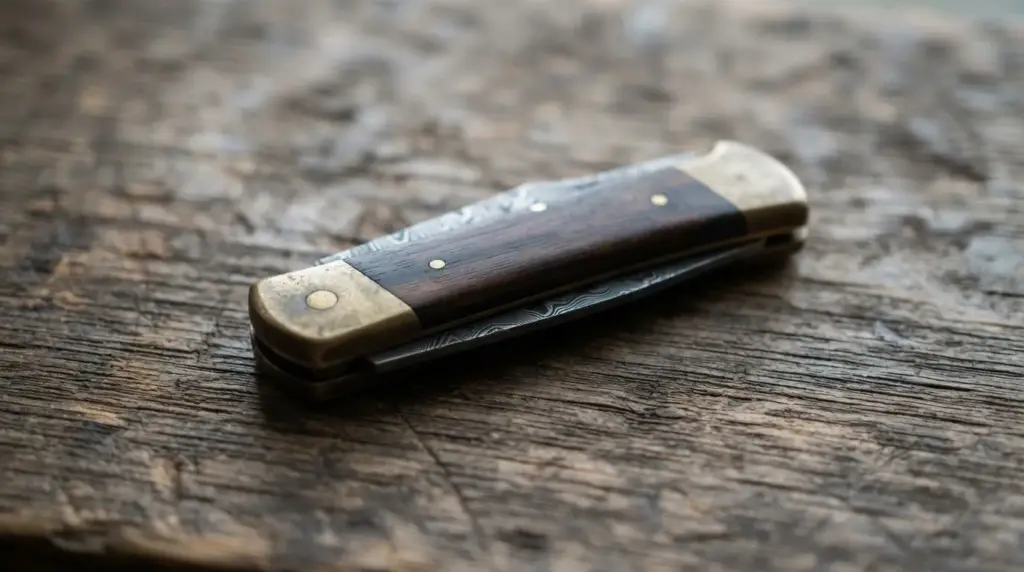
Damascus Pocket Knives: What You Get and What You Give Up
What a Damascus folder is, what 111 of our own listings show, and what it does worse than stainless.
The Cowboy Bull Cutter: A Ranch Pattern Nobody Explains
Why the tip is blunt, what the notched choil does, and the real prices, steels and handles across our 32 bull cutters.
Butchering at Home: The Four Knives That Do the Work
Four knives, the order of work after the animal is home, and the two we do not sell.
