
Short answer: wipe it dry, oil it thinly every few weeks, sharpen it on a plain stone at about 20 degrees, and never put it in a dishwasher. A faded pattern is not damage and it can be brought back in ten minutes.
Everyday care
- Dry it immediately. High-carbon Damascus rusts. Water left on the blade for an hour in a warm kitchen is enough to start a spot.
- Oil the blade, not the handle. A drop of food-grade mineral oil on a cloth, wiped over the whole blade, every two to four weeks. More often if you live somewhere humid or handle it a lot, because skin is slightly acidic.
- Oil the pivot on folders and balisongs. One drop, worked through by opening and closing, then wipe the excess. Dry pivots wear.
- Store it out of the sheath. Leather holds moisture and the tanning salts attack steel. Sheaths are for carrying, not for storage.
- Never the dishwasher. The heat, the detergent and the long wet cycle will ruin a carbon blade and loosen natural handle scales.
Sharpening
Damascus sharpens like any good carbon steel. The one rule that is specific to it: sharpen the edge, never the flats. Grinding or sanding the flat of the blade takes the etch off and flattens the pattern.
- Find the angle. About 20 degrees per side for a general-purpose knife, closer to 15 for a kitchen blade. Lay the blade flat, then lift the spine roughly two blade widths.
- Coarse stone only if it is truly blunt. Most knives that feel dull only need the finishing stone.
- Work one side until you feel a burr along the whole edge, then do the same on the other side.
- Take the burr off with a few very light alternating passes, then strop on leather or the back of a belt.
- Test on paper. A clean slice through printer paper held in the air means you are done.
Ceramic rods and leather strops are fine for maintenance. Powered grinders are not, unless you already know how to keep a blade cool; overheating ruins the heat treatment permanently.
Bringing a faded pattern back
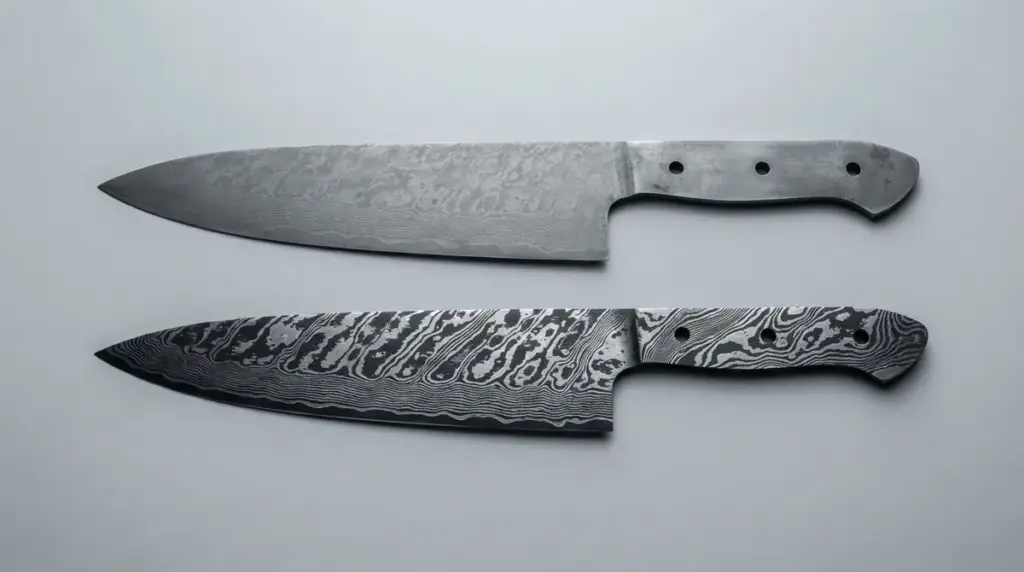
The pattern runs through the whole blade. What fades is the etch, the shallow relief that makes the two steels read differently. Restoring it is straightforward.
- Clean the blade with soap and water, then wipe it with rubbing alcohol so no oil is left.
- If there are rust spots, take them off with a fine abrasive pad and a little oil, working along the blade, not across it.
- Warm white vinegar or a coffee-strength ferric chloride solution in a tall non-metal container. Vinegar is slower and much more forgiving.
- Stand the blade in it, edge up, for a few minutes at a time. Check often. You are looking for the dark steel to darken, not for the blade to go black.
- Rinse in water with a spoon of baking soda in it to stop the acid, dry completely, then oil.
If you would rather not, send it back to us. We re-etch and re-finish our own knives as part of the lifetime warranty on workmanship.
Handles
Wood, horn and bone are natural and move slightly with humidity. A drop of mineral oil rubbed in twice a year keeps them from drying and shrinking away from the bolsters. Brass darkens with handling; leave the patina or bring the shine back with metal polish, keeping the polish off the etched blade.
How to sharpen a Damascus knife, step by step
Sharpening Damascus knives is no different from sharpening any other carbon steel blade, which surprises people who expect the layers to complicate it. They do not. The layers are a pattern, not a structure you can damage, and 1095 and 15N20 are both easy steels to work.
- Pick your angle and keep it. Around 20 degrees per side for a hunting or camp knife, 17 for a kitchen blade. Consistency matters more than the exact number. If you cannot hold an angle by hand, a clamp guide is not cheating.
- Start on a 400 to 600 grit stone if the edge is dull enough to slide off a fingernail. If it still bites, skip straight to 1000.
- Work until you raise a burr along the full length of one side. Feel for it with a fingertip drawn away from the edge, never along it. No burr means you have not reached the apex and everything after this is wasted effort.
- Flip and repeat with the same number of passes, then move to 1000 grit and take the burr down with lighter alternating strokes.
- Finish on a strop, plain leather or with a little compound, ten passes a side, edge trailing. This is what turns sharp into shaving sharp.
The one thing that is different about Damascus. Sharpening removes metal, and the acid etch that makes the pattern visible lives on the surface. Over years of sharpening you will slowly cut the etch away at the bevel, leaving a bright band along the edge while the rest of the blade keeps its figure. That is normal, it is not damage, and it is the mark of a knife that gets used. If it bothers you, the pattern can be re-etched.
Diamond plates work fine and are faster. You do not need them the way you would with D2, and a plain ceramic or water stone will do everything a Damascus blade asks. Our whetstone guide covers the mechanics in more detail, and honing vs sharpening explains when a steel is enough and a stone is not.
The best oil for a Damascus knife
The job of the oil is to keep air and moisture off bare carbon steel. Almost anything non-drying will do that, so the real question is what you can safely put on a blade that might touch food.
| Oil | Use it? | Why |
|---|---|---|
| Food grade mineral oil | Yes, first choice | Cheap, food safe, never goes rancid, never gums up. This is what we use and what we recommend. |
| Camellia oil | Yes | The traditional Japanese blade oil. Very light, food safe, slightly more expensive. |
| Purpose made knife oil | Yes | Usually mineral oil with a rust inhibitor. Fine, and you are paying for the bottle. |
| Renaissance wax or paste wax | Yes, for storage | Better than oil for long storage or display, because it does not migrate off the blade. |
| Olive oil, vegetable oil | No | They go rancid. Within months you have a sticky, smelly film that is harder to remove than rust. |
| 3-in-1 and motor oil | Only on non-food blades | They work, they are not food safe, and the smell stays in a leather sheath. |
| WD-40 | No | It is a water displacer, not a protectant. It flashes off and leaves the steel bare. |
How much: a film, not a coat. A drop on a cloth, wiped over the blade, then wiped again so nothing pools. Anything you can see sitting on the steel will end up on your hands and in the sheath.
How often: after every use for a kitchen blade, after every outing for a field knife, and once a season for anything sitting in storage.
How to store Damascus knives
Storage is where most Damascus knives are ruined, and always the same way.
- Not in the leather sheath. Leather is tanned with salts and holds moisture from the air. Carry the knife in its sheath, store it out of the sheath. This one rule prevents most of the rust we ever see.
- Not in a sealed plastic bag or case. Anything airtight traps whatever humidity was in there when you closed it.
- Oil or wax first. A film of mineral oil for a few months, paste wax if it is going away for a year.
- Somewhere with stable temperature. A garage that swings from cold night to warm day will condense water onto the steel. An interior cupboard will not.
- Blade not touching other blades. Steel on steel chips edges and scratches the etch. A magnetic bar, a block, or a wrap of oiled cloth all work.
Questions people ask
My blade has developed a grey film. Is it ruined?
No, that is patina, and it is protective. Rust is orange, sits proud of the surface and comes off on a cloth. Patina is grey or blue-grey, sits flat, and is a good thing.
Small orange spots appeared. What now?
Deal with them early. Fine abrasive pad, a little oil, work along the blade. Left alone, rust pits and pitting is permanent.
Can I use olive oil?
Use food-grade mineral oil. Cooking oils go rancid and get sticky.
How often does a knife need sharpening?
When it stops slicing paper cleanly, not on a schedule. A hunting knife might go a season; a kitchen knife used daily wants a strop every couple of weeks and a stone a few times a year.
Does the warranty cover a faded etch or a rust spot?
Those are maintenance, not defects, so no. Our lifetime warranty covers our workmanship: welds, fit, finish and heat treatment. We will still happily re-etch a knife for you.
How do you sharpen a Damascus knife?
Exactly as you would any carbon steel blade. Hold about 20 degrees per side, work a 400 to 1000 grit stone until you raise a burr along the whole edge, flip and repeat, then strop. The layers make no difference to the process. Damascus is one of the easier steels to bring back.
Can you sharpen Damascus knives without ruining the pattern?
Yes. The pattern runs through the steel, so it cannot be sharpened away. What you will slowly remove over years is the acid etch at the bevel itself, leaving a bright band along the edge. That is normal wear on a used knife and it can be re-etched.
What oil should I use on a Damascus knife?
Food grade mineral oil. It is cheap, food safe, does not go rancid and does not gum up. Camellia oil and purpose made knife oils are equally fine. Never use olive or vegetable oil, which turn rancid and sticky, and do not rely on WD-40, which displaces water rather than protecting against it.
How often should I oil a Damascus knife?
After every use in the kitchen, after every trip in the field, and once a season for anything in storage. A film wiped on and then wiped back off is all it needs. Oil sitting on the surface just ends up on your hands.
How should I store a Damascus knife?
Out of the leather sheath, somewhere with a stable temperature, with a film of mineral oil or a coat of paste wax on the blade. Leather holds moisture against steel, which is the single most common cause of rust on a good knife.
Do Damascus knives need special sharpening stones?
No. A plain ceramic or water stone does everything a 1095 and 15N20 blade asks. Diamond plates are faster if you own them, but unlike D2 or the powder steels, Damascus does not require them.
More guides
- What 352 Layers Actually Means
- Damascus vs D2 vs 440C vs VG10: Which Steel
- How to Tell Real Damascus from a Printed Pattern
- Hand-Forged vs Factory Made Knives
- Pride Knives and Rainbow Blades: Where the Colour Comes From
More from the workshop
Which Oil to Use on a Knife
Mineral oil for food knives, machine oil for the rest, and never cooking oil.
Damascus vs D2 vs 440C vs VG10: Which Steel
Damascus, D2, 440C and VG10 compared by what each one is actually good at.

Fixed Blade Bevels Explained
Convex vs sabre grind on a hunting or outdoor fixed blade, and what actually survives hard use.
