
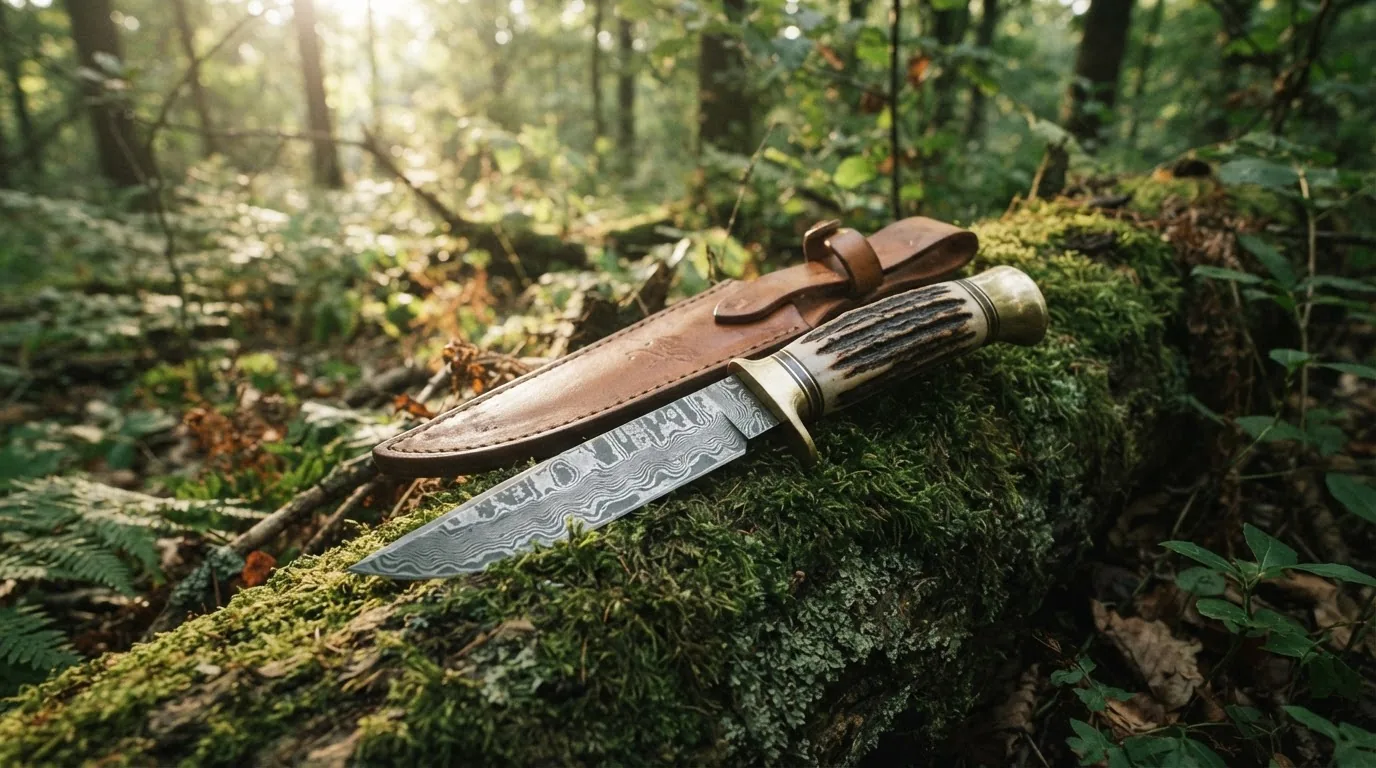
Short answer: there is no single best hunting knife, and anyone who names one is selling it. There are about five designs that have survived long enough to have proved themselves, and the best hunting knife ever made is whichever of those fits your hand and the animal you are actually working on. What separates a great hunting knife from a merely expensive one is heat treat, blade geometry and handle fit, in that order. The pattern on the blade is last.
The knives that have already survived the test
Rather than a list of this year models, here are the designs that have been in continuous use long enough that the argument is settled.
| Design | Since | What it got right |
|---|---|---|
| The Bowie | 1830s | Clip point for tip control, deep belly for slicing, enough mass to chop. Still the template for large American fixed blades. |
| Marble’s Ideal | Early 1900s | Established the classic American hunting profile: modest blade, pronounced belly, stacked leather handle. |
| The Finnish puukko | Centuries | Short, flat ground, no guard, superb control. Proof that a hunting knife does not need to be big. |
| Ka-Bar USMC fighting utility | 1942 | Seven inches of 1095 with a stacked leather handle. Built for war, adopted by hunters because it simply works. |
| Buck 110 Folding Hunter | 1963 | Made the lockback folder a serious hunting tool. Everything with a clip point and a back lock owes it something. |
| Randall Model 1 | 1938 | The benchmark for custom American hand work, and the reason people still wait years for a knife. |
Notice what is not on the list: anything with a serrated spine, anything tactical looking, anything with a hollow handle. Those come and go. The six above are still in production because they were right the first time.
What actually makes a hunting knife good
Four things, and the order matters because people usually get it backwards.
- Heat treat. The single largest difference between two knives that look identical. A blade run at the right hardness holds an edge through a whole animal. A soft one is dull at the ribcage. You cannot see this and you cannot test it in a shop, which is exactly why it is worth asking who did it.
- Blade geometry. How thin the steel is behind the edge decides whether the knife parts hide or drags through it. A thin grind on a modest blade will out-cut a thick grind on an impressive one every time.
- Handle fit. Field dressing is done with cold, wet, bloody hands. A handle that fills your palm and has a real guard is a safety feature, not a comfort one. If your fingers cannot close around it, the knife is wrong for you regardless of what it cost.
- Steel. Last, and it matters less than the internet suggests. 1095, Damascus, D2 and 440C are all perfectly good hunting steels. The choice is really about how much rust you are willing to manage.
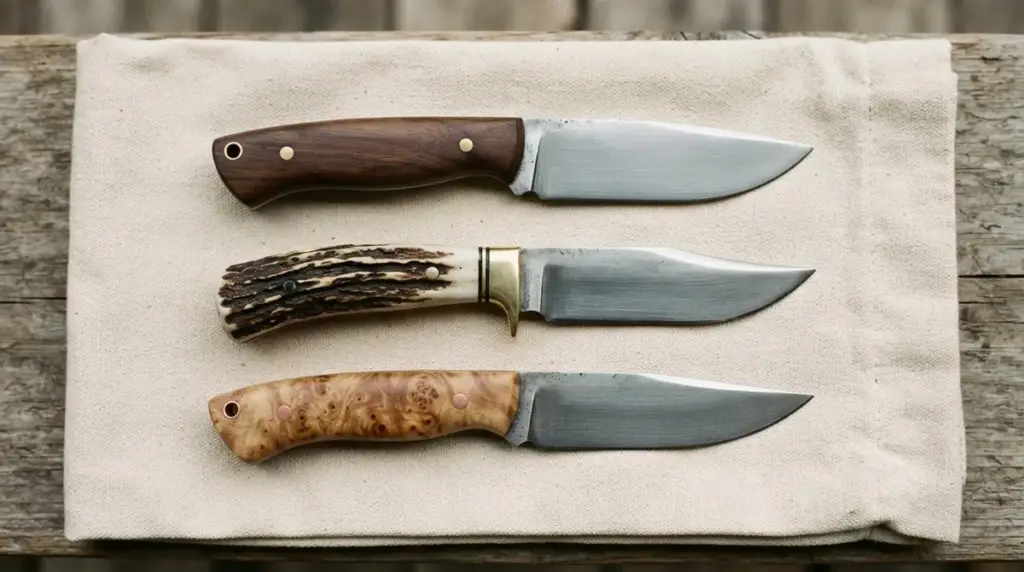
Which handmade hunting knife is considered the best
Among people who actually use them, the answer is consistent and unglamorous: a full tang fixed blade between 3.5 and 4.5 inches, with a drop point or a modest clip point, a deep belly, a real guard, and a handle you can grip when wet.
That is it. Not a nine inch blade. Not a saw back. The reason the answer disappoints is that the correct hunting knife is small, and small does not photograph as well as large.
| Job | Blade | Profile |
|---|---|---|
| Skinning | 3 to 3.5 in | Deep belly, rounded tip. The belly does the work, the tip stays out of the hide. |
| Caping and detail | 2.5 to 3 in | Fine point, narrow blade. Control beats reach. |
| General field dressing | 3.5 to 4 in | Drop point, guard. The one knife most hunters should own. |
| Quartering and camp | 4 to 5.5 in | Heavier spine, full tang, enough mass to work through joints. |
| Gut hook work | 3.5 to 4 in | Drop point with a hook ground into the spine, so you carry one knife instead of two. |
If you want the detail on each of those, our skinning knife guide and Damascus hunting knife guide go further.
Handmade or factory made
A factory hunting knife from a serious manufacturer is a good knife. This is not a page that pretends otherwise. What handmade buys you is different rather than automatically better.
| Handmade | Factory | |
|---|---|---|
| Consistency | Each piece judged by the person who made it | Batch inspected, very consistent within a batch |
| Grind | Usually thinner behind the edge | Usually thicker, for warranty reasons |
| Handle | Natural materials, fitted to the tang by hand | Moulded, dimensionally perfect, identical |
| Repairability | The maker can re-handle or re-profile it | Replace rather than repair |
| Price | $70 to $400 for a working hunter | $30 to $200 |
| Two the same? | Never | Always |
If you want one knife that will be re-sharpened for thirty years and eventually handed to somebody, hand forged is the right side of that table. If you want three knives in the truck that you will not grieve over, the factory side is the sensible answer.
What we would hand you
Our own hunting knives are hand forged in Memphis, Tennessee, full tang, 58 to 60 HRC, and every fixed blade ships with a hand stitched leather sheath. If you are choosing between them:
- One knife for everything — a 3.5 to 4 inch drop point in Damascus. It will do ninety percent of what you need and it is a pleasure to own.
- Wet country, or you will not baby it — the same shape in 440C stainless. Blood and rain are corrosive and 440C forgives being wiped rather than washed.
- You process a lot of game — add a dedicated skinner with a deeper belly, and keep the drop point for detail work.
- You want one knife that does the gut work too — a gut hook model saves you carrying a second blade.
- Camp as well as game — step up to a bowie and accept that it is less precise on fine work.
None of those is the best hunting knife ever made. Each of them is the best hunting knife for one specific person doing one specific job, which is the only version of the question that has an answer.
Questions people ask
What is the best hunting knife ever made?
There is no single answer, and the designs that come closest are old ones: the Bowie, the Marble’s Ideal, the Finnish puukko, the Ka-Bar and the Buck 110. Each has stayed in production for decades because the proportions were right. The best hunting knife for you is a full tang fixed blade of 3.5 to 4.5 inches with a handle that fits your hand.
Which handmade hunting knife is considered the best?
Among people who use them rather than collect them, the consensus shape is a full tang drop point between 3.5 and 4.5 inches, with a deep belly, a real guard and a grip that holds when wet. The maker matters more than the model: ask who did the heat treat before you ask what the blade is called.
What size hunting knife do I actually need?
Three to four inches covers field dressing, skinning and caping for almost all North American game. Longer blades are for quartering, camp work and looking impressive. A shorter blade gives you more control exactly where control matters.
Is a drop point or a clip point better for hunting?
A drop point for most people. The spine curves down to the tip, so the point sits lower and is far less likely to nick the hide or the gut. A clip point gives you a finer tip for detail work and demands more care.
Is Damascus good for a hunting knife?
Yes. Pattern welded 1095 and 15N20 at 58 to 60 HRC takes a fine edge and sharpens easily in the field. It is carbon steel, so it needs wiping dry and it should not be stored in a damp leather sheath, but a hunting knife gets cleaned after use anyway.
Does a hunting knife need a gut hook?
Not necessarily. A gut hook is faster and safer for opening an animal without cutting into the intestines, and it is one more thing to sharpen. If you process several animals a season it earns its place. For one deer a year, a good drop point is enough.
Full tang or partial tang for a hunting knife?
Full tang, without argument. Knives fail where the blade meets the handle, and a tang that runs the whole length of the handle is what carries that load. Our full tang guide explains why.
How much should I spend on a hunting knife?
A genuine hand forged hunter starts around $73 and most sit between $120 and $260. Below that you are gambling on the heat treat. Above about $400 the extra money goes into handle material and size rather than cutting performance.
More reading. What a real Damascus knife costs, are Damascus knives worth it, and choosing a knife for smaller hands.
