
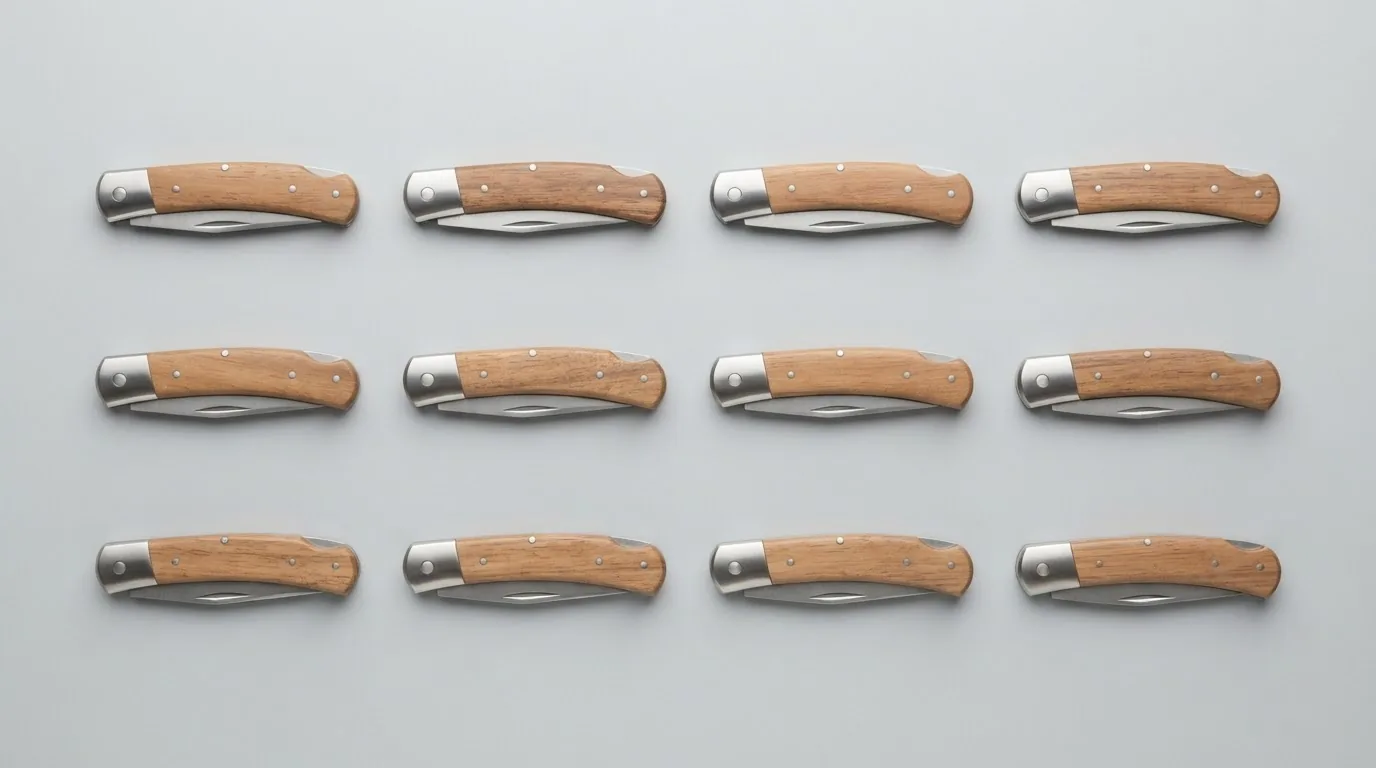
Short answer. Buying knives wholesale means committing to a quantity in exchange for a lower unit price, and the two numbers that decide whether it works are the minimum order quantity and the lead time. Expect wholesale pricing to begin around 10 to 25 pieces with most small suppliers, real tier improvements at 100, and full private label at 500 or more. A hand forging workshop and a container importer are not the same business, and past a few hundred identical units the importer will beat us on price every time. This guide gives you our actual tiers, our real catalogue numbers, and the questions that separate a supplier who can deliver from one who cannot.
What wholesale actually means in the knife trade
Three different arrangements get called wholesale and they behave nothing alike.
The first is stock buying. You order existing catalogue models in volume at a discount, mixed freely, and resell them as they are. Lead time is short because the goods exist. The second is decoration, where you take a catalogue model and add a logo, a name or a date. That adds an artwork approval step and a production step, so lead time grows. The third is private label or original equipment manufacturing, where a supplier builds to your drawing under your brand. That is a manufacturing project, not a purchase, and it is measured in months.
Buyers get into trouble when they price the first arrangement and then ask for the third. A quote for 200 catalogue folders with your logo on the blade is not a useful guide to what 200 folders built to your own profile, steel and handle spec will cost.
The one thing most wholesale guides will not tell you
A forge cannot beat a container importer on a plain reorder. If your requirement is 500 identical low cost folders, delivered on a repeating schedule, at the lowest possible landed cost, the right supplier is a large factory shipping full containers, not a workshop where each blade is ground and finished by hand. The economics are not close. High volume production amortises tooling and moves labour cost per unit toward zero. Hand finishing does not.
What a forge is actually good for is the opposite end: smaller runs, unusual specifications, materials a factory line will not stop for, and a product where the person buying it can see and feel that a human made it. If your retail proposition is price, buy from an importer. If your retail proposition is that the knife is individually made, that is where we are useful. We would rather say that than take an order we will lose money on and deliver late.
Minimum order quantities and where the breaks fall
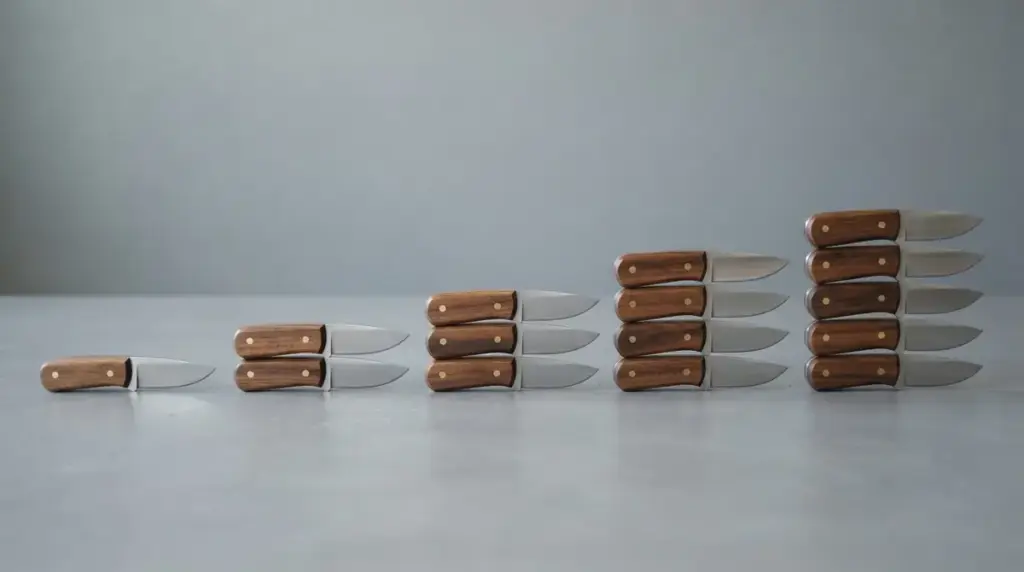
There is no industry standard minimum. Suppliers set their own, and the number varies with model, steel, handle material and how much customisation is involved. Our published tier structure on our wholesale knives in bulk page looks like this.
| Tier | Typical order | What it unlocks |
|---|---|---|
| Sample | 1 to 9 pieces | Judge steel, edge and finish in hand before committing |
| Starter | 10 to 24 pieces | Wholesale pricing begins, logo engraving available on the whole order |
| Growth | 25 to 99 pieces | Improved tier pricing, mixed models in one order, scheduled restock |
| Volume | 100 to 499 pieces | Custom packaging, dedicated production slot, staged delivery |
| OEM | 500 pieces and up | Full private label, custom design development, signature runs |
That structure is indicative. Exact minimums and prices depend on the specification and are confirmed on a quote. We are not going to publish a per unit wholesale price on a public page, because the honest answer changes with steel, handle material and engraving, and a single number would mislead more buyers than it helped.
What we can publish is retail. On 30 August 2026 our catalogue held 609 published products, 608 of them priced. The lowest was 55 dollars, the median 155 dollars, and the highest 1,631 dollars. Folding pocket knives, the category most wholesale buyers start in, held 111 products with a median of 128 dollars and a floor of 70 dollars.
| Category | Products | Lowest | 25th percentile | Median | 75th percentile | Highest |
|---|---|---|---|---|---|---|
| Whole catalogue | 608 priced | 55 | 114 | 155 | 251 | 1,631 |
| Folding pocket knives | 111 | 70 | 101 | 128 | 263 | 845 |
| Best selling hunting | 133 | 73 | 130 | 201 | 266 | 938 |
| Kitchen and chef | 44 | 90 | 119 | 142 | 261 | 694 |
| D2 tool steel | 69 | 119 | 140 | 179 | 245 | 506 |
| Damascus skinning | 22 | 73 | 97 | 106 | 179 | 316 |
All figures in US dollars, counted from the live catalogue on 30 August 2026. Use the retail column to work backwards. If you know the shelf price you need to hit and the margin you need to hold, you know the landed cost you have to negotiate to, and you can tell very quickly whether a supplier is in range before either side wastes time.
Margin, and why keystone is a starting point not a rule
The traditional retail benchmark is keystone, meaning a retail price of twice the wholesale cost, or a 50 percent gross margin. In practice cutlery retailers work above and below it depending on the category. Commodity folders that face direct price comparison online tend to run thinner. Distinctive handmade pieces with no exact comparison run wider, because the buyer cannot pull up an identical item on a marketplace and undercut you.
Build your margin model on landed cost, not invoice cost. Landed cost is the unit price plus freight, plus insurance, plus duty and any additional tariffs, plus customs brokerage, plus the payment processing and currency costs, divided across the units that actually arrive saleable. A 15 percent discount that is eaten by air freight is not a discount.
Duty and import cost if you are sourcing from abroad
If you import directly you need the tariff line before you need the quote. Knives sit in heading 8211 of the US Harmonized Tariff Schedule. Two rates worth knowing, checked on 30 August 2026:
| HTS line | Covers | General duty rate |
|---|---|---|
| 8211.92.40 | Fixed blade knives with rubber or plastic handles | 1 cent each plus 4.6 percent |
| 8211.93.00 | Pen knives, pocket knives and other folding knives | 3 cents each plus 5.4 percent |
Those are general column one rates and they are only part of the bill. Additional duties can apply depending on country of origin and current trade measures, and those change often enough that we are not going to quote a stacked total here. We have not verified the current additional tariff position for any specific origin, so treat that as unverified and get it confirmed by a licensed customs broker before you commit to a landed cost. Classification also matters more than people expect: handle material and blade type change the line, and the line changes the rate.
Lead times you should actually plan around
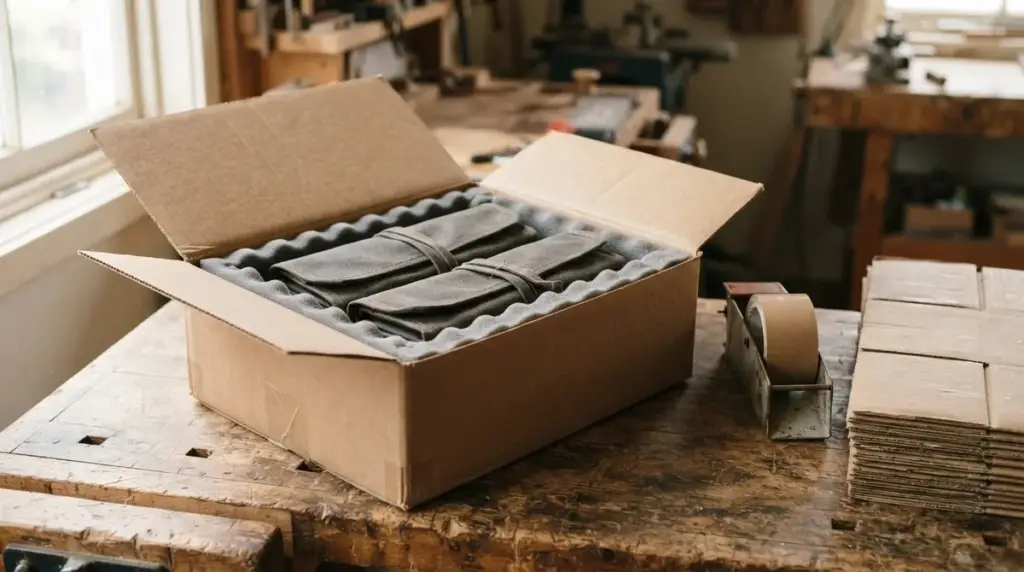
Ask two separate questions of every supplier. How long until production starts, and how long does production take. Suppliers who quote one number are usually quoting the second and hoping you do not ask about the first.
Our own position, published on the wholesale page: catalogue models held in stock dispatch in one to three business days. Because every knife is individually forged and finished, production time for bulk and custom orders is confirmed with the quote rather than estimated in advance. We can point at one delivered example: a customer order of 200 custom Damascus folding knives ran from the drawing board to final delivery in under 60 days, and that customer wrote about it publicly.
Sixty days for a bespoke run of 200 is a realistic planning figure for hand made work, not a promise for your project. If you are aiming at a Christmas sell through, the useful reverse calculation looks like this.
| Stage | Typical elapsed time | What can go wrong |
|---|---|---|
| Specification and quote | 2 to 7 days | Incomplete brief, no reference sample |
| Sample order and evaluation | 1 to 3 weeks including shipping | Buyer approves from photographs instead |
| Artwork proof for engraving | 2 to 10 days | Logo supplied as a low resolution image |
| Production | Confirmed on quote, weeks not days | Spec changes after production starts |
| Inspection and packing | 2 to 5 days | Packaging not specified at order time |
| Freight and customs | Days by air, weeks by sea | Classification query, missing documents |
The single most common cause of a late wholesale order is not the workshop. It is a buyer who takes eleven days to approve an artwork proof and then measures the delay from the original order date.
What you must have in place before you order
Most suppliers will not open a wholesale account without proof that you are a business. In the United States that usually means a resale certificate or seller's permit from your state, and an employer identification number. Some distributors also ask for a business address that is not a residence, a website or storefront, and a minimum first order. None of that is a hurdle designed to keep you out. It exists because a wholesale price without a resale certificate creates a sales tax problem for the supplier.
Have these ready before you ask for a quote: your legal entity name and tax registration, the quantity and model, the steel and handle preference, whether you need engraving and in what format the artwork exists, your delivery address and the date you need goods in hand, and your target landed cost. A supplier who has all of that can quote in a day. A supplier who has to extract it over a week will quote conservatively, which costs you money.
How to judge a supplier before you pay a deposit
Order a sample first. Always. Steel, grind, heat treatment and finish are much easier to judge in the hand than on a screen, and a sample also tells you how the piece presents to your own customer, which is the thing photographs never show. If a supplier discourages sampling, that is the answer to your question.
Then check the things a good supplier will happily confirm in writing: the exact steel and its heat treated hardness, whether the tang is full or partial, what the sheath is made of and how it retains, what the packaging is, who inspects before packing, and what happens if a piece arrives damaged. Our position on hardness, for what it is worth, is that 1095 and 15N20 Damascus runs 58 to 60 HRC, D2 runs 58 to 62 HRC and 440C runs 58 to 60 HRC, and we will not publish other numbers for those steels.
Be careful with two claims in particular. Country of origin claims should be documented, because you will be repeating them in your own store and you carry the consequence. And any supplier who tells you their Damascus is a specific historical steel, or that a pattern indicates a particular performance level, is selling you a story. Our guide on real and fake Damascus covers how to tell.
Corporate gifting is a different buy from retail stocking
If you are buying knives as client or employee gifts rather than for resale, almost every constraint changes. Quantity is fixed by a headcount rather than a sales forecast. Timing is fixed by an event date. Nobody compares your unit price against a marketplace listing, so margin stops mattering and presentation starts mattering a great deal.
That shifts the right specification. Spend less of the budget on exotic steel and more on the things the recipient actually experiences: a comfortable handle, a clean edge out of the box, a sheath or box that opens well, and a mark that is executed properly. Order at least ten percent above headcount, because someone always adds names in the last week.
One inconvenient note. Knives are a poor gift for a recipient list you cannot control, because you cannot ship a blade to every jurisdiction and some employers prohibit them on site. Confirm both before you order, not after.
Restocking, and the trap of the first order
The first wholesale order is the easy one. The second is where suppliers get found out. Ask, before the first order, what a repeat order looks like: how long a restock takes, whether pricing holds, whether the same handle material will be available, and whether the exact model will still exist in six months.
Hand made goods carry a real variation risk here. Natural handle materials differ piece to piece, and a bone or stag scale from a later batch will not match an earlier one exactly. If your retail display depends on ten identical knives sitting in a row, say so at quote stage and expect to pay for the sorting, or choose a synthetic or stabilised handle material instead. Our guide on hand forged against factory made goes through where that variation comes from.
Questions people ask
What is a typical minimum order quantity for wholesale knives?
There is no single figure across the trade. Small suppliers and forges commonly start wholesale pricing somewhere between 10 and 25 pieces, with better tiers at 100 and full private label at 500 or more. Large importers often start much higher because their economics depend on container volume. Always ask for the minimum on your exact specification, not in general.
Do I need a resale certificate to buy wholesale?
In the United States, usually yes. Suppliers ask for a state resale certificate or seller's permit and an employer identification number so they can sell to you without collecting sales tax. Requirements vary by state and by supplier, so confirm before you build a plan around a quoted price.
Is it cheaper to import directly than to buy from a domestic supplier?
Sometimes, and only at volume. Direct import means you carry the freight, duty, brokerage, currency risk, quality inspection and the cash flow gap between paying and selling. At a few hundred units those costs and risks often erase the unit price saving. At several thousand they usually do not.
What duty will I pay on imported knives?
Knives fall under heading 8211. Checked on 30 August 2026, the general rate for HTS 8211.92.40 was 1 cent each plus 4.6 percent, and for HTS 8211.93.00 it was 3 cents each plus 5.4 percent. Additional origin specific duties can apply on top and change frequently, so we have not verified a stacked total and you should confirm yours with a customs broker.
How long does a custom wholesale order take?
For hand made work, plan in weeks rather than days. One documented example from our own order book is 200 custom Damascus folding knives delivered in under 60 days from the drawing board. Your timeline depends on the specification, and the approval steps on your side are usually the largest variable.
Can I mix different models in one wholesale order?
With us, yes from the Growth tier of 25 pieces and up. Elsewhere it depends on how the supplier prices. A supplier who quotes per model rather than per order will usually want the minimum met model by model, which is worth establishing before you build a mixed assortment.
What margin should I plan for as a retailer?
Keystone, meaning double the wholesale cost, is the traditional starting point in cutlery. Whether you can hold it depends on how comparable your product is. Items that appear identically on marketplaces get priced down. Distinctive handmade pieces hold margin better. Model it on landed cost rather than invoice cost.
Should I order a sample before a bulk order?
Yes, and we encourage it. Grind, edge, finish and handle feel are difficult to judge from photographs, and a sample also lets you test how the piece presents to your own customers. The cost of one sample is trivial against the cost of a bad run of 200.
Can I put my own brand on the knives?
Yes. Private label and original equipment manufacturing is a standard offering here: your mark on the blade, the sheath and the packaging, with an artwork proof approved by you before production begins. Note that we do not offer free engraving, so treat marking as a line item in your cost model.
What is the most common mistake a first time wholesale buyer makes?
Ordering too many of one model. A first order should be wide and shallow so you learn what actually sells, then narrow and deep on the winners. Buyers who commit their whole budget to a single model on a hunch usually spend the following season discounting it.
More guides. Read hand forged against factory made, the knife steel chart, real and fake Damascus and what drives Damascus knife prices, or see our wholesale and custom logo programmes and browse folding pocket knives. Please check your local law before ordering.
If the knives are gifts for employees or clients rather than stock to sell, read the corporate knife gift guide instead.
More from the workshop
Flying With a Knife
What TSA actually allows, how to pack a knife in the hold, and where the rules change once you land abroad.
Valuing an Old Pocket Knife: Marks, Condition and Reality
Tang stamps, dot dating, the collector grading scale, and why cleaning it costs you money.
