
Short answer: every dagger is a knife, but not every knife is a dagger. A dagger is double-edged, symmetrical, and built around the stab. A knife has one working edge and is built around the cut. That single design decision — one edge or two — drives everything else: how it is forged, how it is carried, what it is good at, and in some states, whether you can put it in your pocket at all.
The one-sentence difference
A knife is a tool that can fight. A dagger is a weapon that can, at a stretch, do chores — badly. I have watched a man try to dress a deer with a boot dagger, and I want those twenty minutes of my life back more than he wants his thumb back. Both were fine, eventually. The point is: shape follows job, and the jobs are different.
Knife vs dagger, side by side
| Knife | Dagger | |
|---|---|---|
| Edges | One sharpened edge, spine on top | Two sharpened edges, symmetrical |
| Blade shape | Clip point, drop point, trailing point — shaped for a job | Narrow, tapered, spear-point — shaped to penetrate |
| Primary job | Cutting and slicing: food, rope, hide, wood | Thrusting; historically a sidearm, today mostly collected |
| Strength | Thick spine backs up the edge for hard work | Central rib instead of a spine; stiff but edge-fragile |
| Everyday usefulness | High — it is the most used tool most people own | Low — you cannot baton firewood with something sharp on both sides |
| Legal treatment (US) | Generally the friendliest category | Often the most restricted category, especially concealed |
| Examples | Bowie, skinner, chef knife, pocket knife | Stiletto, dirk, push dagger, boot dagger |

Why the double edge changes everything
From the forge side, a dagger is the harder blade to make well. A single-edge knife has a spine — a thick, soft-backed ridge of steel that absorbs shock and lets us grind a hard, thin edge below it. A dagger gives up the spine. Instead it carries a central rib with steel falling away to an edge on both sides, and both bevels have to be ground symmetrically or the blade looks drunk. Grind one side a hair too deep and you start over. That symmetry is also why a well-made Damascus dagger is such a collector's piece: there is nowhere for sloppy work to hide.
It is also why the dagger is a poor tool. Any grip that puts your thumb on the "spine" for control — the way you actually use a knife ninety per cent of the time — now puts your thumb on an edge. The dagger does not want to help you. It was designed for one motion, and it is honest about it.
So is a dagger better for self-defense?
It penetrates better — that is physics, a narrow symmetrical point meets less resistance. But "better for self-defense" involves lawyers as much as geometry, and in several states carrying a concealed dagger is a separate, worse conversation with a judge than carrying a pocket knife. If defense is genuinely your concern, learn your state's law first and pick your carry accordingly. We build daggers for people who love them, and that is reason enough to own one.
Can a knife be a dagger?
The lines blur at the edges — pun fully intended. A spear-point blade sharpened on both sides is a dagger no matter what the catalog calls it. A push dagger is a dagger by construction even at three inches long. And plenty of "daggers" sold online are actually single-edged with a false top edge — which legally, in most states, keeps them knives. The law usually cares about whether the second edge is sharpened, not what the product listing says. Our Damascus daggers are the genuine double-edged article.
What the law says
This part stays serious. Knife law in the United States is state-by-state, changes regularly, and often treats double-edged blades as a separate class. A few examples of how differently states approach it, as of 2026:
| State | General approach to daggers/dirks |
|---|---|
| Texas | Broadly permissive since 2017; location-based restrictions (schools, bars) still apply |
| California | Open carry of a dirk/dagger is allowed; concealed carry of one is a crime |
| New York | Daggers unlawful when carried with intent to use unlawfully — and possession can be treated as presumptive evidence |
| Florida | Concealed carry of a dirk/dagger generally requires a concealed weapon license |
This is general information, not legal advice. Laws change and cities can be stricter than their states. Please check your current local law before ordering or carrying any double-edged blade.
Which should you buy?
If you will use it — hunting, camp, kitchen, everyday carry — buy a knife, full stop. Start with a bowie or a working western blade. If you collect, appreciate symmetry, or want the piece everyone picks up first off the display shelf, a hand-forged Damascus dagger earns its place. Plenty of our customers own both, and I have yet to hear one regret either.
What is a dagger?
A dagger is a short, double-edged blade with a symmetrical taper and a centred point, made to thrust rather than to slice. Everything else follows from that: two sharpened edges instead of one, bevels that mirror each other across a central rib, and a point on the blade's centreline so a thrust drives straight back down the grip.
What makes a knife a dagger is that symmetry — not length, price, or menace. A single-edged blade with a decorative false edge on top is still a knife. People type this a dozen ways — knife vs dagger, dagger vs knife, knife dagger difference, are daggers and knives the same — and it is one question with one answer. Daggers and knives are the same family; the dagger is the branch that gave up the spine.
Types of daggers and knives, named
Most named patterns are regional or job-specific. The ones worth knowing:
- Stiletto — Italian, very narrow, sometimes so needle-thin it has no real cutting edge.
- Dirk — the long Scottish thrusting dagger, worn on the belt.
- Push dagger — a short blade on a T-handle held between the fingers, punched not swung.
- Poignard — French for a slim court or duelling dagger; anglicised as poniard.
- Rondel — medieval, round discs for guard and pommel so the palm can drive it.
- Misericorde — the thin blade used to finish a downed knight through gaps in his plate.
- Bollock or kidney dagger — medieval civilian carry, named for the lobed guard.
- Sgian-dubh — the small Highland knife worn in the sock, single- or double-edged.
- Fairbairn-Sykes — the Second World War British commando knife, still the pattern most military daggers copy.
- Trench knife — First World War close-quarter blade, often on a knuckle-bow handle.
- Boot dagger — any slim double-edged blade sized for a boot top.
- Athame — a ceremonial double-edged ritual dagger, traditionally never sharpened.
For the single-edged patterns alongside them, see knife types explained.
A short history of the dagger
The dagger is older than the sword. Bronze Age smiths could cast a short blade long before a long one that would not bend, so the sword grew out of the dagger as casting improved.
Its high point was the medieval period, when almost everyone wore one. Armoured combat gave it a job nothing else could do: finding the gaps at armpit and visor a sword could not reach. In the Renaissance it moved to the off hand as the parrying dagger paired with the rapier. Firearms then took its battlefield role, leaving it a dress item and then a special-purpose one: the trench knife of 1916, the Fairbairn-Sykes of 1941. Today most daggers are bought to be admired rather than used.
Dagger vs dirk vs stiletto vs poniard
These four words get used interchangeably. They should not be:
| Dagger | The umbrella term. Any short, double-edged, symmetrical thrusting blade. |
| Dirk | A long dagger, Scottish in origin, worn as a belt sidearm — longer than a dagger, shorter than a sword. |
| Stiletto | A dagger reduced to its point. Narrow, often diamond or triangular in section, with little useful edge. |
| Poniard | A slender civilian dagger of the duelling era — a dress stiletto with better manners. |
Legal codes often use "dirk or dagger" as one fixed phrase, defined far more broadly than any workshop would.
What you give up with a double edge
The double edge is a real trade-off, not a styling choice, and it costs more than buyers expect.
- No spine for your thumb. The control grip you use for nine cuts in ten is off the table.
- You cannot baton it. Nothing safe to strike, so splitting kindling is out.
- Twice the sharpening. Two edges, two angles to match, no flat back to steady it on the stone.
- The sheath must be built for it. A dagger needs a double welt so neither edge reaches the thread; a single welt gets cut through from the inside.
- Poor at slicing. The taper that helps it penetrate leaves a short, steep belly that drags.
- Useless in a kitchen. No knuckle clearance, no safe pinch grip.
That makes a dagger specialised, not bad. For a blade that earns its keep daily, read knife blade shapes and pick a single-edged pattern.
Collecting and displaying daggers
A dagger is the piece most people reach for first on a shelf, and a good one repays inspection. Sight down the blade from the point: the central rib should run dead straight, and both bevels should meet it at the same height. Uneven grinds show up on a dagger in a way they never do on a single-edged knife, which is why makers use the form to show off.
Then check the tang runs the full length of the handle — a stub-tang dagger loosens at the guard eventually, and full tang vs partial tang explains why. Look for a guard fitted tight with no gap, handle material pinned or peened rather than only glued, and a sheath with a proper double welt. Our hand-forged 1095 and 15N20 Damascus is heat treated to 58–60 HRC, hard enough to hold both edges. Store a display piece lightly oiled and out of its sheath, since leather holds moisture against steel.
This is general information and not legal advice — check your current local law before ordering or carrying a double-edged blade, since some places treat them as their own class. Our knife law guide covers how such rules are written.
Questions people ask
Is a dagger a knife?
Technically yes — a dagger is a sub-type of knife defined by its two sharpened edges and symmetrical point. In everyday and legal usage, though, "dagger" is treated as its own category, and the law is where the distinction matters most.
Are double-edged knives illegal?
Not federally, and not in most states — but several states restrict how you carry them, especially concealed. California, for example, allows open carry of a dirk or dagger but makes concealed carry a crime. Always check your current state and city law.
What were daggers used for historically?
As a sidearm — the backup weapon of knights, sailors, and soldiers from the Bronze Age through the Second World War. The medieval rondel dagger existed specifically to find the gaps in plate armor, which tells you everything about why it looks the way it does.
Can you hunt with a dagger?
You can, in the sense that you can also eat soup with a fork. The double edge makes safe field dressing grips nearly impossible — a skinner or gut hook does that job the way it should be done.
What is a push dagger?
A short double-edged blade set on a T-shaped handle that sits between the fingers, punched rather than swung. Compact, historically a gambler's last argument, and legally a dagger in most states despite its size. See ours here.
Keep reading: our guide to knife blade shapes covers where the clip point, spear point, and the rest of the family tree come from.
Are daggers and knives the same?
No. Daggers and knives overlap, but they are not the same thing. Every dagger is a knife in the broad sense of a bladed hand tool, yet a knife only becomes a dagger when it has two sharpened edges, a symmetrical taper, and a centred point. Search the phrase knives and daggers and you will get both categories mixed together, which is where most of the confusion starts.
What makes a knife a dagger?
Two sharpened edges and a symmetrical blade. That is the whole test. The knife dagger difference is not size, price, or how dangerous something looks — a four-inch blade sharpened both sides is a dagger and a twelve-inch bowie is not. If only one side is sharpened and the top is a false edge, it stays a knife, whatever the seller calls it.
Is a stiletto a dagger?
Yes. A stiletto is a dagger narrowed almost to a spike — Italian in origin, often diamond or triangular in cross-section, with so little edge that it can only really be used point first. A modern Damascus stiletto is a dagger with a very slim profile. The word also gets used loosely for switchblades, which is a separate thing entirely.
How long is a dagger blade?
There is no fixed length. Historical daggers run from roughly three inches for a boot or push dagger up to around twelve for a Scottish dirk, with most sitting between five and nine. Length is not what defines the category — the double edge is. Some legal codes do set length thresholds, so check yours if you plan to carry rather than collect.
Can you sharpen a double edged dagger on a normal stone?
You can, but it takes roughly twice as long and more care. There is no flat spine to rest a finger against, so you are steadying the blade against a live edge on both strokes. Match the angle on each side or the central rib drifts off centre and the blade starts to look bent. Work slowly, count your strokes, and alternate sides evenly.
What should you look for in a hand forged dagger?
Symmetry first. Sight from the point and check the central rib runs straight with both bevels meeting it at equal height. Then a full-length tang, a guard fitted tight with no gap at the blade, handle scales pinned or peened rather than only glued, and a sheath with a double welt so neither edge reaches the stitching.
More from the workshop
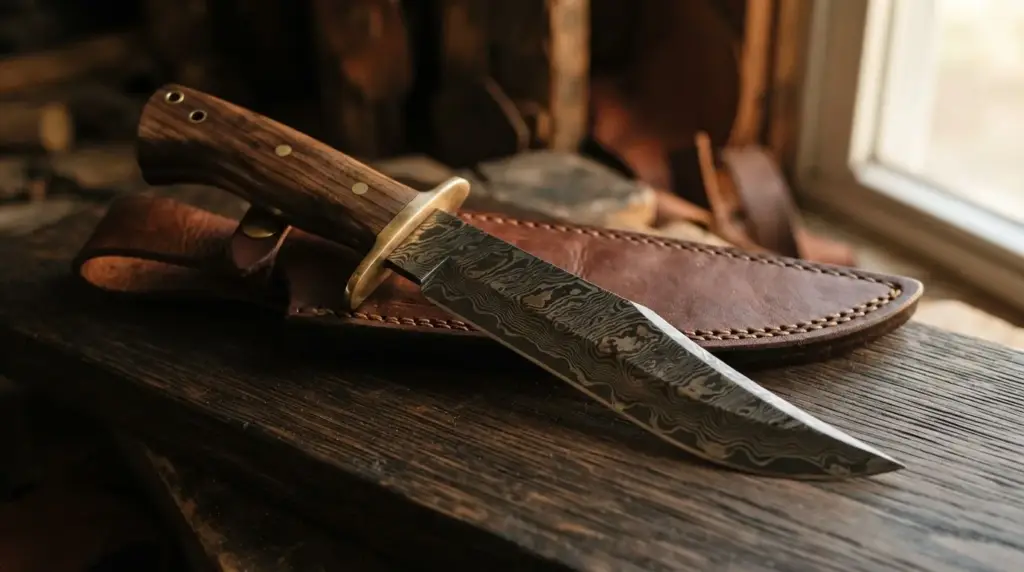
The Damascus Bowie Knife: Sizes, Grinds and What It Is Actually For
Clip points, false edges, grinds and real numbers from our own 27 bowies, plus where a big blade is the wrong tool.
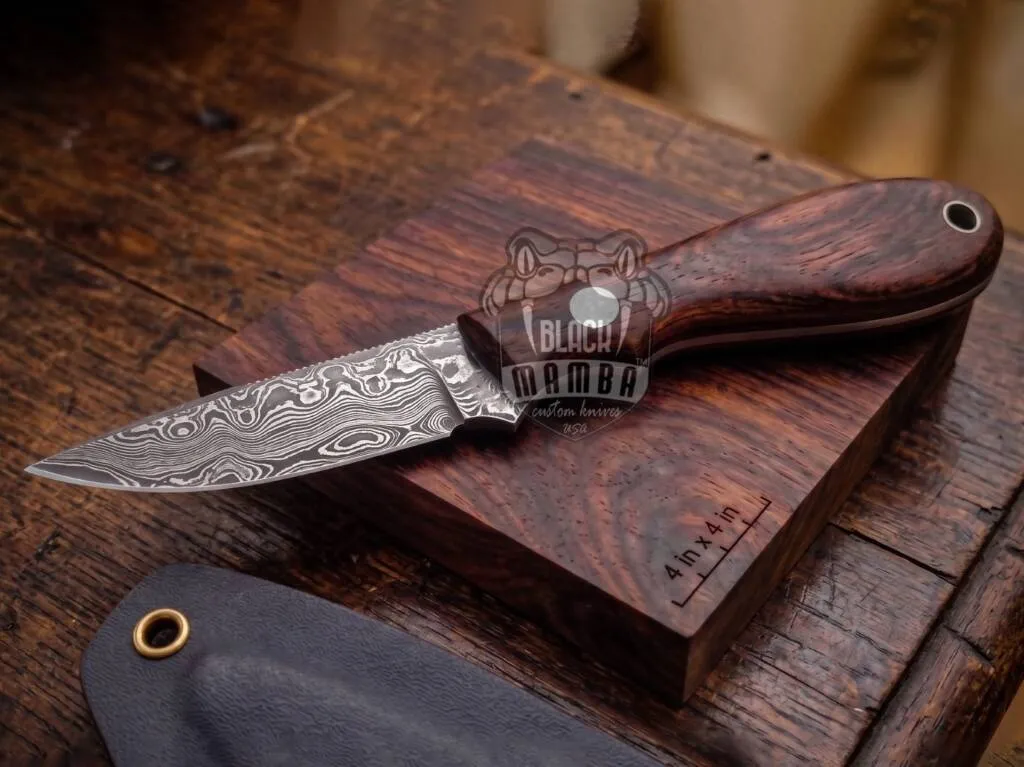
Carbon vs Stainless Kitchen Knives
Carbon is better to cut with, stainless is better to own. Pick by your habits.