
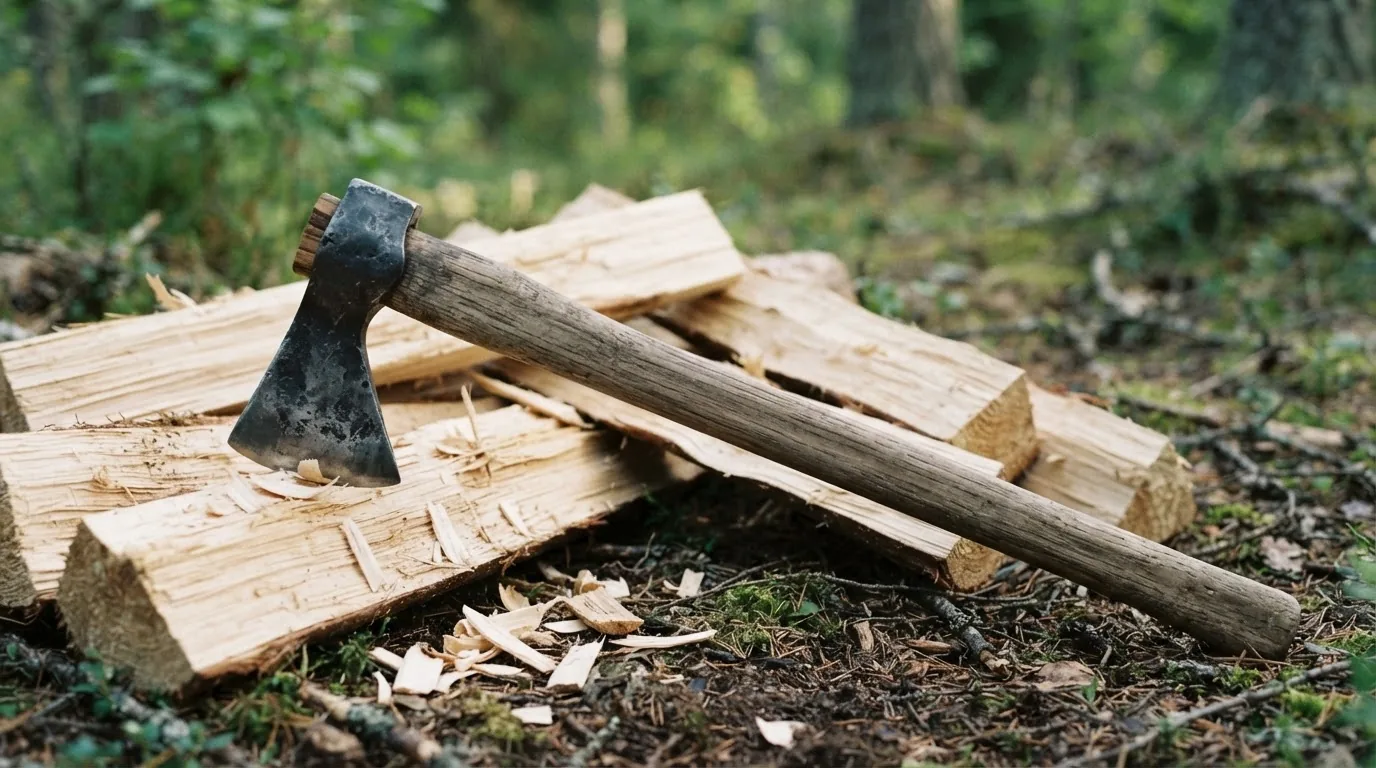
Short answer: a tomahawk is a light headed axe on a long straight haft, and what separates it from a hatchet is the eye and the way the head is hung rather than anything about the blade. Most of ours run 19 inches overall with a fitted leather edge sheath, and the range is ten products from $201 to $401 with a median of $266. A Damascus head looks extraordinary and is the least practical choice for anything you intend to hit hard, which we will explain rather than skate past.
Tomahawk or hatchet: what the word actually distinguishes
The honest starting point is that the distinction is modern. Early colonial tomahawks and belt axes were functionally the same object, and the split we now draw between the two is a convention that hardened much later. Wood Trekker, one of the few sources that treats the question seriously, makes the point directly: the difference was originally about intended use rather than construction, with tomahawks serving as trade goods and weapons while axes were shaped for woodworking.
What the words distinguish today is the eye, the hang and the proportions. A tomahawk carries a light head on a fairly long haft. A hatchet carries a heavier head on a short one. The current stereotype is a head around half a pound on a handle of roughly twenty inches, which is close to where most of our range sits, though historic hawks came in every size a smith felt like making.
The second thing to understand is that "tomahawk" on a product page in 2026 is a marketing word as often as a technical one. Several of our own ten are described as tomahawk axes and would be recognised by an axe person as hatchets or belt axes. We are not going to pretend the vocabulary is tighter than it is. If what you are really after is the older Norse pattern rather than a North American hawk, Ransack Viking sells Viking axes handmade in the Czech Republic.
The eye and the haft, which is the real difference
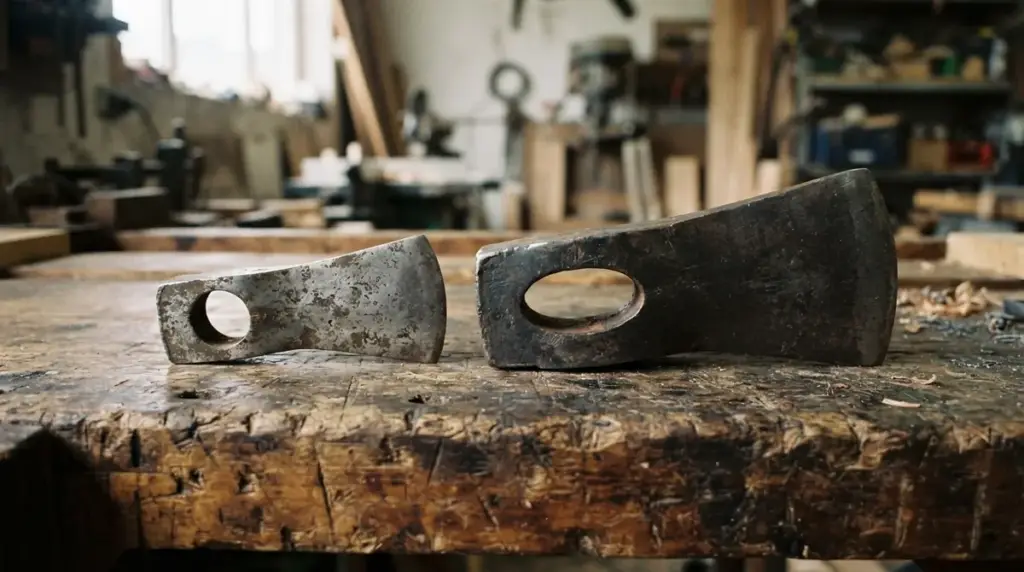
Here is the mechanical distinction that actually matters. An axe has a narrow, roughly triangular eye and is hung from the top: the handle goes in from above, is a friction fit at first, and is then locked with a wooden wedge driven into the top of the eye. A traditional tomahawk has a more or less round eye and is hung from the bottom: the head slides up a tapered haft from below and is held by nothing except friction and the swelling width of the wood.
The advantage of the tomahawk hang is field repair. Break a haft in the woods and you can carve a new one with a knife and drive the head onto it. No wedge, no glue, no vice. That was a genuinely valuable property for a trade axe two hundred years ago and it is the honest historical reason the design exists.
The disadvantages are equally real and axe people are blunt about them. On the friction fit design the head can rotate on the haft under load, and users report exactly that: "the round head does not split wood nearly as well as a belt axe, the head impedes the angle when chopping, the handle rotates in your hand when chopping." A wide round eye also gets in your way once you are cutting deep. As one experienced hand put it, "when you start chopping a 10 inch deep V in a large log that wide eye will be in your way and cause you to cut much less efficiently." Nobody who fells trees for a living chooses a slip fit over a wedged fit.
Now the part that matters for our catalogue. Several of ours are not friction fit at all. The Storm Breacher is a one piece full tang D2 build with G10 scales, so there is no eye and no haft to replace. The throwing set is described as oak with a pinned full tang. Those are stronger and more secure than a traditional hang, and they also throw away the field repair advantage that made the tomahawk a tomahawk in the first place. You are getting an axe with a tomahawk silhouette.
Head weight: the number nobody publishes, including us
Head weight is the single number that decides how an axe behaves. It sets how much energy each swing delivers, how tiring the tool is over an hour, and whether it splits or merely bites. It is more informative than steel type, finish or haft wood.
We do not publish it. We checked all ten of our tomahawk listings while writing this page and not one of them states a head weight, a total weight or a shipping weight you could work back from. That is a real gap in our own product data, we are naming it here rather than hiding it, and we are working through the range to measure and publish it.
Until then, do not let any seller substitute adjectives for the number. If a listing says "perfectly balanced" and "substantial in the hand" and never gives you ounces, you cannot compare it to anything. Ask. If the answer does not come back in ounces or grams, treat the tool as unspecified. That applies to our listings as much as to anybody else's.
Haft length across our ten
Length we do publish, and it is consistent. The table below is our whole tomahawk range as it stands on the site today.
| Model | Head steel | Overall length | Haft or handle | Price |
|---|---|---|---|---|
| Frontier Oak | Hand forged Damascus, mirror polished | 19 inches | American oak with leather cord wrap | $401 |
| Black Kite | Damascus, 7 inch head | 18 inches | Not published | $401 |
| Triple Strike throwing set of three | Hand forged Damascus, skeletonised with spike poll | 14 inches each | Oak, pinned full tang | $353 |
| Twin Forge pair | Damascus rose or high carbon matte | 19 inches | Hickory or ash depending on option | $268 |
| Scorch Ridge camp | D2 tool steel, mirror polished | 19 inches | Torched hickory with paracord wrap | $266 |
| Storm Breacher | D2 tool steel, one piece full tang | 19 inches | OD green G10 scales | $245 |
| Iron Beard bearded | Hand forged high carbon | 19 inches | Curved dark walnut with leather wrap | $234 |
| Anvil Oak hatchet profile | Hand forged high carbon | 19 inches | American oak | $201 |
| Raven Spike | Hand forged high carbon, spike poll | 19 inches | American oak | $201 |
| Homestead Oak | 1095 high carbon | 19 inches | American oak | $201 |
Nineteen inches is the working number here and it is a sensible one. It is long enough that the head does the work rather than your shoulder, short enough to strap to a pack without catching every branch, and it puts your hand far enough back that you can choke up near the head for carving and control. The 14 inch throwing hawks are shorter on purpose, because a throwing hawk needs a predictable single rotation over a shorter distance.
Head steel, and why a Damascus bit is a compromise
Four steel families run through the range: hand forged Damascus, D2 tool steel, hand forged high carbon, and 1095 specifically on one model. We hold Damascus in 1095 and 15N20 to 58 to 60 HRC and D2 to 58 to 62 HRC.
| Head steel | Hardness we hold to | Best at | The catch |
|---|---|---|---|
| Damascus, 1095 and 15N20 | 58 to 60 HRC | Display, gifts, collections | An etched surface takes impact damage visibly and dressing a chip out disturbs the pattern |
| D2 tool steel | 58 to 62 HRC | Camp and hard use, semi stainless | Harder to sharpen in the field than a simple carbon steel |
| Hand forged high carbon | Not published per batch | General chopping, easy field sharpening | Rusts readily. Needs oil after every wet outing |
| 1095 high carbon | Not published per batch | Traditional feel, forgiving to sharpen | Same corrosion behaviour, and a natural forge finish will darken |
Here is the uncomfortable version. A Damascus tomahawk head is a decorative choice and it is also the most expensive thing in our range at $401. The pattern is genuine layered steel and the hardness is real, but the whole point of the etch is a visible surface, and a bit that takes repeated impact into knots, dirt and the occasional nail is going to chip, roll and scuff. Dressing that damage out means grinding into the etched face, and the pattern will not come back the way it was unless the face is etched again. If your hawk is going to be swung at wood every weekend, the D2 and high carbon heads are the better tools and they cost less.
We also will not publish hardness figures for the plain hand forged carbon heads, because they are forged in batches and we have not tested them individually. A single confident number would be easier to sell and it would not be true.
Poll options and what each is for
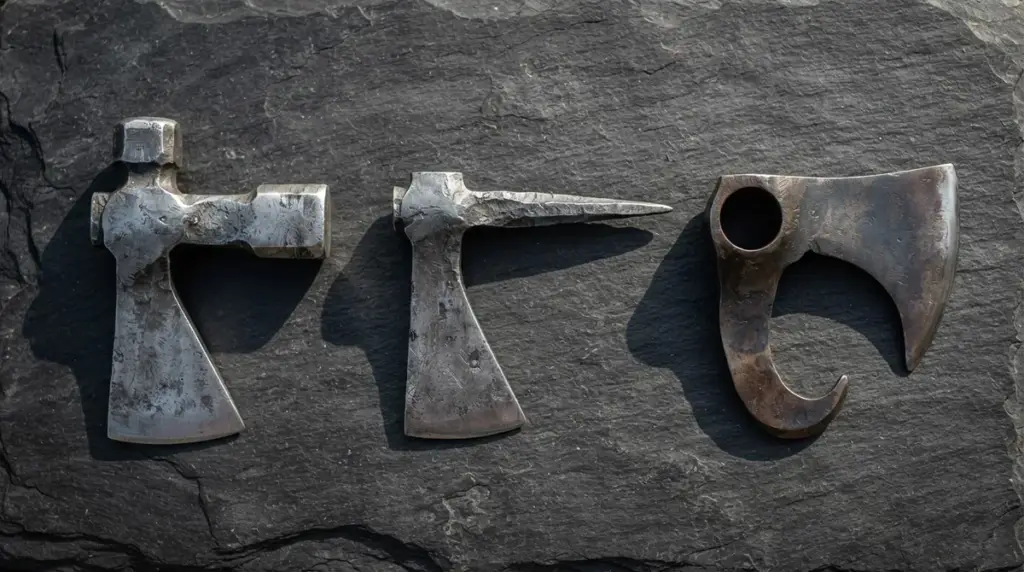
The poll is the back of the head, opposite the bit, and it is where most of the variation in our range lives. A flat hammer poll turns the tool into a mallet for tent stakes and for driving a wedge. A tapered spike poll is a piercing and prying feature that has genuine use for splitting frozen wood and getting into a stump, and no use at all around a campfire. A bearded profile drops the lower part of the bit down into a hook, which lengthens the cutting edge without adding head weight and gives you a very controllable choked up grip for carving. A breaching head with a pry notch and hammer poll, which is what the Storm Breacher carries, is built for forcing rather than for felling.
Pick the poll by the second job you want the tool to do, because the first job is always chopping and every head here does that. If the second job is camp chores, take a hammer poll. If it is carving and shaping, take the bearded head. If it is throwing, take the throwing set, which is the only one in the range designed for it.
What a tomahawk chops well and badly
A light head on a long haft is fast. It excels at limbing, at clearing brush, at cutting through green wood up to about wrist thickness, and at every task where you want to swing quickly and accurately many times. It shines for camp craft: notching, pointing stakes, splitting kindling from a piece you have already quartered, and carving with a choked up grip near the head.
It is a poor splitting tool and it is a poor felling tool. Splitting wants mass and a wedge shaped cheek, and a hawk has neither. Felling anything of real diameter wants a heavier head and a longer bit, and the wide eye that the pattern is built around gets in your way once the cut goes deep. If you are processing a winter's firewood, buy a splitting axe and keep the tomahawk for the fine work. That is straightforward advice from a shop that would rather sell you the $401 hawk.
Throwing, and what it does to the tool
Only one product in our range is built to be thrown: the Triple Strike set of three matched 14 inch hawks, skeletonised with spike polls, at $353 for the set. Throwing hawks come in threes because that is how the sport is scored and because you will otherwise spend your afternoon walking to the target.
Do not throw the others. A 19 inch camp hawk with a mirror polished head and a leather wrapped oak haft will survive a few throws and then start telling you about it. The head takes the impact on its cheeks, not on the edge, and every miss puts the haft into a wooden target or the ground. On a Damascus head every one of those marks is permanent and visible.
Care, rust and rehanging
Every hawk in our range except the one piece D2 build has a wooden haft, and the wood needs more attention than the steel does. Oak, hickory, ash and walnut all shrink in dry indoor air. On a friction fit head that shows up as a loose head, which is a safety problem rather than a cosmetic one. Store the tool somewhere with stable humidity, and if the head has any movement in it at all, stop using it until it is re hung.
The steel is simpler. Carbon and Damascus heads want wiping dry and a film of oil after any wet use, and a fitted leather sheath, which every model here includes, will hold moisture against the bit if you put a wet hawk into it and close the flap. D2 is more forgiving but is not stainless and will still spot.
Sharpening an axe bit is not knife sharpening. Use a file for shaping and a puck or a coarse stone for the edge, work at a convex angle rather than a flat bevel, and stop well short of razor thin. A hawk edge that is too fine will chip on the first knot it finds.
Questions people ask
What is the difference between a tomahawk and a hatchet?
Mainly the eye and the hang. A traditional tomahawk has a round eye and is hafted from the bottom by friction, so the handle can be replaced in the field. A hatchet has a narrow triangular eye, is hafted from the top and is locked with a wedge. Tomahawks also carry lighter heads on longer handles.
How heavy should a tomahawk head be?
The modern convention is around half a pound on a handle of roughly twenty inches, though historic hawks varied enormously. We have to be straight with you here: none of our ten listings currently publishes a head weight, and we are working through the range to measure and publish it.
How long are your tomahawks?
Eight of the ten are 19 inches overall. The Black Kite is 18 inches with a 7 inch head, and the Triple Strike throwing set is 14 inches per hawk. Nineteen inches is the length that suits camp work and pack carry best.
Is a Damascus tomahawk practical?
It is a decorative choice. The steel is genuine layered 1095 and 15N20 at 58 to 60 HRC and it cuts well, but an etched face takes visible damage from impact and dressing out a chip disturbs the pattern. For weekly chopping, a D2 or high carbon head is the better tool and costs less.
Can you throw any tomahawk?
You should not. Only our Triple Strike set of three is built for throwing, at 14 inches each with pinned full tang oak hafts. A camp hawk with a polished head and a wrapped haft will pick up permanent marks fast, and on a Damascus head those marks do not come out.
Will a tomahawk split firewood?
Not well. Splitting wants a heavy head and a wedge shaped cheek, and a hawk has a light head and thin cheeks. Users consistently report that a round eyed head does not split as well as a belt axe. Use a splitting axe for the woodpile and the hawk for kindling and camp work.
Can the handle be replaced?
On a traditional friction fit hawk, yes, and easily. On several of ours, no. The Storm Breacher is one piece full tang with bolted scales and the throwing set is pinned full tang, so neither has a replaceable haft. That is a genuine trade of the pattern's classic advantage for extra strength.
What is the spike on the back for?
Prying and piercing. It gets into a stump, works into frozen or knotty wood, and gives leverage a flat poll cannot. It also makes the tool useless as a hammer and adds a second sharp end to store safely. Take a hammer poll instead if camp chores are your second job.
What steel is best for a tomahawk head?
D2 at 58 to 62 HRC for hard camp use, because it is semi stainless and holds an edge. Plain high carbon if you want to sharpen it easily in the field and do not mind oiling it. Damascus if you want to look at it. All three appear in our range.
How do you sharpen a tomahawk?
With a file to shape and a puck or coarse stone to finish, working a convex edge rather than a flat bevel. Do not take it to a razor edge. An axe bit that is too thin behind the edge will chip on the first hidden knot, and chips on a Damascus face are permanent.
More guides. Knife types explained, how Damascus steel is made, telling real Damascus from fake, Damascus care and oiling, and the tomahawk and axe category.
More from the workshop
Tracker Knives: The Double Edge Profile and What It Is Good At
The tracker profile explained zone by zone, what it is good at, and what two lighter knives do better.
Knife Blade Shapes Explained
What each blade profile is actually built to do, and which one you want.
