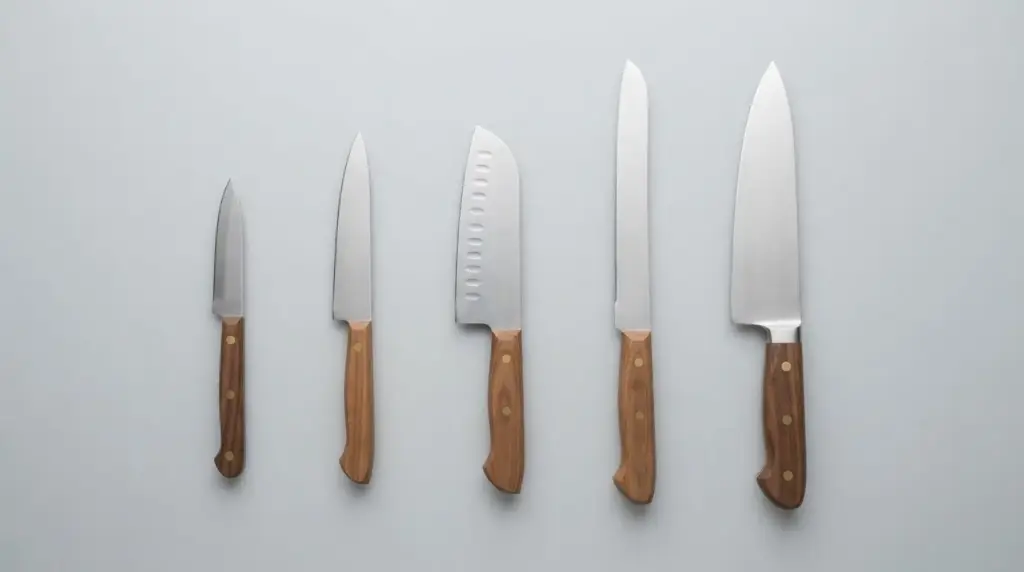
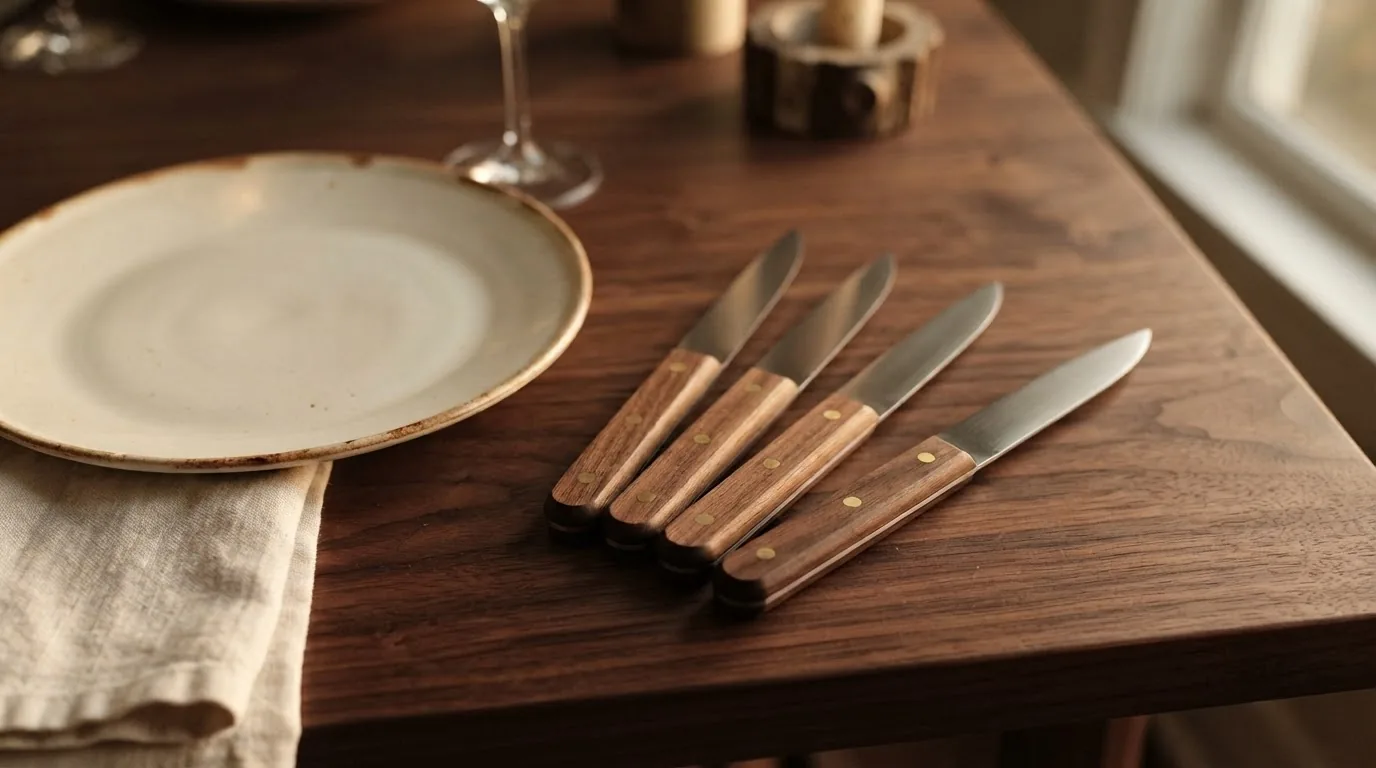
Short answer: A steak knife needs a thin, keen edge and enough length to cross a ribeye in one draw. Straight edges cut cleaner and can be resharpened forever; serrations saw through a crust and then get thrown away when they dull. Four is the honest starting number for most households, six if you host. A forged set of four from a working shop lands near five hundred dollars, and a supermarket set of four lands near forty. That gap is real and this guide does not pretend otherwise.
What a steak knife is actually for
A steak knife has one job and a very narrow set of conditions to do it in. It cuts cooked muscle fibre that has been rested, on a hard ceramic surface, held by a fork that is pushing down while the blade is pulling. It works in one direction, for perhaps twenty strokes a meal, and then it is put away.
That narrowness is why steak knife design has drifted so far from the rest of the kitchen. A chef knife earns its keep through mass and a long belly. A steak knife wants the opposite: light, thin behind the edge, and short enough that you are not lifting your elbow off the table. Our own steak knives run four and a half inches of blade and weigh three and a half ounces on the listings. A chef knife at three and a half ounces would be a toy. At a place setting it is exactly right.
The second thing a steak knife has to do is survive the plate. Every stroke ends on glazed ceramic, which is harder than the steel. This is the single largest source of dulling in table cutlery, and it is why the serrated versus straight argument exists at all.
Straight edge or serrated
Serrations win one argument and lose the rest. Independent side by side testing of serrated and non serrated steak knives has consistently found that a plain edge gives a cleaner cut face with less fluid loss, because the teeth on a serrated blade tear fibre rather than part it. The same testing points out the compensating advantage: on a serrated blade only the points of the teeth touch the plate, so the working edge in the valleys never meets ceramic and the knife appears to stay sharp far longer.
Appears is the operative word. It stays usable longer because most of the edge is protected. When it does finally go, you cannot pull it through a sharpener or run it on a stone. Each gullet has to be addressed individually with a tapered rod, which is slow, and on a factory micro serrated blade the teeth are usually too small and too shallow to take a rod at all. In practice a micro serrated table knife is a consumable. That is not a scandal, it is a design decision, but it should be priced into the purchase.
A plain edge is the opposite trade. It contacts the plate along its whole length and dulls faster, and you fix that with thirty seconds on a rod before service or two minutes on a stone twice a year. Our own view, and we sell only plain edges, is that if you will never sharpen anything then a serrated set is genuinely the better buy for you, and you should buy a cheap one and replace it. If you own a stone already, straight wins on every axis.
| Property | Straight edge | Coarse serrated | Micro serrated |
|---|---|---|---|
| Cut face on rested steak | Clean, minimal tearing | Visible tearing | Visible tearing |
| Contact with the plate | Full edge length | Tooth points only | Tooth points only |
| Apparent time between sharpenings | Shortest | Long | Longest |
| Can you resharpen it at home | Yes, stone or rod | Yes, tapered rod, slowly | Realistically no |
| Handles a hard crust or seared bark | Adequate | Best | Good |
| Sensible lifespan | Decades | Many years | Until it dulls |
How many you actually need
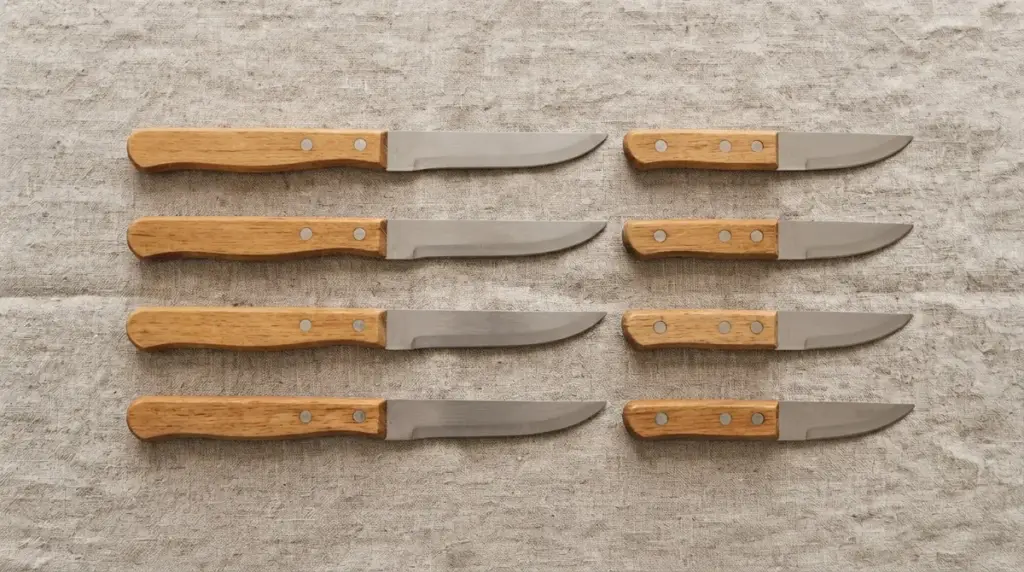
Sets are sold in fours, sixes and eights because that is how tables are laid, not because that is how many you need. Count the number of people who eat a steak in your house at the same time, then add nothing. If that number is two, buy two good ones and stop. Two excellent knives beat six mediocre ones every night of the week, and steak knives do not benefit from a spare in the drawer because they are not lost or borrowed the way a paring knife is.
Where the higher counts genuinely earn their place is hosting. Six is the number that covers a dinner party without borrowing from the block, and eight is for people who actually seat eight. If you are buying with an eye on matching, buy the whole count in one order. Natural handle materials are cut from different blocks and different animals, and a set assembled a year apart will not colour match. That is true of our knives and everybody else's.
What a forged set really costs
Here is the arithmetic that most steak knife articles avoid. Our steak knives run from one hundred and two dollars to one hundred and sixty four dollars, with a median of one hundred and eighteen dollars across the fourteen table knives in the category. Multiply that out and the numbers are not gentle.
| Set size | At our cheapest, $102 each | At our median, $118 each | At our dearest, $164 each |
|---|---|---|---|
| Two | $204 | $236 | $328 |
| Four | $408 | $472 | $656 |
| Six | $612 | $708 | $984 |
| Eight | $816 | $944 | $1,312 |
A stamped stainless set of four from a supermarket is commonly forty dollars. So a set of four from us at the median is roughly twelve times the price. We are not going to argue that a forged knife cuts twelve times better, because it does not. What you are buying at the top of that range is a knife that was moved under a hammer rather than punched from sheet, fitted by hand to a spring made for that blade and no other, and built so it can be resharpened for thirty years instead of thrown out in three. If that trade does not appeal, the honest recommendation is the cheap set. Buy it, use it, replace it, and spend the difference on beef.
What is actually on our steak knife shelf
Transparency first: the Steak Knives category on this site holds fifteen published products, and one of them is a Damascus fish fillet knife that has been filed there by mistake. It is a good knife and it is not a steak knife. Everything below counts the fourteen that belong.
All fourteen are the same pattern in different dress: a Laguiole, ten inches overall, four and a half inches of plain edge, three and a half ounces, hand forged high carbon steel, listed at 58 to 60 HRC oil tempered. That uniformity is unusual and worth saying plainly. If you were hoping to compare a heavy German style table knife against a thin Japanese one on our shelf, you cannot, because we only make one shape.
| Figure | Value |
|---|---|
| Products in the Steak Knives category | 15 published, of which 14 are steak knives |
| Price range of the 14 | $102 to $164 |
| Median price | $118 |
| Blade length | 4.5 inches on all 14 |
| Overall length open | 10 inches |
| Weight | 3.5 oz where listed |
| Steel | Hand forged high carbon, 58 to 60 HRC per the listings |
| Handles | 8 wood, 2 ram horn, 2 buffalo horn, 1 stag horn, 1 listed only as red |
| Edge type | Plain on all 14. We do not make a serrated steak knife |
For context, the wider Damascus chef and kitchen category on this site runs forty four products with a median of one hundred and forty two dollars, so a steak knife is not the cheap end of our kitchen shelf by very much.
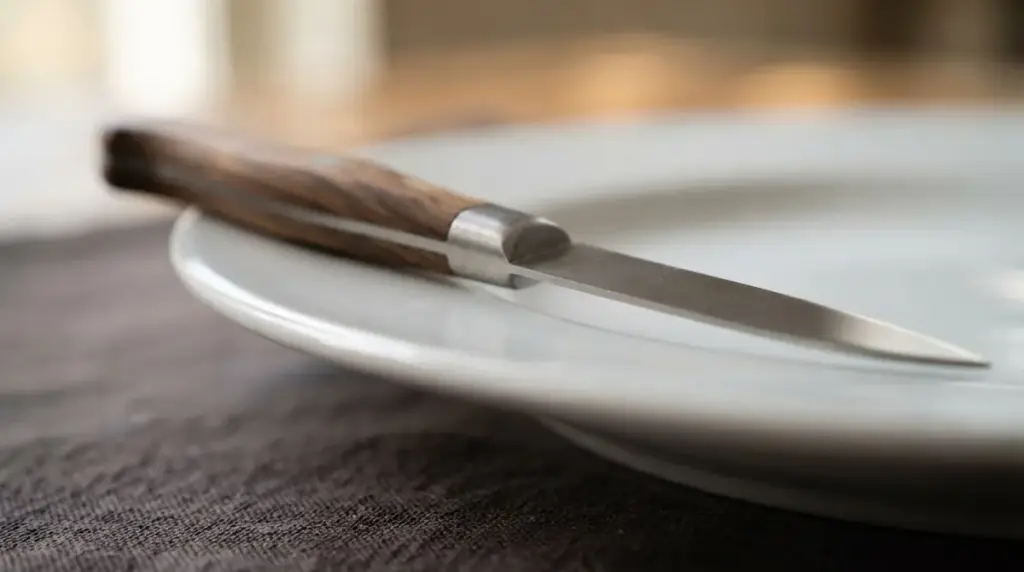
Steel, hardness and what it means at the table
Table cutlery is one of the few places where a very high hardness is not obviously the right answer. Harder steel holds an edge longer and chips more readily, and a steak knife spends its life tapping a ceramic plate. A blade in the high fifties is a sensible compromise: hard enough to hold a working edge through a meal, forgiving enough that a plate strike rolls the edge instead of taking a piece out of it. Our listings put the steak knives at 58 to 60 HRC.
The other half of the question is corrosion. High carbon steel takes a finer edge and is easier to bring back on a stone, and it will spot if you leave it wet. Stainless is duller to sharpen and far more forgiving of neglect. There is no correct answer here, only a question about your habits, and we have a longer piece on it in our guide to carbon and stainless kitchen knives.
Handles, and which ones move
Table knives get more contact with water and detergent than almost any other knife in the house, which makes handle material a practical question rather than a decorative one. Wood and horn both move with humidity. Stabilised wood moves less. Horn and stag move more, and they can shrink very slightly away from steel bolsters that do not move at all, leaving a lip you can feel with a thumbnail. That is not a failure; it is what happens when you pin an organic material between two pieces of metal for a decade.
Eight of our fourteen use wood, two use ram horn, two buffalo horn and one stag horn. The fourteenth lists its handle simply as red, without naming the material, which is a gap in our own product data that we should have closed before publishing this guide.
The folding steak knife question
This is the part of our own catalogue that draws the most argument. The Laguiole pattern we make is a slip joint folder, so our steak knives fold. At a French table that is entirely traditional and nobody blinks. At an American table it means every guest opens and closes a pocket knife before and after the meal, and it means water can find its way into the pivot when someone rinses it in a hurry.
If you want a fixed table knife with no pivot, we do not currently make one, and you should buy elsewhere. If the folding action is appealing rather than annoying, understand the care implication: a folder needs to dry open, and the pivot wants a drop of oil once or twice a year. Our guide to Laguiole knives covers the pattern, the bee on the spring and the question of who is entitled to use the name, which is a longer story than it sounds.
Made in the USA, and what that phrase has to mean
Search demand for steak knives made in the USA is real and the phrase is worth being careful about. The Federal Trade Commission treats an unqualified Made in USA claim as meaning all or virtually all of the product is made and sourced in the United States: final assembly here, all significant processing here, and no more than negligible foreign content. Since the Made in USA Labeling Rule was finalised in 2021 the Commission can seek civil penalties for unqualified claims that do not meet it, on labels, in catalogues and online. Claims that fall short are supposed to be qualified, in the form of assembled in the USA from imported parts or a stated percentage of domestic content.
What that means for a buyer is simple. If a listing says made in the USA and you care, ask the seller where the steel came from, where the handle blocks came from, and where the grinding and heat treat were done. Ask us the same question. A shop that forges its own work will answer it in a sentence; a shop that is relabelling imported blanks usually will not.
Care that actually matters
Three rules cover ninety percent of steak knife failures. Do not put them in a dishwasher: the detergent is aggressive, the heat cycle is hard on natural handles, and blades knock against other items on the rack. Wash by hand, dry immediately, and if the knife folds, dry it open.
Second, mind the plate. If you are already spending on the knives, eat off a plate with an unglazed or lightly glazed contact area, or accept that you will be touching up the edges more often. Third, hone before you sharpen. A rod realigns an edge that has rolled from plate contact and takes seconds; a stone removes metal and should be a twice a year event at most. The difference is explained properly in our guide to honing and sharpening.
Where our own shelf falls short
We should be direct about the gaps. We make one steak knife pattern, in one blade length, with a plain edge and a folding action, in high carbon steel that will spot if you neglect it. We do not make a serrated steak knife, a fixed table knife, a stainless table knife, or a child sized one. Our cheapest is a hundred and two dollars, which is more than many households will ever want to spend on a knife that touches a plate.
If any of those constraints rules us out, it rules us out. If they do not, you can see the full shelf on the steak knives category page, where the prices and specifications above are the ones actually published against each knife.
Questions people ask
Should steak knives be serrated or straight?
Straight if you will sharpen them, serrated if you will not. A plain edge gives a cleaner cut face and can be maintained forever; a serrated edge stays usable longer because only the tooth points touch the plate, but a fine micro serration is effectively unsharpenable at home and becomes a consumable.
How many steak knives do I need?
Match the number of people who eat steak at your table at once. Two is a legitimate answer. Four covers most households, six covers hosting, eight is for people who genuinely seat eight. Buy the full count in one order if you want the natural handles to match.
What is a fair price for a steak knife?
A stamped stainless supermarket knife is roughly ten dollars a place. A forged knife from a working shop starts near a hundred. Ours run one hundred and two to one hundred and sixty four dollars, median one hundred and eighteen. There is very little in between, and the middle of that gap is where most disappointing knives live.
What blade length is right for a steak knife?
Between four and five inches. Long enough to cross a thick cut in one draw, short enough that your elbow stays down. All fourteen of our steak knives are four and a half inches.
Can steak knives go in the dishwasher?
Not if you want to keep them. Dishwasher detergent is hard on edges and harsh on wood and horn handles, and blades get knocked about on the rack. Hand wash, dry at once, and dry a folding knife in the open position.
Are Laguiole steak knives French?
The pattern is French, from the village of Laguiole in Aveyron. The name has a complicated legal history and knives carrying it are made in many countries, including ours in Memphis. Our separate Laguiole guide sets out the pattern, the bee and the naming question in detail.
Does a steak knife need a full tang?
Not for this job. Table cutting applies very little lateral load, so tang construction matters far less here than it does on a hunting or camp knife. Fit and finish at the handle joint matters more, because that joint sees water at every meal.
What hardness should a steak knife be?
The high fifties is the sensible band. Harder holds an edge longer but chips more easily against a ceramic plate. Our steak knife listings state 58 to 60 HRC, oil tempered.
How often should steak knives be sharpened?
Hone before a meal if the edge feels lazy, and take them to a stone once or twice a year in normal household use. If you are sharpening a plain edge steak knife monthly, the plate is doing more damage than the beef and it is worth changing the plate.
Do you sell a serrated or a fixed blade steak knife?
No to both. Every steak knife we publish is a plain edge folding Laguiole in high carbon steel. If you want a serrated table knife or a fixed table knife, we are not the right shop and we would rather say so here than have you find out after the box arrives.
More guides: read honing versus sharpening before you touch a stone, then carbon versus stainless kitchen knives to decide which steel suits how you wash up. The Laguiole knives guide covers the pattern our steak knives are built on, hand forged versus factory explains where the price difference comes from, and the steak knives category lists everything described above.
More from the workshop
Cleavers: Meat, Vegetable and the One Most People Buy by Mistake
How to tell a vegetable cleaver from a bone cleaver, with measured weights, lengths and steels from our own sixteen.
Folding Knife Locks: Liner, Frame, Back and Slip Joint
The six folding locks you will actually meet, how each one fails, and a one minute inspection you can run before you buy.