
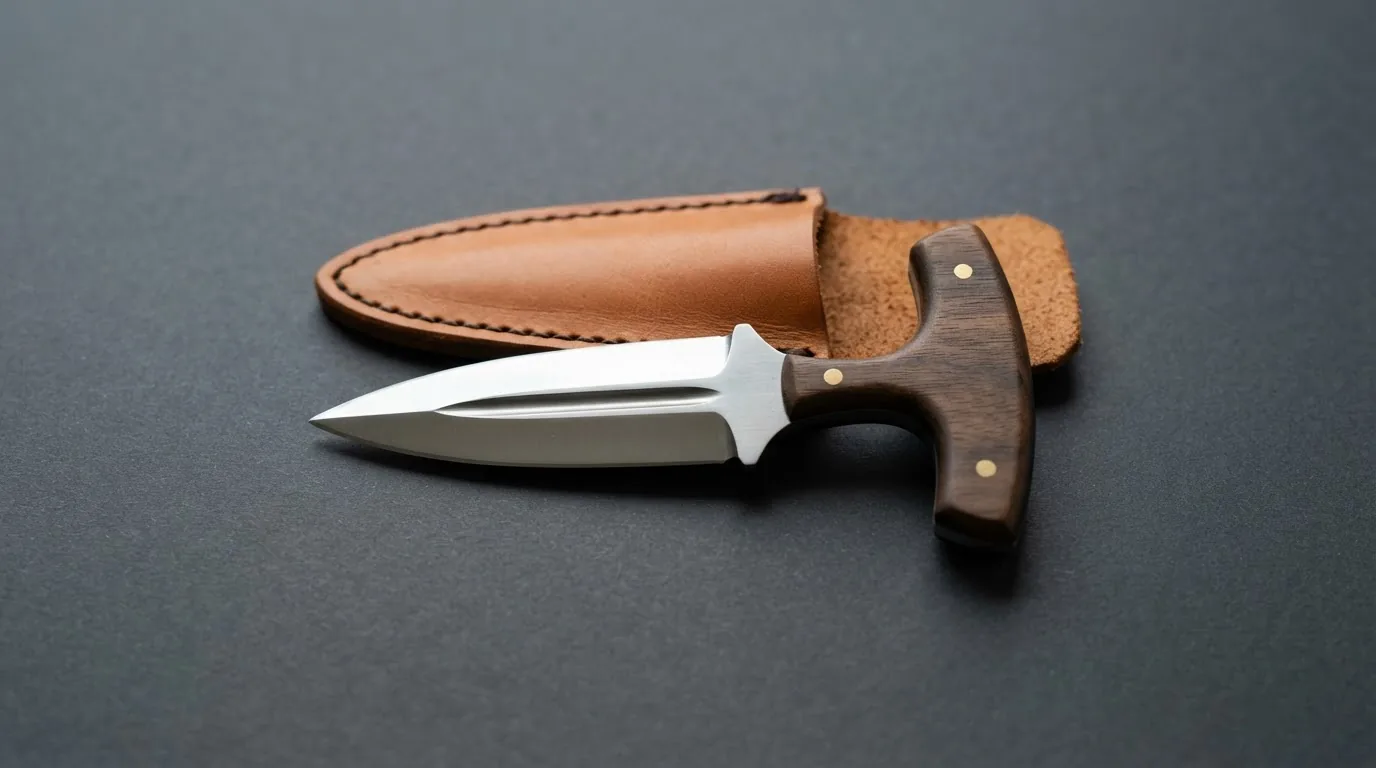
Short answer: a push dagger is a short blade set at ninety degrees to a T shaped handle that sits inside a closed fist. It is the most legally exposed shape in the knife world, banned by name in the United Kingdom and caught by dirk, dagger and double edge language in several American states where an identical length of ordinary fixed blade is legal. Read the law section first. Our fifteen push daggers are 4 inch double edged spear points at $97 to $240, and the pattern is a collector and display shape far more than a working one.
The law comes first on this page
We put this section at the top because burying it would be dishonest. Nothing below is legal advice, laws change, and city ordinances sit underneath state law. Please check your local law before ordering.
Three statutes we read while writing this page, quoted so you can go and check them yourself.
United Kingdom. The Criminal Justice Act 1988 (Offensive Weapons) Order 1988 lists the push dagger by name in its Schedule, alongside the knuckleduster, the swordstick and the balisong. The wording is "the weapon sometimes known as a 'push dagger', being a knife the handle of which fits within a clenched fist and the blade of which protrudes from between two fingers". That is a description of the shape itself, not of how it is carried.
California. Penal Code 21310 states that "any person in this state who carries concealed upon the person any dirk or dagger is punishable by imprisonment in a county jail not exceeding one year or imprisonment pursuant to subdivision (h) of Section 1170". Penal Code 16470 defines a dirk or dagger as a "knife or other instrument with or without a handguard that is capable of ready use as a stabbing weapon that may inflict great bodily injury or death". A push dagger meets that description without argument.
Massachusetts. General Laws chapter 269 section 10(b) applies to whoever "carries on his person, or carries on his person or under his control in a vehicle, any stiletto, dagger" and, in the same list, "any knife having a double-edged blade". Thirteen of our fifteen push daggers are double edged. The stated penalty is imprisonment of not less than two and a half years and not more than five years in state prison, or six months to two and a half years in a house of correction.
Notice what those three have in common and what they do not. Only the United Kingdom names the push dagger as a shape. California and Massachusetts catch it through general dirk, dagger and double edge language. We could not find, and therefore will not claim, a United States statute that names the push dagger specifically. If one exists in your state we did not verify it this session, which is exactly why you should read your own code rather than a shop page.
What a push dagger is
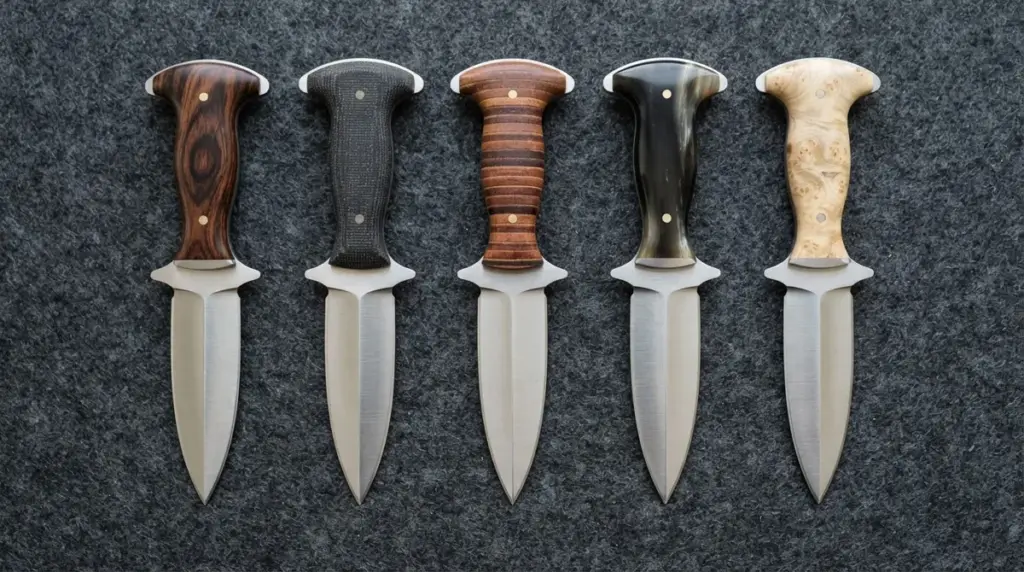
The blade runs perpendicular to the grip. The handle is a T bar that lies across the palm with the blade emerging between the middle and index fingers, so the whole fist drives the point rather than the wrist and forearm steering it.
 Kippah 4 Inches Blade D2 Steel Push Dagger Deep Skull Engraved Knife with Antique Tooth Handle | BMK-1100
 Trenchline Handmade D2 Steel Stonewashed Push Dagger with Olive Green Micarta Handle & Leather Sheath | Tactical EDC Knife | BMK-1192
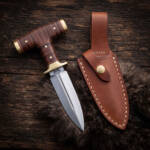 Brass Sentinel Handmade D2 Steel Push Dagger with Stacked Leather Handle, Brass Guard & Pommel | Traditional Collector Knife | BMK-1202
That geometry is the entire argument for the pattern. It is very hard to disarm because there is nothing to twist against, and the force of a straight punch travels down the centreline of the blade instead of through a wrist joint. It is also the entire argument against it, because that is all it does.
Everything a knife normally does depends on being able to align an edge with a cut and change that angle continuously. A push dagger cannot. The edge points away from your knuckles at a fixed angle to your arm. You cannot slice bread with it, you cannot whittle with it, you cannot open a box comfortably, and you certainly cannot skin an animal with it.
Where the pattern came from
The shape as we know it is nineteenth century American. It was common in the South and in the port cities, small enough to sit in a waistcoat and quick enough out of it that politicians carried them into federal buildings, including the Capitol.
New Orleans called its version the gimlet knife, typically a two inch blade on a T handle, and it turned up in enough violence that the city passed an ordinance in 1879 prohibiting anyone within city limits from selling, offering or exhibiting such a weapon for sale. San Francisco had its own version at the same time, often with walrus ivory scales and a slightly longer blade.
It travelled to Britain and Central Europe in the late 1800s, where German makers called it the Stossdolch or Faustmesser. The First World War brought a factory version, the Robbins Dudley pattern, with an aluminium knuckle style handle cast onto a 3.625 inch heat treated blade. It came back again in the Second World War with British commandos.
The Indian katar is often introduced as an ancestor. It is a sixteenth century punching sword and the grip mechanism and blade orientation are genuinely different, so treat the comparison as a family resemblance rather than a lineage.
What our fifteen push daggers actually are
We read the specification table on every published listing in our push dagger category on 30 August 2026. There are fifteen. All fifteen state a blade steel.
| Attribute | What the listings say |
|---|---|
| Listings | 15 published |
| Price | $97 lowest, $119 at the 25th percentile, $135 median, $152 at the 75th, $240 highest |
| Blade length | 4 inches on 13 of 15. One at 7.5 inches, one at 4 inches with no overall length stated |
| Overall length | 7 inches on 13 of 15 |
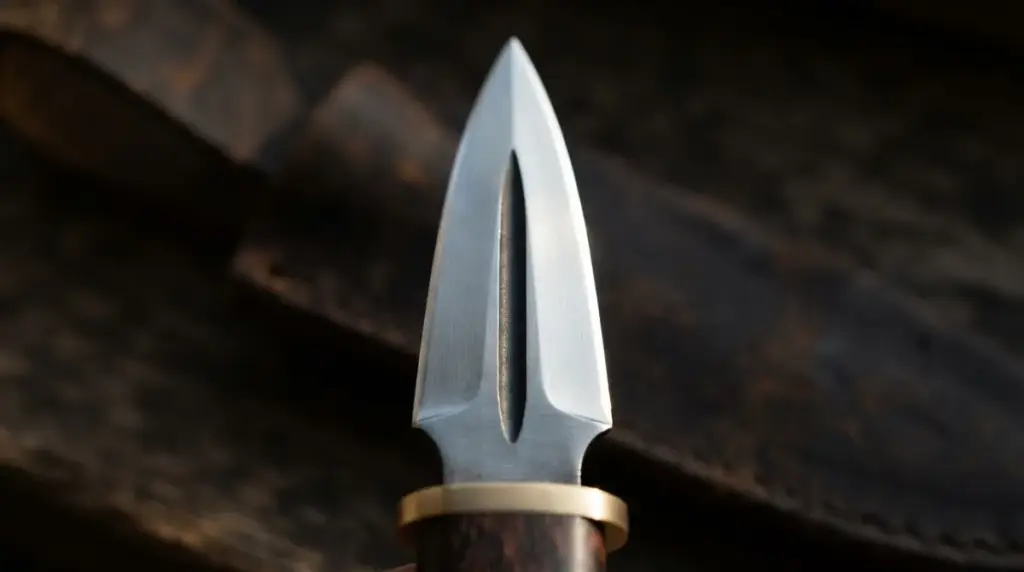
| Blade style | Double edged spear point with a centre fuller on 13 of 15 |
| Tang | Full tang on all 13 that state it |
| Sheath | Handmade leather with a brass stud and belt loop on all 13 that state it |
That is a remarkably uniform category, because thirteen of the fifteen came out of the same production run and differ only in handle material and blade steel. If you are hoping to compare geometry across our range you cannot, because there is only one geometry.
Steel across the fifteen
| Blade steel as listed | Listings | What it means for you |
|---|---|---|
| D2 tool steel | 7 | Holds an edge a long time. Not stainless, despite 11 to 12 percent nominal chromium |
| Hand forged Damascus, acid etched | 6 | 1095 and 15N20. No chromium. The pattern is the point |
| Hand forged Damascus, high carbon | 1 | As above |
| High carbon steel, not pattern welded | 1 | The plainest and usually the cheapest to maintain |
The corrosion note applies to all fifteen. D2 is often sold as semi stainless. Its nominal chromium is around 11 to 12 percent but the high carbon content locks most of that into chromium carbides, and published thermodynamic calculations put chromium in solution at a maximum of about 9.3 percent, against roughly 16.6 percent nominal that would be needed to make D2 genuinely stainless. Treat every knife in this category as carbon steel and oil it.
Hardness on our 1095 and 15N20 blades is held to 58 to 60 HRC, and on our D2 to 58 to 62 HRC. Neither of those is unusual and neither is a selling point on its own.
Handle materials, and where the point of a T grip is
Fourteen of the fifteen state a handle material, and for a category this small the spread is unusually wide. Here is the whole list as the listings give it.
| Handle as listed | Listings | Behaviour under a fist grip |
|---|---|---|
| Polished buffalo horn | 2 | Handsome and slick. Worst of the group when your hand is damp |
| Figured rosewood, plain rosewood | 3 | Warm, moderate grip, moves a little with humidity |
| Canvas Micarta, coyote tan and olive green | 2 | The best grip in the category, wet or dry, and the least attractive |
| Stacked leather washers, sanded and burnished | 1 | Comfortable and traditional. Absorbs moisture and needs feeding |
| Stag antler with walnut centre | 1 | Excellent grip from the natural texture. No two are alike |
| Stabilized burl, cream and amber, and stabilized maple burl | 2 | Sealed, stable, does not absorb water. Grip depends on the finish |
| Ebony contoured to a T grip | 1 | Dense and heavy. The contour matters more than the wood |
| Black G10 with red fibre liners | 1 | Weatherproof and hard. Sharp edges if the shaping is rushed |
| Rosewood with a D2 bolster | 1 | Heavier at the front. This is the outlier listing in the group |
Handle material matters more here than on a normal knife, because the handle is doing something a normal handle does not. It is a bar bearing on the meat between your fingers under compression. Anything slick becomes painful. Anything with sharp corners becomes painful faster. Micarta, stag and stacked leather are the three materials on that list that are actually pleasant under pressure. Polished horn and mirror polished wood look better and grip worse.
A contoured T bar beats a flat one every time. If a listing does not tell you whether the grip is contoured, ask us, because photographs of a T handle rarely make it obvious.
Carry, and why the sheath is the weak point
Thirteen of our fifteen ship with a handmade leather sheath with a brass stud and a belt loop. A belt loop is the single most conspicuous way to carry a push dagger, and in a state with dirk and dagger language, open carry on a belt may be legal where concealed carry is a crime. California is exactly that case: Penal Code 21310 addresses carrying concealed.
Here is the inconvenient truth about our sheaths. A brass stud and belt loop is a display and belt carry arrangement. It is not a pocket sheath, it is not a neck rig, and it is not designed for retention against movement. If your intended carry method is anything other than on a belt, our sheath is not the right sheath and you will be buying another one.
Leather also holds moisture against a carbon blade. Store the knife out of the sheath and oil it. That advice appears on our knife storage page for every carbon steel knife we sell, and it applies double to a blade that lives in a closed leather pocket.
Sharpening a double edge
Two edges means four bevels and twice the work, and there is no comfortable way to hold a T handle against a stone. Most people end up holding the handle in a fist, edge down, and moving the stone rather than the knife, which is slow and easy to get wrong.
The fuller down the centre of each flat does not help. It changes where the flat contacts the stone and it is easy to round a bevel over near the fuller without noticing. Take the angle from the factory bevel, use a small stone you can control, and check both edges under a light frequently.
A spear point with two edges also has a very fine tip. The last quarter inch is the most likely part to bend or chip, and it is the hardest part to bring back. Our sharpening guide covers the general method, and honing against sharpening explains why a steel will not fix a rolled tip.
Who a push dagger suits
It suits a collector. The pattern has a real and documented history, the shape is visually striking, and at $97 to $240 our examples sit at the accessible end of collecting. It suits someone building a display of nineteenth century American patterns, and it suits a gift to a person who already owns everything ordinary.
It does not suit an everyday carry knife, because it cannot do everyday tasks. It does not suit a camping or hunting knife, because it cannot prepare food or process game. And it does not suit anyone who has not read their own state code, because the shape is the single most likely knife in our catalogue to be caught by a general dirk and dagger clause.
If you want the pattern for its history and its look, buy it and enjoy it. If you want a small fixed blade you can actually use, a 4 inch drop point does everything the push dagger cannot and attracts a fraction of the legal attention. Our page on knife against dagger sets out the difference between a single edge and a double edge properly.
Questions people ask
Are push daggers legal in the United States
There is no single federal answer and state law varies widely. We did not find a United States statute that bans the push dagger by name, but general dirk and dagger language catches it in states such as California, and double edged blade language catches it in states such as Massachusetts. Check your own state and city code before ordering.
Is a push dagger illegal in the United Kingdom
The push dagger appears by name in the Schedule of the Criminal Justice Act 1988 (Offensive Weapons) Order 1988, described as a knife whose handle fits within a clenched fist and whose blade protrudes from between two fingers. We do not ship this pattern there.
What does California law say about a push dagger
Penal Code 21310 makes carrying a concealed dirk or dagger an offence, and Penal Code 16470 defines a dirk or dagger as an instrument capable of ready use as a stabbing weapon that may inflict great bodily injury or death. A push dagger fits that definition.
What blade length are your push daggers
Four inches on thirteen of the fifteen, with a seven inch overall length. One listing is a longer 7.5 inch blade and one does not state an overall length.
What do your push daggers cost
From $97 to $240 as of 30 August 2026, with a median of $135. The 25th percentile is $119 and the 75th is $152, so the category is tightly clustered.
Are push daggers good for self defence
We do not sell or describe knives as self defence tools and we will not advise on that use. What we will say is that the legal exposure attached to this shape is higher than for almost any other knife we sell, in some places dramatically so.
Can a push dagger be used as a utility knife
Not usefully. The edge is fixed at ninety degrees to your forearm, which is the wrong relationship for slicing, carving, food preparation or any controlled cut. A 3 inch folder does all of it better.
Why is the blade double edged
Because a fist driven blade has no natural spine side. Thirteen of our fifteen are double edged spear points with a centre fuller. The fuller removes weight from the middle of the blade without narrowing it, which is the same reasoning behind fullers on larger blades.
What steel are your push daggers
Seven are D2 tool steel, six are hand forged Damascus with an acid etch, one is hand forged Damascus described as high carbon and one is plain high carbon steel. None of the fifteen is stainless.
How old is the push dagger design
The recognisable American form dates from the nineteenth century, and New Orleans banned the sale of its local gimlet knife version by city ordinance in 1879. Comparable punching weapons such as the Indian katar go back to the sixteenth century, though the grip works differently.
More guides
Keep reading: knife against dagger, pocket knife laws by state, the most restricted knives in the United States, flying with a knife and how to sharpen a knife. The push dagger category is here.
Shop the knives
Kippah 4 Inches Blade D2 Steel Push Dagger Deep Skull Engraved Knife with Antique Tooth Handle | BMK-1100Trenchline Handmade D2 Steel Stonewashed Push Dagger with Olive Green Micarta Handle & Leather Sheath | Tactical EDC Knife | BMK-1192Brass Sentinel Handmade D2 Steel Push Dagger with Stacked Leather Handle, Brass Guard & Pommel | Traditional Collector Knife | BMK-1202 Forgepoint Handmade High Carbon Steel Push Dagger with Rosewood Handle, Brass Pins & Leather Sheath | Working EDC Knife | BMK-1201
 Blackhorn Handmade High Carbon Steel Push Dagger with Buffalo Horn Handle & Leather Sheath | Traditional EDC Knife | BMK-1200
 Sand Wraith Handmade D2 Steel Stonewashed Spear Point Push Dagger with Coyote Tan Micarta Handle & Black Leather Sheath | Tactical EDC Gift | BMK-1223
More from the workshop
KA-BAR Knife Guide: History, Markings and Value
The 1219C2 pattern explained: wartime makers, dating by markings, real values and what the Corps issues now.
Sharpening a Serrated Edge Without Ruining It
The one procedure a general sharpening guide cannot cover, scallop by scallop with a tapered rod.
Choosing a Bushcraft or Camp Knife
Length, grind, spine geometry and steel for a camp knife, measured against what our own outdoor range actually offers.
