

Short answer: most Western chef's knives use a full flat grind — a straight taper from the spine down to the edge with no flat facet left behind it. It slices thin, sharpens easily, and holds up to daily kitchen use. Traditional single-bevel Japanese knives use a chisel grind instead, which gets even thinner but only cuts cleanly in one direction. Almost every production chef's knife also carries a small secondary bevel at the very edge, whatever the primary grind is.
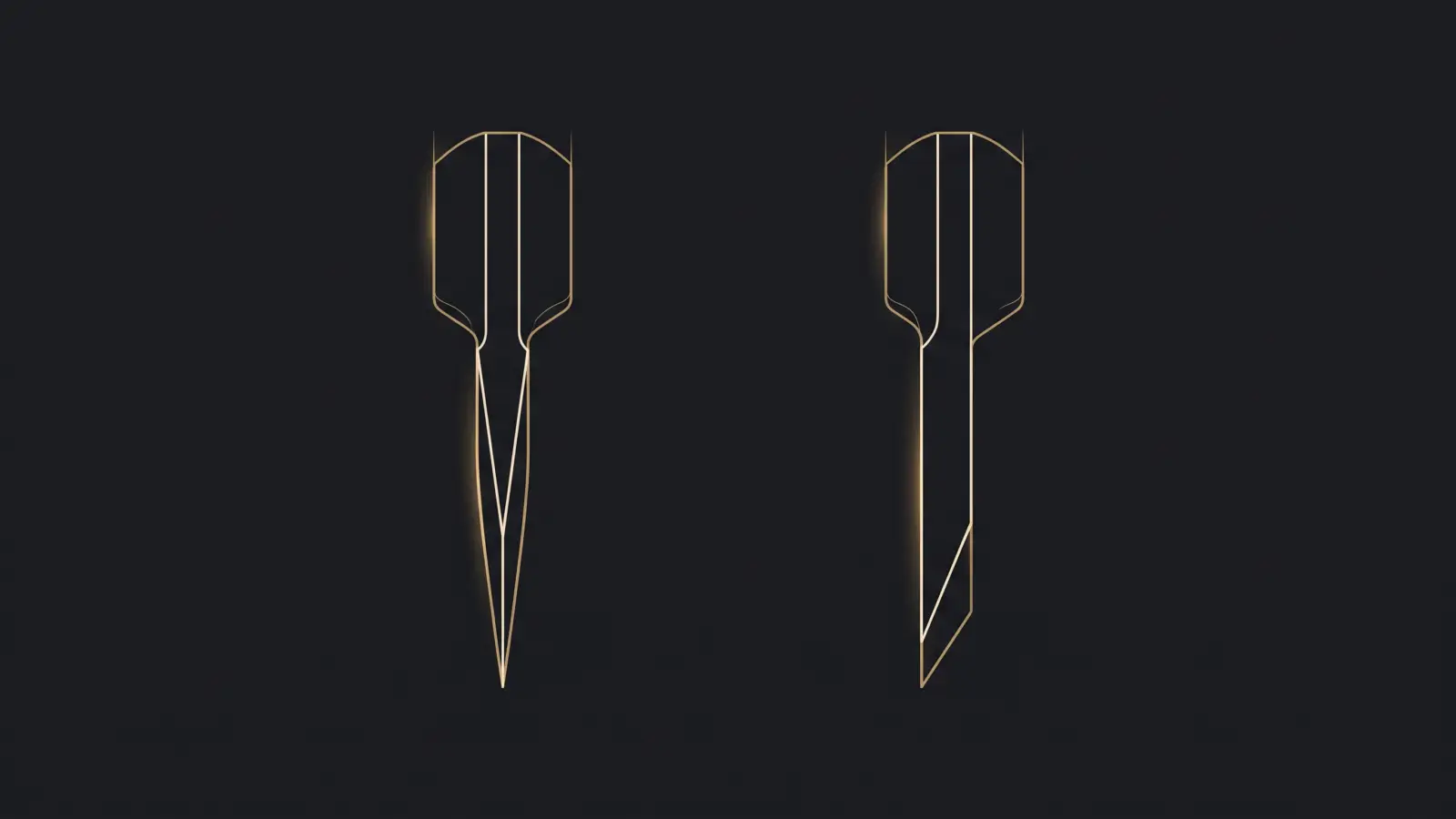
What "bevel" means on a knife
The bevel is the angled section of the blade that gets ground down to a cutting edge. How that angle is shaped — where it starts on the blade, how far it travels, and whether it's on one side or both — is the grind. Grind has nothing to do with steel type or hardness; a full flat grind and a chisel grind can both be made from the same steel at the same hardness and still cut completely differently.
The full flat grind — the standard for a reason
A full flat grind tapers in a straight line from the spine all the way to the edge, so there's no flat, un-ground section left near the back of the blade. Cross-section it and you get a clean wedge. It's the grind on the overwhelming majority of Western-style chef's knives, gyutos included, because it gives a thin, low-friction edge for push cuts and food release, without being so delicate it chips on a cutting board.
It's also the easiest grind to sharpen at home — one consistent angle from spine to edge means less guesswork on a whetstone.
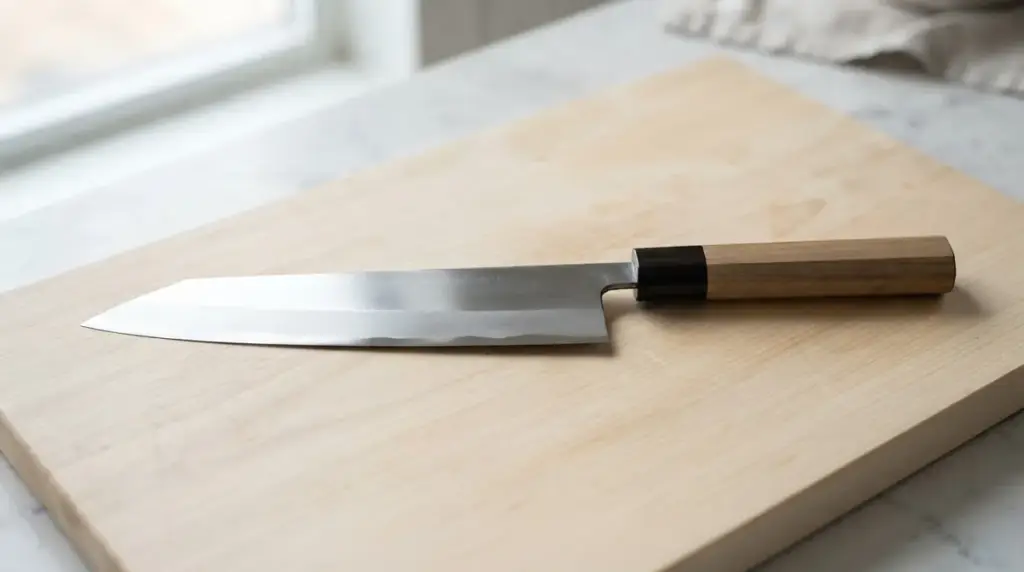
The chisel grind — single-bevel Japanese knives
A chisel grind puts the bevel on one face of the blade only; the other face stays flat. Traditional single-bevel knives like the yanagiba (sashimi slicer) and usuba (vegetable knife) are ground this way, and it lets the edge get thinner than almost any double-bevel grind can manage — which is the point for paper-thin fish slices and precise vegetable cuts.
The tradeoff is handedness. A chisel-ground edge steers slightly during a cut and isn't a general-purpose knife the way a Western chef's knife is. Most home kitchens never need one; most professional sushi and kaiseki kitchens use little else for those specific tasks.
The compound edge you don't see advertised
Look closely at almost any chef's knife, flat-ground or otherwise, and there's a second, steeper bevel right at the cutting edge — usually 1 to 2mm wide. That's the actual edge; the primary grind is what shapes the blade above it. This compound edge is what a whetstone maintains day to day. You are almost never sharpening the whole primary bevel, just that narrow strip.
Which grind for which kitchen
- Home cook, one knife for everything: full flat grind. Forgiving, easy to maintain, cuts almost anything you'll put in front of it.
- Precision fish and vegetable work: a single-bevel chisel grind knife as a second, specialist blade — not a replacement for a flat-ground chef's knife.
- Heavy boning or cutting through joints: look for a slightly thicker flat grind rather than a thin flat grind, which will chip on bone.
How grind changes sharpening and care
A full flat grind is the most forgiving to freehand on a stone because there's only one angle to hold. A chisel grind needs to be sharpened almost entirely on the beveled face, with just an occasional light pass on the flat back to remove the burr — sharpening it like a double bevel knife will ruin the geometry that makes it work. Whichever grind you own, strip food acid and moisture off the blade before it sits, since a thin edge shows the first signs of a chip or a rolled apex faster than a thicker one will.
Single bevel and double bevel in the kitchen
A double bevel knife is ground on both faces, so the edge sits roughly in the centre of the blade. A single bevel knife is ground on one face only, so the edge sits off to one side. That is the whole structural difference, and almost everything else follows from it — how the knife tracks through food, how the slice falls away, and how you sharpen it. Kitchen knife bevels come in those two families and no third one. Western knives are double bevel almost without exception. Single bevel is a Japanese tradition, built around a short list of cuts it does better than anything else and a longer list it does badly.
The Japanese single-bevel knives, and why they are handed
Three single-bevel shapes cover most traditional Japanese kitchen work. The yanagiba is a long, narrow slicer for sashimi, pulled through the fish in one stroke. The deba is thick and heavy at the spine for breaking down whole fish, including light work through the backbone. The usuba is a tall, straight-edged vegetable knife used for peeling and very thin sheet cuts.
All three are handed. A right-handed single bevel knife has the bevel ground on the right face as you hold it edge-down and spine-up; a left-handed one is the mirror image, and it is a different knife, not the same knife held differently. Using the wrong hand with one is not a matter of getting used to it — the blade will wander away from the cut and the slice will come off wedged rather than clean. Left-handed versions exist but are made in far smaller numbers and usually cost more.
Why a single bevel steers in the cut
Push a wedge into food and the food pushes back evenly on both faces. A double bevel blade is symmetrical, so those forces cancel and the knife runs straight. A single bevel is not symmetrical: one face is flat, one is ramped, and the food only has something to climb on one side. The blade is pushed gently towards its flat side all the way down.
Used well, that is the point rather than a fault. The steering is what lets a yanagiba peel a slice cleanly away from the block instead of crushing it, and what lets an usuba take a paper-thin sheet off a daikon. Used badly, it just means your cuts drift out of square.
The kireha and the urasuki hollow back
The wide ground face on the front of a single bevel knife is the kireha. The back is not simply flat: it is ground with a shallow concave hollow called the urasuki, ringed by a narrow flat rim that runs around the edge and the spine.
The hollow does two jobs. It reduces the surface area sticking to the food, so slices release instead of clinging to the blade, and it means sharpening only ever touches that narrow rim rather than the whole back face — which keeps the knife quick to true up over a working life measured in decades. That rim is finite. Every time it is worked it gets slightly wider, and a knife that has been sharpened carelessly for years can have the hollow eaten away entirely.
Kitchen knife bevel angles, Japanese and German
Angles are quoted per side, so a double bevel knife's total included angle is roughly twice the figure below. These are typical working ranges, not rules:
| German / Western double bevel | About 20° per side |
| Japanese double bevel (gyuto, santoku) | About 15° per side |
| Japanese single bevel (yanagiba, usuba) | Ground on one face only, typically shallower again, with a flat back |
| Deba | Single bevel but noticeably more obtuse, because it meets bone |
Harder steel is what makes the shallower Japanese angles survivable. A soft blade taken to a thin angle rolls at the first hard contact, so angle and hardness have to be chosen together — our knife steel chart sets out where each steel sits.
Sharpening a single bevel: the front face and the uraoshi
Nearly all the work happens on the bevelled front face, laid flat on the stone at the angle the maker already ground in. There is no new angle to invent; you are following the existing one.
Once a burr has formed along the edge, it is turned over and removed on the back — the uraoshi, meaning the back is laid completely flat on the stone and given the lightest possible passes across that narrow rim. Flat means flat. Lift the spine even slightly and you begin cutting a second bevel into the back, which turns the knife into a badly made double bevel and cannot be undone without regrinding. Two or three light passes are usually enough. Our sharpening guide covers stone progression and burr detection in general, and honing versus sharpening explains why a steel rod is the wrong tool for either face here.
How to choose the right knife grind bevel for your kitchen
For most cooks, most of the time, a double bevel is simply the better choice. It cuts in both directions, it suits either hand, it survives a distracted moment against a bone or a frozen edge, and any competent sharpener can maintain it. If you own one kitchen knife, this is the one to own.
Two practical points decide the rest. Food release — wet, starchy foods stick to any broad flat face; a single bevel's hollow back helps on the back side only, so potatoes will still cling to the front. If sticking annoys you, blade height and a light touch matter more than bevel type. Knuckle clearance — a taller blade keeps your fingers off the board on a full chopping stroke, which is why a tall double bevel gyuto or santoku is more comfortable for volume prep than any single bevel slicer. Keep whichever you choose dry and off other steel between uses; how to store knives covers the details.
Questions people ask
Is a thinner bevel always sharper?
Thinner cuts with less resistance, which reads as "sharper" at the board, but thin edges also roll or chip more easily on anything harder than food. Edge retention comes from the compound bevel angle and the steel's hardness, not from how thin the primary grind is.
Does a compound edge mean two separate grinds?
No — it's one primary grind (flat, chisel, whatever) with a narrow secondary bevel ground at a steeper angle right at the edge. Almost every working knife has this whether or not it's mentioned in the listing.
Should I buy a single-bevel knife as my only chef's knife?
Not unless you already know you want one. A single-bevel knife rewards a specific set of cuts and skills; a full flat grind knife will do more things adequately, which is usually what a first or only knife needs to do.
What is the difference between a single bevel knife and a double bevel knife?
A double bevel is ground on both faces so the edge sits in the centre of the blade and the knife cuts straight in either hand. A single bevel is ground on one face only, with a flat back, so the edge sits to one side and the blade steers slightly as it cuts. Double bevel is general purpose; single bevel is a specialist tool for slicing fish and vegetables.
Are Japanese single bevel knives made left-handed?
Yes, but they are separate knives rather than the same knife used the other way round. A right-handed yanagiba, deba or usuba has the ground face on the right as you hold it edge-down; a left-handed one is a mirror image. Left-handed versions are produced in much smaller numbers and usually cost more. Using the wrong-handed knife makes the blade wander and wedges the slice.
What knife bevel angle should a Japanese chef knife have?
A Japanese double bevel gyuto or santoku is usually around 15 degrees per side, against roughly 20 degrees per side on a German knife. Single bevel knives are shallower still on their one ground face, and a deba is deliberately more obtuse because it works against bone. Those figures are typical working ranges, not fixed standards, and the harder the steel the better it tolerates the shallower angle.
What is the urasuki on a single bevel knife?
The urasuki is the shallow concave hollow ground into the back of a single bevel blade, surrounded by a narrow flat rim along the edge and spine. It helps slices release instead of sticking, and it means sharpening the back only ever touches that thin rim rather than the whole face. Careless sharpening widens the rim over time and can eventually consume the hollow.
Why does my single bevel knife veer to one side when I cut?
Because it is meant to. The blade is not symmetrical, so the food only pushes against one ramped face and the edge is nudged towards the flat side all the way down. That steering is what lets a yanagiba peel a slice cleanly away. If it is drifting further than you want, the fix is grip and stroke, not regrinding the knife.
Do I need to sharpen the flat back of a single bevel knife?
Only lightly, and only to remove the burr. After working the bevelled front face, lay the back completely flat on the stone and take two or three gentle passes across the narrow rim. Do not lift the spine. Any angle at all starts cutting a second bevel into the back, which turns a single bevel knife into a poorly made double bevel and cannot be corrected without a full regrind.
More guides
- Pocket Knife Bevels Explained
- Fixed Blade Bevels Explained
- Carbon vs Stainless Kitchen Knives
- Hand-Forged vs Factory Made Knives
More from the workshop
Flying With a Knife
What TSA actually allows, how to pack a knife in the hold, and where the rules change once you land abroad.
Whetstone, Pull Through, Guided or Rolling: Which Sharpener
Six sharpening systems graded on cost, steel removed per session and who should buy which.
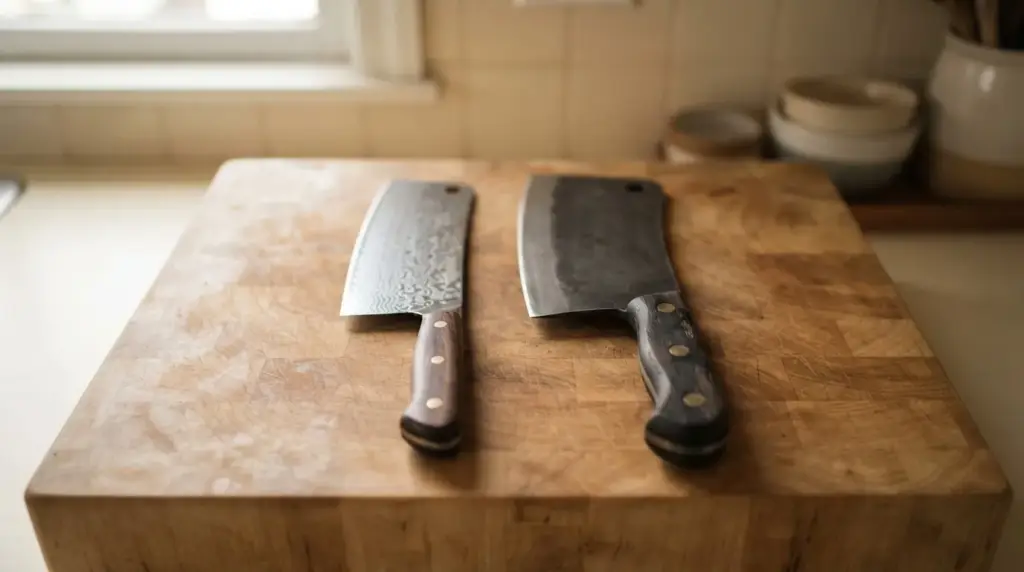
Cleavers: Meat, Vegetable and the One Most People Buy by Mistake
How to tell a vegetable cleaver from a bone cleaver, with measured weights, lengths and steels from our own sixteen.
