
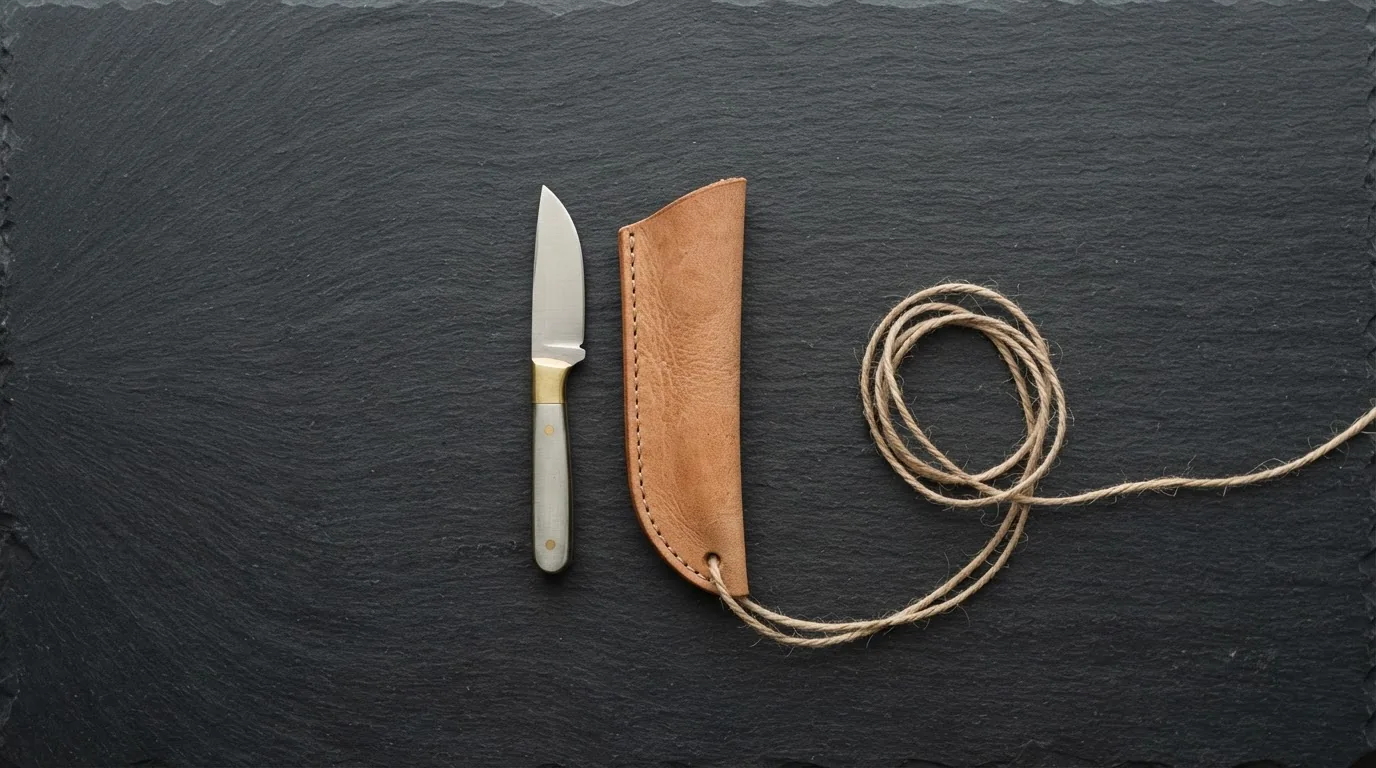
Short answer: a neck knife is a small blade worn on a cord under or over a shirt, usually in an inverted sheath at chest height. The design question is retention, because the sheath is upside down and gravity is working against you all day. The bigger question is legal, because in several states a blade under a shirt is read as a concealed weapon even when the same knife on your belt would be lawful. Our own neck knife category runs nine products at a median of $110, and we will be straight about what it does and does not contain.
What a neck knife is, and what it is not
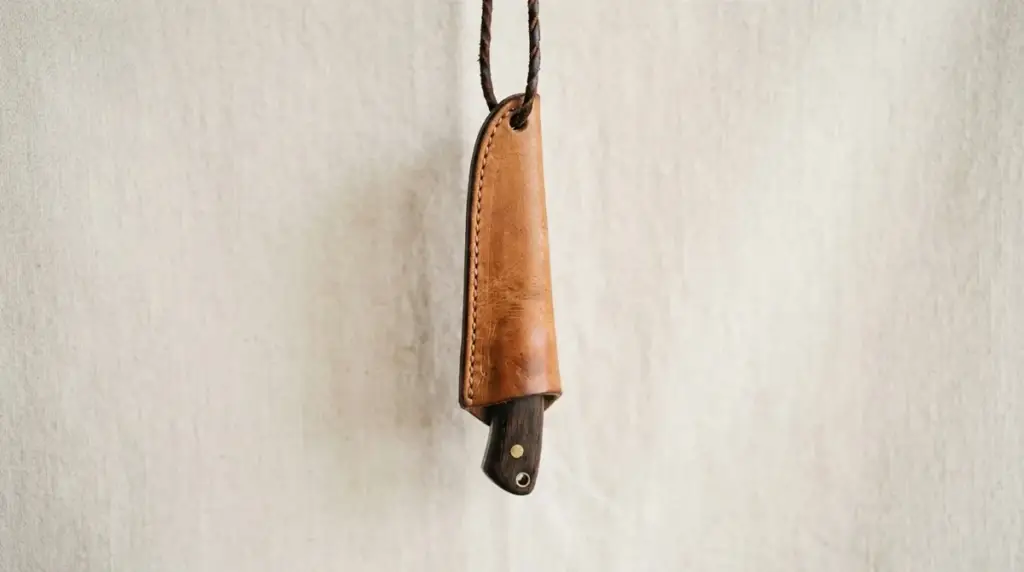
The format is simple. A short fixed blade sits in a tight sheath, the sheath hangs from a cord around the neck, and the knife rides at roughly sternum height with the handle pointing down. You draw by reaching across the chest and pulling down and out. Because it sits high on the body, it is reachable seated, in a vehicle, in a harness, in gloves, and lying on your back, which is why the format is popular with climbers, kayakers, cavers, tree workers and anybody whose belt line is buried under other equipment.
Two things it is not. It is not a large knife. Anything past about three ounces stops being invisible and starts swinging, and a knife that swings gets left at home. And it is not a pocket knife on a string. A proper neck knife is a fixed blade in a moulded or tightly stitched sheath, because there is no lock and no detent doing the retention work. The sheath is the mechanism.
The term also collects a lot of misspelled search traffic, and if you arrived here having typed "kneck knife" you are in the right place. The correct spelling is neck knife. It is not a knife pattern in the way that a bowie or a sheepsfoot is a pattern. It is a carry method that a lot of small blades get sold into.
Carry position, and why it hangs where it hangs
The sheath is inverted for one reason: draw geometry. With the handle pointing down, the natural motion of reaching to your chest and pulling down puts the knife into your hand already oriented for a forward or reverse grip without a wrist rotation. Hang the same knife handle up and you have to reach past it, rotate, and pull upward past your own chin.
Height matters as much as orientation. Too high and the sheath sits against the throat and is visible at the collar. Too low and it swings when you bend forward, taps your ribs when you walk, and becomes reachable only by digging inside your shirt. The workable range for most adults puts the sheath mouth just below the sternum notch, which usually means a cord loop of roughly 30 to 34 inches doubled. Adjustable cord with a barrel lock earns its place here, because two inches changes how the whole thing feels.
The position has genuine costs. It is the worst carry method for seated desk work, because the sheath presses into your sternum every time you lean over a table. It is uncomfortable under a pack chest strap or a seat belt. And in hot weather it sits against skin, which means sweat sits against the sheath, which means the blade sits in salt water. That last one is why so many neck knives are stainless and why a Damascus neck knife needs more attention than most people expect.
Retention is the whole design problem
An upside down sheath is a friction problem with consequences. If the knife falls out it falls point down, through your own shirt, past your own legs. That is the scenario every neck knife sheath is designed to prevent, and it is why sheath quality is a bigger question here than blade quality.
Moulded kydex is the best answer. Heat formed to the specific knife, it grips the handle or the guard with an audible click and holds against a hard shake test. You can wear it, run in it, and turn upside down in it. Leather is the traditional answer and it is a compromise: a well stitched wet formed pouch holds a blade fine when it is new and dry, and loosens as it absorbs body moisture and warms up. Leather stretches. Kydex does not.
Test any neck sheath the same way before you wear it out of the house. Insert the knife, hold the sheath upside down by the cord, and shake it hard six times. If it moves at all, add a retention strap or do not carry it that way. Nobody enjoys writing that sentence about their own products, so here is ours: our small knives ship with hand stitched leather sheaths, not moulded kydex, and leather is the weaker retention material of the two.
The legal reality, which is the real subject
Most neck knife pages open with carry comfort. That is the wrong order. A knife under a shirt is concealed, and concealed is a legal category in a lot of the United States rather than a description of your outfit.
California is the clearest illustration. Penal Code 21310 makes it an offence to carry a concealed dirk or dagger, and Penal Code 16470 defines that as any knife or instrument, with or without a handguard, capable of ready use as a stabbing weapon. That definition is broad enough to cover a great many ordinary fixed blades. The statutory protection is narrow and specific: a knife carried in a sheath worn openly and suspended from the waist is not concealed. Read that carefully, because a neck knife under a shirt is neither open nor suspended from the waist. The offence is a wobbler, with misdemeanour exposure up to a year in county jail and a $1,000 fine, and felony exposure of sixteen months to three years plus a fine of up to $10,000.
Virginia bans concealing a dirk, bowie knife, switchblade, ballistic knife, machete or razor outside your home or place of business, as a Class 1 misdemeanour. Its definition of concealed is worth quoting because it goes further than most people expect: hidden from common observation, and also a weapon that is observable "but is of such deceptive appearance as to disguise the weapon's true nature." Whether a given knife meets that standard is decided case by case.
Texas takes a completely different approach and regulates almost entirely by blade length. A knife with a blade over 5.5 inches is a location restricted knife, barred from schools, courts, secured areas of airports, businesses that take more than half their income from alcohol, hospitals and nursing facilities, amusement parks and places of worship. Blade length is measured from the tip to the forward most part of the hilt. A neck knife is nowhere near 5.5 inches, so Texas is a relatively easy state for this format and California is a hard one.
Three states, three completely different tests. That is the actual situation, and it is why the honest answer to "is a neck knife legal" is that the format itself is what creates most of the risk. None of this is legal advice, city and county rules stack on top of state law, and it changes. Please check your local law before ordering.
Blade length and weight: the numbers that decide whether you keep wearing it
A neck knife lives or dies on weight. The whole point is that you forget it is there, and the moment you notice it you stop wearing it. Two ounces is the number that most makers converge on and it is not an accident.
| Weight on the cord | What it feels like | Realistic use |
|---|---|---|
| Under 2 oz | Genuinely disappears under a shirt | Everyday carry, all day, most people keep wearing it |
| 2 to 3 oz | Noticeable when you bend or run | Workable if the sheath is snug and the cord is short |
| 3 to 5 oz | Swings, taps the chest, visible under thin fabric | Task carry only, for a specific job |
| Over 5 oz | Uncomfortable and unsafe on a cord | Belt carry. Not a neck knife |
Blade length follows the same logic. Somewhere between 1.5 and 3 inches is the practical band. Under 1.5 inches you have a keyring tool with a very short usable edge. Over 3 inches the sheath gets long enough to reach your waistband, at which point you have taken on all the legal difficulty of concealed fixed blade carry to gain nothing over a belt sheath.
What is actually in our neck knife category
This is the section that costs us money and it is the one you most need. Our neck knife category holds nine products. Here is what they really are.
| What is in the category | Count | Price | What it actually is |
|---|---|---|---|
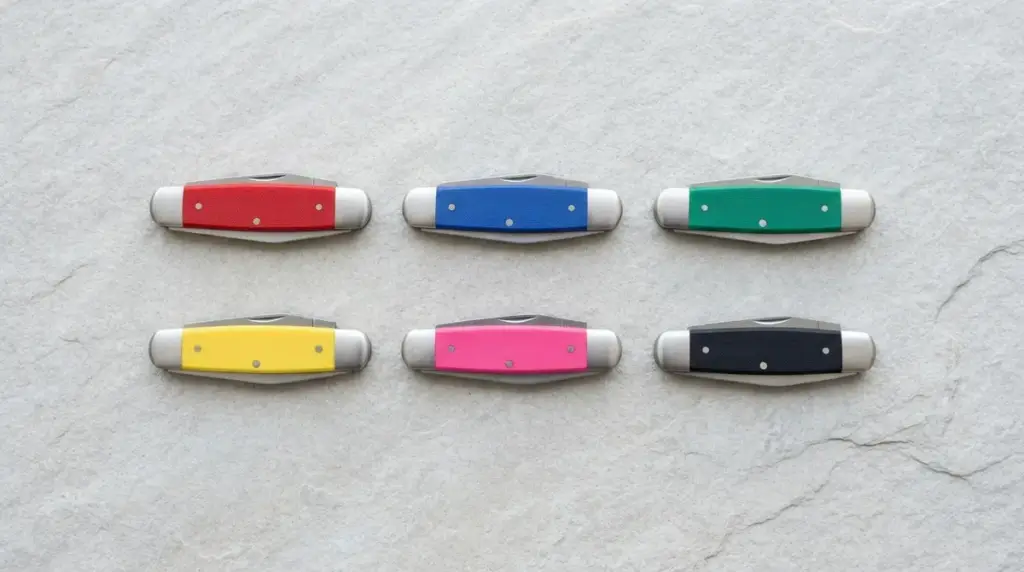
| Tsetse Fly, seven colourways | 7 | $110 each | A small Damascus folding knife on a brass thumb stud, sold with a leather sheath |
| Tsetse Fly set of six | 1 | $845 | Six of the same folder, forged as one batch |
| Golden Talon | 1 | $122 | A 4 inch hand forged high carbon knife with a solid brass handle and a leather sheath. The listing does not state fixed or folding, so treat that as unverified |
So: nine listings, a median price of $110, and not one of them ships with a neck cord or a moulded neck sheath. Seven of the nine are folding knives, which by the definition at the top of this page are not neck knives at all. They are excellent small knives, the steel is genuine 1095 and 15N20 Damascus at 352 layers, oil tempered to 58 to 60 HRC, at two ounces with a 1.5 inch blade on a 3 inch frame. But if you came here to buy a fixed blade neck knife with a kydex sheath and a breakaway cord, we do not currently make one.
There is a second problem we found while writing this and are fixing. The product titles and the specification tables on those listings disagree with each other. Some titles say the knife is 3.5 inches long, some say the blade is 1.2 inches, and the specification table on the same page says 3 inches overall with a 1.5 inch blade. The specification table is the correct data. The titles are being corrected. We would rather tell you that than let you find it yourself.
Steel and hardness on a knife that lives against skin
Sweat is the reason this section exists. A neck knife spends its life in contact with a warm, damp, salty environment, which is close to the worst case for a carbon steel.
| Steel | Hardness we hold to | Behaviour against skin | Maintenance needed |
|---|---|---|---|
| Damascus, 1095 and 15N20 | 58 to 60 HRC | Will spot and patina from sweat. The etched surface shows it | Wipe and oil weekly if worn daily |
| D2 tool steel | 58 to 62 HRC | Semi stainless. Much slower to mark, not immune | Wipe after wet days, oil monthly |
| 440C stainless | 58 to 60 HRC | The most corrosion resistant option we work in | Rinse and dry. Very low upkeep |
| Hand forged high carbon | Not published per batch | Will darken and can rust quickly against skin | Oil after every wear |
The honest reading of that table is that a Damascus neck knife is the least practical choice for the carry method and the most attractive one to own. If you wear it outside the shirt or over a base layer, it is fine. If you wear it against skin in summer, you are going to be oiling it constantly and it will still patina. That is not a fault in the steel. It is the carry position doing what the carry position does.
Cord, breakaway and the safety point nobody sells you
A loop of cord around your neck attached to a rigid object is a snag hazard. That is not a theoretical concern for anybody working around machinery, livestock, climbing systems, boat rigging or moving vehicles. Serious neck knife setups use a breakaway: a small plastic connector or a bead chain that separates under load, so the cord fails before your neck does.
Ball chain is the traditional cheap answer and it does pull apart, though it also catches hair and can leave a mark. Purpose made breakaway buckles are better and cost very little. Braided paracord tied in a fixed loop is the worst option for anybody near moving equipment, and it is unfortunately the most common thing sold with a neck knife, because it is what looks right in a photograph.
Since none of our knives ship with a neck cord, you are buying that separately anyway. Buy a breakaway.
Neck carry against the alternatives
| Carry method | Access | Legal exposure | Comfort | Best for |
|---|---|---|---|---|
| Neck | Excellent seated, in a harness or on your back | Highest. Concealed fixed blade in most readings | Poor at a desk, good when moving | Climbers, boaters, tree workers, medics |
| Belt sheath | Good standing, poor seated | Lowest. Open carry from the waist is the protected case in California | Best all day | Hunting, ranch, camp |
| Pocket clip folder | Good, and socially invisible | Low in most states for a folder that is closed | Excellent | Everyday urban carry |
| Pocket slip, no clip | Slowest | Lowest of all | Excellent | Traditional folders, offices, travel |
Read that table honestly and the neck knife looks like a specialist answer rather than a default. It buys you access in body positions where nothing else works. It costs you comfort, and it costs you a great deal of legal simplicity.
Who should not buy one
If you live in a state that treats concealed fixed blades as a distinct offence and you cannot be confident about how your local courts read it, carry a folder on a clip instead. If you sit at a desk most of the day, you will not wear it past week two. If you work near machinery or livestock and are not willing to fit a breakaway, do not put a cord around your neck. And if what you actually want is a very small knife you always have on you, a two ounce folder in a coin pocket does that job with none of the legal complication.
Questions people ask
What is a neck knife?
A small fixed blade worn on a cord around the neck in an inverted sheath, riding around sternum height with the handle pointing down. It is a carry method rather than a blade pattern, and it is chosen for access in positions where a belt or pocket is unreachable.
Are neck knives legal?
It depends on your state and on how the knife is carried, not on the knife itself. Under a shirt it is concealed. California protects only a sheath worn openly and suspended from the waist. Virginia bans concealing a dirk or bowie knife outside the home. Texas regulates by blade length over 5.5 inches. Please check your local law before ordering.
How heavy should a neck knife be?
Under two ounces if you want to forget it is there. Two to three ounces is workable with a snug sheath and a short cord. Above five ounces a cord is uncomfortable and unsafe, and the knife belongs on a belt.
Do you sell fixed blade neck knives?
Not clearly. Seven of the nine listings in the category are small Damascus folding knives that open on a thumb stud, which by a strict definition are not neck knives at all. The ninth, the Golden Talon at $122, is a 4 inch hand forged brass handled knife whose listing does not say whether it is fixed or folding, so we are treating that as unverified until we check it. None of the nine ships with a neck cord.
Is a leather sheath safe for neck carry?
Less safe than moulded kydex. Leather stretches as it absorbs body moisture and warms, so retention that felt firm at home can loosen by afternoon. Test any neck sheath by holding it upside down by the cord and shaking hard six times. If the knife moves, do not carry it that way.
What blade length works for neck carry?
Between roughly 1.5 and 3 inches. Shorter and the usable edge is too small to be worth wearing. Longer and the sheath reaches your waistband, at which point you have taken on the legal difficulty of concealed fixed blade carry without gaining anything over a belt sheath.
Should the cord have a breakaway?
Yes, and especially around machinery, livestock, climbing systems or boat rigging. Ball chain or a purpose made breakaway buckle separates under load. A fixed paracord loop does not, and it is the most commonly supplied option because it photographs well.
Will a Damascus neck knife rust against skin?
It will patina and it can spot. Damascus in 1095 and 15N20 is a carbon steel and a neck knife lives in warm salty moisture all day. Wipe and oil weekly if you wear it daily, or wear it outside a base layer. 440C stainless is the low maintenance alternative.
Is it a neck knife or a kneck knife?
Neck knife. The misspelling is common enough that we get real traffic from it, so if that is how you searched, nothing is wrong with your knife knowledge, only with your keyboard.
How much does a neck knife cost?
Across our own nine listings the median is $110, with a single set of six at $845 and one brass handled knife at $122. In the wider market small fixed blades with kydex sheaths start well below that. You are paying for hand forged 352 layer Damascus here, not for the carry format.
More guides. Pocket knife laws by state, how to choose an everyday carry knife, what 352 layer Damascus means, whether Damascus knives rust, and the neck knife category.
More from the workshop
Fixed Blade or Folder: Which One You Should Actually Carry
Cleaning and the law decide this, not strength. Which one most people should carry.
Boning Knife vs Fillet Knife
Stiff works around bone, flexible follows it. They are not interchangeable.
Knife vs Dagger: What Is the Difference?
Every dagger is a knife, not every knife is a dagger. One edge or two changes everything, including what you can legally carry.
