
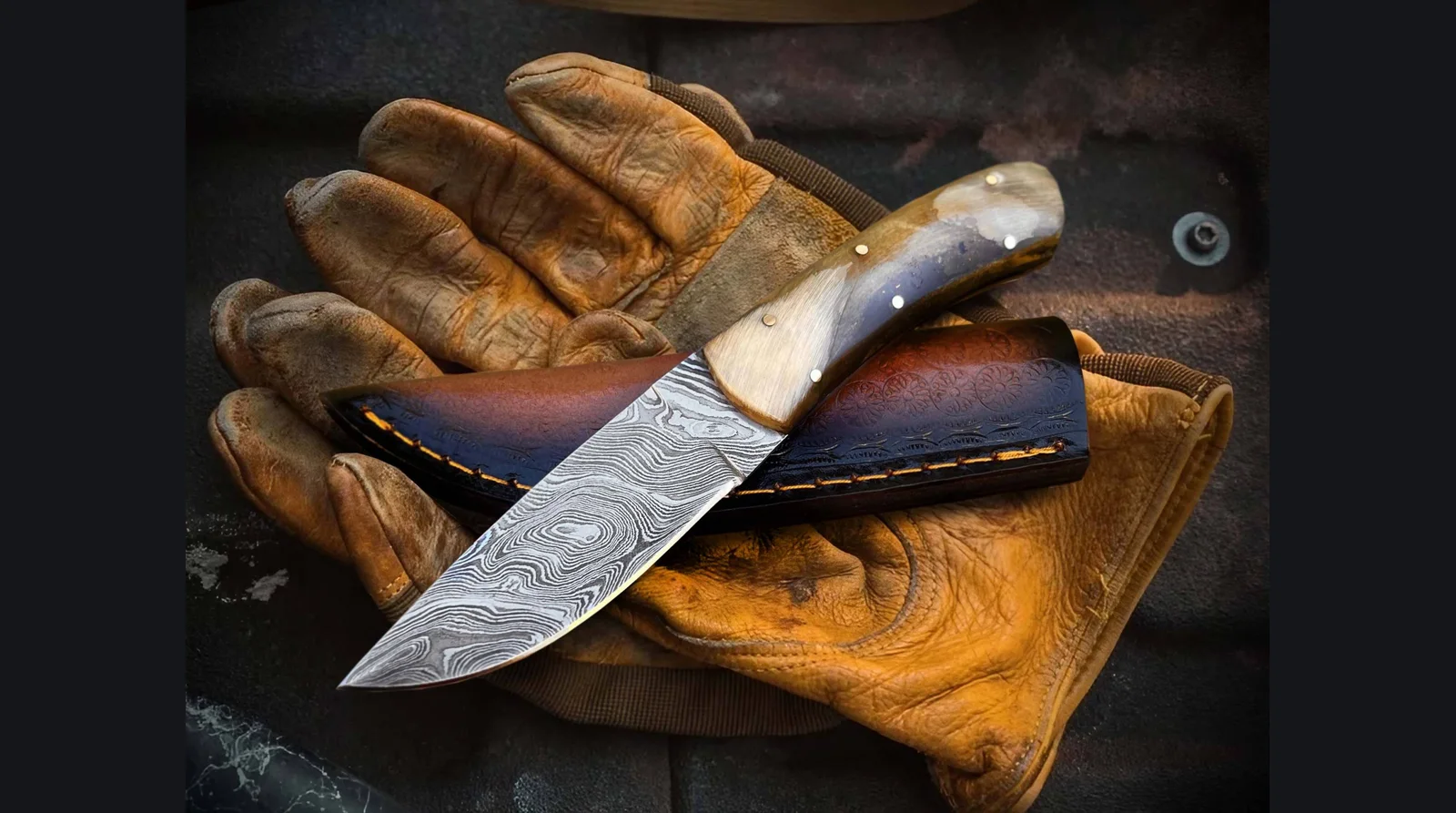
Short answer: 352 is the number of thin layers of two different steels welded together to make one blade. It is not a quality score. A 120-layer blade from a good smith will out-cut a 500-layer blade from a bad one every time. What the number really tells you is what the pattern will look like.
How the layers get there
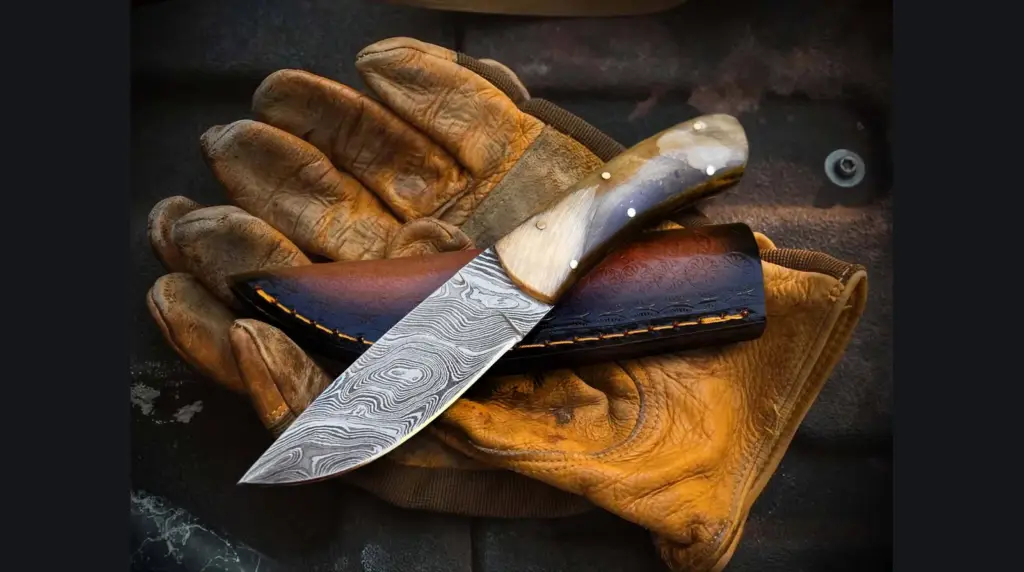
A Damascus billet starts as alternating sheets of two steels. We use 1095, a high-carbon steel that hardens hard and etches dark, and 15N20, which carries about two percent nickel and stays bright in acid. That contrast is the whole trick. Nickel resists the etch, so after the acid bath the 15N20 stands out silver against near-black 1095.
The stack is brought to welding heat, forge welded solid, then drawn out and folded back on itself. Every fold doubles the count. Seven sheets folded five times gives you 224. Eleven sheets folded five times gives 352. The arithmetic is simple; keeping every one of those welds clean at 2,300 degrees Fahrenheit is not.
Why more is not better
Past a point, extra folds make the pattern finer, not the steel stronger. Take it far enough and the layers become so thin that the contrast disappears and the blade looks like plain grey steel again. That is why very high layer counts are usually reserved for specific patterns rather than used as a selling point.
There is a second reason to be sceptical of big numbers. Every fold is another chance to trap scale or leave a cold shut, a weld that never properly took. A smith who folds carefully to 352 has done more real work than one who rushes to 1,000 and hopes the etch hides it.
What actually decides how the knife cuts
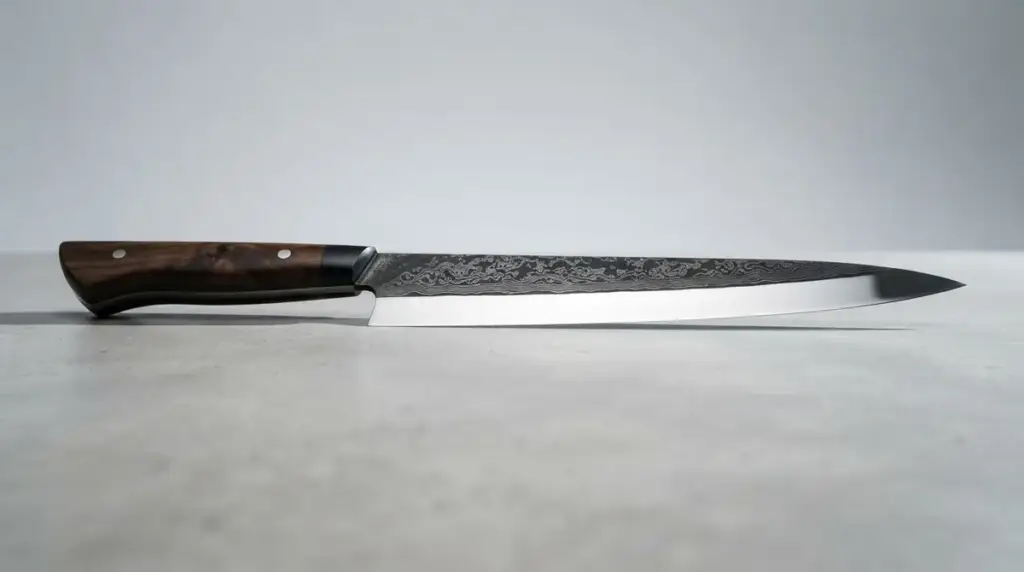
- Heat treatment. The single biggest factor, and the one you cannot see. Our blades are oil quenched and tempered to 58 to 60 HRC. A blade left soft will not hold an edge no matter how it is patterned.
- Grind geometry. How thin the blade is behind the edge decides how it feels in the cut, far more than the steel does.
- Edge finish. A well-finished 400-grit edge out-cuts a badly polished mirror edge in most real work.
- Layer count. Last, and mostly about looks.
Reading a pattern
The layer count sets the resolution; the pattern comes from what the smith does to the billet afterwards.
- Random or wild. Drawn out and forged to shape with no manipulation. Flowing, irregular, no two alike.
- Ladder. Grooves cut or pressed across the billet, then ground flat. Produces rungs running across the blade.
- Raindrop. Round dimples instead of grooves. Concentric rings down the length.
- Twist. The bar is heated and twisted along its axis. Tight spirals, and one of the harder ones to keep clean.
- Feather. The billet is split and folded back. The most difficult of the common patterns and the least forgiving of a bad weld.
The doubling maths behind a layer count
Every layer count you see advertised is the result of one starting stack and a set number of folds, and each fold doubles the total. That is the whole calculation. A billet built from 11 alternating sheets and folded five times gives 352. The same 11 sheets folded six times gives 704. Nothing else is happening, and no smith is placing 352 sheets by hand.
This is why odd-looking numbers such as 352, 224 and 448 keep appearing across the trade. They are not marketing inventions. They are what you get when you multiply a sensible starting stack by a power of two.
| 7 sheets, 5 folds | 224 layers |
| 7 sheets, 6 folds | 448 layers |
| 11 sheets, 4 folds | 176 layers |
| 11 sheets, 5 folds | 352 layers |
| 11 sheets, 6 folds | 704 layers |
| 15 sheets, 6 folds | 960 layers, usually sold as "1000 layer" |
The step-by-step forge welding behind those folds is set out in how Damascus steel is made.
How many layers in Damascus steel is normal?
Most working Damascus knives sit somewhere between 100 and 400 layers, and anything in that band is normal. Below roughly 60 you get a bold, wide pattern with few lines. Above roughly 500 the lines get so fine that on a blade the size of a hunter they start to blur together at arm's length.
There is no correct number, only a number that suits the pattern and the size of the blade. A large bowie can carry a high count and still read clearly because there is more surface for the pattern to spread across. A three-inch folder at the same count often looks like grey steel with a faint shimmer.
What "1000 layer Damascus" actually means
A 1000 layer Damascus knife is almost always a stack of 15 or 16 sheets folded six or seven times, and the round number is rounded for the listing rather than counted. That is not dishonest in itself. It becomes dishonest when the count is presented as a measure of strength, hardness or edge holding, which it is not.
Treat any high layer Damascus claim as a description of appearance. Ask three questions instead of taking the number at face value:
- Which two steels? A seller who cannot name the pair is not the person who made it.
- What hardness, and how was it heat treated? Ours are oil quenched and tempered to 58 to 60 HRC.
- Is the count from the billet or from the listing? An honest answer is a starting stack and a number of folds.
The same caution applies to the 1000 layer Damascus katana listings that circulate online. A long blade drawn from a modest billet can carry a very high nominal count, and the number tells you nothing about the weld quality along a metre of steel.
Layer count is a pattern specification, not a quality one
Think of the layer count the way you would think of a thread count or a screen resolution. It sets how fine the picture can be. It does not set how well the thing works. Every fold makes the lines thinner and the pattern tighter, and past a certain point the eye simply stops resolving them.
| 30 to 60 layers | Bold twist, large raindrop. Few lines, high drama. |
| 60 to 120 layers | Wild and random patterns, open raindrop. |
| 120 to 400 layers | Ladder and feather. The working range for most knives, and where 352 sits. |
| 400 to 800 layers | Fine mosaic and tight twist, best on larger blades. |
| Above 800 layers | Very fine. On a small blade it can read as plain grey steel. |
What decides how the knife performs sits entirely outside the count: the two steels chosen, the heat treatment, how thin the blade is behind the edge, and the angle you sharpen it to. A 15-degree-per-side edge on a well-hardened blade will out-cut a 25-degree edge on the same steel every time, and the layer count moves neither way. If you want to compare steels properly, the knife steel chart is the place to start.
Why 1095 and 15N20 are the standard pair
The pair is chosen for contrast in acid, not for a metallurgical trick. 1095 is a plain high-carbon steel that hardens well and etches dark. 15N20 carries roughly two percent nickel, and nickel resists the etchant, so those layers stay bright. Put them together and the acid does the drawing for you.
The two also carry close to the same carbon content, which matters more than the contrast does. Steels with mismatched carbon levels can move and harden at different rates, which risks warping and uneven hardness through the blade. 1095 and 15N20 behave near enough alike in the quench that the finished blade hardens as one piece.
What a layer count does not tell you
A number on a listing is not evidence that the steel is layered at all. Pattern can be etched, printed or laser-marked onto a plain blade, and a fake carries whatever count the seller types. Real forge-welded Damascus shows its pattern on every surface, including the spine, the tang and the freshly ground edge bevel, because the layers run through the bar rather than sitting on it. The checks are in real versus fake Damascus.
So use the layer count for what it is good for. It tells you roughly how fine the pattern will be, and it hints at how much folding went into the billet. For anything to do with cutting, hardness or durability, ask about the steel and the heat treatment instead.
Questions people ask
Does a higher layer count hold an edge longer?
No. Edge retention comes from the carbon steel in the mix and from heat treatment. The nickel layers are there for contrast.
Is 352 layers a standard?
It is our standard for most blades because it gives a clear, readable pattern at the size of knife we make. Other smiths land on different numbers for the same reason.
Can I count them?
Not by eye on a finished blade, and anyone who tells you they counted 1,000 layers on a knife is counting the arithmetic, not the steel.
Will the pattern wear off?
The pattern goes all the way through, so it cannot wear off. The etch that makes it visible can fade with heavy use, and it can be brought back. See our care guide.
How many layers in Damascus steel is best?
There is no best number. Most working knives sit between 100 and 400 layers because that range gives a pattern the eye can read at normal viewing distance. Lower counts suit bold twist and raindrop, higher counts suit fine mosaic on larger blades. Pick the count that suits the pattern you want, then judge the knife on its steel and heat treatment.
Is a 1000 layer Damascus knife better than a 352 layer one?
No. It is finer, not better. A 1000 layer Damascus knife is usually 15 or 16 sheets folded six or seven times, and the extra folds only make the lines thinner. Cutting performance comes from the steels chosen, the hardness reached in heat treatment, the grind behind the edge and the sharpening angle. None of those change when you add folds.
What does high layer Damascus mean?
High layer Damascus normally means anything above roughly 500 layers, produced by adding folds to the same starting stack. It is a description of pattern fineness. On a large blade it can look superb. On a small folder the lines can be so tight that the pattern reads as plain grey steel unless you hold it to the light.
Are 1000 layer Damascus katanas for sale genuine Damascus?
Some are, many are not. A long blade drawn from a small billet can carry a very high nominal count on paper while telling you nothing about weld quality along the whole length. Check the spine, the tang and the edge bevel for pattern running through the steel rather than sitting on the surface, and ask which two steels were used.
How do I check whether a seller's layer count is honest?
Ask for the starting stack and the number of folds. An honest answer is specific, such as eleven sheets folded five times for 352. A seller who cannot give you that, or who names a round number with no arithmetic behind it, is repeating a listing rather than describing a billet they made. Ask which two steels as well.
Does the layer count tell you whether Damascus is real?
Not at all. A printed or acid-etched pattern on plain steel can be advertised with any number the seller likes, because nothing is being counted. The count only becomes meaningful once you have established the blade is genuinely forge welded. Judge authenticity by looking for pattern on every ground surface, then treat the number as a note about appearance.
More guides
- Damascus vs D2 vs 440C vs VG10: Which Steel
- Damascus Knife Care and Sharpening
- How to Tell Real Damascus from a Printed Pattern
- Hand-Forged vs Factory Made Knives
More from the workshop
Damascus Knife Care and Sharpening
Stop the rust, sharpen it correctly, and bring a faded etch back in ten minutes.
Engraving a Knife: What Works and What Ruins the Blade
What engraving costs, what fits in 20 characters, and why the handle beats the blade.
Christmas Knife Gift Guide
What to buy for whom, the engraving cutoff dates nobody publishes, and the penny tradition that settles the old superstition.
