
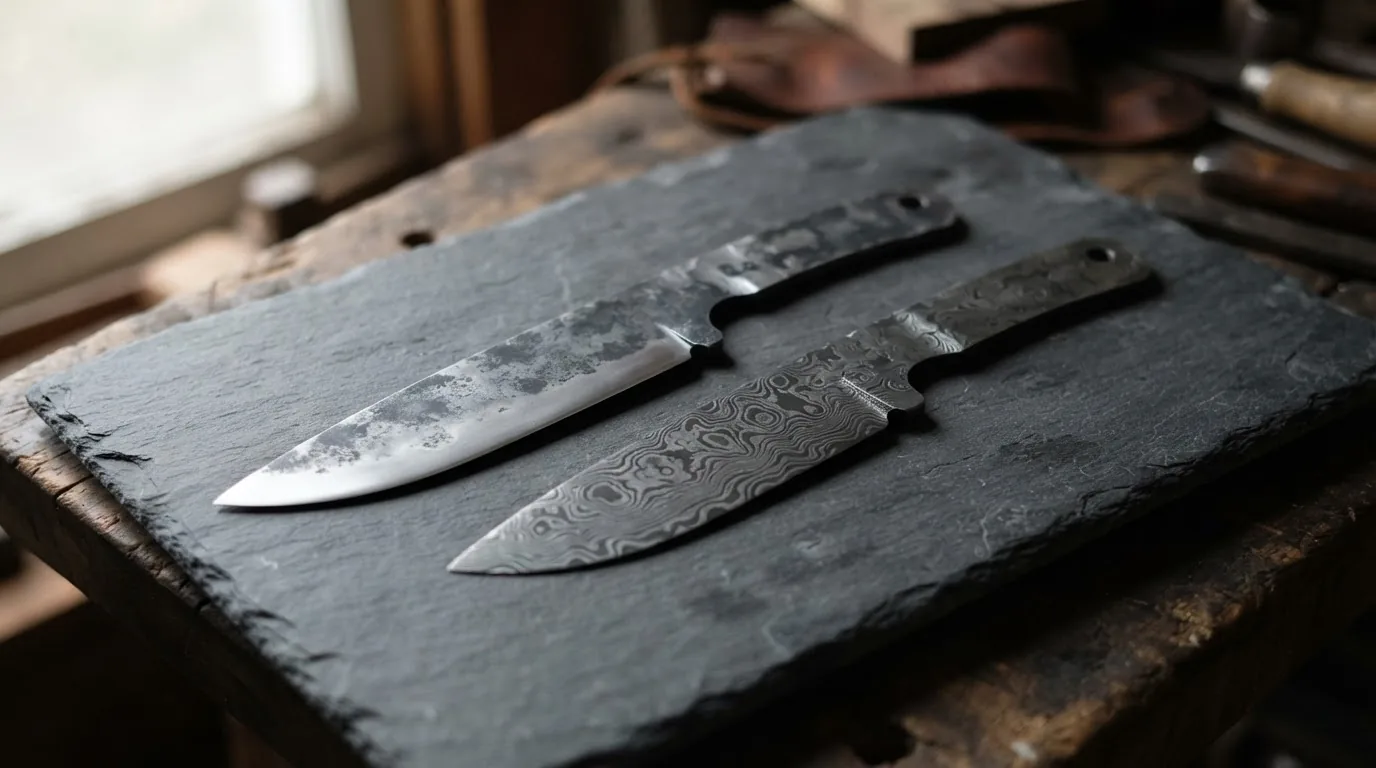
Short answer. Both are laminated steel, and that is where the similarity stops. San mai is three layers: one hard cutting core with a softer jacket forge welded to each side, so the blade has one steel at the edge and a different steel everywhere else. Pattern welded Damascus is a stack of alternating layers, often hundreds of them, folded and drawn until the boundaries make a visible pattern that runs right through the edge. San mai is built for a functional split between edge and body. Damascus, in a modern billet, is mostly built for the pattern. And BMK does not sell san mai, which we will come back to below.
What san mai actually is
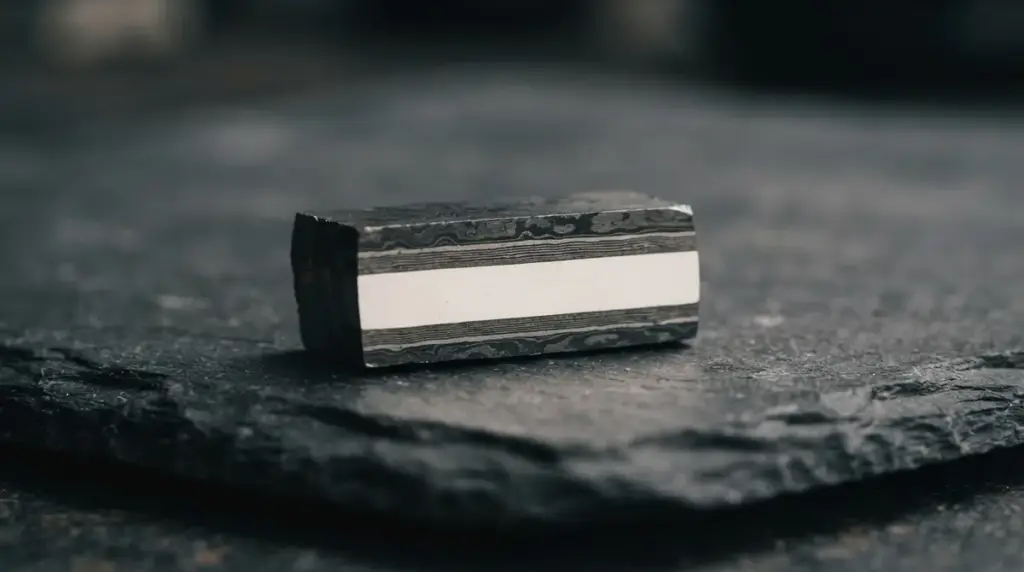
San mai is Japanese for three layers. A billet is assembled as a sandwich: a slab of hard, high carbon core steel with a slab of softer, tougher jacket steel forge welded to each face. The assembly is drawn out and ground so that the core is exposed only at the cutting edge. Everything the hand touches is jacket.
The point is a division of labour. The core can be run harder than a whole blade could safely be run, because it is supported on both sides by steel that will bend rather than crack. On a Japanese kitchen knife the core is very often a carbon steel such as Shirogami or Aogami and the jacket is soft iron or stainless. Vendor guides commonly quote core hardness figures in the low sixties. The table below reproduces figures published by the retailer Stag Steel Knives. They are their numbers, not ours, and they describe a category we do not make.
| Core steel | Published hardness | Type | Source |
|---|---|---|---|
| Shirogami, white steel 1 and 2 | 60 to 63 HRC | Very pure carbon steel | Stag Steel Knives |
| Aogami, blue steel 1 and 2 | 61 to 64 HRC | Carbon steel with tungsten and chromium | Stag Steel Knives |
| SG2 or R2 | 62 to 64 HRC | Powder metallurgy stainless | Stag Steel Knives |
| VG10 | 60 to 61 HRC | Stainless | Stag Steel Knives |
| 52100 | 60 to 62 HRC | Bearing steel, carbon | Stag Steel Knives |
| AUS-10 | 58 to 60 HRC | Stainless | Stag Steel Knives |
There are two close relatives worth naming. Ni mai is a two layer version used on single bevel Japanese knives, hard steel on one face and soft on the other. Warikomi splits a bar of soft steel and inserts the hard core into the split, so the core reaches only part way up the blade. Sharp Edge, a Japanese knife retailer, describes warikomi as the route used for steels that are difficult to forge weld across a full face, including powder steels.
What pattern welded Damascus actually is
Modern Damascus starts as a stack of alternating bars of two steels, typically 1095 and 15N20 in the western tradition. The stack is forge welded, drawn out, cut, folded back on itself and welded again. Each fold doubles the layer count. Seven doublings from a 7 layer start gives 896 layers. Our own 352 layer guide and our how Damascus steel is made page walk that sequence in detail.
Then the billet is manipulated. Ladder, raindrop and twist patterns come from cutting, drilling, pressing or twisting the billet so that the flat layers surface at an angle when the blade is ground. Finally the finished blade is etched in acid. One steel darkens, the other resists, and the pattern appears.
The critical structural point is that the layers run through the whole cross section. There is no core. The edge of a Damascus blade is made of the same alternating stack as the spine.
One interface against hundreds
The cleanest way to hold the difference in your head is to count interfaces at the edge.
A san mai blade has two, one on each side of the core, and the core between them is thick, typically a millimetre or more at the bevel. A 352 layer Damascus blade has 351 interfaces stacked through a blade that might be 3 millimetres thick at the spine, which means each individual layer is a few microns thick.
That difference in scale is not cosmetic. It changes what the laminate can do, and it is the thing almost every page on this topic skips.
| Property | San mai | Pattern welded Damascus | Monosteel |
|---|---|---|---|
| Layers | Three, sometimes two or five | Commonly 120 to 1,000 or more | One |
| Layer thickness at the edge | Core about 1 mm or more | A few microns | Not applicable |
| What is at the cutting edge | Core steel only | All layers, alternating | The one steel |
| Where the visible line sits | Jacket to core boundary, above the edge | Across the entire blade including the edge | Nowhere |
| Purpose of the lamination | Functional split of hard and tough | Mostly appearance | Simplicity and price |
| Can be stainless outside, carbon inside | Yes, common | Not in the same way | No |
| Pattern survives heavy sharpening | Line moves but stays | Yes on the flats, thins on the bevel | Not applicable |
Carbon diffusion, and why Damascus layers end up the same hardness
Here is the fact that changes how you should read every claim made for Damascus.
Carbon is a small, fast moving atom. At forge welding temperature it migrates across a steel boundary very quickly. Verhoeven and Pendray published exactly this measurement in Materials Characterization in 1998, in a paper on carbon diffusion between the layers in modern pattern welded Damascus blades. Knife Steel Nerds, summarising the same body of work, puts it plainly: carbon equalises between the two steels in seconds at normal forge welding temperatures.
The consequence is that after a few welding heats, the carbon content of the 1095 layers and the 15N20 layers is essentially the same. They will therefore harden to essentially the same hardness. The pattern you can see is not a pattern of hard and soft. It is a pattern of nickel and manganese, elements that diffuse far more slowly and that change how each layer responds to acid.
So a Damascus blade is, mechanically, close to a monosteel of averaged composition. It is not a hard core supported by soft cladding, and any seller who tells you the alternating layers give you self sharpening micro serrations or a hard and soft edge structure is describing something the metallurgy does not support at that layer thickness.
There is one honest exception worth recording, because it cuts against the simple version. Knife Steel Nerds tested a 1095 and pure nickel combination and found it did show a genuine serration effect, with the soft nickel layers wearing back faster than the steel and improving slicing edge retention. Pure nickel does not carburise the way 15N20 does, so the contrast in hardness survives. That is a specific pairing and not a general property of Damascus.
In san mai the same diffusion happens, but the geometry saves it. Carbon moves across the core to jacket boundary too, and produces a diffusion zone. That zone is measured in fractions of a millimetre, and the core is a millimetre or more thick, so the middle of the core keeps its carbon and its hardness. Layer thickness is the whole difference. This is why san mai is a functional laminate and a 352 layer billet is a decorative one.
Where the hard steel sits, and what that means at the edge
On a san mai blade the working edge is core steel and nothing else. The jacket never touches the food or the game. It is there to carry impact, to resist rust if it is stainless, and to make the blade easier to straighten if it bends.
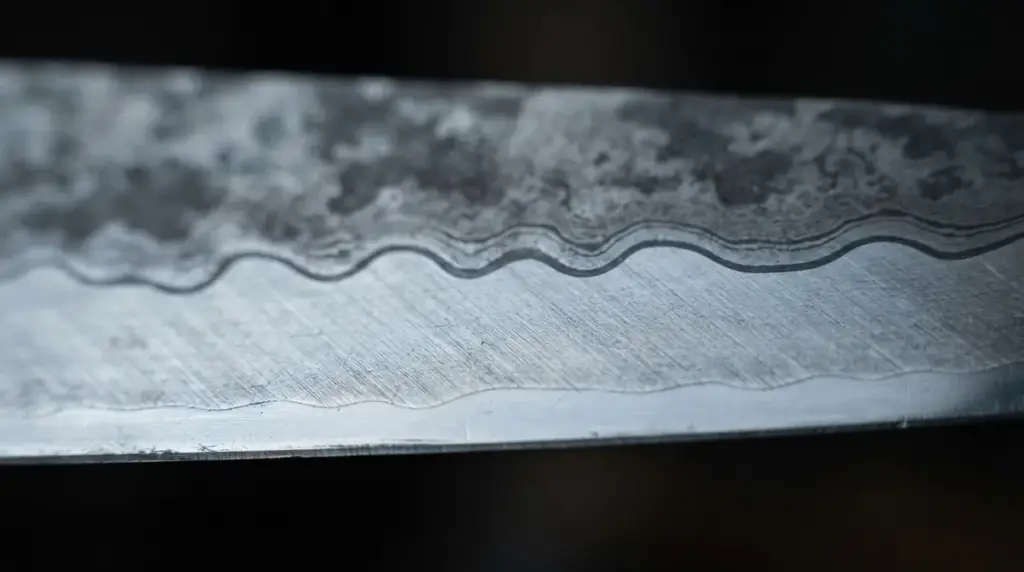
That has a consequence people find surprising the first time. On a san mai kitchen knife the pattern, whether it is a soft cloudy kasumi finish or a full Damascus clad jacket, is on the sides of the blade and stops above the bevel. Sharpen the knife for a year and the bevel climbs slightly up the blade, so the visible line between jacket and core moves with it. The pattern does not vanish, but it is not on the part that cuts, and it never was.
On a Damascus blade the reverse is true. The pattern is on the bevel as well as the flats, because the layers go all the way through. Sharpen it aggressively on a coarse stone and you grind the etch off the bevel, because the etch lives in the top few thousandths of an inch. We wrote a whole page on that problem in sharpening a Damascus knife without wrecking the pattern.
Corrosion, and the real argument for san mai
The strongest practical case for san mai has nothing to do with cutting. It is that you can put a stainless jacket around a carbon core.
A carbon steel core can be run hard and takes a very fine edge. It also rusts if you leave it wet. Clad it in stainless and roughly ninety percent of the exposed surface stops rusting, leaving only the thin strip of core at the edge exposed. That strip is the part you wipe and dry anyway. For a working kitchen knife this is a genuinely good engineering answer, and it is why the construction dominates Japanese kitchen cutlery.
Carbon Damascus gives you none of that. Both steels in a 1095 and 15N20 billet are carbon steels, so the entire blade rusts. Our page on whether Damascus knives rust does not soften that, and it applies to every Damascus knife in our catalogue. The stainless Damascus route exists, using pairs such as 440C with 416 or AEB-L with 302, but as we set out in stainless Damascus and carbon Damascus, the pattern comes out much quieter because both halves resist the acid.
Cost, and why san mai is not the cheap option
San mai has fewer layers, so people assume it is simpler and cheaper. It is neither.
Three layer forge welding is unforgiving. A single unwelded spot inside the sandwich becomes a delamination that may not appear until the customer is halfway through the first year. Welding stainless jacket to carbon core is harder still, because the chromium oxide layer fights the weld and the two steels expand at different rates on the quench. The core has to be centred accurately, because if it wanders the edge exposes jacket on one side and the knife will not sharpen straight.
Damascus, by contrast, is forgiving in a specific way: a small flaw in a 300 layer billet is one thin layer among hundreds and often disappears into the pattern. A small flaw in a three layer billet is a third of the blade.
What Black Mamba actually sells, which is not san mai
We should be direct about this because it would be easy to be vague.
Counting the live catalogue on 30 August 2026, 609 products are published. Exactly two of them use the word sanmai in the title. Neither of them is a three layer laminated blade according to its own specification table. One is a 13 inch bowie whose spec names 440C stainless steel, a monosteel. The other is a bunka whose spec names 1095 with 15N20 Damascus at 58 to 60 HRC, with the word sanmai attached to the bolster rather than the blade.
| Construction | Live BMK listings | Notes |
|---|---|---|
| Pattern welded Damascus, 1095 with 15N20 | 321 | 58 to 60 HRC, carbon, will rust |
| D2 monosteel | 112 | 58 to 62 HRC |
| Plain high carbon monosteel | 76 | Hardness not published |
| 440C monosteel | 26 | 58 to 60 HRC |
| True three layer san mai | 0 | We do not make it |
| Listings using the word sanmai | 2 | Neither spec describes a laminate |
So the answer to whether you can buy a san mai knife from us today is no. Two listings use the word loosely, we have flagged both for correction, and if you want a genuine hard core clad blade you should buy it from a Japanese kitchen knife specialist rather than from us. We would rather lose that sale than take it on a word.
How to tell a real san mai from a printed line
The market is full of blades with a wavy line near the edge that is not a lamination boundary at all.
Look at the spine. A genuine three layer blade shows the sandwich when you look straight down at the spine under a light: two outer bands and a centre band, usually with slightly different reflectivity. A printed or etched line shows nothing at the spine.
Look at where the line goes at the tip. On a real laminate the boundary follows the geometry of the grind and converges at the point, because the core is a physical slab. A decorative line often runs parallel to the edge in a way no grind would produce.
Look for the line on both sides. A real core is exposed on both faces at roughly the same height. A one sided line is either a ni mai single bevel blade, which is a legitimate construction, or a fake.
Do not trust a hamon as evidence. A hamon is a differential hardening line on a single piece of steel and has nothing to do with lamination. Many marketplace listings use the two words as if they meant the same thing. They do not. Our page on real versus fake Damascus covers the same category of problem on the pattern welded side.
Which one should you actually buy
If it is a kitchen knife you will use every day and you want a very hard, very fine edge with the easiest possible care, san mai with a stainless jacket over a carbon core is the better engineering, and you should buy from someone who makes it properly.
If you want a pattern that runs through the whole blade, a knife with visible evidence of forge welding, and a large fixed blade in a shape a kitchen maker does not build, carbon Damascus is the right answer, and you should buy it understanding that the pattern is decorative and the whole blade needs oiling.
If you want the best cutting performance per dollar with no romance attached, buy a good monosteel. That is the least profitable sentence on this page and it is true.
Questions people ask
What is the difference between san mai and Damascus?
San mai is three layers with a hard core and a softer jacket welded to each side, so only the core reaches the cutting edge. Damascus is a stack of alternating layers, often hundreds, running through the whole cross section including the edge. San mai divides the job between two steels. Damascus mostly makes a pattern.
Is san mai stronger than Damascus?
Tougher rather than stronger, and for a specific reason. The soft jacket carries impact and lets the blade bend instead of snapping, which allows the core to be run harder than a whole blade safely could be. A Damascus blade has no such support because the layers are microns thick and end up at similar hardness.
Why do Damascus layers not act as hard and soft layers?
Because carbon diffuses across the boundaries during forge welding. Verhoeven and Pendray measured this in Materials Characterization in 1998, and the practical summary is that carbon equalises between the layers in seconds at welding temperature. The visible contrast comes from nickel and manganese, which move much more slowly, not from a hardness difference.
Is san mai the same as a hamon?
No. A hamon is a hardening line on one piece of steel, produced by clay coating the spine so it cools slowly during the quench. San mai is three physically separate pieces of steel welded together. They can look similar in a photograph and they are completely different things.
Can you have Damascus cladding on a san mai blade?
Yes, and it is common on Japanese kitchen knives. The jacket is a patterned billet and the core is a plain hard steel. You get the pattern on the sides and a single clean steel at the edge, which is arguably the best of both. It is also expensive, because it is two difficult processes stacked.
Does the san mai pattern wear off with sharpening?
Not exactly. The visible line is the boundary between jacket and core, so as the bevel is sharpened back over years the line moves slightly up the blade. The pattern on the flats is untouched. This is different from a Damascus bevel, where a coarse stone will grind the etch off entirely because the etch is only a few thousandths of an inch deep.
Which is more expensive, san mai or Damascus?
It depends on the core steel and the layer count more than on the construction. Three layer welding with a stainless jacket over a carbon core is technically demanding and delaminations are unforgiving, so good san mai is not the budget option people expect it to be.
Does san mai rust?
The exposed core does if it is carbon steel, and that is the strip at the edge. A stainless jacket protects the rest, which is most of the surface area. That is the whole appeal. A carbon Damascus blade has no protected area at all and needs oiling everywhere.
How many layers does san mai have?
Three in the classic form: jacket, core, jacket. Ni mai is two, used on single bevel Japanese knives. Some makers use five by adding a decorative layer to each face. Anything with dozens or hundreds of layers is pattern welded Damascus and not san mai, whatever the listing calls it.
Does Black Mamba sell san mai knives?
No. Of 609 live listings on 30 August 2026, two use the word sanmai in the title and neither describes a three layer laminate in its specification. One is 440C monosteel and one is 1095 with 15N20 Damascus. We are correcting both titles. If you want genuine san mai, buy it elsewhere.
More guides. For the forge welding sequence step by step, read how Damascus steel is made. For what a layer count really means, see Damascus 352 layers. For spotting a fake pattern, read real versus fake Damascus. For the steels in each billet family, see stainless Damascus and carbon Damascus. For the step that decides more than any laminate, read knife heat treatment explained.
More from the workshop
Tracker Knives: The Double Edge Profile and What It Is Good At
The tracker profile explained zone by zone, what it is good at, and what two lighter knives do better.
Balisong History and Origins
Batangas, the disputed origin, what balisong really means, and how to tell a traditional knife from a modern one.
Folding Knife Locks: Liner, Frame, Back and Slip Joint
The six folding locks you will actually meet, how each one fails, and a one minute inspection you can run before you buy.
