
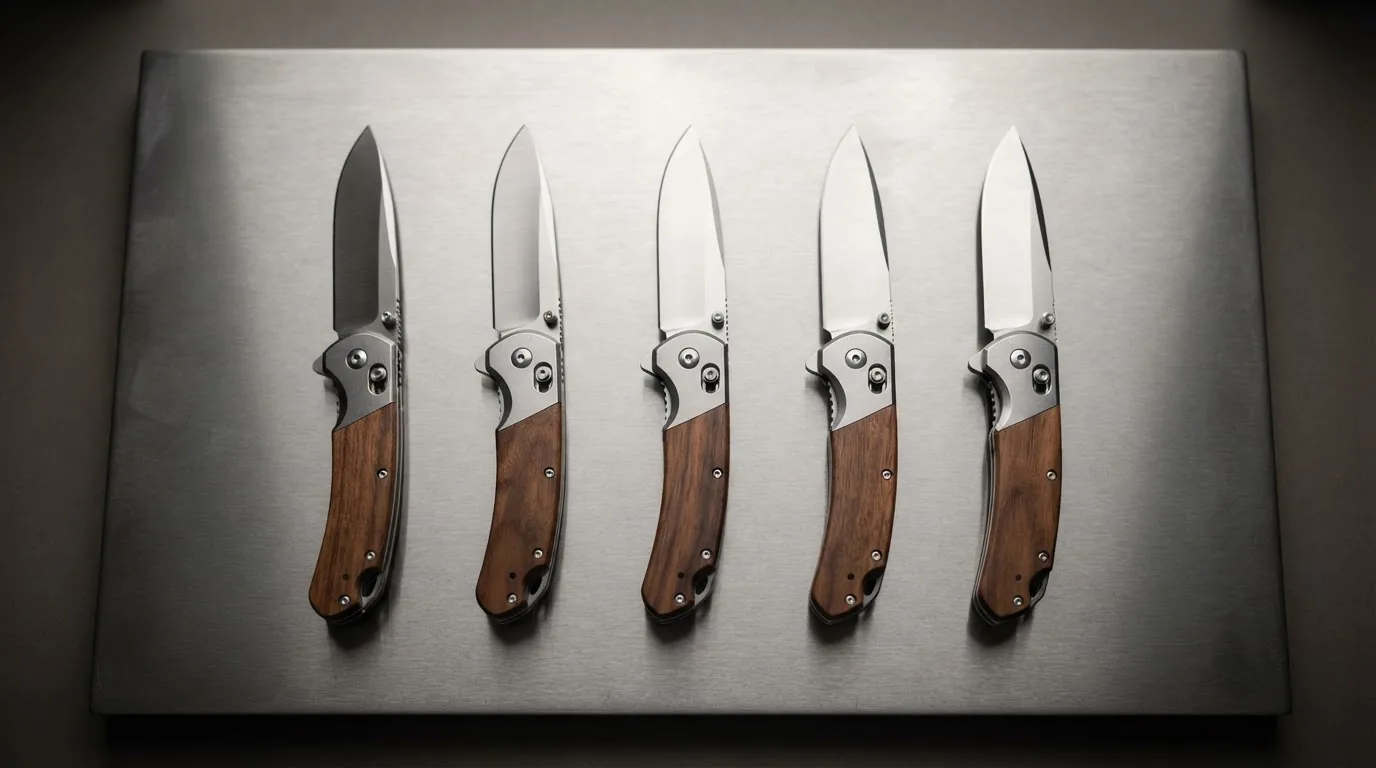
Short answer: a folding knife lock is a mechanical stop that keeps the blade from folding back onto your fingers under load. The six you will actually meet are the liner lock, the frame lock, the back lock, the crossbar lock, the button lock and the compression lock, and one more, the slip joint, which is not a lock at all. Frame, back and crossbar locks take the hardest use. Liner locks are the most common and the most variable. If you want the short version: buy a frame lock or a back lock for hard work, a slip joint if your local law restricts locking blades, and check the lock on the knife in your hand rather than trusting the name on the box.
What a lock is for, and what it is not
A folder has a pivot, and a pivot lets the blade rotate both ways. Cutting away from yourself pushes the edge forward, which the stop pin handles. The problem is the opposite load. When you push on the spine, twist in a cut, or catch the tip so the blade tries to rotate back into the handle, something has to sit in the way of the tang. That something is the lock.
Notice what that leaves out. A lock is not a strength rating for the whole knife, and it does not make a folder equal to a fixed blade, because a fixed blade has no joint to fail. Nor does it protect you during the part of the job where most folder injuries happen, which is closing the knife: on a liner lock and a frame lock your finger has to cross the path the blade travels through. Treat a lock as a probability, not a guarantee. People who read it as a guarantee end up prying with folders, and prying is how locks get discovered.
The liner lock
The liner lock is a leaf of spring steel cut from one of the handle's internal liners, bent inward so it wants to sit under the flat back of the blade tang. When the blade swings open the leaf snaps across and wedges against the tang. To close, push the leaf sideways and rotate the blade back.
It became the standard modern lock because it is cheap, using a part the knife already needed, and easy to work one handed. Michael Walker refined the modern version in the early 1980s and never patented it, which is a large part of why every factory now builds one.
What varies is where the leaf lands on the tang. Fresh from the box a good liner lock engages a quarter to halfway across the tang face. Right at the very edge is early lock up and it will wear quickly. All the way across is late lock up, with nowhere left to go as the parts wear, and a liner lock at full travel is at the end of its service life. Nobody fixes that at home.
Liner locks are fine for cord, post and boxes. They are not what we would choose for anything involving torque.
The frame lock
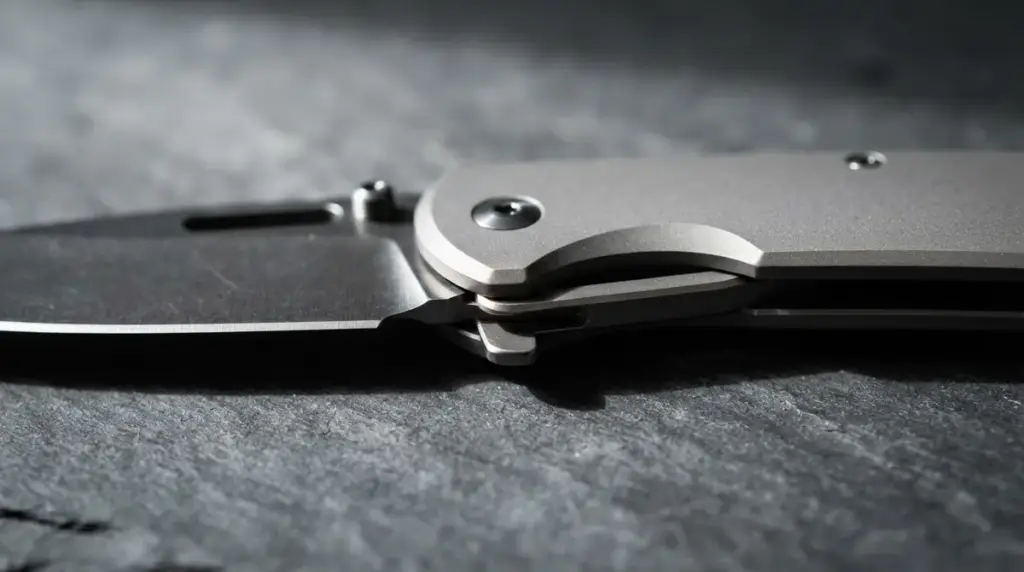
A frame lock is a liner lock promoted. Instead of an internal liner, one whole side of the handle is slotted and bent so the frame itself becomes the lock bar. It is thicker, stiffer and your grip pushes it inward rather than outward. Chris Reeve popularised it as the integral lock, which is why you still see it called the Reeve Integral Lock.
It is the strongest of the lock bar family and also the one with the most named failure modes, because the industry has spent thirty years engineering around its quirks. Titanium frame locks gall against hardened steel, producing lock stick, where the bar refuses to slide sideways and you fight your own knife. The fix is a hardened steel insert on the contact face, which most good makers now fit. Overtravel stops prevent you bending the bar past its elastic limit. The trade is weight: a frame lock folder is heavier in the pocket than a liner lock of the same blade length, and if you never load a knife laterally you are paying for strength you will not use.
The back lock and its variants
The back lock, also called a lockback or spine lock, is the oldest of the modern locks. A steel rocker bar runs along the spine on its own pivot, held down by a spring at the rear, and a lug on the front of that bar drops into a notch cut in the blade tang. Press the exposed rear of the bar and the front lug levers up out of the notch.
Three things recommend it. There is no handedness in a bar that runs down the middle, so it is fully ambidextrous. Your fingers never enter the blade path during closure, because the release is at the back of the handle. And the load path is good, since the lug is pressed into the notch by the spring and jammed into it by any force trying to close the blade. Cold Steel's Tri Ad variant adds a stop pin between tang and lug so impact loads are shared, which is why lockbacks still appear on lists of the strongest folding locks despite being the oldest pattern on them.
The weaknesses are real. Most back locks want two hands to close safely, they collect pocket lint in the tang notch, and a notch full of lint stops the lug seating fully. A worn lockback also develops vertical blade play.
Slip joints and friction folders, which do not lock at all
A slip joint has no lock. A backspring bears on a flat on the tang, holding the blade open, holding it closed, and resisting a moderate push on the spine before it gives. That resistance is called the pull, graded in traditional cutlery from a light two up to a very stiff eight or nine. Every stockman, trapper, barlow and peanut works this way.
People read that as a weakness. It is better understood as a different bargain. A slip joint has fewer parts, almost nothing to gall or wear out of spec, and it stays legal in jurisdictions where a locking blade is not. In England and Wales the general carry allowance covers a folding pocket knife with a cutting edge under three inches that does not lock, and a locking folder falls outside it. That one rule keeps the traditional slip joint alive across a whole country.
Friction folders remove the spring too. The tang extends past the pivot and your grip traps it so the blade cannot rotate. It is the simplest folder there is, and it depends entirely on you holding it correctly.
Crossbar, button and compression locks
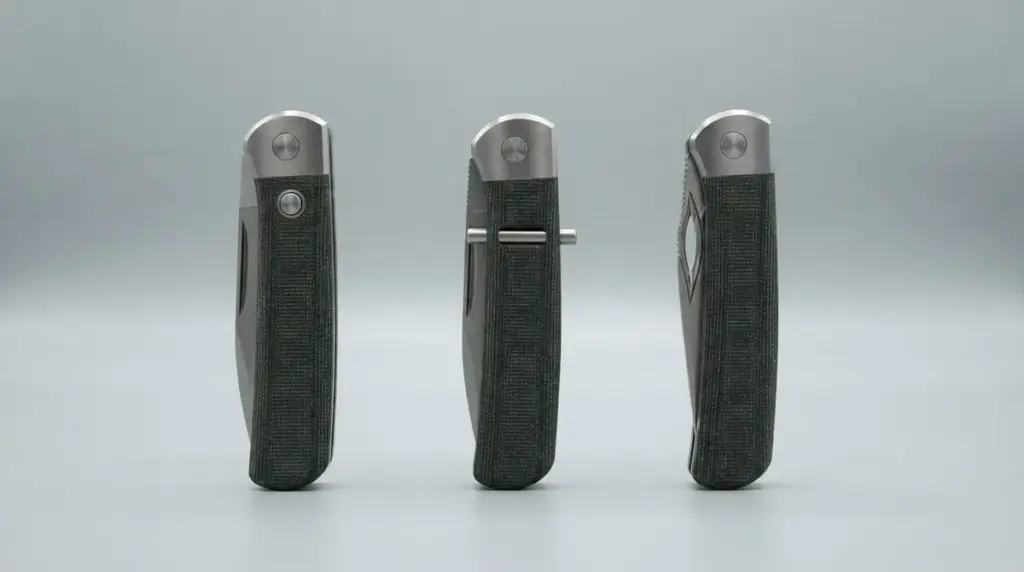
The crossbar lock, which most people still call by Benchmade's trade name Axis, is a hardened bar running across the handle in a slot, pushed forward by two small omega springs. When the blade opens the bar rolls forward and wedges into the ramped rear of the tang. Studs on both sides pull it back, so it is ambidextrous and your hand stays clear of the edge. Its weak point is the springs, which are fine wire and do break, and some examples develop horizontal blade play as the slot wears.
The button lock uses a spring loaded plunger that drops into a recess in the tang. It is the easiest lock in the world to use, very strong in the direction that matters, and your hand never crosses the blade path. It carries one problem that is not engineering: button locks are traditional on automatic knives, so a manual button lock folder can be misread as an automatic by somebody not looking closely.
The compression lock is Spyderco's inversion of the liner lock. The leaf sits on the spine side and wedges between a ramp on the tang and the stop pin. Because the force pinches the leaf between two solid surfaces instead of shearing it sideways, it is stronger than a conventional liner lock, and the release is again on the spine, so fingers stay clear.
Lock strength compared
Two warnings. There is no industry standard for folding lock strength, so every ranking you read, this one included, is consensus rather than measurement. And the variation between two examples of the same lock type from different factories is larger than the variation between types. A well executed liner lock beats a badly executed frame lock every time.
| Lock | Strength | Fingers cross blade path | One handed close | Ambidextrous | Main failure mode |
|---|---|---|---|---|---|
| Slip joint | Lowest, not a lock | Yes | No | Yes | Backspring gives under spine load |
| Friction folder | Grip dependent | Yes | No | Yes | Grip relaxes, blade folds |
| Liner lock | Moderate | Yes | Yes | No | Late lock up, slip under torque |
| Frame lock | High | Yes | Yes | No | Lock stick, overtravel, galling |
| Back lock | High | No | Usually not | Yes | Lug and notch wear, lint |
| Crossbar lock | High | No | Yes | Yes | Omega spring breakage |
| Button lock | High | No | Yes | Yes | Plunger wear, debris in the recess |
| Compression lock | Very high | No | Yes | No | Same wear pattern as a liner lock |
The four ways a lock fails
Almost every folder lock failure is one of four things, and three are visible before they hurt you.
| Failure | What it feels like | Cause | Fixable |
|---|---|---|---|
| Late lock up | Bar fully across the tang, no travel left | Wear, or a soft tang from poor heat treat | No, retire from hard use |
| Vertical play | Open blade ticks up and down | Worn lug and notch, or worn contact face | Rarely, not at home |
| Lock stick | Bar will not release without force | Titanium galling on the steel tang | Yes, with a maker fitted steel insert |
| Sudden release | Blade closes during a cut | Debris, or all of the above ignored | Prevention only, so clean the pivot |
Debris is the one worth dwelling on. A back lock with a plug of compacted lint in the tang notch feels normal in the hand and is not doing its job. Cleaning a folder is not cosmetic. The method is in how to clean a pocket knife.
A sixty second lock inspection you can run yourself
This is the part every buying guide leaves out. You do not need a laboratory to assess a lock, only the knife and a minute. Run it before you buy, and on your carry knife twice a year.
One. Look at engagement. Open the blade fully and see where the lock bar meets the tang. On a liner or frame lock you want a quarter to halfway across. Right at the edge is too early. All the way across is finished.
Two. Rock it vertically. Hold the handle, pinch the open blade and rock the tip up and down. You are feeling for a tick. Detectable vertical play on a lock meant to be solid means the contact surfaces have worn.
Three. Rock it laterally. Same grip, push the tip side to side. A little is normal on a crossbar lock and most slip joints. A lot on a frame lock means the pivot needs attention.
Four. Release under light load. Press gently on the spine with the flat of your palm, every finger outside the arc the blade sweeps through, and while that pressure is on try to disengage the lock. A lock that releases easily under load is telling you something. One that will not release under load is normal.
Five. Close it and listen. On a slip joint or back lock you want one clean snap. A mushy close means lint, gummy oil or a tired spring.
What we are deliberately not telling you to do is the spine whack, where people slap the spine of an open folder against a table edge to see if it shuts. It destroys good knives, it tells you little that step four does not, and it puts your hand near a blade you have just decided you do not trust.
What our own folders use, and what our listings do not say
Here is the part that is inconvenient for us, and we would rather publish it than have you find it out at checkout.
We list 111 folding pocket knives, and every one carries a specification table on its product page. On 30 August 2026 we counted what those 111 tables actually declare. The result is below. Lock type appears on none of them. Zero out of 111.
| Specification row | Present on how many of our 111 folders |
|---|---|
| Steel | 111 |
| What is included | 111 |
| Hardness | 102 |
| Overall length | 99 |
| Blade length | 95 |
| Handle length | 92 |
| Damascus pattern | 68 |
| Weight | 61 |
| Handle material | 54 |
| Lock type | 0 |
That is a gap in our listings, not a secret about the knives. What we can tell you is the shape of the range. Our folders run from $70 to $845, a quarter under $101, a median of $128 and three quarters under $283. Blade lengths, where published, run from 1.5 inches to 7 inches with a median of 3 inches. Those are small, traditional proportions, and traditional proportions in hand-forged Damascus usually mean a slip joint or a simple liner lock. Our five multi blade folders, $135 to $188, are slip joints by construction, because two or more blades sharing a backspring is what a slip joint is.
So, honestly: if you want a documented hard use lock with a named mechanism and a warranty on the lock itself, buy from a maker whose whole business is folding mechanisms. That is not us. What we build well is blades. If the mechanism matters to you on one of our folding pocket knives, ask before you order and we will tell you what that knife uses. Until the spec tables are fixed you should not have to guess.
Locks, the law and choosing one
Two legal facts are worth carrying. Several jurisdictions restrict knives by whether they lock rather than by blade length alone, which is why the non locking slip joint is a mainstream product and not a museum piece. And mechanisms that resemble automatic knives, particularly button locks, attract attention from people whose job is to notice knives. Neither point is legal advice and both change. Please check your local law before ordering. Our state by state summary is a starting point rather than an answer.
Choosing, then. If your knife opens boxes and mail, a liner lock is enough and the money is better spent on steel. If your knife gets torque, buy a frame lock, a back lock or a crossbar lock. If you are left handed, a back lock or a crossbar lock will not fight you. If you want a knife you can hand to anyone without a briefing, a slip joint is the safest thing to put in an inexperienced pocket, because nothing about it pretends to be stronger than it is. If the call is close, the tie breaker from how to choose an EDC knife applies: carry the knife you will actually clean.
Questions people ask
What is the strongest folding knife lock?
In practice the compression lock, the reinforced back lock and a well built frame lock sit at the top, with the crossbar lock close behind. There is no standard test, so treat any ranking as informed opinion.
Is a liner lock strong enough for everyday carry?
Yes, for the tasks everyday carry actually involves. Cord, tape, boxes, food and packaging are cutting loads rather than prying loads, and a liner lock handles those without complaint. It is torque that finds a liner lock out.
What is the difference between a liner lock and a frame lock?
A liner lock uses a thin internal liner as the lock bar, with the outer scale separate. A frame lock uses the outer handle itself. The frame bar is thicker, so it is stronger, and your grip pushes it further into engagement.
Why do slip joint knives not lock?
Because they predate the demand for a lock and the backspring already does most of the job. A slip joint resists closing until you overcome the spring, and it stays legal where locking blades are restricted, which is why the pattern survives.
What is lock stick and can I fix it?
Lock stick is a titanium frame lock bar galling against a hardened steel tang, so it grips and will not slide sideways to release. Some cases ease with use. The real fix is a hardened steel insert on the lock face, which is a maker's job.
What is late lock up and why does it matter?
Late lock up is a lock bar sitting all the way across the tang face with no room left. Wear only moves the bar one way, so once travel is gone there is no reserve and the next stage is a lock that slips. Retire that knife from hard use.
Should I spine whack test my knife?
We would not. It applies an impact load no cutting task produces, it can damage a good lock, and it puts your hand near a blade you are trying to make fail. A gentle static load with fingers outside the blade arc tells you nearly as much.
Do Damascus folding knives use weaker locks?
The steel and the lock are separate questions, but the correlation is real. Hand-forged Damascus folders tend to be built on traditional patterns, and traditional patterns tend to be slip joints or simple liner locks. A Damascus folder is therefore less likely to carry a hard use lock than a modern production folder at the same price. Ours are no exception.
Which lock is best for a left handed user?
A back lock or a crossbar lock, because both are genuinely ambidextrous. Liner, frame and compression locks are built for one hand, usually the right. Button locks are also symmetrical and work either handed.
How often should I check the lock on my carry knife?
Twice a year in light use, and after any job where the knife took a twist or a knock. Combine it with cleaning the pivot, because most of what degrades a lock is debris rather than metal fatigue.
More guides. Knife anatomy and the names of the parts, how to choose an EDC knife, multi blade pocket knives, what a Damascus pocket knife gives you and what it costs you, how to clean a pocket knife, and the folding pocket knife category itself.
More from the workshop
Chef Knife Bevels Explained
What a full flat grind and chisel grind actually do in the kitchen, and which one to buy.
San Mai and Damascus: Two Different Laminates
A three layer core and jacket against a stack of hundreds, and what each one really does.
Kydex or Leather: Choosing a Fixed Blade Sheath
Corrosion, retention, thickness, welts and repair compared, and the cases where our own leather is the wrong choice.
