
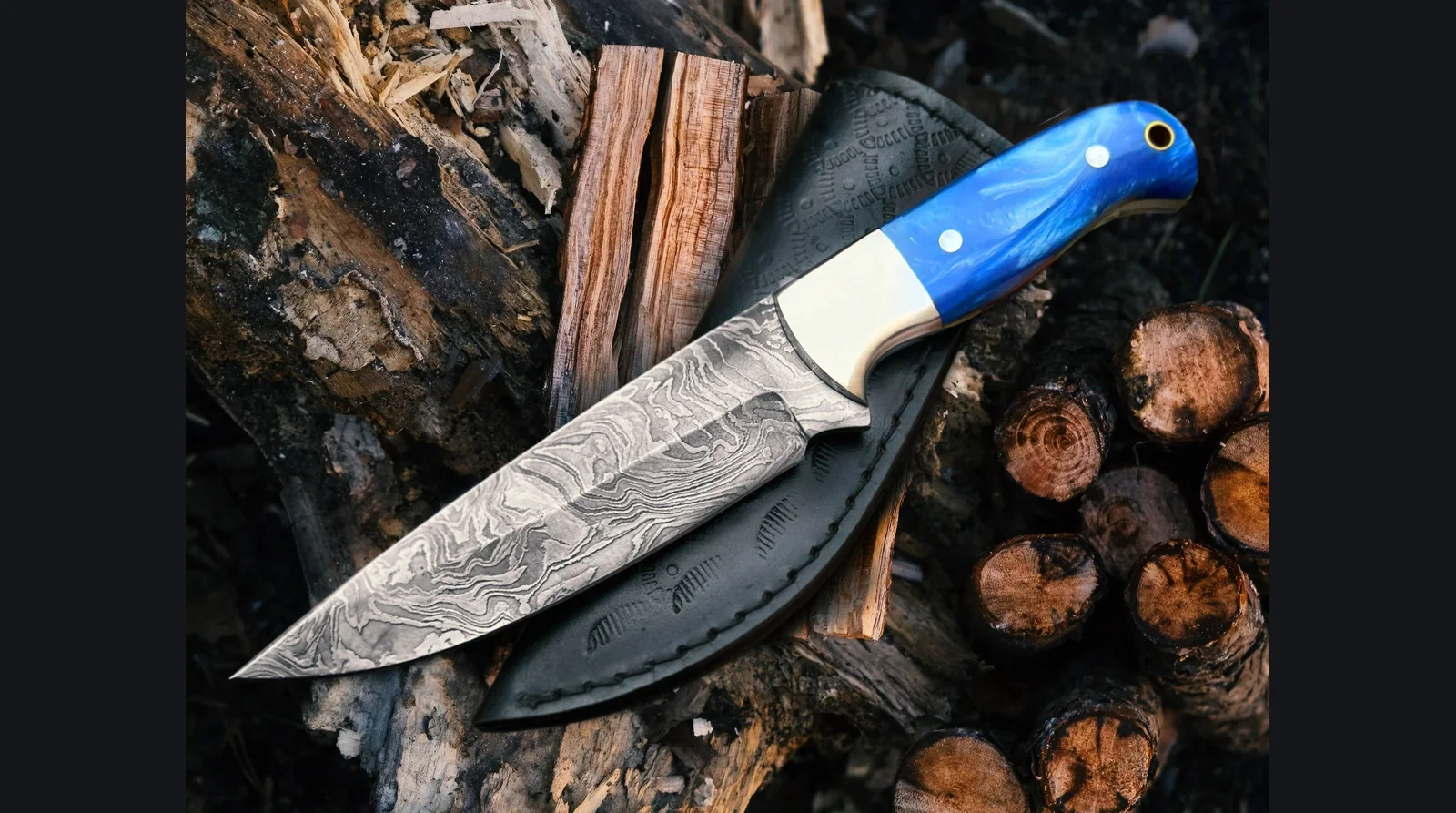
Short answer: real Damascus is two steels forge welded together, so the pattern goes all the way through and reappears when you sharpen. Printed or acid-stencilled patterns sit on the surface only. There are three checks you can do in a shop, and one you can do at home.
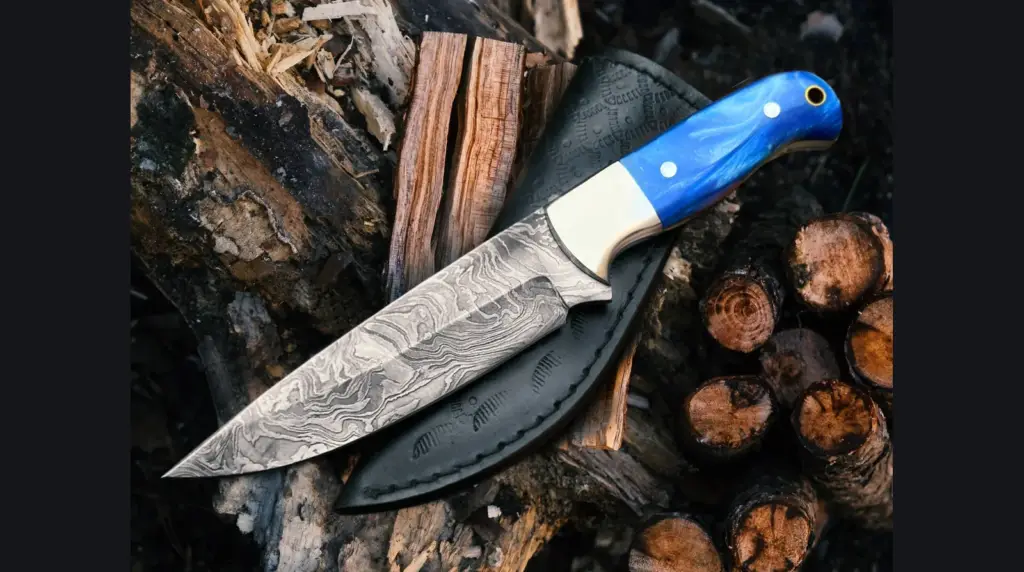
What the fakes are
- Laser or chemical etched. A pattern burned or masked onto plain stainless. Looks convincing in a photo, sits on the surface only.
- Printed or wrapped. A film or transfer, usually on very cheap knives. Wears at the edges.
- Powder pattern-welded but sold as hand forged. Genuine layered steel, made industrially in large billets. Not a fake material, but not what most people mean by hand forged, and it should not cost what a hand-forged blade costs.
Four checks
1. Look at the edge bevel
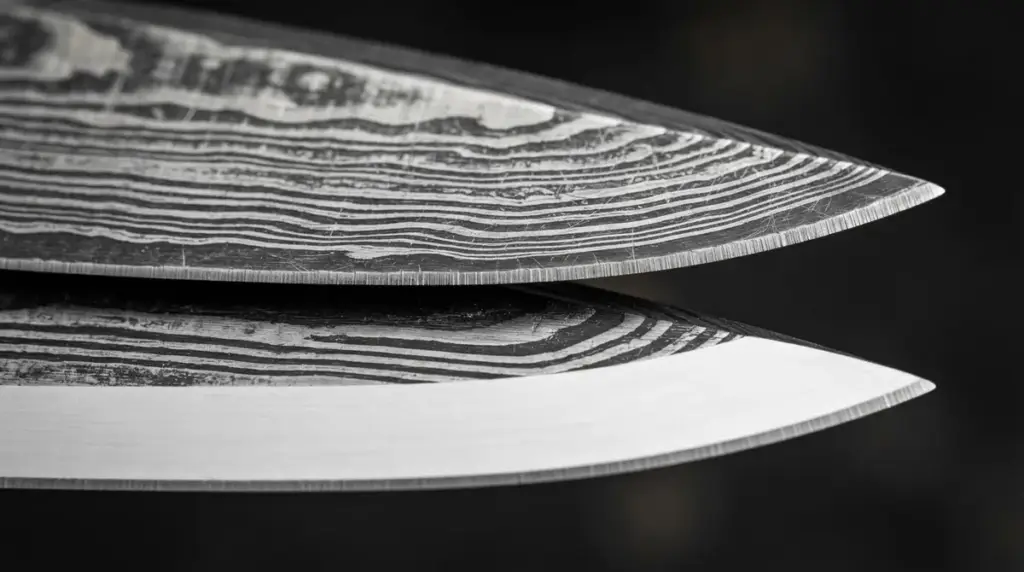
The most reliable test. On real Damascus the pattern continues down into the sharpened bevel and across the very edge, because the layers run through the steel. On an etched imitation the pattern stops dead where the bevel begins, leaving a clean bright line along the edge.
2. Look at the spine and the tang
Layers should be visible on the spine, on the plunge line and, if you can see it, on the exposed tang. A surface pattern is usually applied to the flats only, because that is what shows in a photograph.
3. Check that both sides differ
Forge welding produces a pattern that is related but never identical on the two faces of the blade. Stencilled patterns are often mirror-perfect, or repeat at a regular interval, because they came from one file.
4. The sharpening test, at home
Sharpen the knife properly on a stone. Real Damascus keeps its pattern into the fresh bevel. An imitation loses it and never gets it back.
What to look for before you buy
- The steel is named. Real makers say what is in the mix; ours is 1095 and 15N20.
- The hardness is given. If nobody will tell you the HRC, nobody heat treated it carefully.
- Photographs are of the actual knife, and two knives never share an identical pattern.
- The price covers the labour. Forge welding, drawing out, grinding, heat treating, fitting and finishing is days of work.
- The origin is specific. Hand forged somewhere is not an answer. Ours are forged in Memphis, Tennessee.
Are Damascus knives real Damascus?
This is the question underneath all the others, and it has two answers depending on which Damascus you mean.
If you mean historical wootz, then no, and nobody's knife is. Wootz was a crucible steel made in South Asia and traded through Damascus, and its pattern came from carbide banding inside a single steel rather than from layers. The production method genuinely was lost and has only been partially reconstructed in laboratories. Any seller claiming their blade is historical Damascus steel is either confused or lying.
If you mean modern pattern welded steel, which is what the entire knife trade means by the word, then a great many knives are perfectly real and a great many are not. Real means two steels forge welded, folded, drawn out and etched, so the pattern goes all the way through the blade. Fake means a pattern applied to the surface of a single piece of steel by acid stencil or laser, which stops at the surface and disappears where you sharpen.
So the honest phrasing is this: modern Damascus is not the ancient stuff, it never claimed to be, and it is a legitimate steel in its own right. The fraud in the market is not modern versus ancient. It is layered versus printed.
Where are Damascus knives made?
Most Damascus sold in the United States is forged overseas, principally in Pakistan and India, and finished or simply relabelled domestically. That is not automatically a quality problem. It becomes a problem when an imported blade is sold at the price of an American forged one, or when the listing implies domestic manufacture without saying it.
The wording on the page is the tell. Made in USA is a strong claim covering the blade. Assembled in USA, handcrafted in USA, designed in USA and finished in USA are all much weaker and usually mean the blade arrived finished. We wrote a full breakdown in best Damascus knives made in the USA.
Our own blades are forged, ground, heat treated and finished in our workshop in Memphis, Tennessee, from layered 1095 and 15N20 at 58 to 60 HRC. There is no second imported line under another label.
How to spot fake Damascus steel, step by step
Work through these in order. The first three cost nothing and cannot damage the blade, so do them before you buy. The last two remove metal or stain the finish, so save them for a knife you own and have stopped trying to return.
Step 1: inspect the edge under magnification
A ten times jeweller's loupe or a phone camera in macro mode is enough. On real Damascus the layer bands cross the bevel at a shallow angle and continue to the cutting edge, and because the two steels etch to different depths you can feel faint relief with a fingernail. On a printed blade the pattern is dead flat, stops at the bevel shoulder, and leaves a bright band along the edge. It settles most cases in ten seconds.
Step 2: check the spine, the plunge line and the tang
Turn the knife and look at every surface that is not a flat. Layers should show on the spine, at the plunge, and on any exposed tang. Surface patterns go on the flats because that is what a listing photograph shows, so the spine of a fake is usually plain, and any pattern on it will not line up with the face.
Step 3: sanity check the price against the labour
Forge welding a billet, drawing it out, grinding, heat treating and finishing is days of skilled work. Compare a listing against that, not against the other listings on the same marketplace, because a market full of printed blades makes a printed price look normal. More on the process in how Damascus steel is made.
Step 4: the sharpening test
This removes metal, so it is not reversible and it voids most return windows. Sharpen a millimetre or two off the edge on a stone, following how to sharpen a knife. Real Damascus carries the pattern into the new bevel, because the layers go through the steel. An imitation loses it along the freshly ground band and never gets it back, and each sharpening walks that bright line further up the blade.
Step 5: the acid re-etch, last resort only
Diluted ferric chloride, or a long soak in strong vinegar, darkens the high carbon layers and brings a genuine pattern up. It also stains a satin finish, ruins a mirror polish, pits the blade if left too long, and attacks fittings, pins and some handle materials. Never do this to a knife you might return or care about. It proves nothing the edge bevel has not already told you.
Laser-etched and chemically printed fakes, and how they give themselves away
The three surface methods each leave their own signature.
- Laser etched. A pattern burned into plain stainless. Under a loupe the lines are all the same width, with a grey frosted edge where the metal oxidised. The pattern usually stops short of the blade outline instead of running off it, because a file was placed on the blank.
- Chemically printed or stencilled. Acid bitten through a mask. Boundaries are hard-edged with no gradient, the figure repeats at a fixed interval, and both faces are often mirror images. A real billet is never symmetrical face to face.
- Film or transfer wrapped. A printed layer sitting on top of the steel. A fingernail catches where the film terminates at the ricasso, and it wears through first at the pocket contact points.
All three behave the same once a stone touches them. The fresh bevel comes up bright, uniform and plain, with a hard line where the pattern stops.
Wording that should slow you down
Sellers rarely lie outright. They pick a true phrase that lets you assume the rest.
- Acid washed. A legitimate finish on a single piece of steel. It darkens the surface, it does not create layers, and a blade described only as acid washed is a mono-steel.
- Damascus pattern, finish, style or effect. Every one of these describes an appearance rather than a material. The seller has already told you what it is.
- Damascus pattern coated. Coated means applied on top. There is nothing ambiguous about this one.
- A layer count with no steels named. A real count comes from a known stack and a known number of folds. If nobody will say which two steels were welded, the number is decorative. See what 352 layers actually means.
What a seller should be able to answer
Five questions, each answerable in a sentence by anyone who made the knife or bought it from whoever did.
| Which two steels? | A named pair. Ours is 1095 and 15N20. |
| How many layers, and how was it counted? | A starting stack and a number of folds, not a round marketing number. |
| Who forged the billet, and where? | A workshop and a place. Ours is Memphis, Tennessee. Hand forged somewhere is no answer. |
| What is the heat treatment and the hardness? | A tested HRC range. Ours is 58 to 60 HRC. |
| Is the photograph this knife? | Yes, or a clear no. Two forged blades never share a pattern. |
Silence, brand language, or an answer that changes when you ask twice all tell you the same thing.
What to do if you think you were sold a fake
Act in this order, and stop testing the knife, because you need it in the condition it arrived in.
- Do not sharpen it and do not acid test it. Both destroy the evidence you would rely on.
- Photograph the edge bevel under magnification, and screenshot the listing before it can be edited.
- Contact the seller and quote their own wording back. If the listing said pattern or finish, they have a defence. If it said forged, folded or layered, they have none.
- Use the marketplace dispute process inside its window. If that fails, ask your card issuer or payment provider for a chargeback on the basis that the item was not as described. In practice this is the route that recovers money.
- Reporting is separate from recovery. Consumer protection bodies act on patterns of deceptive advertising rather than on one order, so reporting a seller rarely gets your money back, but it is still worth doing. This is general information, not legal advice, so check your local law.
If the knife turns out genuine, look after it. Layered 1095 and 15N20 is carbon steel and spots if it goes away damp; see Damascus knife care.
Questions people ask
Is modern Damascus the same as historical wootz?
No. Wootz was a crucible steel from India and Persia with a pattern that came from the casting, and the method was lost. What everyone makes today is pattern-welded steel, which is a different and older European and Japanese tradition.
Does a mirror polish hide the pattern?
It can. Polishing removes the etch relief. A properly finished Damascus blade is etched after final polish, not before.
Can I test it with a magnet or acid at home?
A magnet tells you nothing useful. Acid does work but you can ruin a knife with it. Read the edge bevel instead; it is free and it is conclusive.
Are Damascus knives real Damascus?
Modern Damascus is real pattern welded steel, but it is not the historical wootz that the name comes from. The question worth asking a seller is not whether the knife is ancient Damascus, it is whether the pattern runs through the steel or sits on top of it. Look at the edge bevel and you will know in three seconds.
How can I tell if a Damascus knife is authentic?
Check the edge bevel: on a real blade the layers continue into the freshly ground bevel, on a printed one the pattern stops at the shoulder. Check that both faces show different figure, because a real billet is never symmetrical. Check the spine and the exposed tang, which are almost never etched on a fake.
Where are Damascus knives made?
Most Damascus sold in the US is forged in Pakistan or India and finished domestically. Some is forged in the United States, Japan and Europe. Origin is a separate question from authenticity: an imported blade can be genuinely layered, and a domestically finished one can be printed.
Is a real Damascus knife worth the money?
If it is properly forged and heat treated, yes. Our guide on whether Damascus knives are worth it goes through the trade offs, and what a real Damascus knife costs covers the price bands.
How do I spot fake Damascus steel before I buy online?
Ask for a close photograph of the edge bevel and the spine, taken in daylight. Real layers continue into the bevel and show along the spine; a printed pattern stops at the bevel shoulder and leaves the spine plain. Then compare both faces of the blade. A forged billet produces related but different figure on each side, while a stencilled one is often mirror-perfect.
Does "acid washed" mean the Damascus is fake?
It means the listing has not claimed layers. Acid washing is a real finish that darkens the surface of a single piece of steel, and it is used honestly on plenty of good knives. It just has nothing to do with pattern welding. The same applies to Damascus pattern, Damascus finish, Damascus style and Damascus pattern coated, all of which describe an appearance rather than a material.
Will sharpening remove the pattern from a fake Damascus knife?
Yes, along the ground band, and permanently. Real Damascus keeps the pattern into the fresh bevel because the layers run through the steel. On an etched or printed blade the new bevel comes up bright and plain, and every subsequent sharpening pushes that bare line further up the blade. It is a conclusive test, but it removes metal and voids most return windows, so use it last.
What should a seller be able to tell me about a Damascus blade?
Five things, each in a sentence: which two steels were welded, how many layers and how the count was reached, who forged the billet and where, what heat treatment was used and to what hardness, and whether the photograph is of that actual knife. Ours is 1095 and 15N20, forged in Memphis, Tennessee, at 58 to 60 HRC. Vague answers to any of the five are the answer.
Can a jeweller's loupe tell real Damascus from a printed pattern?
Usually, yes. At ten times magnification a genuine blade shows layer bands crossing the bevel with slight surface relief you can feel with a fingernail, because the two steels etch to different depths. A laser-etched pattern has uniform line widths and a grey, frosted edge. A stencilled one has hard boundaries with no gradient and repeats at a fixed interval.
What can I do if I was sold a fake Damascus knife?
Stop testing it, photograph the edge under magnification and screenshot the listing. Quote the seller's own wording back to them: forged, folded and layered are claims, while pattern and finish are not. Then use the marketplace dispute window, and failing that a card chargeback for an item not as described, which is what usually recovers the money. This is general information, not legal advice; check your local law.
More guides
- What 352 Layers Actually Means
- Damascus vs D2 vs 440C vs VG10: Which Steel
- Damascus Knife Care and Sharpening
- Hand-Forged vs Factory Made Knives
- Pride Knives and Rainbow Blades: Where the Colour Comes From
More from the workshop
Corporate Knife Gifts: Engraved Logo Knives for Employees and Clients
Gift ideas for employees and clients, logo engraving that survives the blade, volume tiers and the dates to order by.
Pearl, Abalone, Stag and Bone: The Exotic Handle Materials
What the exotic handle materials actually do over time, written by the people who have to warranty them.
Starting a Knife Collection Without Wasting Money
Four knives, one rule, a budget that holds, and the truth about resale value.
