

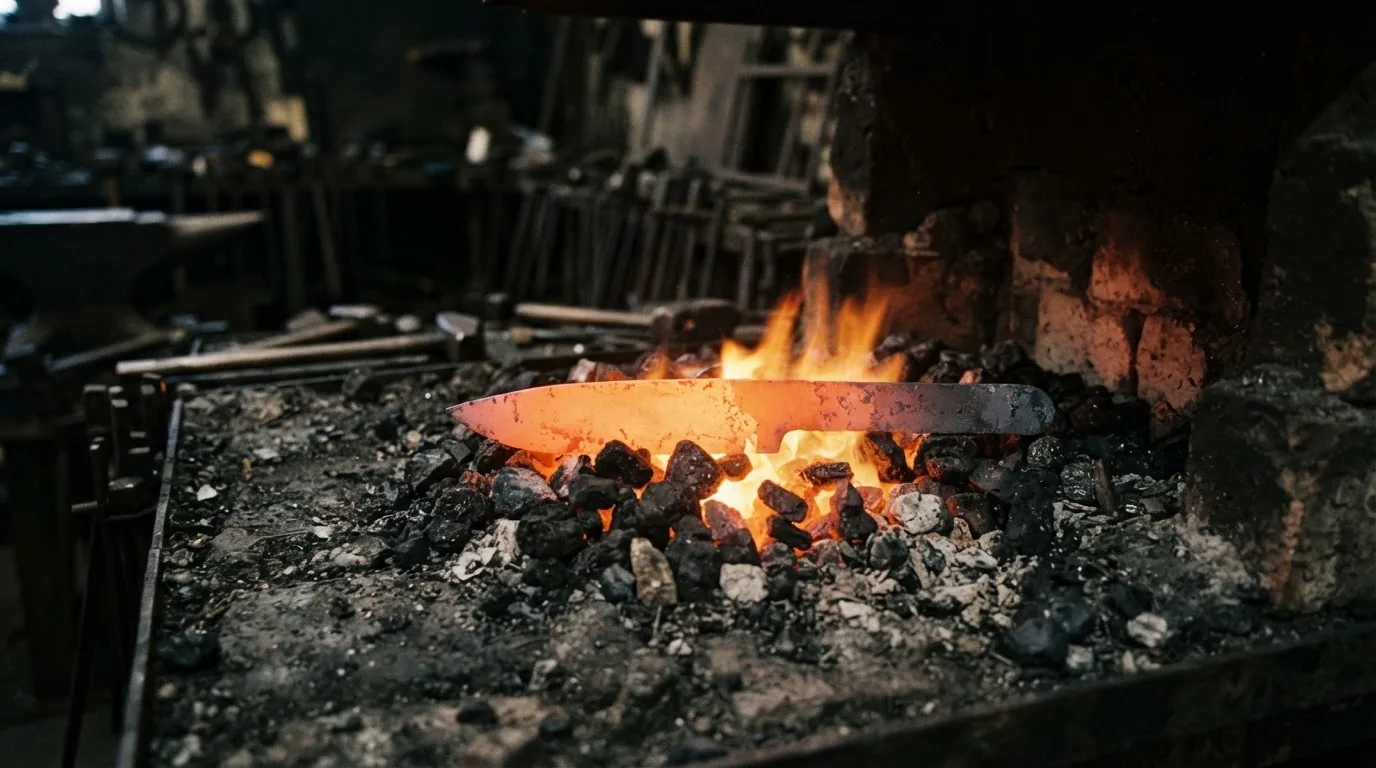
Short answer. Heat treatment is the controlled heating and cooling that turns a soft bar of steel into a blade. It runs in three stages: austenitising, which dissolves carbon into the structure at high temperature, quenching, which traps that carbon by cooling fast enough to form martensite, and tempering, which gives back a little hardness in exchange for the toughness that stops the blade snapping. Every measurable thing a knife does well comes from this step and not from the shape of the hammer that made it. It is also the one step a buyer cannot inspect, which is why a soft heat treat is the most common defect in cheap Damascus and the hardest one to catch.
What is actually happening inside the steel
Knife steel is iron with carbon in it, plus whatever alloying elements the grade calls for. At room temperature the carbon sits in a soft phase called ferrite, mostly locked away in carbides. Heat the steel past its critical temperature and the crystal structure changes to austenite, which can hold far more carbon in solution. Hold it there and the carbides begin to dissolve, feeding carbon into that solution.
Now cool it fast. If you cool fast enough, the carbon has no time to move back out, and the structure shears into martensite: a distorted, strained, very hard arrangement. That is the whole trick. Hardness is trapped carbon.
Martensite straight out of the quench is also brittle enough to snap under hand pressure. Tempering, which is a low temperature reheat, lets a small, controlled amount of that strain relax. You lose a point or two of hardness and you gain the toughness that makes the object a knife rather than a piece of glass shaped like one.
Normalising and annealing, the preparation nobody sees
Before any of that can work reliably, the steel has to start in a known condition. This matters most on forged blades, because forging heat grows grain and grain size is a first order control on toughness.
Normalising means heating above the austenitising temperature, often to something near 1,650 degrees Fahrenheit for a simple carbon steel, then cooling in still air. Two or three cycles at falling temperatures reset the grain and relieve forging stress. Annealing is a lower temperature soak, often near 1,400 degrees Fahrenheit, with a slow cool, and it softens the steel so it can be drilled and ground.
Larrin Thomas of Knife Steel Nerds puts inconsistent starting microstructure at the top of his list of ways a heat treat goes wrong, and it is the invisible one. Two blades that go into the same oven on the same schedule can come out different if they did not go in the same.
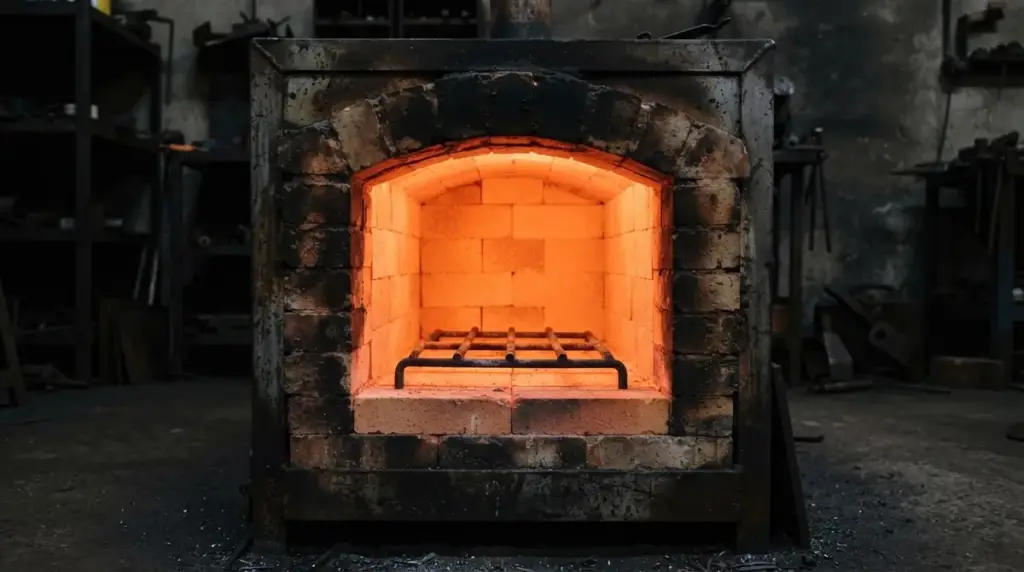
Austenitising: temperature and soak time
This is the high temperature hold, and the number depends entirely on the grade. Across the range of knife steels it spans roughly 1,450 to 2,250 degrees Fahrenheit. A simple 1095 lives near the bottom of that. A high alloy stainless or a powder steel lives near the top.
Two mistakes sit either side of the correct number. Too low, or too short, and the carbides never dissolve, so there is not enough carbon in solution and the blade comes out soft. Too high, or too long, and the grain grows, plate martensite forms, and retained austenite increases. Thomas gives a blunt example: CruForgeV austenitised at 1,550 degrees Fahrenheit rather than the correct 1,450 to 1,500 range absorbed less than 2 ft lbs of energy in toughness testing. That is a blade that will chip if you look at it.
Soak time is not a detail either. His practical guidance is to hold for about 30 minutes at temperature after the furnace has recovered from the door being opened, which is longer than a lot of home shops allow.
A magnet will tell you when steel has passed its Curie point and stopped being magnetic, and that is a useful floor. It will not tell you whether you are at 1,475 or 1,600 degrees, and the difference between those two numbers is the difference between a good knife and a brittle one. Anyone heat treating by eye in a forge is working with a wide tolerance, which is workable for 1095 and not workable for D2.
The quench: media, speed and what goes wrong
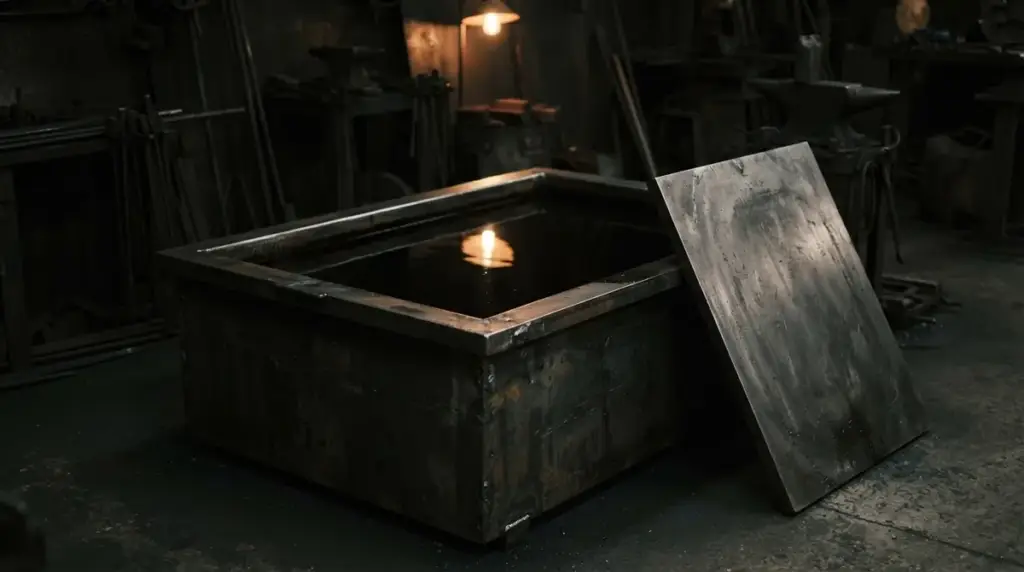
The quench has to outrun the steel's own chemistry. Cool too slowly and softer phases form before martensite gets a chance. Cool too fast and the blade cracks or warps.
Steels are grouped by what they need. Water hardening steels need the fastest media and are the least forgiving. Oil hardening steels, which covers most simple carbon knife steels, want a fast quench oil. Air hardening steels, which is where D2 sits, are cooled in still or moving air, or plate quenched between aluminium blocks.
| Stage | What it does | Typical range | What goes wrong |
|---|---|---|---|
| Normalising | Resets grain after forging, relieves stress | Around 1,650 F, air cool, two or three cycles | Skipped, leaving coarse grain from the forge |
| Annealing | Softens for drilling and grinding | Around 1,400 F, slow cool | Cooled too fast, steel stays hard to machine |
| Austenitising | Dissolves carbides into solution | 1,450 to 2,250 F depending on grade | Too low means soft, too high means brittle |
| Quench | Traps carbon as martensite | Water, fast oil, air or plate | Too slow means soft spots, too fast means cracks |
| Cryogenic hold | Converts retained austenite | Dry ice or liquid nitrogen, straight after the quench | Delayed too long, so it does much less |
| Tempering | Sets final hardness and toughness | Usually two cycles of one to two hours | Too few cycles, or landing inside the embrittlement band |
One detail worth knowing because it explains a lot of warped blades: the blade should be moved up and down through the quenchant to break the vapour jacket, not side to side. Side to side motion cools one face faster than the other and pulls the blade into a curve.
Retained austenite and cryogenic treatment
Not all of the austenite converts to martensite at room temperature. What is left over is called retained austenite. It is soft and ductile, which sounds harmless and is not: it lowers yield strength, and it can transform later, in use, into untempered martensite, which is the most brittle thing that can exist inside a blade.
A cryogenic hold, using dry ice or liquid nitrogen immediately after the quench, drives more of that conversion and raises hardness. It works best when it happens straight away rather than the next morning.
The honest limit on cryo is that it does less for cutting than the marketing suggests. Knife Steel Nerds reports CATRA edge retention testing on 154CM showing no improvement from cryogenic treatment beyond what the hardness gain itself explains. It is a hardness and dimensional stability tool, not a magic step.
Tempering: where the final number is set
Tempering is a low temperature reheat, usually two cycles of one to two hours each, and it is where the maker chooses the hardness the customer gets. Higher tempering temperature means lower hardness and more toughness. Two cycles rather than one matter because the first cycle transforms some retained austenite into fresh untempered martensite, and the second cycle tempers that.
There is a trap in the middle of the range called tempered martensite embrittlement. Tempering in roughly the 450 to 650 degree Fahrenheit band reduces toughness rather than increasing it, which is not what intuition suggests. Thomas gives 5160 as an example where tempering at 350 degrees Fahrenheit yielded less than half the toughness of tempering at 375, a 25 degree difference producing a doubling. Silicon alloying and higher alloy content push that band around, but it is real and it is why makers work to a datasheet rather than by feel.
The nine ways a heat treat goes wrong
Thomas lists nine failure modes. They are worth reading as a buyer, because each one shows up differently in the hand.
| Fault | What it is | What the owner notices |
|---|---|---|
| Inconsistent starting structure | Blades enter the oven in different conditions | Two knives from one batch behave differently |
| Insufficient austenitising | Too cool or too short, carbides never dissolve | Blade below 50 Rc, will not hold an edge at all |
| Overaustenitising | Too hot or too long, grain grows | Edge chips instead of rolling, tip snaps |
| Decarburisation | Carbon burned out of the surface | Sharpens easily, dulls immediately, never improves |
| Quench too slow | Soft phases form before martensite | Soft patches along the edge |
| Quench too fast | Thermal shock | Cracks, sometimes hairline and invisible, and warping |
| Under tempered | Too cold or too short | Brittle, chips out on bone or a staple |
| Over tempered or in the embrittlement band | Wrong temperature choice | Soft, or oddly brittle at a hardness that should be tough |
| Too few tempering cycles | Fresh untempered martensite left behind | Unpredictable chipping |
Differential hardening, hamon and edge quenching
A blade does not have to be one hardness end to end. Differential hardening leaves the edge hard and the spine soft, so the knife resists chipping at the edge and bending rather than breaking through the body.
The traditional method coats the spine in a clay slurry before the quench, so that region cools more slowly and does not form martensite. The boundary between the hardened and unhardened zones becomes visible after polishing and etching as a hamon: a wavy line following the clay edge. Edge quenching does the same thing more crudely by dipping only the lower part of the blade in the oil.
Two things worth saying. First, a hamon is evidence of a differential quench only when it is a genuine transition line, and a great many hamon looking lines on the market are etched or wire brushed on. Second, differential hardening works on shallow hardening simple steels such as 1095 or W2 and does not work on air hardening steels such as D2, which harden all the way through no matter what you paint on them. We publish no hamon blades in the current catalogue and we do not claim any.
What hardness we hold, and what we do not test
Here is the part that is uncomfortable to write. These are the hardness figures we hold and publish.
| Steel | Hardness held | Live listings | Tested per batch? |
|---|---|---|---|
| 1095 with 15N20 Damascus | 58 to 60 HRC | 321 | Yes, held to the published range |
| D2 tool steel | 58 to 62 HRC | 112 | Yes, held to the published range |
| 440C stainless | 58 to 60 HRC | 26 | Yes, held to the published range |
| Plain high carbon steel | Not published | 76 | No, not tested per batch |
| High carbon spring steel | Not published | 5 | No, not tested per batch |
| No steel named in the listing | Not published | 23 | No |
Counted on 30 August 2026 across 609 published products, 393 listings carry an HRC figure and 216 do not. Of the 99 listings built on plain high carbon or spring steel, 47 publish no hardness at all. We do not Rockwell test those batches and we do not publish a number for them, because publishing one we had not measured would be an invention. If hardness matters to you, buy from the Damascus, D2 or 440C lines where the figure is held, and ask us before you order otherwise.
The second uncomfortable number: 36 of our 320 Damascus listings do not name 1095 and 15N20 anywhere in the description. Those are almost certainly the standard billet, but almost certainly is not a specification, and we are correcting them.
How a buyer can check, and why mostly they cannot
Hardness is the one specification you cannot verify by looking, and a soft blade looks exactly like a hard one. A few practical checks exist.
The file test. A sharp new file drawn across the spine at a shallow angle will bite into steel below roughly 58 Rc and skate on steel above it. It is crude, it damages the finish, and it tells you a range and not a number.
Ask for the number and the steel together. A seller who names one without the other is telling you nothing. 58 HRC means very different things in 1095 and in D2.
Watch how the edge fails. An edge that rolls or dents is soft. An edge that chips is hard, or coarse grained, or under tempered. An edge that sharpens beautifully and is gone within a day of light use is the classic signature of decarburisation or a badly under austenitised blade.
Be suspicious of unpriced hardness. A proper heat treat with a controlled oven, a soak, a fast quench, cryo where the grade wants it and two tempering cycles costs money and time. A Damascus knife sold at a price that cannot cover it usually has not had it. Our own Damascus knife price guide sets out where the money goes.
Questions people ask
What does heat treating a knife actually do?
It dissolves carbon into the steel at high temperature and then traps it there by cooling fast, producing martensite, which is hard. Tempering afterwards relaxes some of that hardness in exchange for toughness. The result is a blade that can take an edge and keep it without snapping.
What are the three stages of knife heat treatment?
Austenitising, quenching and tempering. On a forged blade, normalising comes first to reset the grain. A cryogenic hold sits between the quench and the temper on steels that benefit from it.
What hardness should a knife be?
Most kitchen and outdoor knives sit between 58 and 62 HRC. Below about 56 the edge rolls under normal use. Above about 63 in a simple steel the edge chips instead of deforming. The right number depends on the steel and the job, not on bigger being better.
Does higher hardness mean better edge retention?
Broadly yes, and the size of the effect is modest. Knife Steel Nerds puts the gain at roughly 5 to 10 percent per Rockwell point. Edge geometry does more: the same testing shows that going from 25 degrees per side to 15 degrees per side improves cutting performance across every steel tested by a much larger margin.
Can a bad heat treat be fixed?
Usually yes, by heat treating again from the start, including a fresh normalising sequence. What cannot be fixed is a crack, a badly warped blade, or a knife that has already been ground, polished and handled, because the whole thing has to come apart first. In practice nobody redoes a finished knife.
What is retained austenite?
The portion of the austenite that never converted to martensite during the quench. It is soft, and it can transform later during use into untempered martensite, which is brittle. Cryogenic treatment and multiple tempering cycles are the two tools for dealing with it.
Is cryogenic treatment worth it?
For high alloy and stainless steels it raises hardness and improves dimensional stability, and it is standard practice in good shops. For cutting performance specifically the evidence is thinner: CATRA testing on 154CM published by Knife Steel Nerds showed no edge retention improvement attributable to cryo itself.
Can you heat treat a knife in a forge instead of an oven?
You can, and it is how blades were made for centuries, but the tolerance is much wider. A forge without a controller gives you a temperature you are guessing at within perhaps a hundred degrees. That is workable for a simple shallow hardening steel and unworkable for D2 or a stainless grade.
Why do cheap Damascus knives lose their edge so fast?
Almost always heat treatment, not the pattern. The two commonest causes are an under austenitised blade that never reached hardening temperature properly, and a decarburised surface left on after forging. Both produce a knife that sharpens easily, feels sharp, and is blunt within a day. Neither is visible in a photograph.
Do you publish the hardness of every knife you sell?
No. We publish and hold 58 to 60 HRC for 1095 with 15N20 Damascus, 58 to 62 HRC for D2 and 58 to 60 HRC for 440C. We do not Rockwell test our plain high carbon and spring steel blades per batch and we publish no hardness for them. Counted on 30 August 2026, 216 of 609 live listings carry no HRC figure. We would rather say that than print a number we have not measured.
More guides. For the alloys and what each one is for, see the knife steel chart and the knife steel comparison. For the forge welding sequence that comes before any of this, read how Damascus steel is made. For how the two Damascus families differ in steel, see stainless Damascus and carbon Damascus. For where heat treat sits among the things that make a blade worth buying, see our best hunting knife guide.
More from the workshop
Damascus Katana and Samurai Sword Guide
Pattern welded versus traditional, the stainless warning, tang checks and real price bands.
Neck Knives: Carry Position, Sheath Retention and Legal Reality
Neck carry is a concealment question first. Retention, weight, cord safety, and an honest look at what our nine listings really are.
Butterfly Knife Tricks for Beginners
Start on a trainer, get smooth before fast, and learn the close before the open.
