
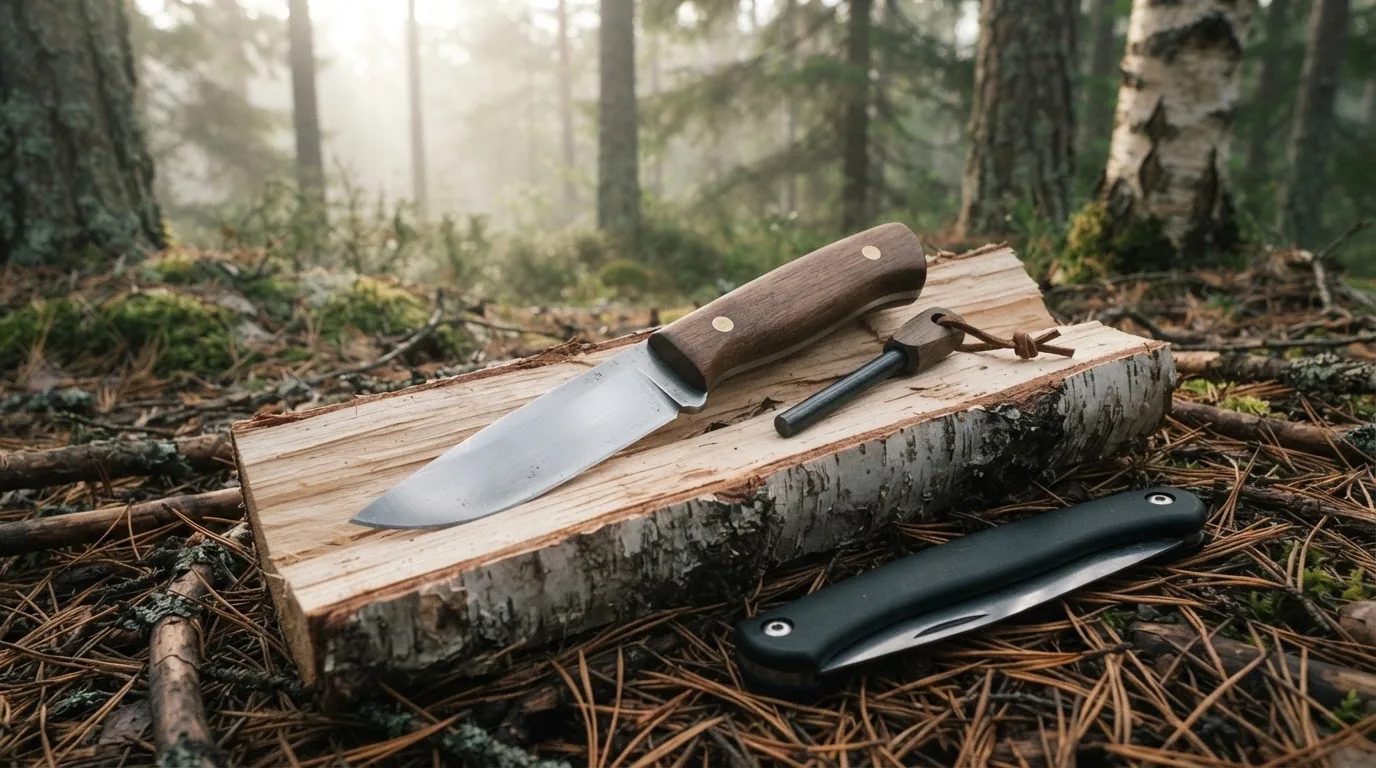
Short answer: a bushcraft or camp knife is a fixed blade of roughly 3.5 to 4.5 inches, full tang, with a simple grind, a comfortable handle and a sheath you can carry all day. It is a woodworking tool first and a food and game tool second. Get the length, the grind and the spine right and almost any decent steel will serve. Get them wrong and no steel will save you. The two details that separate a real bushcraft knife from a camp knife that merely looks the part are a sharp, square spine you can strike a ferro rod with, and an edge geometry you can restore with one stone in the field.
What a bushcraft knife actually has to do
Strip away the marketing and the job list is short and specific. Carve feather sticks and tent pegs. Notch and shape wood for a pot hanger or a trap trigger. Split small rounds down to kindling. Strike a ferro rod. Cut cord, tape and webbing. Prepare food, and process small game or fish if the trip calls for it. Occasionally, scrape a birch bark tinder bundle or make char cloth.
Notice what is not on that list. Chopping is not on it, because a knife is a poor axe. Prying is not on it. Digging is not on it. Combat is not on it. The single most common mistake in this category is buying a knife long enough to chop, which makes it clumsy at every job that is actually on the list, and still worse than a hatchet at the one that is not.
The second thing to notice is that most of the list is woodworking. That is why bushcraft knife design has more in common with a carpenter's marking knife than with a hunting knife, and it is why the grind argument matters more here than anywhere else in knives.
Blade length: why the window is narrow
Almost every experienced source lands in the same place: a blade between about 3.5 and 4.5 inches, with an overall length under about 10 inches. That is not fashion. It is the range where a blade is long enough to split a wrist thick round with a baton and short enough that you can choke up on it and carve with control.
Under about 3.25 inches you lose the ability to baton anything worth splitting, and the handle usually shrinks with the blade until it stops filling a gloved hand. Over about 5 inches the blade starts to lever against your wrist during fine carving, the balance moves forward, and you find yourself gripping the blade itself to get control back.
Blade thickness sits in a similar band. Around 0.1 to 0.16 inches at the spine is the usual working range. Thinner cuts better and is more fragile in a baton. Thicker survives abuse and wedges badly in wood. Anything over about 0.2 inches is a survival knife pretending to be a bushcraft knife.
Grind: scandi, flat and convex
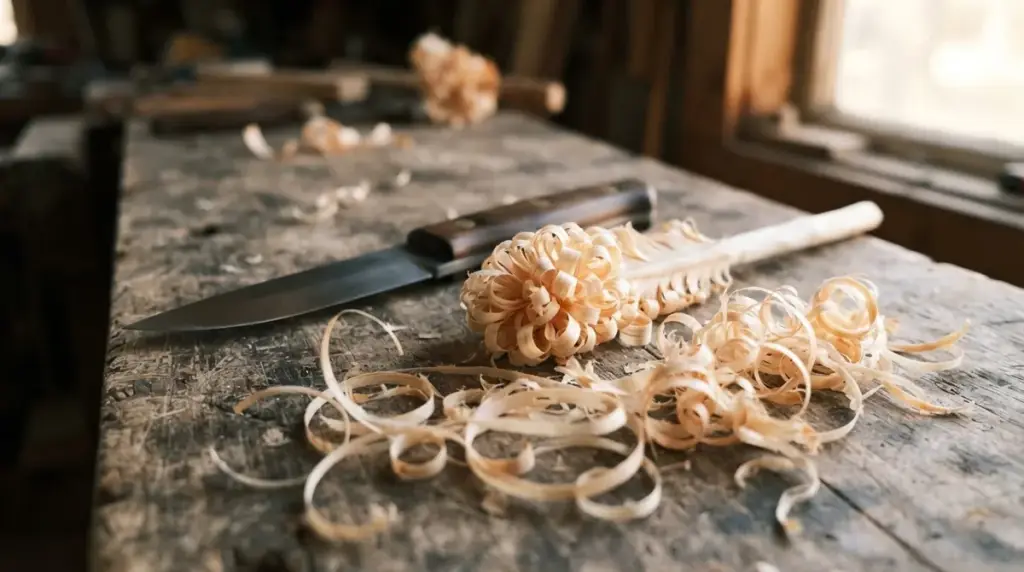
The scandi grind is a single flat bevel running from a fairly high shoulder straight down to the edge, with no secondary micro bevel. Nothing carves wood like it. The bevel acts as a built in guide against the workpiece, so you can feel the angle through the handle, and once it bites it dives and lifts a long clean shaving.
The honest counter argument, which the enthusiast sites tend to skip, is that a scandi grind is a wedge. In dense wood, in deep cuts and in anything soft and fibrous like meat or root vegetables, that wedge binds. A scandi knife is superb at the ten percent of camp work that is woodcarving and merely acceptable at the rest. It is also slower to sharpen than people claim, because restoring a true zero bevel means removing steel across the whole face rather than just at the edge.
A full flat grind tapers from the spine to the edge and takes a small secondary bevel. It slices better through food and game, it is easier to touch up, and it gives up some of the scandi's control in wood.
A convex grind rounds the shoulder away so the blade sheds material as it passes through. It is the strongest geometry at the edge, it does not bind, and it is the hardest to maintain properly without a strop and some practice.
Our own working answer, and we will be plain that this is a preference rather than a measurement: scandi if woodcraft is the point of the trip, flat if the knife is also going to cook and clean game, convex if you baton often and dislike chipping. If you want the geometry explained on a broader set of blades, our fixed blade bevels guide covers the same ground.
Spine geometry: the detail everyone skips
This is the part almost no buying guide covers, and it is a genuine specification rather than an opinion.
To throw sparks off a ferrocerium rod you need to scrape rod material away, and that requires an edge with a sharp arris, meaning a crisp 90 degree corner where the spine meets the flat of the blade. A spine that has been rounded off on a belt for comfort, or coated, or left with a heavy chamfer, will slide along a ferro rod and produce almost nothing. So will a spine that has been given a decorative bevel.
The same square spine does three other jobs. It scrapes fatwood into shavings. It scrapes birch bark into a fine tinder fluff. And it works as a scraper against a hardwood board when you want to true a stick.
What to check before buying: run a thumbnail down the spine near the handle. It should catch, not slide. If the maker has rounded the spine, you can restore a square arris yourself with a file or a coarse stone in about ten minutes, working only on the last two inches nearest the handle so the rest stays comfortable for a thumb.
Here is our own gap. Across 609 published products we mention a square spine on exactly one listing and a scandi grind on one. We do not publish spine geometry as a specification at all. If a square spine matters to you, and for a bushcraft knife it should, ask us about a specific knife before ordering rather than assuming.
Steel for a camp knife
Steel matters less than the internet believes, and it matters in a different way than most guides say. For camp work you want a steel that is tough rather than merely hard, that you can bring back with a pocket stone, and that will not surprise you with a chipped edge halfway through a baton.
| Steel | Hardness we hold | Toughness | Field sharpening | Corrosion | Camp verdict |
|---|---|---|---|---|---|
| Plain 1095 carbon | Varies by maker | Very good | Easy | Will rust, patinas | The traditional right answer |
| 1095 with 15N20 Damascus | 58 to 60 HRC | Good | Easy | Will rust, and the etch shows it | Beautiful, not the toughest choice |
| D2 tool steel | 58 to 62 HRC | Moderate, can chip | Slower, needs a decent stone | Semi stainless | Great edge holding, less forgiving |
| 440C stainless | 58 to 60 HRC | Moderate | Easy | Good | Sensible for wet country |
Now the part that is against our own interest. Patterned Damascus is a laminate of two steels chosen for how differently they etch, not for how they behave under a baton. Plain 1095 in a good heat treat is a tougher and more predictable batoning steel than the same maker's Damascus, and it costs less. We sell 320 Damascus products out of 609 and we still think that if your knife is going to be hit with a stick regularly, a plain carbon blade is the better tool. Buy the Damascus because you want the blade to be beautiful, and know what you are trading.
The other Damascus specific issue is the etch. The pattern lives in the top few thousandths of an inch of the surface. Striking a ferro rod on the spine will scuff it back to bright steel in a season, and so will a fire steel and a coarse stone. That is cosmetic, not structural, but people are surprised by it.
Tang, handle and sheath
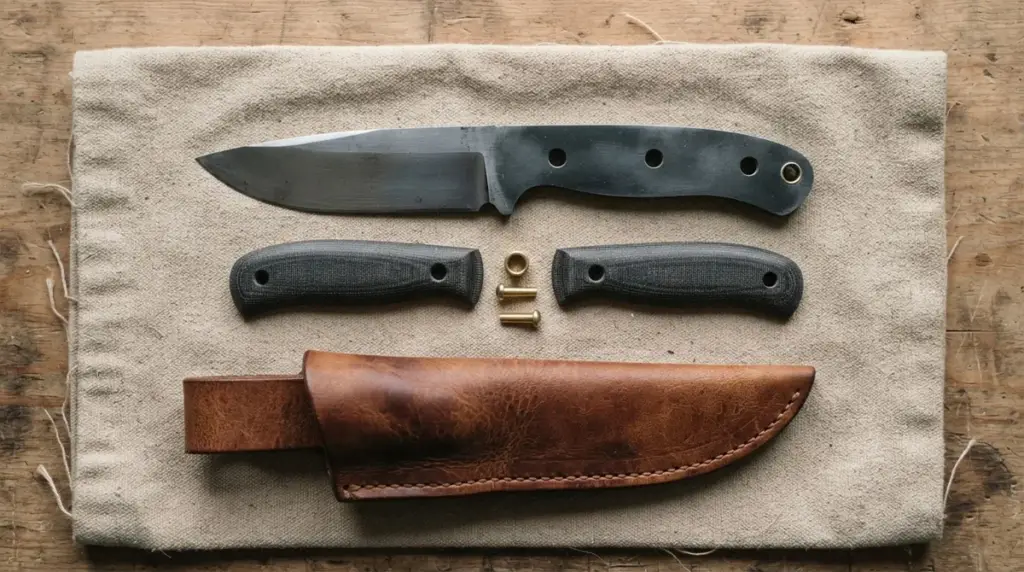
Full tang, meaning the steel runs the full width and length of the handle with scales pinned to it, is the default for a camp knife and for good reason: batoning puts a bending load through the handle. A well made hidden tang can be just as strong, but you cannot see it, so unless you know the maker, take the full tang. Our full tang and partial tang guide shows the failure points.
Handle shape beats handle material. A camp knife handle wants to be a simple oval or a gentle coke bottle with no aggressive finger grooves, because grooves only fit one hand size and one grip. You will use at least four grips: standard forward, chest lever, thumb on spine for control cuts, and reverse for scraping. Deep grooves fight three of them.
For material, micarta and stabilised wood both stay grippable when wet. Untreated wood swells and shrinks. Stag and horn look superb and move with humidity, which we cover in how to store knives. Polished, unstippled surfaces are a bad idea on anything that will be handled with cold, wet fingers.
The sheath is not an accessory. A camp knife lives on your belt for twelve hours, so a dangler or a firm belt loop that lets the knife swing when you sit matters more than the leather grade. Leather is quiet, kind to the edge and slow to dry. Kydex is loud, fast to drain and can dull an edge over years of draws. Whichever you get, check the retention with the sheath upside down before you trust it in the woods.
Batoning: what it actually costs
Batoning means placing the edge across the end grain of a round and driving the blade through with a wooden club on the exposed spine. It is a legitimate technique for making dry kindling out of a wet log and it is not free.
What it costs: it puts a bending load through the tang and handle, it hammers the spine, it can roll or chip an edge on a knot, and it will eventually loosen pinned scales. Split rounds no larger than the blade is long, never baton through a knot, never baton with the tip buried and the handle unsupported, and stop if the blade binds rather than twisting it out. Twisting is what actually breaks knives, not the hammering.
And the honest hierarchy: a folding saw and a small axe will do more work, faster and more safely, than any amount of batoning. Batoning is the technique you use when the saw is not in the pack.
What a bushcraft knife needs, against what we actually sell
We can measure this, so we will.
| Bushcraft target | What our hunting and outdoor range offers |
|---|---|
| Blade 3.5 to 4.5 inches | 32 of the 125 listings that publish a blade length fall in that window |
| Blade under 5 inches | 53 of 125. The median published blade length is 5 inches |
| Not a chopper | 51 of 125 are 6 inches or longer, up to 17 inches |
| Square spine for a ferro rod | Not published on any listing. One product of 609 mentions a square spine |
| Scandi grind | One product of 609 mentions a scandi grind |
| Full tang | Common across the fixed blade range, stated per product |
| Tough, sharpenable steel | 69 products in D2 at 58 to 62 HRC, $119 to $506, median $179 |
| Price | Hunting range $73 to $938, median $201 |
Read that honestly. Most of our outdoor catalogue is longer than a bushcraft knife should be, because most of it was designed as hunting and bowie work. Roughly a quarter of the range sits in the right length window. If you are shopping our hunting range for a camp knife, filter on blade length first and ignore everything else until you have. And our tracker knives, all twelve of which carry a 6.38 inch blade, are not bushcraft knives no matter how they are marketed elsewhere.
The knife, axe and saw system
The single biggest improvement most people can make to their camp cutting kit is to stop asking one knife to do three jobs.
A folding saw of about 7 to 10 inches cuts across the grain faster, safer and with less energy than any blade. A small axe or a hatchet splits and fells. The knife then only has to do the work it is actually good at, which is carving, notching and fine cutting, and it can be a lighter, thinner, better carving knife as a result.
Total weight for saw plus hatchet plus a 4 inch knife is usually lower than for one 8 inch survival knife trying to do everything, and it is far more capable. If weight is critical, drop the axe before you drop the saw. A saw plus a 4 inch knife plus batoning covers almost everything a hatchet does.
Sharpening a scandi in the field
Nobody writes this down, so here it is. A true scandi has one bevel and no secondary edge, which means the bevel itself is your angle guide. Lay the whole bevel flat on the stone. You will feel it seat. That is the angle, and you do not have to guess it.
Work the flat bevel on a medium stone with light pressure until you raise a burr along the full length, then do the same number of strokes on the other side. Finish on a fine stone or the back of a leather belt loaded with compound, again with the bevel flat. Do not add a micro bevel unless you have decided to convert the knife, because once you do, the self jigging property is gone and you are guessing an angle like everybody else.
Carry a medium and fine double sided pocket stone rather than a guided system. If your knife is D2 you will want a diamond plate instead, because D2's carbides are hard on natural and ceramic stones. The full method for plain edges is in how to sharpen a knife, and if you are carrying Damascus, read sharpening a Damascus knife first, because a coarse stone will take the pattern off the bevel permanently.
Questions people ask
What size blade is best for a bushcraft knife?
Between about 3.5 and 4.5 inches, with an overall length under about 10 inches. Shorter and you cannot baton usefully. Longer and fine carving becomes awkward, because the balance moves forward and the blade levers against your wrist.
Is a scandi grind really better for bushcraft?
For woodwork, yes, because the bevel jigs itself against the workpiece and lifts long clean shavings. For food, game and general cutting it binds, and it takes more steel removal to restore than people admit. If your camp knife also cooks, a full flat grind is the more sensible all rounder.
Why does a bushcraft knife need a square spine?
Because striking a ferrocerium rod works by scraping material off the rod, and that needs a crisp 90 degree corner where the spine meets the blade flat. A rounded or coated spine slides and gives you sparks that will not light tinder. The same square spine also scrapes fatwood and birch bark.
Can I baton with a Damascus knife?
You can, and people do, but plain 1095 in a good heat treat is tougher and more predictable under a baton than patterned Damascus, and it costs less. Damascus is a laminate chosen for how it etches, not for impact behaviour. If batoning is a weekly activity, buy plain carbon and spend the difference on a saw.
Full tang or hidden tang for a camp knife?
Full tang unless you know the maker well. Batoning puts a bending load through the handle, and a full tang lets you see that the steel goes all the way. A good hidden tang is equally strong, but you cannot inspect it from a photograph.
What steel is best for a camp knife?
Plain 1095 carbon if you can sharpen and oil it, 440C if you camp in wet country, D2 if you want the longest edge life and own a diamond plate. Toughness and ease of sharpening matter more in the woods than absolute edge retention.
Do I need an axe as well as a knife?
You need a saw more than an axe. A folding saw does more work per gram than either, and a saw plus a 4 inch knife will handle most camps. Add a hatchet when you are splitting a lot of rounds or building fires in wet weather.
How thick should a bushcraft blade be?
About 0.1 to 0.16 inches at the spine. Thinner carves better and is more fragile under a baton. Thicker survives abuse but wedges in wood and makes poor feather sticks. Over 0.2 inches you are carrying a survival knife, not a bushcraft knife.
Are tracker knives good for bushcraft?
Not really. The tracker profile splits its edge into a chopping section and a carving section, and does neither as well as a dedicated tool. All twelve of ours carry a 6.38 inch blade, which is well outside the bushcraft window. We have written the full case in our tracker knife guide.
Does Black Mamba Knives publish spine geometry?
No, and that is a gap. Across 609 products only one listing mentions a square spine and one mentions a scandi grind. If the ferro rod matters to you, ask us about the specific knife before ordering. We would rather answer the question than have you find out at the campsite.
More guides. Knife types explained, fixed blade bevels and grinds, full tang and partial tang, the knife steel chart, tracker knives explained, and the tracker knife category itself.
More from the workshop
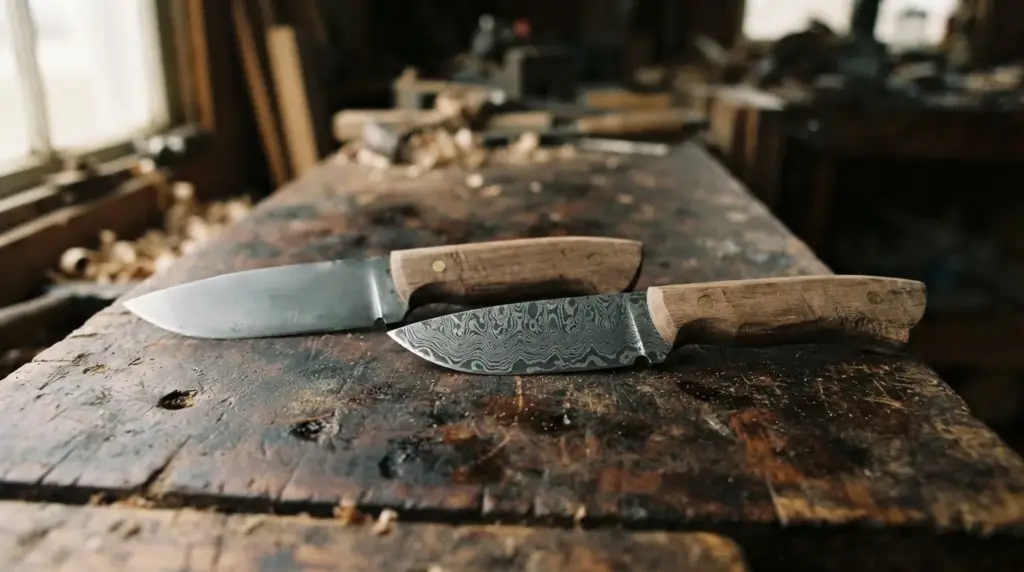
1095 or D2: Two Steels We Actually Sell
The pairwise comparison the steel charts skip, from a catalogue holding 111 D2 knives and 320 Damascus.
Field Dressing a Deer: The Cuts and the Knives
The field dressing sequence in order, sorted by which knife is in your hand, with the published cooling and CWD guidance.
Christmas Knife Gift Guide
What to buy for whom, the engraving cutoff dates nobody publishes, and the penny tradition that settles the old superstition.
