
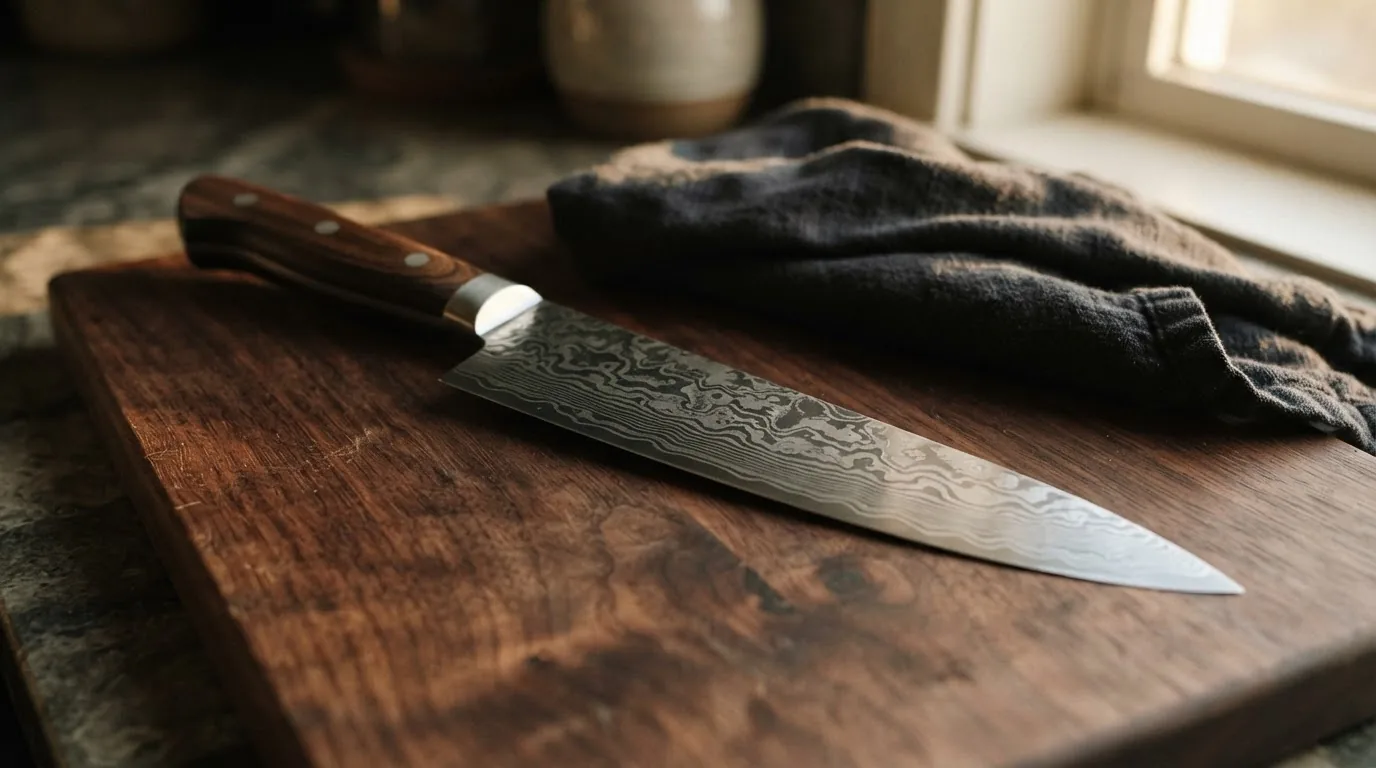
Short answer: yes, if you buy a real one and you want a knife that is a pleasure to own and use. No, if you are buying it because you have been told Damascus steel is stronger than everything else. It is not. What makes a Damascus knife worth the money is the forging, the heat treat and the hand work, and the pattern is the visible proof that all three happened. Anyone selling you the pattern alone is selling you a photograph of a knife.
What Damascus steel actually is
The word gets used for two completely different things, and almost every argument about Damascus knives comes from people talking about different ones.
Historical Damascus, sometimes called wootz, was a crucible steel made in South Asia and traded through Damascus from roughly the third century onwards. It had a surface pattern that came from carbide banding in the steel itself, not from layering. The method was genuinely lost, and modern metallurgists have only partially reconstructed it.
Modern Damascus, which is what every knife sold today means by the word, is pattern welded steel. Two steels with different nickel content are forge welded into a billet, drawn out, folded and welded again. At the end the blade is etched in acid, one steel darkens and the other stays bright, and the pattern appears. Ours is 1095 and 15N20.
So when someone asks what Damascus knives are made of, the honest answer is: two ordinary carbon steels, joined properly. That sounds less romantic than the legend and it is a great deal more useful, because it means the quality is knowable rather than mystical.
What is a Damascus knife?
A Damascus knife is a knife whose blade is made from pattern welded steel: two different steels forge welded together, drawn out, folded and welded again, then etched in acid at the end so the layers appear as a pattern. In our case the two steels are 1095 and 15N20, and the finished blade runs 58 to 60 HRC.
The name is borrowed. Historical Damascus, or wootz, was a crucible steel made in South Asia and traded through the city of Damascus, and its pattern came from carbide banding inside a single steel rather than from layers. That method was genuinely lost. Nobody sells it today, and anyone claiming to is either confused or lying.
So the modern definition is the useful one: a Damascus knife is a forged, layered blade whose pattern goes all the way through the steel. If the pattern sits only on the surface, it is a printed imitation rather than a Damascus knife, and the edge bevel will tell you which you are holding in about three seconds.
What is so special about Damascus knives
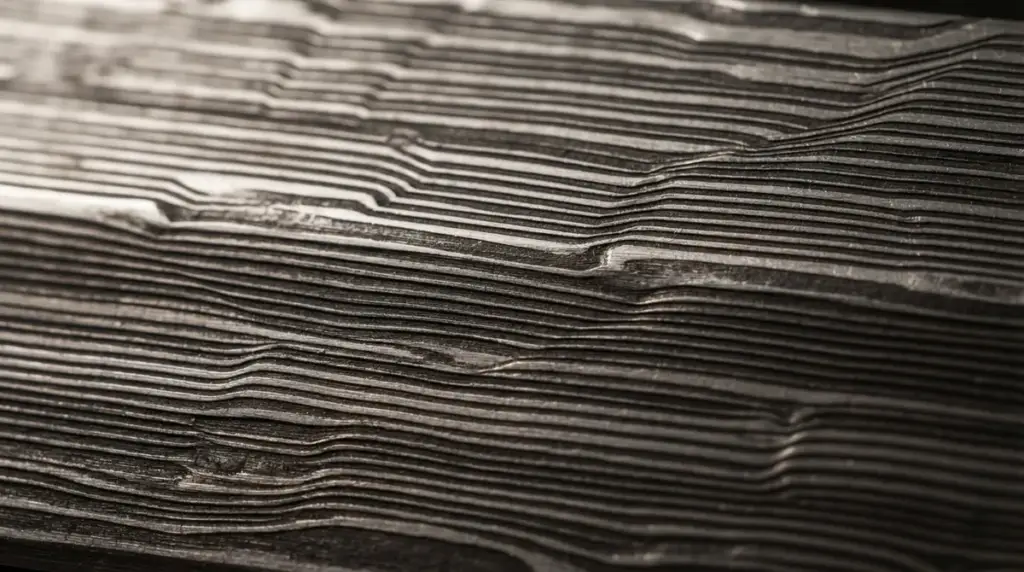
Here is the part most sellers will not put in writing. Pattern welding does not make steel stronger. A billet of 1095 and 15N20 folded 352 times is not tougher than a well heat treated bar of plain 1095. The layers do not act like plywood, they do not stop cracks, and they do not hold an edge longer. That claim gets repeated because it sounds like it should be true.
What is actually special is this:
- It proves the knife was forged. You cannot stamp Damascus out of a sheet. Every real Damascus blade passed through a forge and a press, in someone hands, several times.
- The two steels are chosen to work together. 1095 brings the carbon that lets the blade harden and hold an edge. 15N20 brings nickel, which is why it stays bright under acid and why the pattern is visible at all. Both are proper knife steels on their own.
- No two are the same. The pattern is a record of how that specific billet was folded and cut. It is the closest thing a knife has to a fingerprint.
- It is honest about its maker. A bad Damascus billet shows its faults. Cold shuts, inclusions and delamination are visible in the etch, which means a maker cannot hide sloppy welding behind a polish.
That is a real list of reasons to want one. None of them are metallurgical superpowers, and you should be suspicious of anyone who offers you those instead.
Damascus steel vs stainless: which is better
This is the comparison people actually mean when they ask if Damascus steel is good for knives, so here it is straight.
| Damascus (1095 and 15N20) | Stainless (440C, VG10) | |
|---|---|---|
| Edge sharpness achievable | Excellent. Carbon steel takes a finer edge. | Very good. VG10 is close, 440C slightly behind. |
| Edge retention | Good, 58 to 60 HRC | Good to very good |
| Corrosion resistance | Poor. It will patina and it can rust. | Excellent. Near enough maintenance free. |
| Ease of sharpening | Easy. Comes back on any stone. | Easy for 440C, slower for VG10 |
| Toughness | Very good. Bends before it chips. | Good |
| Looks | The reason you are reading this | Plain |
| Best for | Hunting, camp, collecting, gifts | Kitchen, fishing, salt water, neglect |
If the knife will live in a wet environment or be owned by somebody who will not dry it, stainless wins and it is not close. If the knife will be used and cared for, Damascus gives you a better edge and a piece worth looking at.
Is Damascus steel good for knives? It depends what the knife does
| Use | Is Damascus the right call? | Why |
|---|---|---|
| Hunting and skinning | Yes | Fine edge, easy field sharpening, and the blade gets wiped and oiled anyway. This is where Damascus makes the most sense. |
| Kitchen and chef knives | With a caveat | A Damascus kitchen knife cuts beautifully and will patina from acidic food. If nobody in the house will hand wash and dry it, buy stainless instead. |
| Everyday carry folders | Yes | Pocket knives get used lightly and cleaned often. Damascus suits the job and the knife is a pleasure to open. |
| Fishing and salt water | No | Salt is the one thing carbon steel cannot forgive. Buy 440C. |
| Collecting and gifts | Yes, obviously | Nothing else looks like it, and the pattern makes each piece specific to the person you gave it to. |
| Hard chopping and batoning | Either | Toughness comes from the heat treat and the tang, not the pattern. A good Damascus chopper and a good 1095 chopper perform the same. |
Do Damascus knives rust?
Yes. Damascus is carbon steel, and carbon steel rusts. Anyone telling you otherwise is either confused or hoping you are.
What actually happens on a used blade is a patina, not rust. Patina is a stable grey or blue grey oxide layer that forms from contact with food acids and hand oil, and it protects the steel underneath. Rust is orange, it flakes, and it eats into the surface. The first is fine and many owners encourage it. The second means the knife was put away wet.
Three rules cover the whole subject. Wipe it dry after use. Do not store it in a leather sheath for months, because leather holds moisture against steel. Put a light film of mineral oil on it if it is going in a drawer for a season. That is the entire maintenance routine, and it takes about a minute.
If rust does appear, it comes off with a little oil and a non metallic scouring pad or fine steel wool worked along the blade rather than across it. Our Damascus knife care guide covers oils and storage in more detail.
Do the layers matter?
Barely, and not in the way the marketing implies. Layer count tells you how many times the billet was folded, which is a description of process rather than a measure of quality. A clean 120 layer billet beats a badly welded 500 layer one every time, and past a certain point the layers get so thin that the pattern loses contrast rather than gaining it.
What layer count does tell you is roughly what the pattern will look like. Low counts give bold, wide figure. High counts give tight, fine figure. Both are correct. If you want the arithmetic, we wrote about what 352 layers actually means.
When a Damascus knife is not worth it
Three situations, and we will lose sales by writing them down.
- When it is not really Damascus. A laser etched or acid stencilled pattern on a bar of stainless costs almost nothing to produce and is sold at Damascus prices constantly. The pattern sits on the surface and sharpening will eventually cut through it. Our guide on telling real Damascus from a printed pattern shows what to look for.
- When the buyer will not maintain it. A Damascus chef knife given to someone who runs everything through a dishwasher is a ruined knife within a month. That is not a defect, it is a mismatch.
- When you are paying for the pattern and nothing else. The forging is the value. If the seller cannot tell you the two steels, the hardness, and where the heat treat happened, the pattern is the only thing you are buying and it is not worth what they are charging.
So is a Damascus steel knife worth it?
For most people who ask, yes. A properly made Damascus knife at 58 to 60 HRC will take a keener edge than a comparable stainless, sharpen more easily, and last several lifetimes with a minute of care after use. It also happens to be the only category of knife where the object itself is interesting to look at, which is not a small thing in something you handle every day.
The condition attached is simple: buy it from somebody who will tell you how it was made. Everything else about the value follows from that one answer.
Questions people ask
Are Damascus knives good?
A real one is very good. Pattern welded 1095 and 15N20 at 58 to 60 HRC takes a fine edge, sharpens easily and is tough. What it is not is rust proof, and it is not stronger than plain carbon steel of the same hardness. The quality comes from the forging and the heat treat, not from the number of layers.
Is Damascus steel good for knives?
Yes, for knives that get used and wiped down: hunting, camp, everyday carry and kitchen knives in a household that hand washes. For fishing, diving or anything that lives in salt, a stainless steel such as 440C is the better specification.
Is Damascus steel good for kitchen knives?
It cuts superbly and it will develop a patina from onions, tomatoes and citrus. That patina is harmless and protective. If the knife will go in a dishwasher or sit wet in a sink, buy stainless instead, because a Damascus kitchen knife is only as good as the person drying it.
Damascus steel vs stainless: which is better?
Neither, they solve different problems. Damascus gives you a finer edge, easier sharpening and a blade worth looking at. Stainless gives you corrosion resistance and no maintenance. Choose by where the knife will live rather than by which sounds more impressive.
Can Damascus steel rust?
Yes. It is high carbon steel and it will rust if stored wet or left in a damp leather sheath. A grey patina is not rust and is protective. Orange flaking is rust, and it comes off with oil and fine steel wool worked along the blade.
What does Damascus mean in knives?
Today it means pattern welded steel: two steels forge welded, folded and etched so the layers show. The name comes from historical wootz steel traded through Damascus, which was a different material made by a different method that is no longer in use.
Why are Damascus knives better?
They are not automatically better. They are usually better made, because pattern welding cannot be done by machine stamping and a poorly welded billet shows its flaws in the etch. You are buying evidence of hand work rather than a superior alloy.
Are Damascus knives worth it?
If it is genuinely forged, and the seller can tell you the steels, the hardness and where the heat treat was done, then yes. If the pattern is printed on, or nobody can answer those questions, then no at any price.
Is Damascus steel the best for knives?
No single steel is best. Powder metallurgy steels hold an edge longer, stainless resists rust better, and simple 1095 is tougher for its cost. Damascus wins on edge quality, sharpening ease and appearance, which for most owners is the combination that matters.
What is a Damascus knife?
A blade made from pattern welded steel: two steels forge welded, folded and etched so the layers show. Ours are 1095 and 15N20 at 58 to 60 HRC. It is not the historical wootz the name comes from, which was a single crucible steel and is no longer made.
More reading. Damascus steel patterns explained, Damascus vs D2 vs 440C vs VG10, and best Damascus knives made in the USA.
