
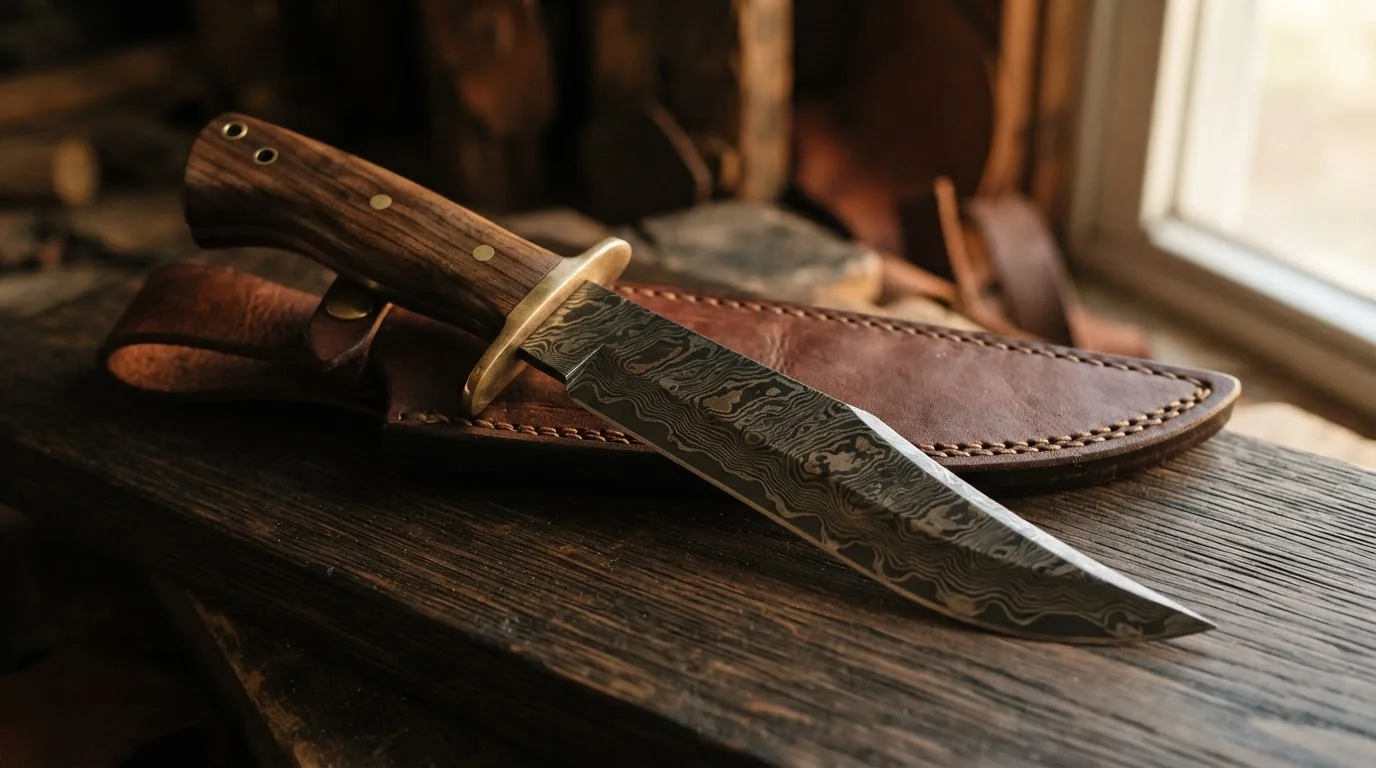
Short answer. A bowie is a large fixed blade with a clip point, usually a guard, and a blade somewhere between about 5 and 12 inches. The clip is the angled or concave cut taken out of the spine near the tip, and the false edge is the bevel ground onto that clip, sharpened on some knives and left blunt on most. A Damascus bowie is the same knife in pattern welded steel, which changes how it looks and how you maintain it, not what it can do. If this is your first big fixed blade and you intend to use it on game, buy a shorter one than the photographs make you want.
What actually makes a knife a bowie
There is no standards body for the word. In practice a knife gets called a bowie when it carries most of these features: a large fixed blade, a clip point, a cross guard, a substantial handle sized for a full grip, and a sheath. Historical and modern examples commonly run from about 5 to 12 inches of blade, with the nineteenth century pieces frequently at 8 inches or more, one and a half to two inches wide, and steel from three sixteenths to a quarter of an inch thick at the spine.
The clip point is the defining feature. The spine runs straight from the guard, then near the tip it is clipped away so the point drops down closer to the centreline of the handle. That does two things. It moves the tip in line with the thrust, which is why the pattern got its reputation as a fighting shape. And it thins the tip, which improves penetration and detail work but removes material from exactly the part of the blade most likely to be levered or dropped.
The clip itself comes in two families. A straight clip is a flat angled cut and leaves a stronger tip. A concave clip curves inward and produces a finer, more delicate point. If you look at a bowie and cannot decide which you are seeing, sight down the spine: the straight clip reads as a single flat facet, the concave clip catches light in a curve.
The false edge, and whether it should be sharp
The false edge, also called a swedge, is the bevel ground along the clip. Sharpening it fully turns the top of the tip into a cutting edge, which historically supported saber fencing techniques with the back of the blade. Leaving it unsharpened keeps a stronger tip and avoids a blade that cuts you when you push on the spine with a thumb.
For anything other than a wall piece, an unsharpened false edge is the better choice, and here is the practical reason: batoning, spine thumbing during detail cuts, and pushing a blade through hide with your off hand all involve putting weight on the spine. A fully sharpened false edge makes all three unpleasant or impossible. There is also a legal dimension. Some jurisdictions treat a double edged blade differently from a single edged one, and a fully sharpened false edge can move a knife into that category. Our guide on knife laws by state covers the general shape of that problem, and you should check your own local rules before buying.
What our own 27 bowies actually are
Rather than describe an archetype, here is what we counted in our own catalogue on 30 August 2026. The category at Damascus bowie knives held 27 published products.
| Feature present in the listing | Products of 27 |
|---|---|
| Damascus blade | 25 |
| Supplied with a sheath | 26 |
| Cross guard mentioned | 18 |
| Brass fittings mentioned | 16 |
| Clip point stated explicitly | 7 |
| Sold with a scabbard rather than a belt sheath | 3 |
| False edge or swedge stated explicitly | 2 |
| D2 rather than Damascus | 2 |
Two of those rows are embarrassing and we are publishing them anyway. Only 7 of our 27 bowies say "clip point" anywhere in the listing, and only 2 name the false edge or swedge, even though those are the two features that define the pattern. Across the whole catalogue of 609 products, only 98 carry a stated blade length in their structured attributes. If you are choosing between two of ours on geometry, the listings will not always help you, and you should email and ask. We are working through it.
The category structure is also untidy. There are 37 products with the word bowie in the title, 27 in the Damascus bowie category, and a separate Ultra Line Bowie series of 55 products of which only 3 also sit in the Damascus bowie category. Browsing one category will not show you everything we have.
Prices, and what the spread means
Counted on 30 August 2026, our Damascus bowie category ran from 97 dollars to 938 dollars, with a median of 326 dollars and the middle half sitting between 140 and 449 dollars. That is a much wider spread than most of our categories, and it is worth understanding why before you read the price as a quality signal.
| Group | Products | Lowest | 25th percentile | Median | 75th percentile | Highest |
|---|---|---|---|---|---|---|
| Damascus bowie knives | 27 | 97 | 140 | 326 | 449 | 938 |
| Ultra Line bowie series | 55 | 191 | 245 | 266 | 469 | 938 |
| Best selling hunting | 133 | 73 | 130 | 201 | 266 | 938 |
| Damascus skinning knives | 22 | 73 | 97 | 106 | 179 | 316 |
| Whole catalogue | 608 priced | 55 | 114 | 155 | 251 | 1,631 |
All figures in US dollars. Notice that the bowie median of 326 dollars is more than double the catalogue median of 155 dollars, and more than three times the skinning knife median of 106 dollars. Some of that is steel volume, because a large bowie simply contains far more forged and ground material. Some of it is fittings, since brass guards, pins and butt caps add operations. And some of it is that big display pieces sell on presence, which is not the same as capability.
Why a 12 inch bowie is a poor first hunting knife
This is the part of the page that costs us money, because the twelve inch bowie is the one people want to buy.
Field dressing and skinning are close work. You are working inside a body cavity, around bone, with a hand that is often wet and cold, making short controlled cuts with the first inch or two of the edge. A long blade puts the balance point far ahead of your hand, gives you a lever arm you have to fight on every cut, and puts eight or ten inches of sharpened steel somewhere you cannot see it while your other hand is in the way. Blade length beyond roughly four inches contributes very little to that job.
The blade lengths that actually get used for game processing sit in a narrow band. That is why our skinning knife category is priced so much lower than our bowie category: the working knives are smaller and simpler. If you are buying a knife to use on animals, read our skinning knife guide and our guide to choosing a hunting knife before you buy a bowie.
Where a large bowie is genuinely the right tool: camp work where you want one blade to do light chopping, splitting kindling and food prep; brush clearing where a machete is too flexible; and collecting or display, which is a perfectly honest reason to buy one. What it is not is a first knife for someone who will actually process game.
Grinds, and what each one costs you
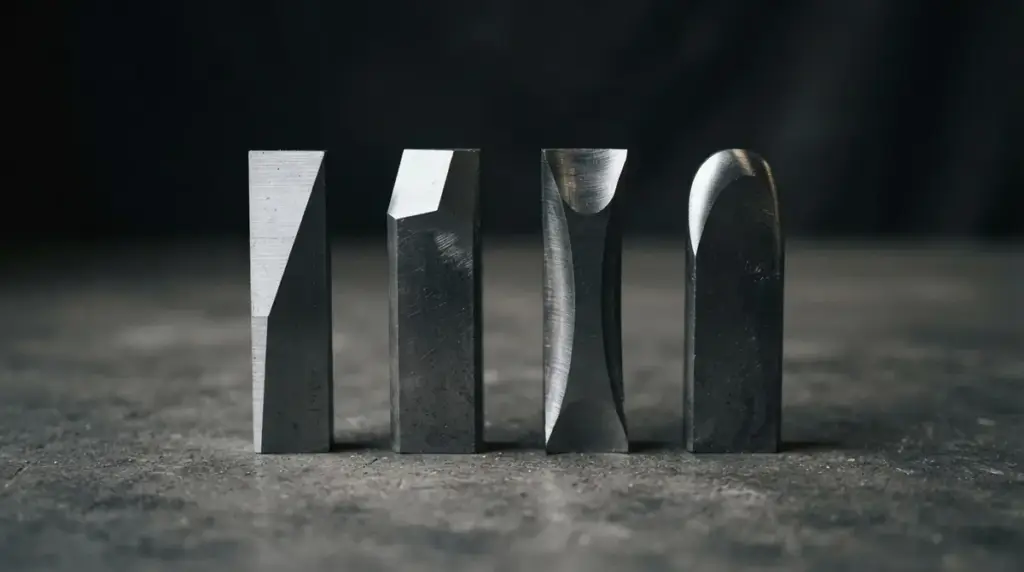
Grind matters more than length for how a bowie behaves. The three you will meet are the flat grind, the hollow grind and the convex grind.
| Grind | Cross section | Good at | Weak at |
|---|---|---|---|
| Full flat | Straight taper from spine to edge | General slicing, good balance of strength and cutting | Slightly more drag in deep material than hollow |
| Saber flat | Flat grind starting partway down the blade | Strength, chopping, batoning | Thicker behind the edge, so it wedges in cuts |
| Hollow | Concave, ground on a wheel | Very keen edge, excellent for skinning | Thin at the edge, chips and rolls under impact |
| Convex | Curved, thickening toward the spine | Impact resistance, splitting, chopping | Harder to sharpen freehand, less keen at the apex |
A big Damascus bowie in a saber or convex grind is a chopper. The same outline in a hollow grind is a display knife with a fragile edge that you should not baton. Our guide on fixed blade bevels goes through the geometry in detail.
What Damascus changes and what it does not
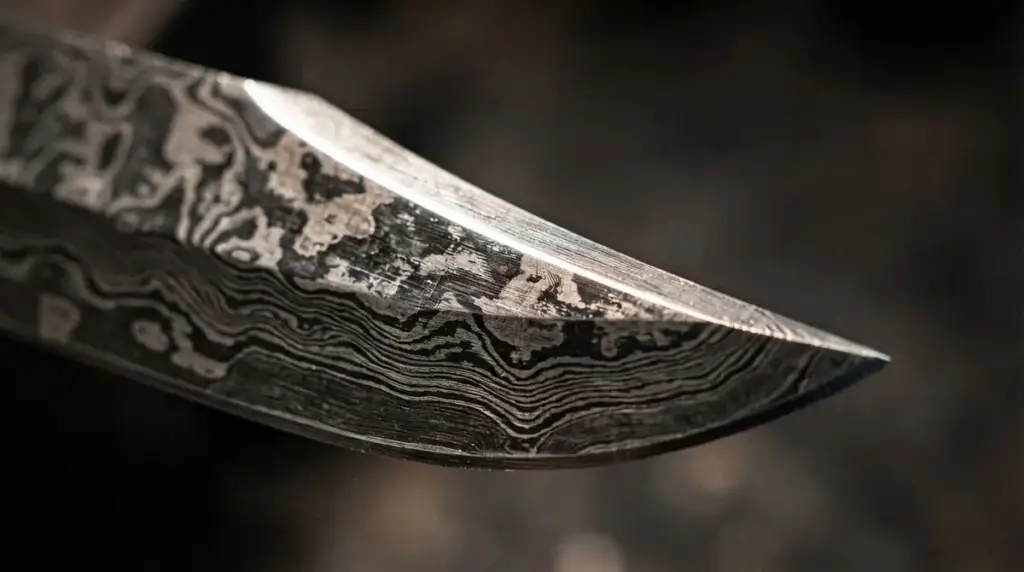
Pattern welded Damascus is made by forge welding alternating layers of two steels, drawing the billet out, folding or restacking it, and finally etching the finished blade so the two alloys show as light and dark bands. In our work the standard pairing is 1095 with 15N20, and we hold that combination to 58 to 60 HRC. It is a real, functional carbon steel blade.
What Damascus does not do is make a blade tougher, sharper or more corrosion resistant than a good monosteel of the same hardness. If a seller tells you their pattern improves cutting performance, that is a story. The pattern is aesthetic, and the etch that reveals it lives in the top few thousandths of an inch of the surface.
That last point has a practical consequence people discover too late. Sharpening a Damascus blade on a coarse stone will grind the pattern off the bevel and leave a bright band along the edge where the etch used to be. It does not hurt the knife. It does change how it looks, permanently, until it is re etched. High carbon Damascus also rusts, readily, and a bowie with a large exposed flat is one of the easier knives to neglect. Our guide on Damascus knife care is the one to read before the first outing, and real and fake Damascus covers how to spot a laser etched or acid printed pattern.
Handles, guards and the tang question
On a knife this size the handle is not a comfort feature, it is a safety feature. Look for a full tang, meaning the steel runs the whole length and width of the handle with scales pinned to it, or on a hidden tang design a substantial through tang with a threaded pommel drawing everything together. A partial or rat tail tang in a chopping knife is where failures happen. Our guide on full tang and partial tang explains what to look for.
The guard on a bowie exists so your hand cannot run forward onto the edge when a thrust stops suddenly, or when a wet grip slips. Historically the brass or soft metal guard was also claimed to catch an opponent's blade, though a more sober reading is that it added support and absorbed shock on blades whose steel and heat treatment could not be relied on. Sixteen of our twenty seven bowies use brass fittings, which is a material choice about appearance and workability more than performance.
Handle materials on a large knife matter for grip when wet. Stag, bone and horn look right on this pattern and give a warm, textured grip, but they move with humidity and can leave a proud pin. Stabilised wood and micarta are more predictable. None of them are dishwasher safe, and none of them like being left in a hot vehicle.
Carrying one legally
A bowie is long, obvious and, in a number of jurisdictions, specifically named in statute. Historic bowie specific laws were passed in Alabama in 1837, Tennessee in 1838, Texas in 1871 and elsewhere, and while many have been repealed or replaced, blade length thresholds are still very much alive.
Texas is a useful example because it changed recently. House Bill 1935 in 2017 removed the old illegal knife category, and the current framework instead defines a location restricted knife as one with a blade longer than 5.5 inches. Those are legal to own and carry generally, but restricted in schools, courthouses, polling places, secured airport areas, hospitals, correctional facilities, licensed racetracks, bars deriving most revenue from alcohol, and certain sporting events, with the school offence being the most serious.
Almost every bowie worth the name exceeds 5.5 inches. Treat that as the normal case rather than the exception, and check your own state and city rules before you carry rather than after. Please check your local law before ordering.
Questions people ask
What blade length counts as a bowie?
There is no fixed rule. Modern bowies commonly run from about 5 to 12 inches, and nineteenth century examples were frequently 8 inches or more. What makes it a bowie is the clip point and the overall configuration, not a specific number.
What is the difference between a clip point and a false edge?
The clip is the shape, meaning the part of the spine cut away near the tip. The false edge, also called a swedge, is the bevel ground onto that clip. Every clip point has a clip. Not every clip point has a ground or sharpened false edge.
Should the false edge be sharpened?
For a working knife, no. An unsharpened swedge keeps the tip stronger and lets you put your thumb or a baton on the spine. A fully sharpened one may also change how the knife is classified legally in some places, so check before you buy one that way.
Is a Damascus bowie stronger than a plain steel bowie?
No. Pattern welding is a cosmetic process. A 1095 and 15N20 Damascus blade at 58 to 60 HRC behaves like a good high carbon blade at that hardness. It is not tougher, sharper or more rust resistant than a well made monosteel equivalent.
Will sharpening ruin the Damascus pattern?
It will remove the pattern from the bevel you sharpen, because the etch only penetrates the top few thousandths of an inch. The pattern on the flats stays. Use fine abrasives and a consistent angle to keep the bright band as narrow as possible.
Is a bowie a good first hunting knife?
Usually not. Field dressing and skinning are close, controlled work best done with a much shorter blade. A large bowie makes those jobs harder and more dangerous. Buy a smaller fixed blade for game and a bowie for camp work or collecting.
What is the difference between a bowie and an Arkansas toothpick?
An Arkansas toothpick is essentially a heavy dagger with a straight, symmetrical blade, historically described in lengths from about 15 to 25 inches and intended for thrusting and throwing. A bowie has a clip point, a belly for cutting, and is a general purpose blade.
Do I need a guard on a bowie?
On a knife of this size, yes. The guard stops your hand running onto the edge if a thrust stops abruptly or a wet grip slips. Eighteen of our twenty seven bowies name a cross guard in the listing.
How much should a good Damascus bowie cost?
Ours run from 97 to 938 dollars with a median of 326 dollars as of 30 August 2026. Price tracks size, fittings and finish more than it tracks cutting ability. A larger, brass fitted display piece will always cost more than a smaller working knife that performs better in the field.
Can I baton with a Damascus bowie?
It depends entirely on the grind and the tang, not on the pattern. A full tang blade in a saber or convex grind will take it. A hollow ground blade or one with a partial tang should not be batoned. If the listing does not tell you which you have, ask before you try.
More guides. Read knife blade shapes, choosing a hunting knife, fixed blade bevels explained and Damascus knife care, or browse our Damascus bowie knives. Please check your local law before ordering.
More from the workshop
Which Oil to Use on a Knife
Mineral oil for food knives, machine oil for the rest, and never cooking oil.
Full Tang Knife Guide: Full Tang vs Partial Tang
Knives break where the blade meets the handle. Tang is what carries that load.
Folding Knife Locks: Liner, Frame, Back and Slip Joint
The six folding locks you will actually meet, how each one fails, and a one minute inspection you can run before you buy.
