
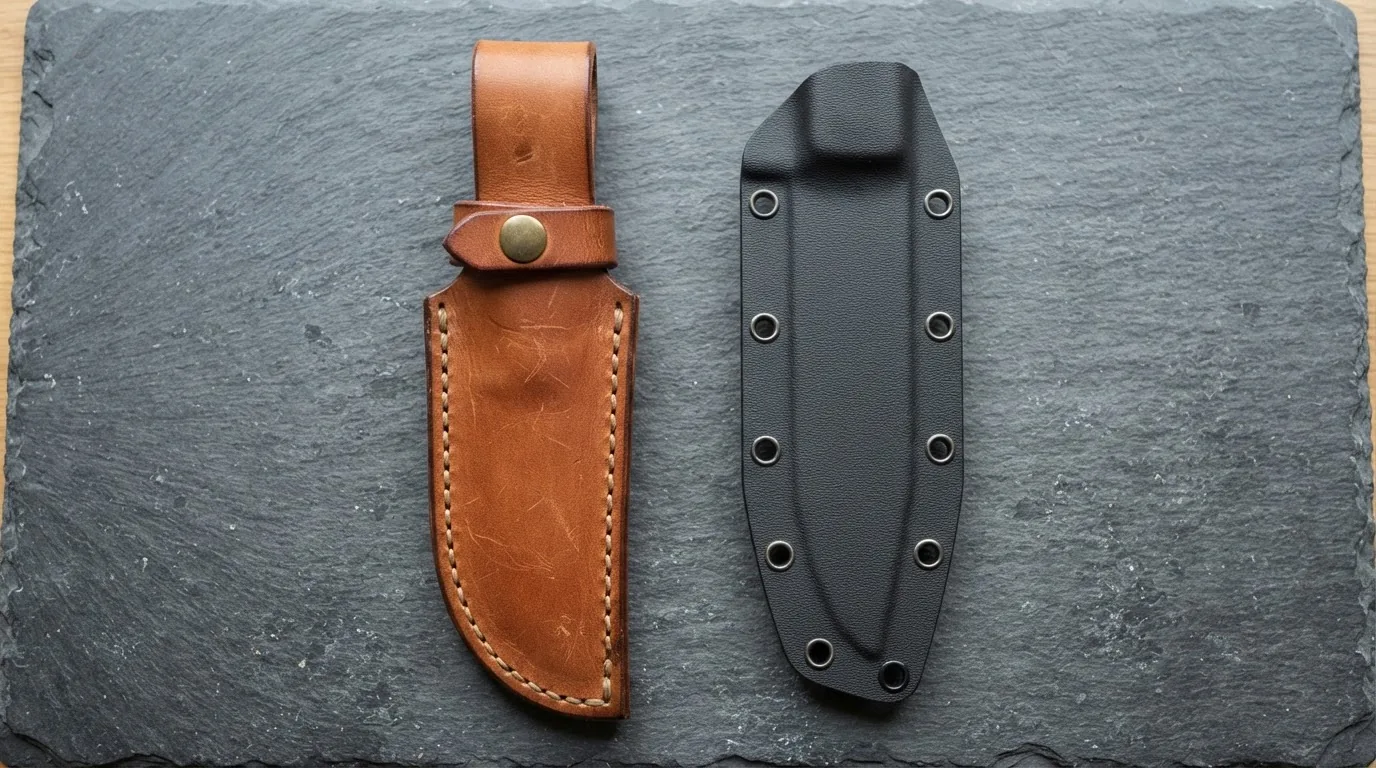
Short answer. Kydex is a thermoformed plastic sheath. It grips the blade mechanically, sheds water, and does not care how long the knife sits in it. Leather is a stitched and wet formed sheath. It grips by friction, it looks and feels better, and it holds moisture against steel. If your knife is carbon steel, including pattern welded Damascus, leather is the material more likely to rust it, and a damp leather sheath is the single most common way a good blade gets ruined. We ship leather on almost everything we sell and no kydex at all, which makes this a page we would rather not have to write honestly. We are writing it honestly anyway.
What each material actually is
Kydex is a trade name for a sheet material that is an alloy of acrylic and PVC. It arrives flat, softens at moderate oven temperatures, and is pressed around a blade between two foam platens until it cools and holds the shape. It is not the same as the injection moulded polymer sheath that comes free with a mass market knife, and the forming process is why a kydex sheath fits one specific knife and nothing else.
Leather for sheaths is almost always vegetable tanned cowhide. Vegetable tanning uses plant tannins and produces a firm hide that will wet form: soaked, moulded around the blade, boned down with a smooth tool, and dried hard. Chrome tanned leather, the soft kind used for jackets and most bags, does not take a wet form and holds salts that are worse for steel. If a seller cannot tell you which tannage their sheath is, assume the answer is the cheaper one.
Both do the same three jobs: keep the edge off you, keep you off the edge, and keep the knife where you put it. They fail in completely different ways, and that is what this comparison is about.
The corrosion problem, and why it is worse than either side admits
Every kydex advocate says leather rusts knives. Every leather advocate says that is only if you store it wet. Both are talking past the mechanism.
Leather is a porous protein structure. It absorbs water from rain, sweat, humidity and blood, and releases it slowly. Vegetable tanned leather is also mildly acidic, because tannins are acids and the tanning liquor is never fully neutralised. A blade in a leather sheath therefore sits in a slightly acidic, slowly drying, oxygen rich pocket pressed against the steel on both sides. That is close to a laboratory setup for pitting corrosion.
It does not need a soaking. A carbon blade slid into a leather sheath after cleaning a deer, with a film of moisture on it, will show rust in a day. A carbon blade left in a leather sheath in a garage over a humid summer will pit where the leather touched it and stay bright where it did not, which is how you can tell exactly what happened after the fact.
Kydex has none of this. It is chemically inert, it does not absorb, and a properly made one has a drain hole at the tip. What it does instead is hold water rather than absorb it, so a sheath with no drainage, or one carried tip up, becomes a small bath. The material is not the problem; the water still is.
| Situation | Leather | Kydex |
|---|---|---|
| Blade put away dry, dry storage | Fine indefinitely | Fine indefinitely |
| Blade put away damp | Rust within a day on carbon | Rust unless it drains and dries |
| Long term storage in the sheath | Do not, on any steel | Acceptable, with an oiled blade |
| Rain and river work | Sheath soaks and stays wet | Sheds and drains |
| Salt water | Worst case for both, worse for leather | Rinse the sheath, oil the blade |
| Humid garage or shed | Wicks humidity onto the blade | Neutral |
The rule that applies to both, and that the material argument distracts from: a sheath is for carry, not for storage. Neither material is a place to keep a knife for six months.
Retention, and what a click actually is
Retention is the force that stops the knife falling out. The two systems achieve it differently and age differently.
Leather grips by friction along the flats, usually with a strap or snap over the handle as the actual security. The fit is tight when new and loosens, because the blade compresses and stretches the leather on every draw. A sheath that fits perfectly at six months is looser at three years. The retaining strap is not decorative. It is the mechanism.
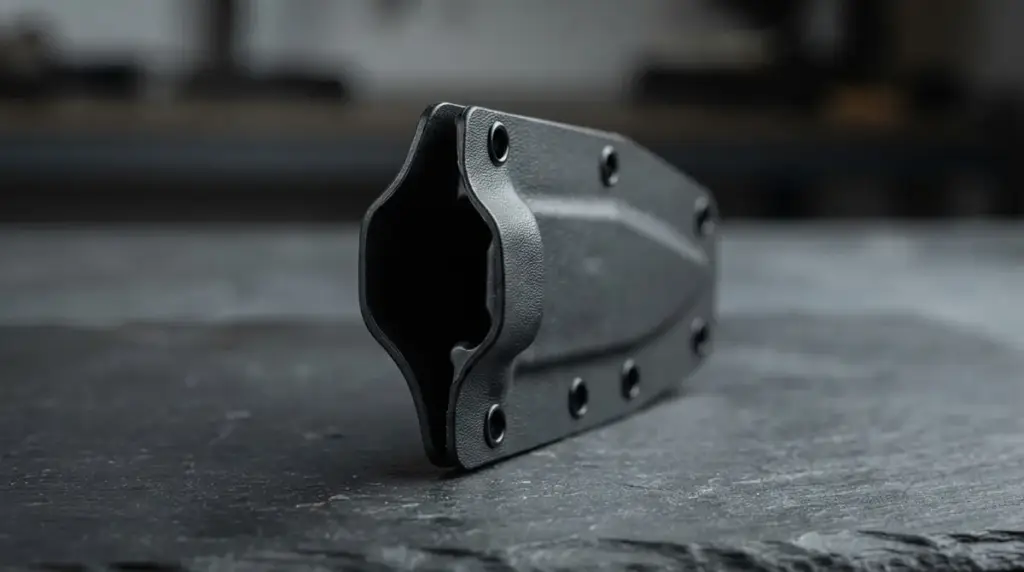
Kydex grips by a formed detent, usually around the ricasso or the choil, and clicks as the blade seats. That click is the plastic springing back over a step in the blade profile. It stays consistent because the material has elastic memory, and on better sheaths it is adjustable by tightening the eyelet screws. A kydex sheath can be carried upside down and shaken with the knife staying in, which is the most persuasive demonstration in the whole argument.
The counterpoint nobody in the kydex camp makes: that detent rubs the same spot on the blade every single draw. On a mirror polished or etched blade, kydex will wear a visible track there within a few hundred draws, and grit that gets into the sheath is held against the steel by the same spring pressure. Leather absorbs grit into itself. Kydex traps it against your knife. If you carry in dust, rinse the kydex out.
Thickness, gauge and how to read a spec
Both materials are sold by thickness and both use a unit that confuses buyers.
Kydex sheet is specified in thousandths of an inch. The gauges commonly used for sheaths are 0.060 inch for light fixed blades, 0.080 inch general purpose, and 0.093 inch where abuse is expected. Thinner is lighter, quieter and more flexible; thicker is stiffer and holds a detent more positively.
Leather is specified in ounces, which is a thickness measure and not a weight. One ounce equals one sixty fourth of an inch, so 8 ounce leather is one eighth of an inch thick. Sheath work is usually 7 to 9 ounce, roughly 0.109 to 0.141 inch.
| Spec | Kydex | Leather |
|---|---|---|
| Unit | Thousandths of an inch | Ounces, where 1 oz is 1/64 in |
| Light duty | 0.060 in | 5 to 6 oz |
| General purpose | 0.080 in | 7 to 8 oz |
| Heavy duty | 0.093 in and up | 9 to 10 oz |
| What thickness buys | Detent strength and stiffness | Stiffness and puncture resistance |
| What thickness costs | Weight and bulk | Weight, bulk and break in time |
If a listing gives no thickness at all, in either material, that is a signal about the maker rather than about the sheath.
The welt, the stitch, and how a leather sheath fails
This is the part of the argument that only leather workers make, and it is the most useful thing on this page if you are buying leather.
A leather sheath is two panels stitched together at the edge. If they are stitched directly to each other, the cutting edge of the knife sits against the thread every time it goes in or out. Within a year the blade cuts the stitching and the sheath opens along the seam, usually near the tip, usually while you are walking.
The fix is a welt: a strip of leather sandwiched between the two panels along the stitch line, which holds the seam open by its own thickness so the edge never touches the thread. A welted sheath has a visible third layer at the edge and costs a little more to make. An unwelted one is flat at the seam. You can see the difference in a photograph, and it is the single most reliable indicator of whether a leather sheath was made by someone who understood the job.
The other leather failures, in order of how often we see them: stitching abraded through at the mouth, the retaining snap pulling out, mould from putting it away wet, and leather dried too hard that cracks at the fold. The first two are half hour jobs for a saddler. The last two are not fully reversible. Repairability is leather's real structural advantage.
How a kydex sheath fails
Kydex fails less often and worse. The failure modes are short.
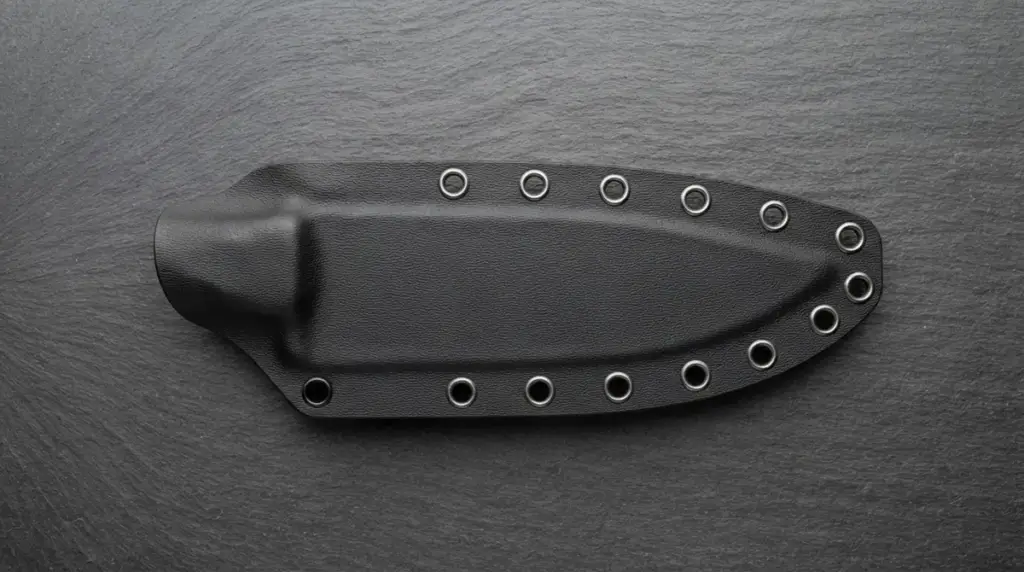
It cracks. Usually at a screw eyelet, usually from an impact in cold weather, because the material becomes noticeably more brittle at low temperature. A cracked kydex sheath cannot be stitched. It has to be reformed or replaced.
It deforms. Kydex softens well below the temperature that would damage a knife, and a sheath left on a dashboard in summer sun can lose its detent permanently. Forming temperatures for the material sit in the region of 290 to 350 degrees Fahrenheit, and a black sheath behind glass gets far hotter than the air around it.
It loses retention if the eyelets loosen, which is the one kydex failure that is trivially fixable with a screwdriver, and which nobody checks until the knife falls out.
None of these are common. But when kydex fails you generally replace it, and when leather fails you generally repair it. That is the honest shape of the durability comparison, rather than the flat claim that kydex lasts longer.
Temperature, water and the field
Cold: kydex stiffens and gets brittle, and the detent gets harder to overcome with gloved hands. Leather stiffens too but does not crack from cold alone. Advantage leather, marginally.
Heat: leather is fine at any temperature you will experience. Kydex is not, as above. Advantage leather, clearly.
Rain and immersion: kydex sheds and drains, leather soaks and stays wet for hours. Advantage kydex, decisively, and this is the one that matters most because it is the one that costs you a blade.
Dust and grit: leather absorbs it, kydex holds it against the steel. Advantage leather, marginally, if you never rinse your gear.
Blood and field dressing: here the argument is not close. A sheath used during field dressing takes on protein and moisture. Kydex washes under a tap with soap and dries in ten minutes. Leather cannot be washed properly at all, and blood in leather is the fastest route to both rust and smell. If you dress game regularly, that is the argument for kydex whatever your blade is made of.
Carry positions and mounting
Kydex mounts to hardware, which is why the tactical world standardised on it. Belt loops, quick attach clips, scout carry across the small of the back, danglers and pack webbing attachments all bolt to the eyelets, and the carry position changes in two minutes with a screwdriver.
Leather sheaths are usually built with one carry position and that is what you have. A traditional pouch sheath with a fixed belt loop rides high and tight, comfortable standing and painful sitting. A dangler, a short strap between the belt loop and the sheath body, is the most underrated feature on a hunting sheath: it lets the knife swing forward when you kneel instead of levering into your hip. A saddler can add one for very little.
One thing to check on either material: whether the sheath is handed. Many are cut for right hand carry only, and a left handed carry on a right handed sheath puts the retaining strap in the wrong place.
Noise, weight and the things that matter sometimes
Kydex clicks. It clicks going in, it clicks coming out, and it clicks against buttons and buckles when you move. If you are hunting and the animal is close, that is not a small thing. Leather is silent.
Weight is close enough not to matter. A 0.080 inch kydex sheath and an 8 ounce leather one for the same 4 inch blade are within a few tens of grams, kydex usually the lighter.
Appearance is not a trivial criterion and pretending otherwise is dishonest. A hand stitched vegetable tanned sheath ages into something people keep. Kydex looks exactly the same on day one and day three thousand, which is either a feature or the point, depending on why you bought the knife.
What we ship, and when to leave it in the drawer
Pulled live from the catalogue on 30 August 2026. There are 609 published products on this site. 435 of them mention a leather sheath somewhere in the title, description or short description. A further 76 mention a sheath without naming the material. Not one product on this site mentions kydex, because we do not make it and we do not source it.
| Figure | Value |
|---|---|
| Published products | 609 |
| Listings mentioning a leather sheath | 435 |
| Listings mentioning a sheath, material unnamed | 76 |
| Listings mentioning kydex | 0 |
| Hunting knives | 133 |
| Bowie knives | 27 |
| Skinning knives | 22 |
| Damascus products, all carbon billets | 320 |
| Kitchen listings that also ship a leather sheath | 44 of 44 |
Two admissions follow from that table. The first is that we cannot sell you a kydex sheath, so the recommendation below is one we lose money on. The second is stranger: every one of our 44 kitchen and chef knives is listed with a leather sheath, which is a hunting habit that has followed the kitchen line across. A kitchen knife should not live in leather. Use ours for transport and store the blade on a magnetic strip.
So: leave our leather sheath in the drawer if the knife is carbon Damascus and you are working in rain or on water, if you are field dressing regularly and cannot wash the sheath afterwards, if the knife lives in a humid shed or a vehicle, or if you are storing the knife for more than a few weeks. In every one of those cases, either buy a kydex sheath from a maker who does them, or carry the knife oiled and out of the sheath and dry it before it goes back.
Choosing, by use
| Use | Pick | Why |
|---|---|---|
| Regular field dressing | Kydex | Washable, drains, no protein trapped in the material |
| Boat, river, salt water | Kydex | Sheds water, will not wick it onto a carbon blade |
| Duty and hard use carry | Kydex | Positive retention, mounts to any hardware |
| Dry hunting and general woods | Either | Leather if you value silence and looks |
| Cold weather | Leather | Kydex is more brittle and harder to draw gloved |
| A knife you keep and hand on | Leather | Repairable, and it ages into something |
| Long term storage | Neither | Oiled blade, out of the sheath, in a drawer |
| A carbon or Damascus blade in any damp | Kydex | Leather plus moisture plus carbon steel is how blades pit |
Questions people ask
Will a leather sheath rust my knife?
It can, and it is the most common cause of rust we see on a carbon blade. Leather absorbs moisture from rain, sweat and humidity and holds it against the steel, and vegetable tanned leather is mildly acidic. A blade put away damp will show rust within a day. Dry the blade and the sheath before they go together and store the knife outside the sheath.
Is kydex better than leather for a knife sheath?
For wet work, field dressing, hard use carry and anything left in the sheath, yes. For cold weather, silence, repairability and appearance, no. The single decisive factor is moisture: if the knife will be wet and the blade is carbon steel, kydex is the safer material by a wide margin.
How thick should a kydex sheath be?
0.080 inch is the general purpose gauge. 0.060 inch is fine for small fixed blades and folders and is lighter and quieter. 0.093 inch is for sheaths expected to take real abuse. Thinner than 0.060 and the detent gets vague.
What does 8 ounce leather mean?
Thickness, not weight. One ounce equals one sixty fourth of an inch, so 8 ounce leather is one eighth of an inch thick. Sheath work is usually 7 to 9 ounce. A listing that gives no ounce weight has told you something about the maker.
What is a welt on a leather sheath and why does it matter?
A welt is a strip of leather sandwiched between the two panels along the stitch line, so the cutting edge never touches the thread. Without one the blade cuts its own stitching and the sheath opens at the seam, usually near the tip. A welted sheath shows a visible third layer at the edge in a photograph.
Can a kydex sheath dull a knife?
Not the plastic itself, meaningfully. What dulls the blade is grit held against the steel by the detent pressure, and the detent contacts the same spot on every draw, which on a polished or etched blade wears a visible track. Rinse a kydex sheath out after dusty work.
Does kydex melt in a hot car?
It can deform. The material is formed at oven temperatures in the region of 290 to 350 degrees Fahrenheit, and a dark sheath behind glass in direct sun reaches far higher temperatures than the air around it. A deformed sheath loses its retention permanently. Leather has no equivalent problem.
Do you sell kydex sheaths?
No. Not one of the 609 products on this site mentions kydex. We ship vegetable tanned leather, and 435 of our listings say so. If your use case is one of the wet or field dressing cases above, buy a kydex sheath for our knife from a maker who does them.
Should I store my knife in its sheath?
No, in either material. A sheath is for carry. Leather wicks humidity onto the steel and kydex traps whatever water went in with it. For anything longer than a few weeks, oil the blade lightly and store it out of the sheath, somewhere ventilated.
Can a leather sheath be repaired?
Usually yes, and this is leather's genuine advantage. Cut stitching, a pulled snap and a worn mouth are all half hour jobs for a saddler. Mould and cracked, over dried leather are not fully reversible. A cracked kydex sheath cannot be repaired at all; it is reformed or replaced.
More guides. Read how to store knives for what to do instead of the sheath, how to remove rust from a knife if you already left one damp, the best knife oil for the film that prevents it, do Damascus knives rust for the carbon billet question, and Damascus knife care for the routine. Or browse hunting knives. Please check your local law before ordering.
Design your own knife and pick the sheath →
More from the workshop
Engraving a Knife: What Works and What Ruins the Blade
What engraving costs, what fits in 20 characters, and why the handle beats the blade.
The Damascus Bowie Knife: Sizes, Grinds and What It Is Actually For
Clip points, false edges, grinds and real numbers from our own 27 bowies, plus where a big blade is the wrong tool.
How to Choose an EDC Knife
Weight is why people stop carrying. Buy for Tuesday, not for the emergency.
