
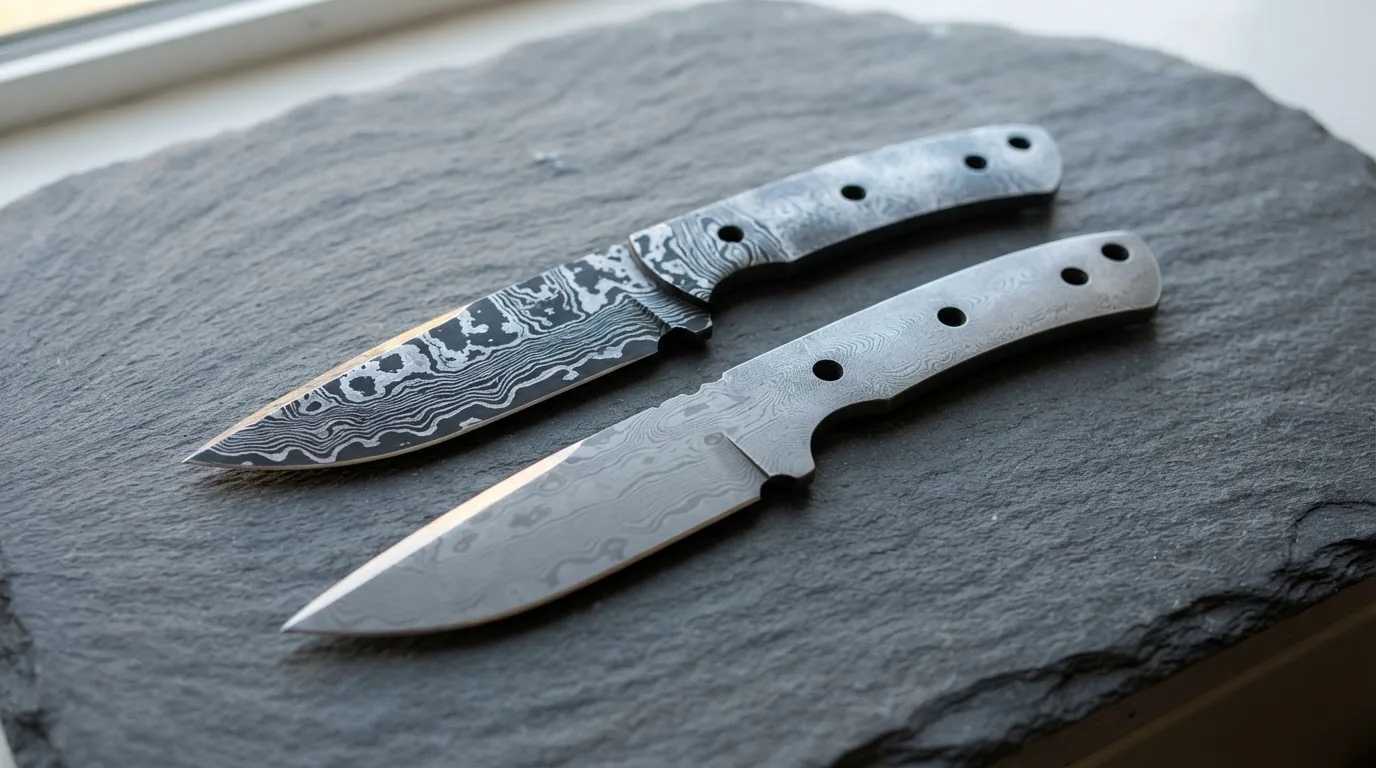
Short answer. Carbon Damascus and stainless Damascus are the same idea built from different steels. Carbon Damascus is almost always 1095 or 1084 forge welded to 15N20, a nickel bearing steel that refuses the acid and stays bright, which is why the pattern is loud. Stainless Damascus uses two chromium rich alloys such as AEB-L with 302 or 304, or 440C with 416, or the powder steels RWL34 and PMC27, and because both halves resist the acid the pattern comes out quiet. You buy corrosion resistance and you pay for it in contrast and in money. Everything we sell is carbon Damascus, so this page is us explaining an option we do not stock.
What the two names actually mean
Neither name describes an alloy. Both describe a billet: two or more steels stacked, forge welded, drawn out, folded and folded again until the boundary between them becomes a pattern that runs through the whole thickness of the blade. The word Damascus here is a trade term for pattern welding. It has nothing to do with the historic wootz crucible steel from South Asia, which was a single alloy with a pattern that came from carbide banding rather than from stacking.
So when a seller writes stainless Damascus, they mean a pattern welded billet in which every constituent steel carries enough chromium to be called stainless, normally taken as at least 10.5 percent. When they write carbon Damascus, or high carbon Damascus, they mean a billet in which none of the steels carries meaningful chromium. There is a third case that trips people up: a billet where only one of the two steels is stainless. That is not stainless Damascus. It will rust in the layers that are not stainless, and it will do so in stripes.
The steels in each billet
Here are the pairings you will actually meet. The carbon side is settled and has been for decades. The stainless side is more varied because the metallurgy is harder and different makers solved it differently.
| Family | Typical pairing | What each layer contributes | Where you see it |
|---|---|---|---|
| Carbon | 1095 with 15N20 | 1095 is the dark layer. 15N20 carries roughly 2 percent nickel and stays bright under the etch | The default across the hand forged trade, including every Damascus blade on this site |
| Carbon | 1084 with 15N20 | Same optical result. 1084 has more manganese than 1095 and is more forgiving to heat treat | Common with American makers who quench in oil at home |
| Carbon | 1075 with pure nickel | Maximum contrast. Pure nickel does not harden, so it is decorative rather than structural | Show billets and jewellery grade bar stock |
| Stainless | AEB-L with 302 or 304 | AEB-L hardens and cuts. 302 and 304 are austenitic and do not harden at all | Commercial stainless billet from US suppliers |
| Stainless | 440C with 416 | 440C is the cutting layer. 416 is a free machining stainless that etches darker | The pairing most often named in the stainless Damascus queries we see |
| Stainless | RWL34 with PMC27 | Both are powder metallurgy. RWL34 carries about 4 percent molybdenum and resists the etch; PMC27 gives way | Damasteel, the Swedish mill product used on high end folders |
Note what is missing from the stainless column: a pairing where both layers harden usefully. AEB-L with 304 gives you a blade in which roughly half the layers are structurally soft. RWL34 with PMC27 avoids that, because both are hardenable, and it is priced accordingly.
Why the contrast comes from the etchant, not the carbon
There is a persistent story that Damascus contrast comes from a difference in carbon content between the layers, dark for high carbon and light for low. It is wrong, and it has been known to be wrong since a 1998 study by Verhoeven and Clark which found that carbon diffuses across the weld boundaries during forging until it is close to even throughout the billet. If carbon were the mechanism, the pattern would fade as the billet was worked. It does not.
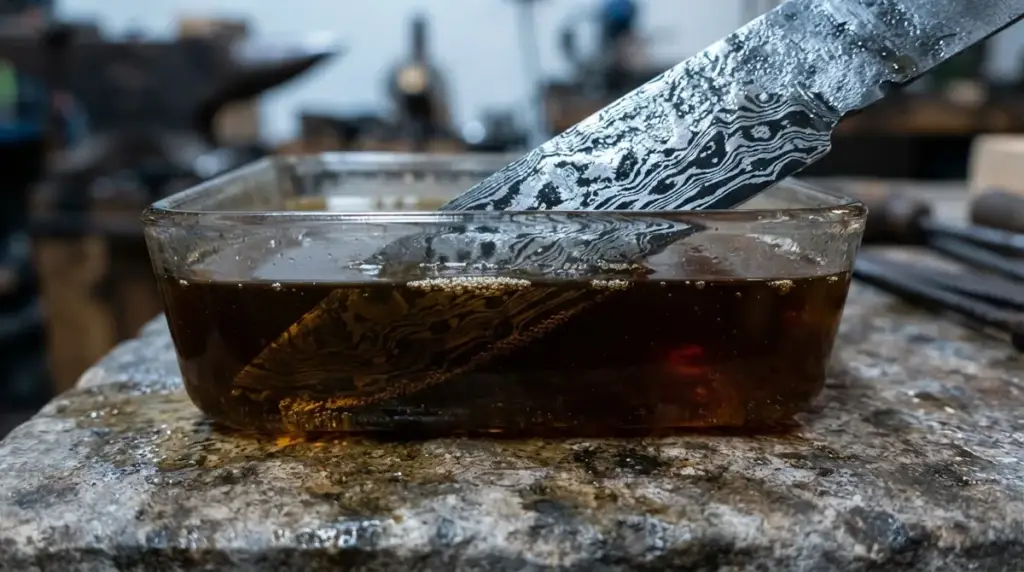
What actually produces the contrast is that the two steels react differently to the acid used to finish the blade. In a 1095 and 15N20 billet the nickel in the 15N20 leaves that layer largely untouched while the 1095 is eaten back and darkened. Knife Steel Nerds suggests the effect is probably galvanic, an anode and cathode relationship in which one steel is attacked preferentially rather than the other simply being immune. In a Damasteel billet the same job is done by molybdenum: RWL34 has about 4 percent of it and shrugs off the etch, PMC27 does not.
Now apply that to stainless. Chromium at 13 percent or more forms a passive oxide film almost instantly. Both layers do it. So the differential the etch depends on is much smaller, and ferric chloride, which is the standard etchant for carbon Damascus, gives flat muddy results on stainless. Makers move to sulfuric acid at roughly 15 to 20 percent, or muriatic acid, or an electrolytic setup, and even then the pattern reads as a texture in the light rather than as black and white. That is the honest reason most sellers avoid stainless Damascus: it photographs badly, and a pattern that photographs badly does not sell online.
Corrosion: what stainless Damascus really buys you
Stainless is a promise about rate, not about immunity. A 440C or AEB-L based billet will sit through a humid summer, a sweaty pocket and a rinse under the tap without spotting. A 1095 and 15N20 billet will not. It will develop grey freckles within days if you leave it wet, and if you cut citrus or tomato and walk away it will show the mark of the cut by the next morning.
Two qualifications. The etched surface on a carbon blade is not bare steel, because it carries a thin oxide from the acid plus whatever oil the maker left on it. And the sharpened edge is bare on both: even on stainless Damascus, the apex is the least protected part of the blade and it is where a neglected knife starts to go.
The practical rule that comes out of this: if the knife will live in a kitchen and be washed by more than one person, stainless earns its money. If it lives in a sheath, gets wiped and oiled after use, and spends most of its life dry, carbon Damascus costs you a habit rather than a knife.
Hardness and edge holding, and what we will hold to
We will publish only numbers we can stand behind. On this site, hand forged 1095 and 15N20 Damascus is held to 58 to 60 HRC, D2 to 58 to 62 HRC, and 440C to 58 to 60 HRC. We do not publish a hardness for stainless Damascus, because we do not make it and we are not going to repeat a mill figure as though we had measured it. Damasteel publishes that its RWL34 and PMC27 billet reaches about 61 HRC on a standard heat treatment with a cryogenic step, and about 64 HRC with a hotter austenitise and a lower temper. That is their number, from their datasheet, not ours.
Edge holding across the two families is closer than the marketing suggests, and it is complicated by an effect most comparison articles skip: in a pattern welded billet, the toughness of the mixture tends to sit near the toughness of the worse constituent, not the average. Knife Steel Nerds measured a 1084 and 15N20 random pattern at roughly 34 foot pounds against 45 to 50 for 15N20 on its own. So a Damascus blade of either family is usually a little tougher or a little weaker than one of its two steels alone, and almost never better than both. Pattern welding is a decorative process that costs you something. It is worth being clear about that on a page hosted by a shop that sells 320 of them.
| Property | Carbon Damascus (1095 and 15N20) | Stainless Damascus |
|---|---|---|
| Pattern contrast after etch | Strong black against bright silver | Muted, reads as texture in raking light |
| Standard etchant | Ferric chloride, roughly 3:1 or 4:1 water to acid | Sulfuric at about 15 to 20 percent, muriatic, or electrolytic. Ferric chloride gives flat results |
| Corrosion behaviour | Will spot if left wet. Needs a wipe and a film of oil | Shrugs off water and washing up. Edge still needs drying |
| Hardness we publish | 58 to 60 HRC | Not published by us. Damasteel states about 61 HRC for RWL34 and PMC27 |
| Forge welding difficulty | Straightforward in an open coal or gas forge | Needs vacuum, a controlled atmosphere or a press to keep chromium oxide out of the weld |
| Sharpening | Easy. Both layers cut on any stone | Slower on the harder alloys. A diamond or hard ceramic stone helps |
| Typical cost of the raw billet | Lower | Materially higher. Vegas Forge listed one stainless AEB-L and 304 pattern at 596 dollars a billet on 30 August 2026 |
Price, and where the money actually goes
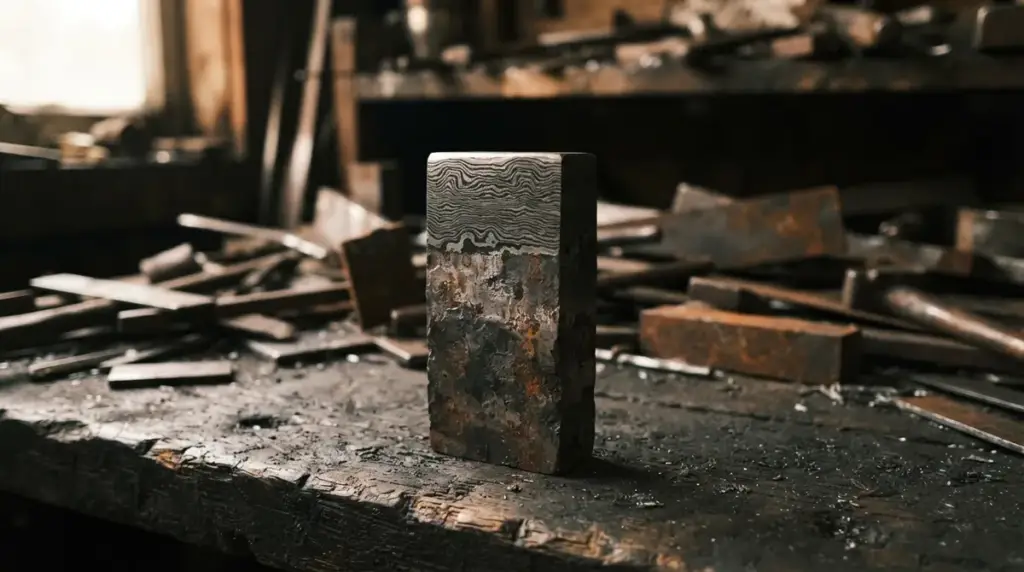
Stainless Damascus costs more at every stage. The billet is more expensive because forge welding chromium bearing steels means keeping oxygen away from the weld faces, which in practice means a vacuum or an inert atmosphere or a very careful canister process. The heat treatment is more expensive because the good stainless recipes want a foil wrap, a plate quench and often liquid nitrogen. The finishing is more expensive because the etch is fussier and the acids are nastier. And then the pattern that comes out the other end is fainter than the cheap carbon billet the shop next door is using.
That is why the stainless Damascus market has split. At the top there is Damasteel and a few makers using it, on folders bought by people who know exactly what they are getting. At the bottom there is a lot of steel sold as stainless Damascus that is either a laser etched pattern on a plain stainless blade or a carbon billet with a stainless sounding name. Our guide to real versus fake Damascus covers how to tell those apart.
For reference on the carbon side of the same market, the 320 Damascus knives on this site run from 70 dollars to 1,631 dollars, with a quarter of them under 116 dollars and a median of 172 dollars. Those are carbon billets throughout.
What is actually in the BMK catalogue
We pulled these figures from our own product database on 30 August 2026 rather than repeating a marketing line.
| What we stock | Count | Price low | Median | Price high |
|---|---|---|---|---|
| All published products | 609 | 55 dollars | 155 dollars | 1,631 dollars |
| Damascus, carbon billet | 320 | 70 dollars | 172 dollars | 1,631 dollars |
| Damascus listings that name 15N20 in the copy | 283 of 320 | |||
| Stainless Damascus | 0 | |||
| 440C monosteel, not patterned | 14 | 73 dollars | 155 dollars | 531 dollars |
| D2 tool steel, not patterned | 111 |
Two things in that table are awkward for us and we would rather say them than have you find them. The first is the zero. If you came here searching for a stainless Damascus knife, we do not have one, and no amount of scrolling our Damascus category will produce one. The second is the gap between 283 and 320. Thirty seven of our Damascus listings do not name the two steels in the billet anywhere in the description. They are the same 1095 and 15N20 billet as the rest, but the copy does not say so, and a buyer is entitled to ask. We are working through those.
If corrosion resistance is the thing you actually want, the honest recommendation from us is not a Damascus knife at all. It is one of the 14 440C knives in monosteel, where the chromium is doing its job across the whole cross section and there is no forge weld to worry about. Our 440C steel guide goes through what that alloy does well.
Sharpening and re-etching are not the same job
Both families sharpen on the same stones at the same angles, and both lose the pattern along the bevel when you do, because the visible contrast is a surface effect only a few thousandths of an inch deep and the stone takes it off. The difference is what it takes to put it back.
On carbon Damascus, restoring the etch is a kitchen table job: ferric chloride diluted around 3:1 or 4:1 with distilled water, a few passes of three to five minutes with a scrub between each, then neutralise in water with baking soda.
On stainless Damascus, it is not a kitchen table job. Ferric chloride will give you a flat grey mess. You need sulfuric or muriatic acid or an electrolytic rig, which means proper ventilation and proper handling, and most owners will send the blade back to the maker instead. If you want the whole process for a carbon blade, we wrote it up separately in sharpening a Damascus knife.
How to tell which one a seller is really selling
Four questions, in order of how quickly they end the conversation.
- Name the two steels. A real maker answers instantly: 1095 and 15N20, or AEB-L and 304, or RWL34 and PMC27. A seller who answers with a layer count instead of an alloy pair is not answering.
- Ask what the pattern looks like on the bevel. On any genuine pattern welded blade, the freshly sharpened bevel shows a bright band with no contrast until it is re-etched. On a laser etched or printed fake, the pattern stops dead at the shoulder and the bevel is clean because the pattern was never in the metal.
- Ask what etchant was used. Ferric chloride means carbon. Sulfuric, muriatic or electrolytic means stainless, or means the seller has read this page.
- Ask about rust. An honest seller says stainless resists corrosion without being immune, and that carbon can spot. A seller who says a Damascus knife never rusts is selling something else.
So which one should you buy
| If this is you | Buy | Why |
|---|---|---|
| You want the loudest possible pattern for a display piece or a gift | Carbon Damascus | Nothing stainless comes close on contrast, and the whole point of the purchase is how it looks |
| It is going in a kitchen shared with other people | 440C or another stainless monosteel | Somebody will leave it in the sink. Assume it and buy accordingly |
| You want a patterned kitchen knife and will look after it yourself | Carbon Damascus | Wipe it dry, oil it occasionally, and it is fine. Our Damascus care guide is four minutes of reading |
| Coastal, humid or a boat | Stainless Damascus if you can find it, stainless monosteel otherwise | Salt air is the one condition where carbon Damascus is genuinely a bad idea |
| You want the best cutting performance per dollar | Neither. A good monosteel | Pattern welding costs toughness and adds cost. It buys appearance |
| You are buying from us | Carbon Damascus, because that is all we have | See the catalogue table above |
Questions people ask
Is stainless Damascus real Damascus?
It is real pattern welded steel, which is what the modern knife trade means by Damascus. It is not historic wootz, but then neither is carbon Damascus. If the question is whether the pattern goes through the metal rather than sitting on it, then yes, provided it was forge welded and not laser etched.
Does stainless Damascus rust?
Much less than carbon Damascus, and it will survive normal washing up and a humid pocket. It is not rust proof. Salt, prolonged wet and a neglected edge will still mark it. Nothing sold as stainless is immune, it is a rate difference rather than a guarantee.
Why is the pattern on stainless Damascus so faint?
Because both steels in the billet carry chromium and both form a passive oxide film, so the acid attacks them at similar rates. Contrast in pattern welded steel comes from one layer resisting the etchant more than the other, and in a stainless billet that difference is small. Damasteel gets a useful difference by pairing a high molybdenum steel with a low alloy one.
Is 440C Damascus a thing?
Yes, 440C is commonly paired with 416 in stainless billets, and it is one of the pairings people search for by name. We do not sell it. We sell 440C as a monosteel in 14 knives, which is a different product with a different look.
Which holds an edge longer, stainless or carbon Damascus?
It depends far more on which specific alloys are in the billet and how they were heat treated than on which family they belong to. A powder metallurgy stainless billet at about 61 HRC will outlast a 1095 and 15N20 billet at 58 to 60 HRC in abrasive cutting. A budget stainless billet with soft austenitic layers will not.
Can you make Damascus from stainless and carbon steel together?
It can be forge welded, and some makers have done it, but the result is not stainless. The carbon layers rust while the stainless ones do not, which produces striped corrosion. It also complicates heat treatment, because the two families want different austenitising temperatures. Treat anything sold this way as a carbon knife.
Is stainless Damascus worth the extra money?
If you need corrosion resistance and you specifically want a pattern, yes, and there is no substitute. If you need corrosion resistance and you do not care about the pattern, a stainless monosteel does the same job for far less. Buying stainless Damascus for cutting performance alone is the one case where the money is poorly spent.
How many layers should stainless Damascus have?
Layer count is close to meaningless as a quality measure in either family. What matters is that the welds are clean and that the pattern is developed enough to read. Our carbon billets are typically stated at 352 layers, and 223 of our Damascus listings say so, but the number is a description of the process rather than a performance claim. We wrote about that in our 352 layers guide.
Can a stainless Damascus knife be re-etched at home?
Not easily. The ferric chloride that works on carbon billets gives flat, muddy results on stainless, and the alternatives are sulfuric acid, muriatic acid or an electrolytic setup, all of which need ventilation and care. Most owners return the knife to the maker. Carbon Damascus, by contrast, is genuinely a home job.
Do you sell any stainless Damascus?
No. As of 30 August 2026 we have 320 Damascus knives published and every one of them is a carbon billet, almost all 1095 with 15N20. If you specifically need patterned stainless, buy it somewhere else. If you want stainless from us, it is 440C in monosteel.
More guides
If you want the manufacturing side, how Damascus steel is made follows a billet from stack to finished blade. Our knife steel chart and knife steel comparison put the monosteels side by side. Do Damascus knives rust answers the corrosion question at length, and the 440C guide covers the stainless alloy we actually stock.
More from the workshop
Butterfly Knife Tricks for Beginners
Start on a trainer, get smooth before fast, and learn the close before the open.
The Cowboy Bull Cutter: A Ranch Pattern Nobody Explains
Why the tip is blunt, what the notched choil does, and the real prices, steels and handles across our 32 bull cutters.
Damascus vs D2 vs 440C vs VG10: Which Steel
Damascus, D2, 440C and VG10 compared by what each one is actually good at.
