
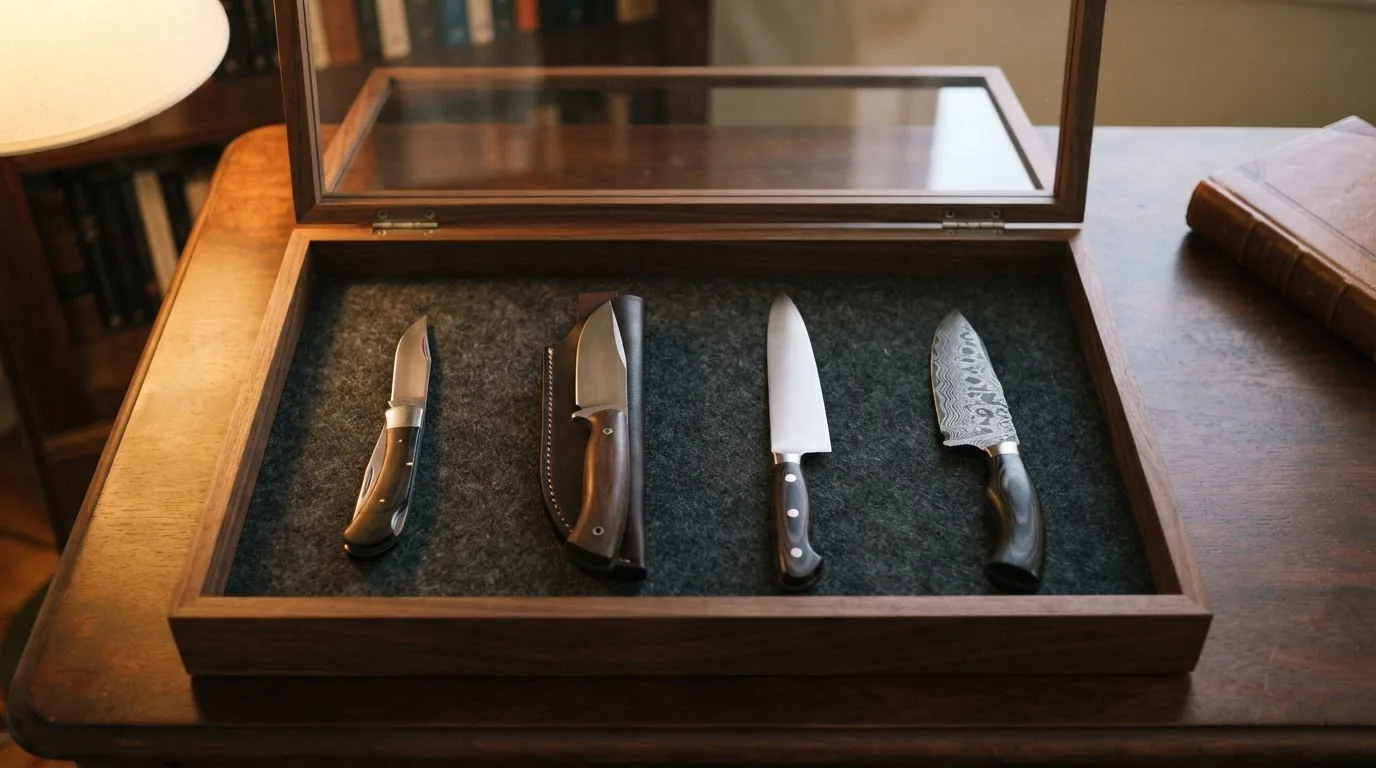
Short answer. Buy one good knife in each of four categories, a folder, a fixed blade, a kitchen knife and one knife you simply like the look of, then stop and use them for a year. Set a per knife ceiling before you start and hold it. Store them dry, oiled and not touching each other. And go in knowing that almost nothing you buy new will be worth more later, including things you buy from us.
That last sentence is the reason this page exists. The knife collecting advice that ranks for this query is written either by shops that would like you to buy more knives or by enthusiasts describing a hobby they are already deep inside. Neither tells a first time collector the thing that would save them the most money, which is that a collection is a spending habit, not an asset.
What a collection is, and what a pile of knives is
A collection has a rule. It might be one maker, one country, one blade shape, one era, one steel or one price band. The rule is what makes the group interesting to look at and interesting to talk about, and it is also what stops the buying from becoming infinite.
A pile of knives has no rule. It is the result of buying whatever caught your eye that month. Piles are common, they are how nearly everyone starts, and they are not a disaster. But a pile of eleven mid priced folders that all do the same job is a worse outcome than four deliberately chosen knives at the same total spend, and the difference between the two is a decision made in the first six months.
Pick your rule early. It does not have to be clever. "Fixed blades under $250 with natural handle material" is a perfectly good rule. So is "one knife from each type of grind" or "knives I have actually used". The rule is doing a job whether or not anyone else finds it interesting.
The four knife rule: buy one of each, then stop
The best first year for a new collector is four knives, chosen from four different categories, used regularly, and then a pause of at least six months before buying anything else.
Four categories, because each teaches you something different. A folder teaches you about pivots, locks, detent and pocket carry. A fixed blade teaches you about tang construction, sheaths and how a full sized knife balances in the hand. A kitchen knife teaches you about edge geometry and what a truly sharp knife feels like, because you will use it more often than everything else combined. And one knife bought purely because you like it teaches you what your taste actually is, which is usually not what you assumed at the start.
| Category | What it teaches you | Our published count | Our price range | Our median |
|---|---|---|---|---|
| Folding pocket knife | Locks, pivots, detent, carry | 111 | $70 to $845 | $128 |
| Fixed blade, hunting or outdoor | Tang, sheath, balance, grind | 133 | $73 to $1,014 | $201 |
| Kitchen or chef knife | Edge geometry, real world sharpness | 42 | $90 to $694 | $142 |
| One you simply want | Your actual taste | whole catalogue, 609 | $55 to $1,631 | $155 |
Figures are from our published catalogue on 30 August 2026, counted server side. They describe our shop, not the market. Plenty of good knives exist below our floor and plenty exist far above our ceiling.
The pause matters more than the four. Six months of using those knives will teach you which one you reach for and which one has sat in a drawer since week two, and that information is worth more than the next three purchases you would otherwise have made.
Setting a budget that survives year two
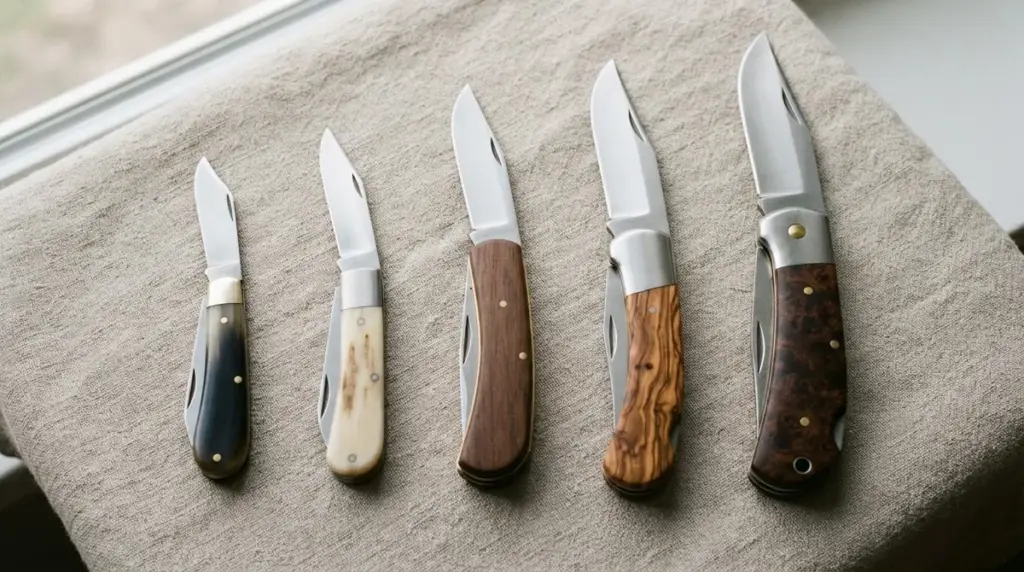
Two numbers, decided before you buy anything. A per knife ceiling and an annual total. Write both down somewhere you will see them.
The per knife ceiling stops the single expensive mistake. The annual total stops the slow accumulation, which is the one that actually gets people, because forty dollars a month feels like nothing and is five hundred a year.
| Band | What it buys in our catalogue | Sensible for |
|---|---|---|
| $55 to $114 | Our lowest quarter by price | First knife, testing whether the hobby sticks |
| $114 to $155 | Up to our catalogue median | The four knife starting set |
| $155 to $254 | Third quarter of our range | A considered purchase after the first year |
| $254 to $401 | Up to our ninetieth percentile | One piece a year, not a habit |
| $401 and above | Top tenth, up to $1,631 | Only when you know exactly what you want and why |
Our premium and limited edition range gives a sense of what the upper end looks like: 108 published products running from $90 to $1,269 with a median of $353. That is a real tier and some of it is genuinely beautiful work. It is also the tier where a new collector is most likely to buy something they do not yet have the experience to evaluate.
Almost nothing you buy new will appreciate
This is the honest part and it costs us sales, so here it is in plain terms.
A production knife bought new from any shop, including ours, is worth less the moment it ships. The secondary market for used knives generally clears well below retail, because the buyer can get a new one with a warranty for not much more. That gap does not close over five years or over ten. Carry wear, sharpening marks and a missing box all widen it.
Knives that do appreciate share specific and rare characteristics: a maker with a genuine waiting list and a reputation built over decades, a genuinely limited run that sold out and was never repeated, a documented provenance, and an active enthusiast community with a functioning marketplace. Very few knives have all four. Almost no knife has them at the point of first release, which is exactly when a shop would like you to buy it as an investment.
Treat "limited edition" as a description of the run size and nothing more. It is not a prediction. A limited run only becomes valuable if demand for that specific piece outlives the run, and nobody, including the maker, knows in advance whether it will.
Buy knives because you want to own them and use them. If one of them turns out to be worth something in twenty years, treat that as a surprise rather than a plan.
What actually holds value, when anything does
Condition first. An unused knife in its original packaging with any papers it came with holds value far better than the same knife carried for a month. That creates an unpleasant tension: the knives you enjoy most are the ones you use, and using them costs whatever resale value they had. Most collectors resolve this by deciding on purchase which knives get used and which do not, and then not changing their minds.
Completeness second. Box, sheath, papers, spare hardware, anything that shipped with it. Keep all of it in one place from day one, because it is easier than finding it later.
Maker reputation third, and it is slow. A maker's name carries resale value only after years of consistent output and a community that talks about them. New names carry none, however good the work is.
Materials and steel come fourth and matter less than people assume. A rare handle material or an exotic steel adds interest but rarely adds resale on its own. It is a reason to want the knife, not a reason to expect a return.
Steel matters less to a collection than it does to a working knife
A working knife is chosen on edge retention, toughness and corrosion resistance because it has a job. A collected knife spends most of its life not cutting anything, which changes the calculation.
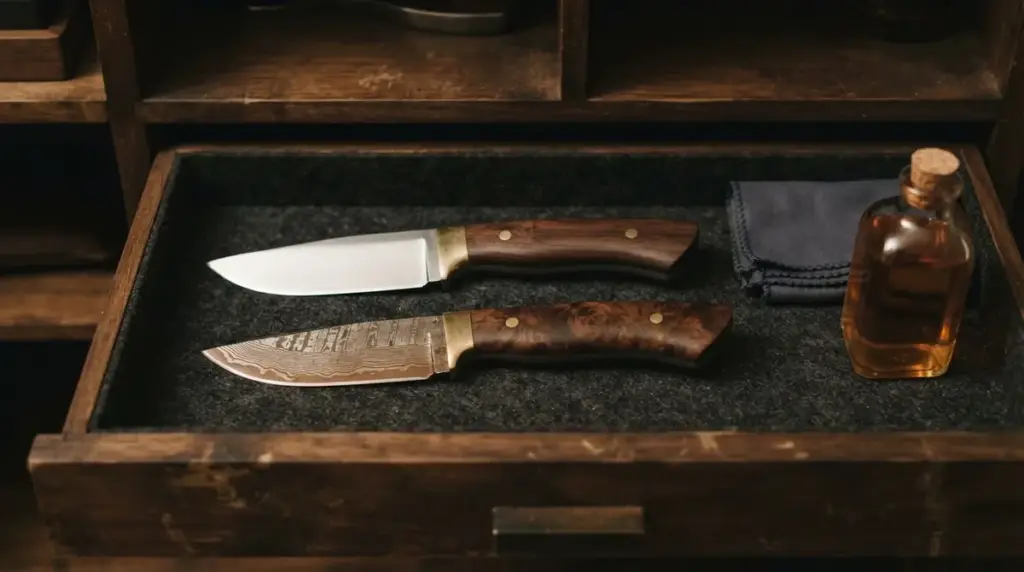
What still matters is corrosion resistance, because a collection is stored rather than used and stored carbon steel is the thing most likely to go wrong. Our Damascus, layered 1095 and 15N20 at 58 to 60 HRC, has effectively no chromium in it and will rust if the storage is damp. Our D2 knives at 58 to 62 HRC carry roughly 12 percent chromium and are much more tolerant of neglect. If you are building a display collection and you are not confident about your storage conditions, that difference is worth more than any edge retention figure.
What matters less is edge retention. A knife in a case does not go dull. Paying a premium for a super steel on a piece you will never cut with is paying for a property you are not going to use.
The knife steel chart covers what each steel actually does if you want to go deeper before choosing.
Storing a collection so it does not quietly destroy itself
Humidity is the enemy and it is the only variable most people can control. Steel corrodes when moisture sits on it, and a closed drawer in a humid house is worse than an open shelf in a dry one because still damp air does not carry moisture away.
| Storage method | Good for | Watch out for |
|---|---|---|
| Display case with felt lining | Pieces you look at, keeps dust off | Felt holds moisture against the blade if the room is damp |
| Knife roll or fabric pouch | Transport and kitchen knives | Fabric traps humidity, never store a damp blade in one |
| Leather sheath, long term | Nothing, do not do this | Tanning residues in leather actively corrode steel |
| Open rack or magnetic strip | Kitchen knives in daily use | Dust, edges touching, and grease from cooking |
| Drawer with individual slots | A growing collection on a budget | Blades touching each other, which chips edges |
| Sealed case with desiccant | Carbon steel in a humid climate | Desiccant needs recharging or it stops working |
The leather point catches people every year. A sheath is for carrying a knife, not for keeping it. Leather retains moisture and the chemicals used in tanning are corrosive to steel over months. A carbon steel blade left in a leather sheath through a humid summer can come out pitted. Our how to store knives guide goes through the options properly.
Handling, oiling and a maintenance rhythm you will actually keep
Skin is slightly acidic and fingerprints on a bare blade will etch into the surface over weeks. Handle collected pieces by the handle, or wipe the blade down before it goes back. That single habit prevents most of the marks that show up on collections.
Oil is the other habit. A thin film of a suitable oil excludes moisture from the surface, and on carbon steel and Damascus it is not optional. For anything that will touch food, use a food safe oil, and be aware that some traditional choices go rancid. Our best knife oil guide covers what to use and what to keep away from a kitchen blade.
A rhythm that works: wipe and oil anything carbon steel every three months, check the whole collection twice a year, and inspect immediately after any change in where the knives are stored or after a very humid spell. Set a reminder. Collections do not fail because people do not care, they fail because eighteen months pass without anyone opening the case.
If something has already gone wrong, how to remove rust from a knife covers the repair, and it is worth reading before you attack a patterned blade with an abrasive, because rust removal takes the etch contrast off with the rust.
Where to buy, and the counterfeit problem
Buy from the maker, from an established retailer, or from a person with a long verifiable history in a community that polices itself. Those are the three safe routes and everything else carries risk.
The specific risk in this category is misrepresentation rather than outright fakery. Very few knives are counterfeits of a specific product. Very many are described in ways that are not true: acid etched patterns sold as pattern welded Damascus, partial tangs photographed to look full, hardness claims with no basis, and handle materials that are dyed substitutes for the real thing. Our real versus fake Damascus guide shows what to look for, and hand-forged versus factory explains what those words are supposed to mean.
Three questions cut through most of it. What is the steel, named specifically rather than as "high carbon"? What hardness is it run at, as a number? Is the tang full, and is there a photograph showing it? A seller who cannot answer all three is either not making the knives or not paying attention to them.
Law, travel and the part nobody wants to read
Knife law in the United States is set at state and often city level, and it varies more than people expect. Blade length limits, restrictions on locking mechanisms, automatic opening, concealed carry rules and outright prohibitions on specific types all differ across state lines. A knife that is entirely legal to own and carry in one state can be a criminal offence in the next one.
Owning is generally treated differently from carrying, and both are treated differently from selling. A display collection at home is the least regulated case in most places, but that is a generalisation and it is not legal advice. Please check your local law before ordering.
Travel adds another layer, and the rules for checked baggage, hand luggage and crossing state or national borders are all different. Our guides on pocket knife laws by state and flying with a knife cover the ground in detail.
Questions people ask
How do I start a knife collection?
Choose a rule that defines what belongs in it, buy one knife in each of four categories, use them for at least six months, and only then decide what the fifth should be. The pause does more for the collection than the first four purchases do.
How much should a beginner spend?
Set a per knife ceiling and an annual total before you buy anything. In our catalogue the median knife is $155 and the lowest quarter sits between $55 and $114, which is a reasonable place for a first purchase while you find out whether the hobby sticks.
Do knives increase in value?
Almost never, if bought new from a shop. A production knife loses value the moment it ships and the secondary market clears well below retail. The rare exceptions involve an established maker, a genuinely limited run, documented provenance and an active collector community, and very few knives have all four.
Does limited edition mean it will be worth more?
No. It describes the run size and nothing else. A limited run gains value only if demand for that specific piece outlasts the run, which nobody can predict at release, including the maker.
Should I use the knives in my collection?
Decide per knife on the day you buy it, and then stick to it. Using a knife costs whatever resale value it had, and since most knives have very little resale value anyway, the argument for using them is stronger than most collectors admit.
What is the best steel for a collection?
Whichever one you can store safely. Corrosion resistance matters far more for a stored knife than edge retention does, since a knife in a case never goes dull. Our D2 at 58 to 62 HRC tolerates imperfect storage. Our Damascus, made from 1095 and 15N20 at 58 to 60 HRC, will rust if the storage is damp.
How should I store collectible knives?
Dry, oiled, not touching each other, and never in a leather sheath for the long term. Leather holds moisture and tanning residues corrode steel. A lined case is fine in a dry room and a liability in a damp one.
How often should I oil the blades?
Every three months for carbon steel and Damascus, and check the whole collection at least twice a year. Set a calendar reminder, because the common failure is not carelessness, it is time passing.
Where should I buy collectible knives?
From the maker, from an established retailer, or from someone with a long verifiable history in a community with a functioning marketplace. Ask for the steel by name, the hardness as a number, and a photograph of the tang. A seller who cannot supply all three is worth walking away from.
Is knife collecting legal?
Owning a collection is generally the least regulated case, but carry laws vary considerably by state and city, and some knife types are prohibited outright in some places. Please check your local law before ordering, and treat this as general information rather than legal advice.
More guides
Before you spend anything, are Damascus knives worth it and what a Damascus knife should cost will calibrate your expectations on price. Knife types explained is a good map of the categories, and how to store knives covers the storage side properly. If you already know what you want from the upper tier, the premium edition knives category is where our 108 published pieces sit.
More from the workshop
Damascus Tomahawks: Head Weight, Haft and What They Chop
What separates a tomahawk from a hatchet, why head weight matters, and the lengths, steels and prices of our ten.
Fishing Knives: Bait, Fillet, Folding and Saltwater
Sizing a fillet blade, why carbon Damascus loses to salt water, and what our seven fishing listings really are.
