
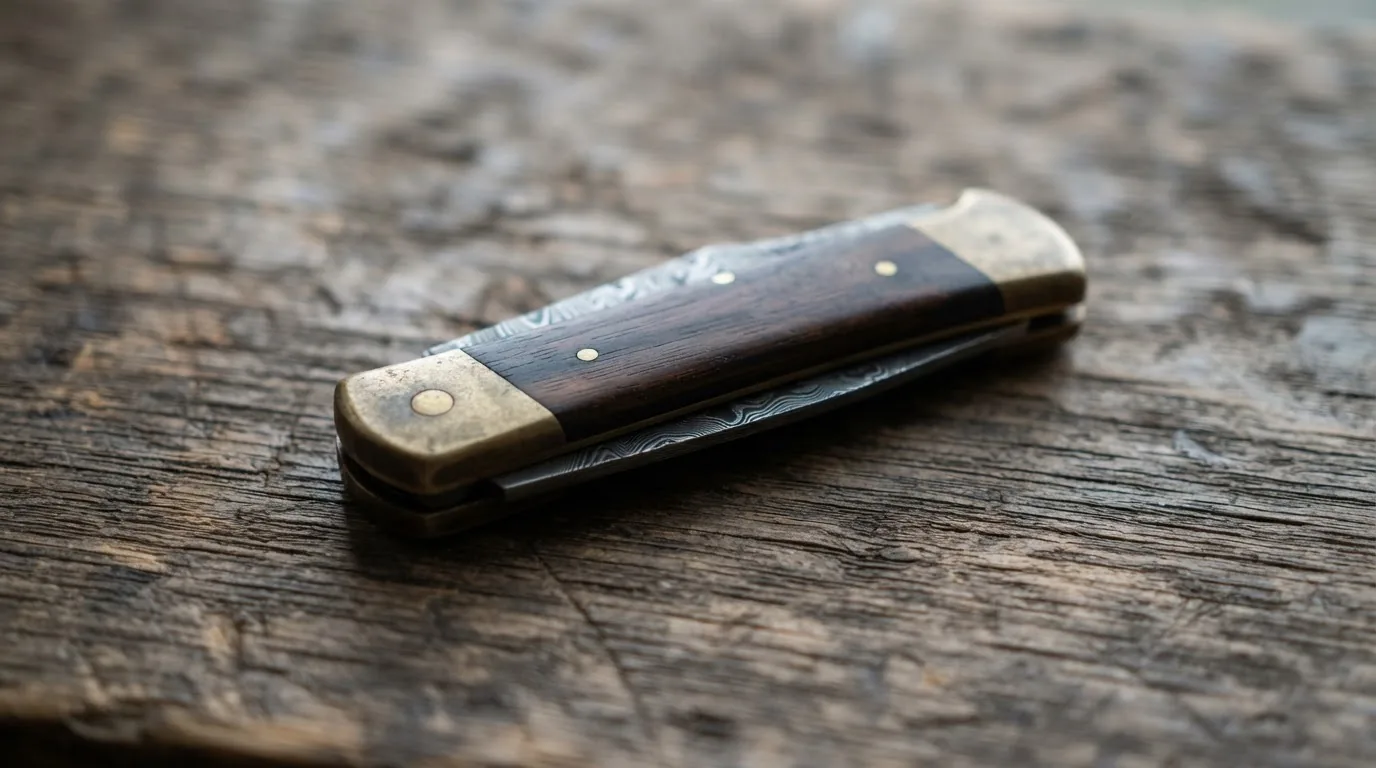
Short answer: a Damascus pocket knife is a folder whose blade is pattern welded from two steels, almost always 1095 and 15N20, then acid etched so the layers show. You are buying a blade that holds a good edge and looks like nothing else in a pocket. You are giving up corrosion resistance, and in most cases you are giving up a published lock type as well. Across our own 111 folding listings the median price is $128 and the median blade is 3 inches.
What a Damascus folder actually is
Pattern welded steel is a stack. Bars of two alloys are cleaned, stacked, brought to welding heat and forge welded into one solid billet, then drawn out, cut, folded and welded again. The pattern you see is the cut ends of those layers meeting the surface of the ground blade.
The two steels are chosen for contrast, not for chemistry. 1095 is a plain high carbon steel. 15N20 carries roughly 2 percent nickel, which is why it resists the acid etch and stays bright while the 1095 goes dark. Neither of them contains any meaningful chromium. That single fact drives most of what follows on this page.
A folder complicates the job. A fixed blade is one piece of steel and a handle. A folder is a pivot, two liners or bolsters, a spring or a lock bar, a stop, pins and scales, and every one of those parts has to sit within a few thousandths of an inch of where it should be or the knife rattles, drags or closes on you. That is why a well made Damascus folder costs more than a well made Damascus fixed blade of the same length. We charge more for ours, and the numbers below show it.
What our own 111 folders are made of
We pulled the specification table out of every published listing in our folding pocket knife category on 30 August 2026. There are 111 of them. 103 state a blade steel in the table. Here is the whole set, with nothing rounded or grouped to flatter us.
| Blade steel as listed | Folders | Share of the 103 that state one |
|---|---|---|
| 1095 and 15N20 Damascus, 352 layers | 66 | 64 percent |
| 1095 and 15N20 Damascus, layer count not stated | 21 | 20 percent |
| VG10 stainless | 11 | 11 percent |
| 440C stainless | 3 | 3 percent |
| High carbon steel, not pattern welded | 2 | 2 percent |
| No steel stated in the table | 8 of 111 | not counted above |
So 87 of our 111 folders are carbon Damascus and 14 are stainless. If you came to this page hoping for a stainless Damascus folder, we do not make one. The 14 stainless folders we do list are plain VG10 or 440C with a mirror finish, not a pattern.
Hardness is stated on 102 of the 111 as 58 to 60 HRC, oil tempered. That is the band we hold 1095 and 15N20 to, and we do not publish a different number for it.
What a Damascus folder costs
Prices below are the live prices on 30 August 2026 and they move. The point of the table is the shape of the range, not the exact figure on any given day.
| Group | Listings | Lowest | 25th percentile | Median | 75th percentile | Highest |
|---|---|---|---|---|---|---|
| All folding pocket knives | 111 | $70 | $102 | $128 | $283 | $845 |
| Damascus folders only | 87 | $70 | not calculated | $114 | $286 | $845 |
| Whole catalogue, all 609 products | 609 | $55 | $114 | $155 | $254 | $1,631 |
Read the gap between the median and the 75th percentile. It is $128 against $283 for the folding category. That is not a smooth curve, it is two populations sitting in one aisle: a large group of plain wood or resin handled Damascus folders around $100 to $140, and a smaller group of pearl, engraved brass and inlaid pieces that start near $280 and run to $845. Nothing sits comfortably in between, so if your budget is $200 you will find less choice than at $120 or at $300. We would rather tell you that than let you find out by scrolling.
Blade length and what fits a pocket
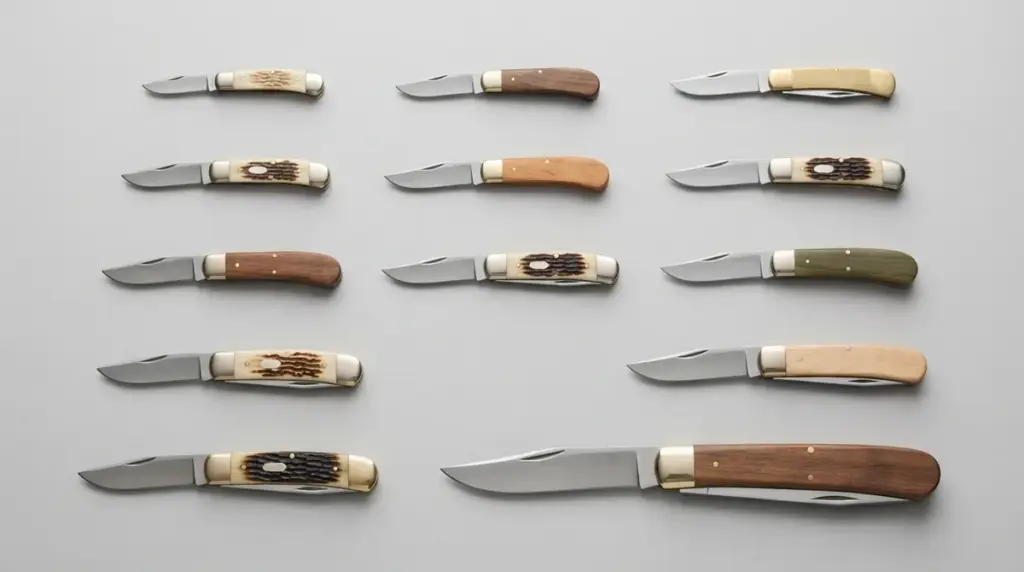
95 of the 111 listings state a blade length. The median is 3 inches and the 75th percentile is 3.5 inches. The shortest is 1.5 inches and the longest is 7 inches. Overall length runs 3 inches to 12 inches with a median of 7.
| Blade length | What it does well | What it does badly |
|---|---|---|
| Under 2.5 inches | Vanishes in a pocket, opens mail and packages, legal in more places | Too little edge for food prep or cordage, small handle tires your hand fast |
| 3 inches | The general purpose size and our median. Enough edge for most daily cutting | Nothing much. It is the safe answer for a reason |
| 3.5 to 4 inches | Real slicing capacity, better for food and for field work | Noticeably heavier in the pocket, restricted by blade length rules in some places |
| Over 4 inches | Cuts like a small fixed blade | An awkward object to carry every day and the first thing a blade length rule catches |
If you are choosing your first folder and you have no strong opinion, take the 3 inch blade. Our own catalogue converged on it without anybody deciding to, which is usually a sign the market worked it out first.
The lock, and why we cannot tell you ours
This is the inconvenient part. We read the specification table on all 111 folder listings. Not one of them states a lock type. The tables carry steel, hardness, overall length, blade length, handle length, pattern, weight and what is included. There is no row for the lock, and there is no row for the pivot hardware either.
That matters because the lock is the part of a folder that decides whether it is a hard use tool or a gentleman's knife. A back lock and a liner lock behave differently under a twisting cut. A slip joint does not lock at all, it just resists. A knife you cannot identify the lock on is a knife you should not lean on.
Until those rows exist, treat a Damascus slip joint or a light liner lock from us as a slicing and opening knife, not a prying or batoning knife. If you need to know the lock on a specific listing before you buy, ask us and we will look at the actual knife rather than guess. That is a worse answer than a published spec, and we know it.
Pattern, and what a layer count means
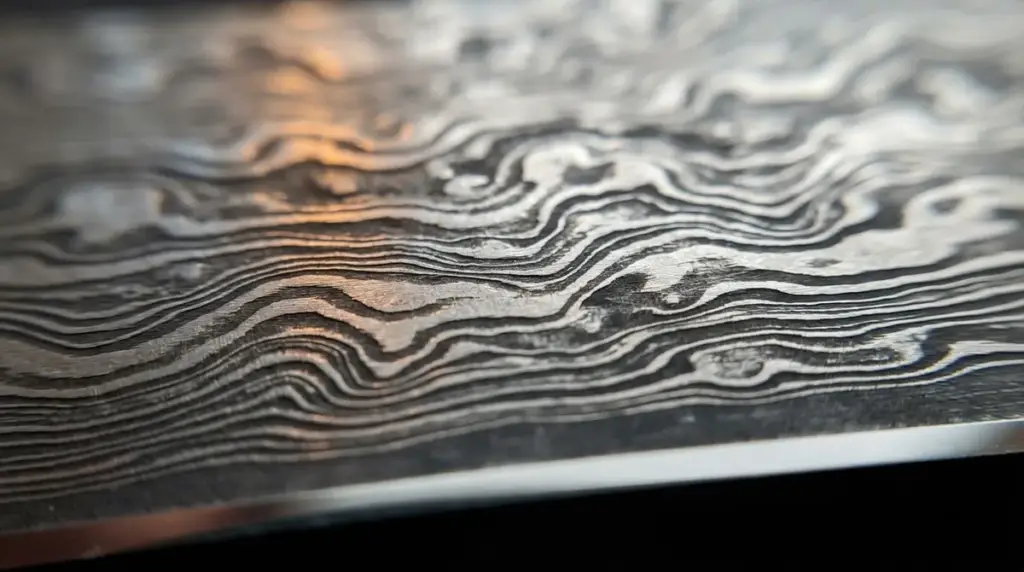
68 of our folder listings state a pattern. The most common by a wide margin is described as a wind and mix twist fire pattern with brass file work, which appears on 38 of them. A further 14 add feather, rain drop and ladder to the same description.
Layer counts get quoted more than they get understood. 352 layers on 66 of our folders is a real number that comes from the fold arithmetic, not a marketing round up, but it tells you about appearance and very little about performance. Two blades at 352 layers can behave completely differently depending on heat treatment. We wrote a whole page on what a layer count actually tells you, and the short version is that it tells you about the pattern.
If a seller will not say which two steels went into the billet, that is a more useful warning sign than any layer figure. Our page on telling real pattern welding from a printed pattern covers what to look at on the spine and the plunge line.
Corrosion, the part nobody wants to read
Stainless steel is defined by a chromium content of 10.5 percent or more, which forms a thin chromium oxide film that blocks oxygen from reaching the metal underneath and repairs itself when scratched. 1095 has effectively no chromium. 15N20 has effectively no chromium. A blade made of both has no passive layer at all.
In practice that means a Damascus folder will develop spots if you put it away wet, if you cut citrus or onion and leave the juice on it, or if you carry it against a sweaty leg all summer. The etch that makes the pattern visible is itself a controlled corrosion, so the surface starts life already reactive.
None of that makes the knife defective. It makes it a knife that wants ten seconds of attention after use. Wipe it dry, put a film of oil on it, and it will outlive you. Skip that for a month in a humid house and you will be reading our rust removal page. There is a fuller answer on whether Damascus knives rust, and the honest one is yes, readily.
Folders are worse than fixed blades here because water gets into the pivot and stays there. Our page on cleaning a pocket knife deals with the pivot specifically.
Handles, and a gap in our own data
Only 54 of the 111 folder listings carry a handle row in the specification table. That is under half. Of the 51 we could read cleanly, 20 name a wood, 8 name brass, 6 name pearl, 5 name bone, 5 name Micarta, 4 name a resin, 4 name copper, 3 name turquoise, 2 name stag and 2 name horn. Several list more than one material because bolsters and inlays are counted.
Practical differences are easy to state. Wood and bone are warm in the hand and move slightly with humidity. Brass and copper are heavy, patinate, and look better after a year than they do new. Pearl and abalone are the most fragile things in the catalogue and should not be dropped on tile. Micarta and G10 are the two that do not care about weather at all.
Poured resin is the one on that list that behaves itself in every season: waterproof, dimensionally stable and unbothered by humidity. Our pride knives are built on a stabilized honeycomb block of it over a Damascus bolster.
If a listing you are looking at has no handle row, ask before you buy. Do not read the title and assume, because the title is marketing copy and the table is the specification.
Clip or sheath, and why this may disappoint you
110 of our 111 folder listings say the knife ships with a hand stitched leather sheath. Exactly one says pocket clip, no sheath included.
People search for a Damascus pocket knife with a clip constantly. We know, because those searches show up against our own site. We mostly do not sell that. A leather belt pouch is a different carry: slower to draw, kinder to the finish, better for a knife that is half an object and half a tool, and completely useless if your habit is to drop a knife in a jeans pocket and forget about it.
If a clip is non negotiable for you, filter hard, or accept that you are buying a pouch carry knife and change your habit. We would rather say that on the guide page than let you discover it in a box.
Who a Damascus folder suits
It suits someone who likes objects, does mostly light cutting, and does not mind a maintenance habit. It suits a gift, particularly to someone who will look at it as much as use it. It suits a collector building a set, and our category runs deep enough at the top end to do that.
It does not suit a wet trade. Roofers, boat crew, fishmongers and anyone whose knife lives in a damp bag should be carrying stainless. It does not suit a person who wants a lock they can research before buying, at least not from us today. And it does not suit someone who wants the cheapest working folder, because a $55 plain carbon fixed blade from our own catalogue will out cut a $128 patterned folder every day of the week.
If you want the wider comparison of steels before you commit, our steel comparison page puts 1095 and 15N20 next to D2, 440C and VG10. If you are still deciding what to carry at all, start with how to choose an EDC knife.
Questions people ask
Is a Damascus pocket knife worth the money
It depends entirely on whether the pattern is worth something to you, because the pattern is what you are paying for. At 58 to 60 HRC a 1095 and 15N20 blade cuts about like a good plain carbon blade, which is to say very well. It does not cut better because it is layered.
Will a Damascus folder rust in my pocket
Yes, if you sweat and never wipe it. There is no chromium in either steel, so there is no self repairing oxide layer. A wipe and a light oil after each use prevents almost all of it.
How many layers should a Damascus folder have
The number is an appearance choice, not a quality grade. 66 of our 111 folders are stated at 352 layers. A 120 layer blade from the same billet stock and the same heat treatment will cut identically.
What is the average price of your Damascus folders
The median price across the 87 Damascus folders in our folding category was $114 on 30 August 2026, with a 75th percentile of $286 and a top price of $845. The whole folding category has a median of $128.
What blade length do most of your folders have
3 inches. That is the median of the 95 listings that state a blade length, and the 75th percentile is only 3.5 inches. The range runs from 1.5 inches to 7 inches.
Do your Damascus folders come with a pocket clip
Almost none of them. 110 of 111 listings state a hand stitched leather sheath and one states a pocket clip with no sheath. If a clip is essential, check the individual listing before ordering.
What lock do your folders use
The specification tables do not state it, on any of the 111. That is a gap in our own listings rather than a secret. Ask us about a specific knife and we will check the physical example.
Is Damascus stronger than ordinary steel
No. Modern pattern welded steel is made for appearance. Strength and edge holding come from the alloys chosen and the heat treatment, and 1095 and 15N20 are ordinary alloys with a long track record. Layering does not add toughness.
Can I carry a Damascus folder legally
Blade length rules and locking blade rules vary by state and by city, and a patterned blade is treated no differently from a plain one. Our state by state pocket knife page is the starting point. Please check your local law before ordering.
How do I keep the pattern looking sharp
Do not polish it. The contrast comes from an acid etch that sits only a few microns deep, and metal polish or a buffing wheel will take it straight off. Wash, dry, oil. If the pattern has faded, it can be re etched, but that is a job for a shop and not for a kitchen sink.
More guides
Keep reading: do Damascus knives rust, what 352 layers means, real against fake Damascus, how to choose an EDC knife and multi blade pocket knives. Or go straight to the folding pocket knife category.
More from the workshop
Boning Knife vs Fillet Knife
Stiff works around bone, flexible follows it. They are not interchangeable.
Do Damascus Knives Rust?
Damascus is carbon steel and it rusts. Why the nickel does not help, what causes it, and how to stop it.
