
Short answer: a rainbow knife gets its colour in one of four ways, and only two of them survive being owned. A coated blade is titanium nitride or a similar PVD film sprayed on in a vacuum chamber, and it is a few microns thick, so it goes first at the edge and then at every corner your pocket touches. Anodised titanium is an oxide layer on titanium parts, thin as well but tougher than it looks. A printed handle is ink under lacquer, and it wears at the exact spots your fingers sit. Dyed or poured resin is the only one where the colour goes all the way through the material, which is why it is the only one that still looks the same in ten years. If you are buying a pride knife as a gift, that distinction is the whole purchase.
The four ways a knife ends up rainbow
Search for a rainbow knife and you get a wall of pictures that all look roughly the same and cost anywhere from nine dollars to three hundred. The photographs cannot tell you which is which. The construction can, and there are only four methods in common use.
| Method | What it actually is | Where the colour lives | How it fails | Usually costs |
|---|---|---|---|---|
| PVD or titanium nitride coating | A metal film deposited on the blade in a vacuum chamber | On the surface, a few microns deep | Sharpening removes it at the bevel immediately. Rubbing wears it at the corners | Cheap to apply, common on budget knives |
| Anodised titanium | An oxide layer grown electrically on titanium parts | On the surface, but grown into it rather than sprayed on | Scratches through to grey titanium. Does not flake | Mid range, usually on clips, liners and hardware |
| Printed or wrapped handle | Ink or film applied to a scale, then lacquered | Under a clear coat | Wears through where your fingers and pocket seam sit | The cheapest of the four |
| Dyed or poured resin handle | Pigment cast into the resin block before it is cured and machined | All the way through the material | It does not. It can chip like any solid, and the chip is the same colour | Mid to high, depending on who poured it |
There is a fifth that you occasionally see on hand made pieces, which is heat colouring: the straw, purple and blue that steel goes through as it is tempered. It is genuinely beautiful and it is also genuinely fragile, because it is an oxide film measured in nanometres. One pass on a stone and the colours in that spot are gone. Nobody sells it as a rainbow knife, and nobody should.
Rainbow Damascus is two claims stacked on top of each other
This is the phrase that causes the most confusion, so it is worth pulling apart. Damascus is a description of the steel: two alloys forge welded together, folded, then acid etched so the two react differently and the pattern appears. On our billets it is 1095 and 15N20, and the nickel in the 15N20 is what resists the etch and gives you the bright lines. Real Damascus has exactly two colours, dark and light, and its personality comes from the pattern rather than from a palette.
So when a knife is advertised as rainbow Damascus, one of three things is true. Either it is real Damascus with a coloured coating on top of it, or it is plain stainless with a coating and a printed pattern pretending to be Damascus, or the word rainbow is describing the handle and the listing is written badly. The first is legitimate as long as the seller says so. The second is the one to walk away from. Our guide on telling real Damascus from a printed pattern has the four checks you can do before you buy, and they work on any knife, not only ours.
One quick test that costs nothing: look at the ricasso and the spine, the flat unground areas near the handle. On forged Damascus the pattern continues through those faces and around the edges, because the pattern is the steel. On a printed or coated blade the pattern usually stops where the flat stops, and the spine is a different finish entirely.
The coating question nobody asks: what happens at the edge
Here is the part that gets left out of every listing for a coloured blade. A coating is on the surface. An edge is created by removing surface. The first time that knife is sharpened, the bevel goes back to bare steel, and now you have a bright silver line running along a coloured blade. Some people like that look. Most people are surprised by it, because nobody warned them.
It also means a coated blade quietly discourages sharpening, which is a bad habit to build into a tool. A knife you are reluctant to touch up is a knife you stop using. If the person you are buying for actually cuts things, the colour should be somewhere other than the edge.
The second wear point is the pocket. Coating rubs off at the corners of the spine, along the clip, and around the thumb stud, because those are the places that make contact a hundred times a day. Six months of honest carry on a cheap coated folder looks like a knife that has been through a dishwasher. On a resin handle, six months of honest carry looks like a knife that has been carried.
Resin handles, and why the colour cannot leave
A poured resin handle starts as a liquid. Pigment goes in, sometimes into separate batches that are then combined so the colours stay distinct instead of blending into brown, and the whole thing is cast into a block and cured hard. Some blocks are stabilised, which means resin is drawn into a porous material such as wood or a honeycomb structure under pressure so the finished block is one solid piece rather than a shell.
Then the block gets cut, ground, shaped and polished, which is the important bit: the surface you hold is a cross section through the colour, not a layer on top of it. Sand it, chip it, drop it on a tile floor and the damage is the same colour as the rest. There is nothing to wear off, because there is no coating to begin with.
The trade off is honest and worth stating. Every block is poured on its own, so no two handles are identical. If you are the kind of buyer who wants the item to match the photograph exactly, poured resin will annoy you. If you like that yours is the only one, it is the best material on the list.
Our own pride knives are built this way: a honeycomb block poured in full spectrum colour, stabilised, then ground flat and polished so the cells sit under a smooth surface, fitted over a Damascus bolster with a brass liner. The blade underneath is uncoated 1095 and 15N20 at 352 layers, which means it can be sharpened forever without ruining anything, because there is nothing on it to ruin.
Buying a pride knife as a gift: seven things to check
Most pride knives are bought as presents, usually by someone who is not a knife person, for someone who may or may not be. That is a recipe for buying the shiniest photograph on the page. Seven checks fix it.
| Check | Why it matters | Red flag |
|---|---|---|
| Where the colour is | Coating and print wear, resin does not | The listing never says. It just says rainbow |
| Whether the blade is coated | Sharpening will cut a bright line through it | Photographs only ever show the blade from one angle |
| Steel named, not implied | A real answer is a specific alloy | Surgical steel, high carbon steel, or no answer at all |
| Blade shape suits the person | A blunt sheepsfoot is far harder to nick yourself with | Aggressive tanto tips sold as a first knife |
| How it opens and whether it locks | Decides how safe it feels in an inexperienced hand | Assisted openers marketed on speed alone |
| What it ships in | A gift arrives finished or it arrives in a poly bag | Presentation box quietly listed as an extra |
| Who made it and where | You can ask a workshop a question. You cannot ask a dropshipper | No location, no maker, stock photography |
On blade shape specifically: if you do not know how much knife experience the person has, buy the blunt tip. A sheepsfoot cuts a box, a rope, a package and a fingernail perfectly well and is significantly harder to stab yourself with while learning. The whole run down is in our knife blade shapes guide.
Engraving, and the twenty character reality
Engraving is the thing people ask about most and think about least. It is a paid add on with us, done in our own shop before the knife ships, and the constraint that surprises everybody is length. Twenty characters is not a lot. A date is ten. A first name is five. A sentence you composed at midnight is not going to fit, and if it is squeezed on anyway it reads as clutter rather than as a message.
A Damascus blade is also the hardest surface in the shop to mark cleanly, because the pattern is already competing for the eye. Handles and bolsters take a mark better. If you want the full picture before you order, read the knife engraving guide, which covers the four marking methods and the cases where we tell people not to bother.
Care, by how the colour was applied
Three different materials, three different routines, and mixing them up is how finishes get ruined.
| Coated blade | Etched Damascus | Poured resin handle | |
|---|---|---|---|
| Daily | Wipe dry, avoid abrasives | Wipe dry, light oil film | Wipe. That is the entire routine |
| Cleaning | Mild soap, soft cloth, no scouring pad | Mild soap, dry immediately | Soap and water, it is waterproof |
| Sharpening | Removes the coating at the bevel, permanently | Normal. The pattern is unaffected | Not applicable |
| Long storage | Dry, out of a leather sheath | Oiled, dry, out of a leather sheath | Anywhere. It does not move with humidity |
| What ruins it | Any abrasive, and time | Neglect plus moisture | Dropping it on stone, like any solid |
The oil question comes up constantly, so briefly: mineral oil on anything that touches food, machine oil on everything else, never cooking oil, because it goes rancid and sticky. Longer version in which oil to use on a knife, and the full routine in Damascus knife care.
What we make, and what we do not
We do not coat blades. Not as a moral position, just a practical one: we forge and etch our own steel and we are not going to spray a film over the thing we spent the day making. So there is no rainbow blade in our catalogue and there is not going to be.
What we do make is two folders where the colour lives in the handle. Both run a three inch blade, 7.25 inches open, 4.25 inches closed, on 352 layer 1095 and 15N20 Damascus, with the same stabilised honeycomb resin. The difference is the tip and the way they open.
| Model | Tip | Opening | Who it suits |
|---|---|---|---|
| BMK-745 | Working point | Round thumb hole | Someone who already carries a knife and wants a point for detail work |
| BMK-746 | Sheepsfoot, blunt and rounded | Brass thumb stud | A gift, a first knife, or anyone who cuts on a board and against surfaces |
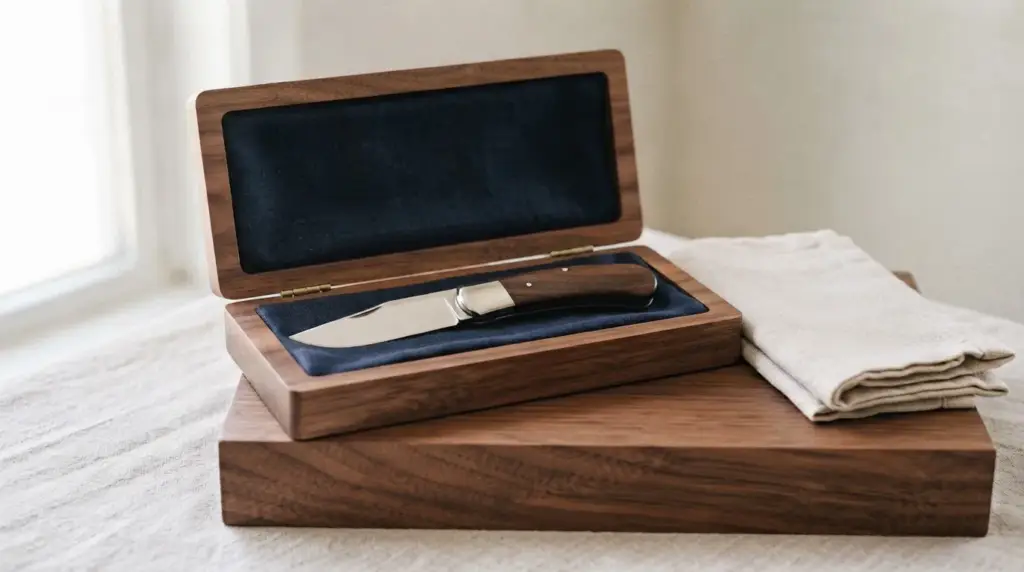
Both ship in a handmade walnut presentation box at no extra cost, with a hand stitched leather pouch, and both carry the lifetime craftsmanship warranty that every knife we make carries. They live in the pride knives collection, and if you want to see how they sit against the rest of the folders we build, the folding pocket knives category is the wider shelf.
Buying two, for two people
A fair number of these go out as pairs, and the instinct is to buy two identical knives. It is usually the wrong instinct, for a reason that has nothing to do with sentiment: two people rarely have the same hand or the same use. A pair that matches in material and differs in shape gets carried by both of them. A pair that matches exactly gets carried by one of them while the other sits in a drawer looking symmetrical.
With poured resin there is a second wrinkle, which is that two knives ordered together will not look identical anyway. Order them at the same time and say so in the order notes and we will pick the closest blocks we have, but they will still be two knives rather than one knife twice. Our guide on matching knives for couples goes through the four ways to pair two properly, and why sizing to the hand beats sizing to the photograph.
Questions people ask
Is rainbow Damascus real Damascus?
Sometimes. If the seller states the two alloys and shows the pattern running through the spine and the ricasso, and separately says the colour is a coating, that is real Damascus with a coloured finish. If the pattern only exists on the flat faces and nobody will name an alloy, you are looking at print. The colour itself is never part of forged Damascus.
Does the rainbow wear off?
If it is a coating or a print, yes, at the contact points, and quickly at the edge if the knife is sharpened. If it is dyed or poured resin, no, because the colour is the material rather than a layer on it.
Can you sharpen a coated blade?
Yes, and it will look exactly as you would expect afterwards: a bare metal bevel with colour above it. This is not damage, it is what a coating is. Just know it before you take the knife to a stone rather than after.
Is a pride knife a good gift for someone who does not own a knife?
It is a very good gift, with one condition: buy the blunt tip and make the first handling a calm one. A sheepsfoot folder in a presentation box is a gift. An assisted opening tanto is a story about a trip to urgent care.
Can I get it engraved?
Yes, as a paid add on, done in our own shop before it ships. Keep it to about twenty characters. A name, a date or two words land far better than a sentence.
Why do the handles not match the photographs exactly?
Because each resin block is poured on its own, and the pigments arrange themselves differently every time. You get the same model, the same size and the same material, running its colours in its own order. The photograph shows the material, not the individual piece.
Is a gay pride knife different from a pride knife?
Only in the wording of the listing. Both usually describe the same thing: a knife carrying full spectrum rainbow colour, whether that colour is a coating, a print or resin. The words tell you nothing about the construction, which is the only part that decides whether the knife is still worth owning in five years. Read the material, not the label.
Are they made in the USA?
Ours are. Forged, heat treated, ground, assembled, sharpened, inspected and engraved in our workshop in Memphis, Tennessee. Plenty of coloured knives on the market are not, which is fine, but it is worth knowing which you are buying and whether there is anyone to answer an email afterwards.
What is the honeycomb pattern in the handle?
A honeycomb structure cast into the resin block, so the finished surface shows the cell walls in cross section with colour running through the cells. It is the same principle as a stabilised burl handle, with a manufactured structure in place of a natural one.
More guides
If you are still deciding, read the Damascus pocket knife guide for what a folder in this steel is actually like to own, how to choose an EDC knife if it is going to be carried daily, and what 352 layers actually means if the layer count in the listing is doing more work than it should. When you are ready to look at the two we build, they are in pride knives.
More from the workshop
Engraving a Knife: What Works and What Ruins the Blade
What engraving costs, what fits in 20 characters, and why the handle beats the blade.
Forged or Ground: The Two Ways a Knife Is Made
The two ways a blade is shaped, what each one does to the steel, and what neither can do.
