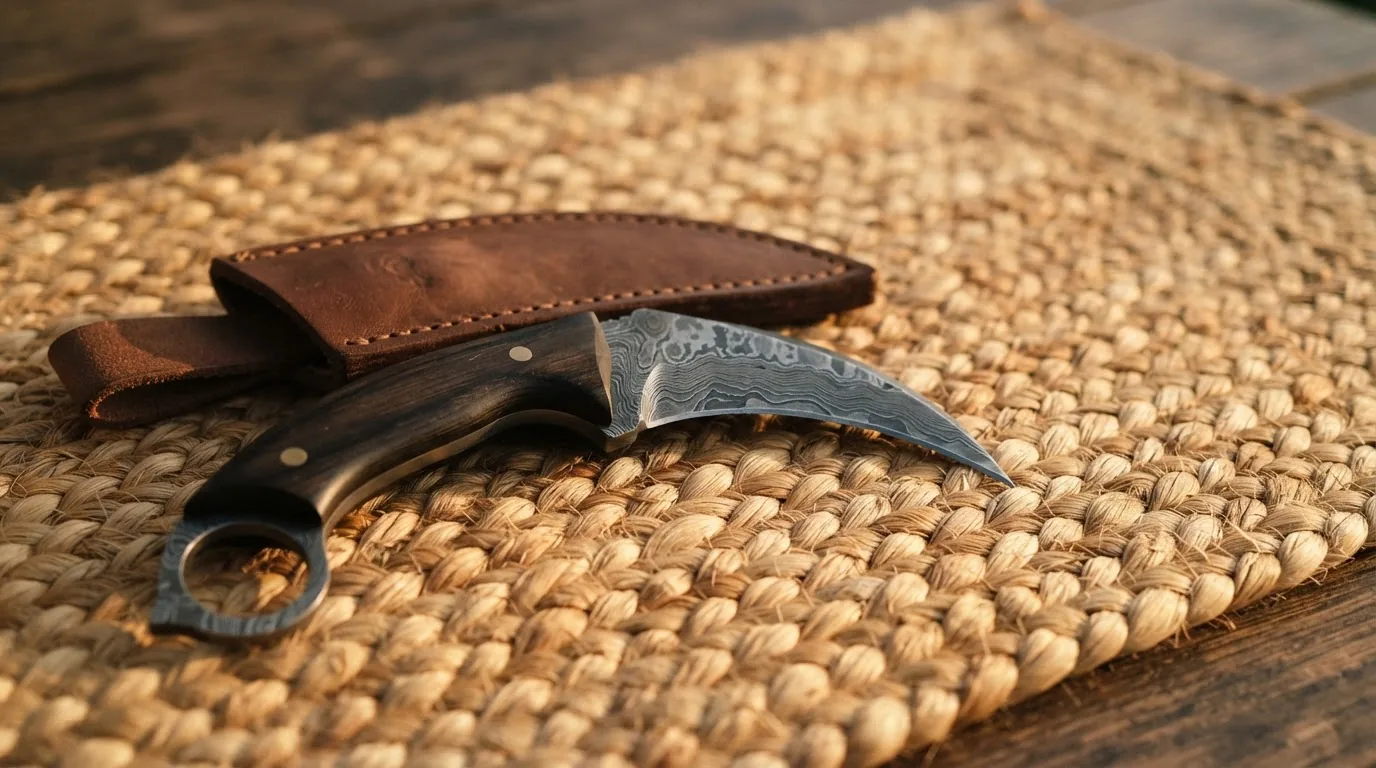
Short answer: a karambit is a small curved knife with a ring at the butt, descended from a farming tool used by the Minangkabau people of West Sumatra. The ring exists so the knife cannot be dropped or pulled out of your hand, and the curve exists because the original job was raking and hooking, not slicing. A Damascus karambit is that shape rendered in patterned 1095 and 15N20 steel. Ours are fixed blades, all eleven of them, priced from $94 to $152 with a median of $101.
Where the karambit comes from
The karambit is Indonesian before it is anything else. It originates with the Minangkabau people of West Sumatra and spread outward along the trade routes of island Southeast Asia into Malaysia, the Philippines, Thailand, Cambodia, Laos and Myanmar. The name travels with it and changes spelling as it goes: karambit and kerambit in Indonesian, kurambik and karambiak in Minangkabau, and a long list of regional variants including Lawi Ayam, Kuku Macan and Kerambit Lombok.
What it was for at the start is the useful part. The karambit began as an agricultural implement used to rake roots, gather threshing and plant rice. It is best understood as a small relative of the regional sickle, and that is exactly what the profile looks like once you stop thinking of it as a fighting knife. The romantic story that the shape imitates a tiger claw is folklore that grew up around the tool later. Both things can be true at once: farmers made a hooked blade because hooking is what they needed, and the culture around it built a legend on top.
Blade sizes were never standardised. Length varied from one village and one smith to the next, so anybody quoting you a canonical historical measurement is guessing. That is worth remembering when a listing tells you a particular blade length is "traditional."
What the finger ring is actually for
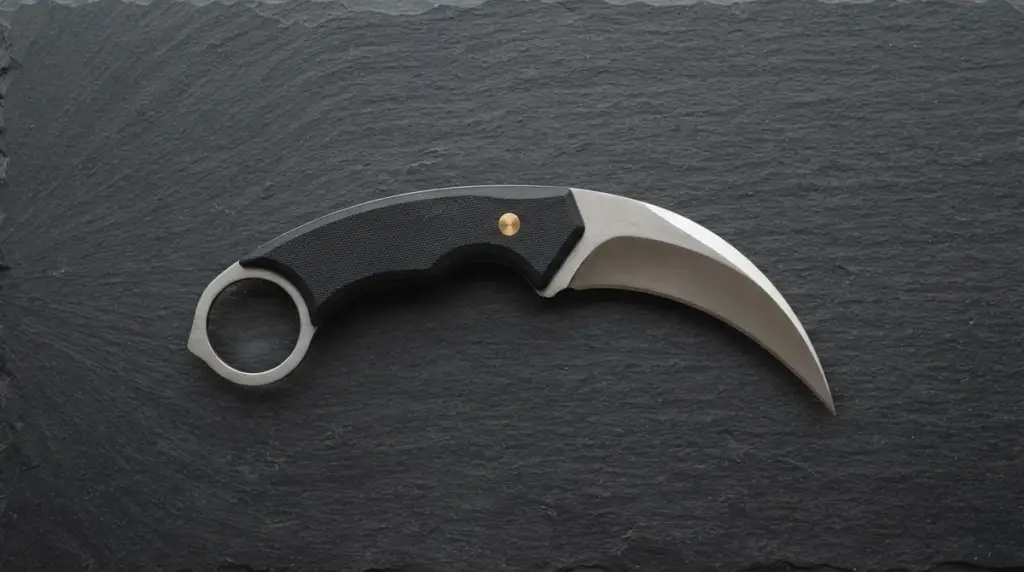
The ring is the one feature nobody should get wrong, and most sellers explain it badly. It is a retention device. Three things follow from putting your index finger through it. The knife cannot be dropped if your grip fails, wet or otherwise. The knife cannot easily be stripped out of your hand by anything pulling on the blade. And you can open your hand completely to do something else without putting the tool down, then close it and still be holding the knife.
That third one is the agricultural reason and it is the one that makes sense of the whole design. If you are working through a row of plants with your hands full, a blade that stays attached to you when you let go of it is worth a lot. The combat reading, that a ringed knife is difficult to disarm, is real and documented, but it is a later consequence of a feature that already existed for work.
The ring also costs you things. It sets the knife at a fixed distance from your hand, so you cannot choke up or back off the way you can with a normal handle. It makes the knife awkward to hand to somebody else. It catches on pockets, packs and sheath mouths. And on a fixed blade with a leather sheath, which is what all of ours are, the ring is the part that most often decides whether the knife sits comfortably on a belt or digs into you.
Reading the curve, and what it costs you
Held in the traditional grip the blade points down out of the bottom of the fist and curves forwards. The edge lives on the inside of the curve, so the knife cuts on the pull. Everything a karambit is good at follows from that: hooking a strap and drawing back, opening a bag by pulling through the seam, cutting a cord that is under tension, drawing a line through material that is held taut in front of you.
Everything it is bad at follows from the same fact, and this is the section we would rather not write. A recurved blade has no flat. You cannot lay it on a cutting board and rock it. You cannot push cut on a work surface. You cannot pierce straight forward with any control, because the tip is pointing across your line of push rather than along it. You cannot whittle. Opening a taped box with one is genuinely more difficult than opening it with a $12 folder, and food preparation with a karambit is close to a party trick.
Even the people who like the pattern say this out loud. The consistent view among writers who have carried one is that the curve "can also make certain everyday tasks more awkward than they would be with a straight edge," and that the karambit was never designed as a general purpose utility blade. It also has a real learning curve. Most people pick up a conventional pocket knife and immediately know what to do with it. A karambit does not work that way, and a buyer who expects it to be an everyday carry knife on day one is usually disappointed by week two.
What our eleven karambits actually are
Here is our range as it stands, taken from the live catalogue rather than from a spec sheet. Every one of them is a fixed blade with a leather sheath included. None of them is a folder.
| Measure | Our karambit range |
|---|---|
| Products | 11 |
| Lowest price | $94 |
| 25th percentile | $97 |
| Median | $101 |
| 75th percentile | $124 |
| Highest price | $152 |
| Blade length | 3.6 inches on every current model |
| Overall length | 8.7 inches on every current model |
| Sheath | Leather, included with all eleven |
Look at those last three rows for a second, because they say something inconvenient. Ten of the eleven are the same knife geometry: 3.6 inch blade, 8.7 inches overall. The eleventh, an older Damascus model, measures the same 8.7 inches with the same 3.6 inch blade and lists at 4.2 ounces. When you shop our karambits you are not choosing a size or a curve. You are choosing a steel, a finish and a handle on one blade shape. If you need a longer or shorter karambit than 3.6 inches, we do not have it, and we would rather tell you now than after you have paid.
Steel, and what Damascus means on this shape
Three steels run through the eleven. The distribution is worth seeing because it maps directly onto price.
| Blade steel | Knives | Hardness we hold to | Price span | What you are buying |
|---|---|---|---|---|
| Damascus, 1095 and 15N20 | 4 | 58 to 60 HRC | $97 to $152 | Pattern and appearance. A carbon steel surface that needs oil |
| D2 tool steel | 4 | 58 to 62 HRC | $100 to $106 | Edge retention and semi stainless behaviour. The practical choice |
| High carbon steel | 3 | Not published per batch | $94 to $98 | Simplest and cheapest. Will patina, will rust if neglected |
A Damascus karambit is a decorative object with a functional edge, and we will say that even though the Damascus models are the ones we make the most margin on. Patterned 1095 and 15N20 is genuine layered steel, it hardens to 58 to 60 HRC, and it cuts perfectly well. It is also a carbon steel with an acid etched surface, which means it marks. On a karambit that matters slightly more than on a straight knife, because the inside of a recurve is exactly the part your cleaning cloth reaches last.
If your karambit is going to be handled, carried and used, D2 at 58 to 62 HRC is the sensible steel and it sits in the middle of the price band anyway. If it is going in a display case or a gift box, Damascus is the reason people buy Damascus, and there is nothing wrong with buying a knife to look at.
Handles, liners and the ring itself
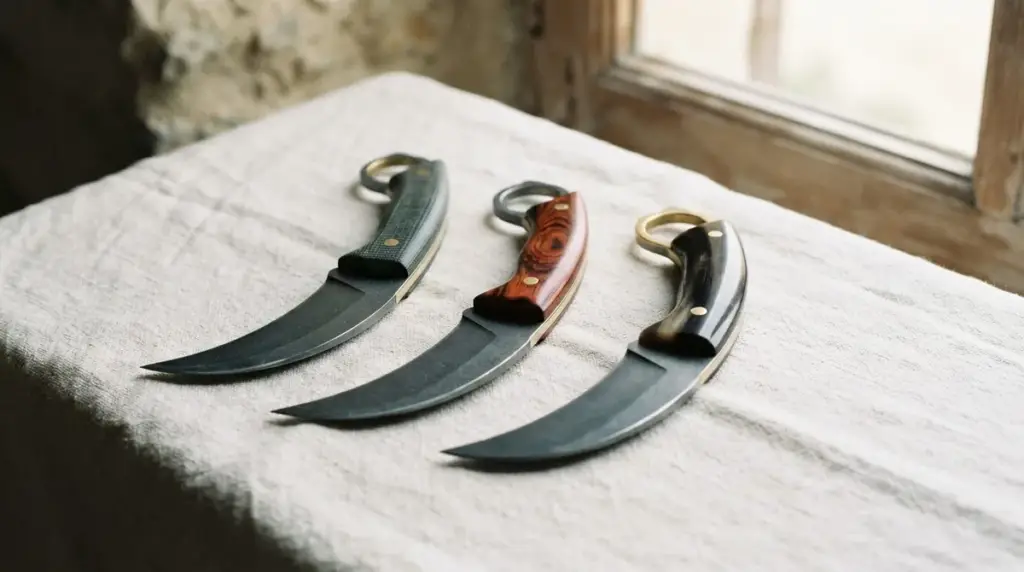
Across the ten current models the handle materials break into four families. Micarta on two, G10 on two, paracord wrap on two, and natural material on the rest: stabilised maple burl, figured rosewood, olive wood, and polished buffalo horn on the top model with brass spacers and a Damascus finger ring.
Which one you want depends almost entirely on whether the knife will get wet. A ringed knife is held by one finger and a partial grip, so a slick handle is a worse problem here than it is on a normal knife. Micarta and G10 both grip better damp than dry, and both are the correct answer for anything outdoors. Paracord is grippy and cheap to replace but absorbs water and holds it against the tang. Wood and horn look better than either and behave worst of the four in rain.
One detail buyers ask about that we can answer plainly: the ring on our models is part of the blade steel, not a bolted attachment, so there is no fastener to loosen. On the buffalo horn model the ring is Damascus like the blade, which looks superb and means the ring will patina in your hand along with everything else.
Sharpening a recurve
This is the maintenance fact that catches people out, so plan for it before you order. You cannot properly sharpen a recurved blade on a flat bench stone. The belly of the curve never touches the stone, so a flat abrasive sharpens the two ends of the edge and slowly turns the middle into a dull spot. Do it for a year and you will have ground the curve out of your karambit.
What works is a round or oval abrasive small enough to sit inside the curve: a ceramic rod, a tapered diamond rod, a rod sharpener, or sandpaper wrapped around a dowel. Work the inside of the curve in short sections and keep the angle constant as the curvature changes under your hand, which is the difficult part and the reason recurves have a reputation.
Our karambits ship with a leather sheath and no sharpening rod. If you do not already own one, budget for it, because a flat stone will not keep this shape sharp.
Carry, sheaths and the legal shape of the problem
All eleven of ours are fixed blades that come with a leather sheath. That is comfortable, traditional and quiet, and it is also slower to draw from than a moulded kydex sheath with a click, which we do not currently offer on this pattern. If a fast draw is the point of the knife for you, ours are not built for that and you should look at makers who mould to the ring.
The legal picture matters more than the sheath. A karambit is a fixed blade, and several states treat a concealed fixed blade very differently from the same knife carried openly. California is the clearest example: under Penal Code 21310 carrying a concealed dirk or dagger is an offence, and the only method the statute explicitly protects is a knife carried in a sheath worn openly and suspended from the waist. Virginia forbids concealing a dirk or bowie knife outside your home or business as a Class 1 misdemeanour, and defines concealed as hidden from common observation, which includes a weapon that is visible but disguised in appearance. Texas takes a different approach again and regulates by blade length, treating anything over 5.5 inches as a location restricted knife. Our 3.6 inch blades sit under that line, which helps in Texas and does nothing for you in California.
None of that is legal advice and knife law changes at city and county level as well as state level. Please check your local law before ordering.
Who a karambit is actually for
Three groups, honestly. Collectors, who want a shape with a real history and a Damascus pattern to look at, and who are the majority of our karambit buyers. Martial artists training in silat and related systems, for whom the ring and the reverse grip are the point and for whom our fixed blade format is the correct one. And people doing specific hooking work, where a curved pull cut on strapping, netting, cordage or plastic banding is genuinely faster than a straight blade.
If you are none of those three and you want one knife to carry every day, buy a straight blade. That advice costs us sales on this category and it is still the right advice. The karambit is a specialist shape that rewards the person who wants exactly what it does and frustrates everybody else.
Questions people ask
What is a karambit knife used for?
Originally for agricultural work: raking roots, gathering threshing and planting rice in island Southeast Asia. Today it is used in martial arts training, by collectors, and for practical hooking and pull cutting on cord, strapping and netting. It is a poor general purpose utility knife.
Why does a karambit have a ring?
Retention. The ring stops the knife being dropped, makes it hard to pull out of your hand, and lets you open your hand to do something else without setting the tool down. That last point is the agricultural reason and it explains the whole design.
Is a Damascus karambit better than a plain one?
Not functionally. Our Damascus is genuine 1095 and 15N20 at 58 to 60 HRC and it takes a fine edge, but it is a carbon steel with an etched surface that marks and needs oiling. A D2 blade at 58 to 62 HRC will hold an edge at least as well with less maintenance for around $100.
How long is a karambit blade?
There is no traditional standard. Historical blade length varied from village to village and smith to smith. Every current karambit we sell is 3.6 inches of blade and 8.7 inches overall, and one older model lists at 4.2 ounces.
How do you sharpen a karambit?
With a round or oval abrasive that fits inside the curve: a ceramic rod, a tapered diamond rod, or sandpaper on a dowel. A flat bench stone cannot reach the belly of a recurve and will slowly grind the curve away. Our knives do not ship with a rod.
Are karambits legal to carry in the United States?
It depends entirely on where you are and how you carry it. Ours are fixed blades, and several states restrict concealed fixed blades far more tightly than open carry. California protects only a sheath worn openly and suspended from the waist. Texas regulates by blade length above 5.5 inches. Please check your local law before ordering.
Can you use a karambit for everyday tasks?
Badly. There is no flat edge to use on a board, no straightforward piercing, and opening a taped parcel is harder than it should be. Writers who carry karambits agree the curve makes ordinary jobs more awkward than a straight edge would. Buy one because you want the shape, not because you need a box opener.
Is a karambit a fixed blade or a folder?
Both exist in the wider market. Everything in our karambit category is a fixed blade with a leather sheath. If you specifically want a folding karambit, we do not make one and you will need to look elsewhere.
What handle material should I choose?
Micarta or G10 if the knife will get wet or be used, because both grip better damp than dry and a ringed knife depends on grip. Wood, horn and burl look better and behave worse in rain. Paracord is grippy and replaceable but holds water against the tang.
Where does the name karambit come from?
From the Indonesian kerambit, with kurambik and karambiak in Minangkabau, plus a long list of regional names including Lawi Ayam and Kuku Macan. The pattern belongs to the Minangkabau people of West Sumatra and travelled through island Southeast Asia by trade.
More guides. Blade shapes and what each one is for, knife anatomy explained, how to sharpen a knife, whether Damascus knives rust, and the karambit category.
More from the workshop
Military Knives: The Complete Buying Guide
The 1942 service pattern explained, choosing by branch and steel, engraving and unit orders, what the rules are on base, and how to claim the 15% military discount in about a minute.
Butterfly Knife Laws in the US: How to Check Your State
Why federal law rarely applies, and how to check your own state properly.