
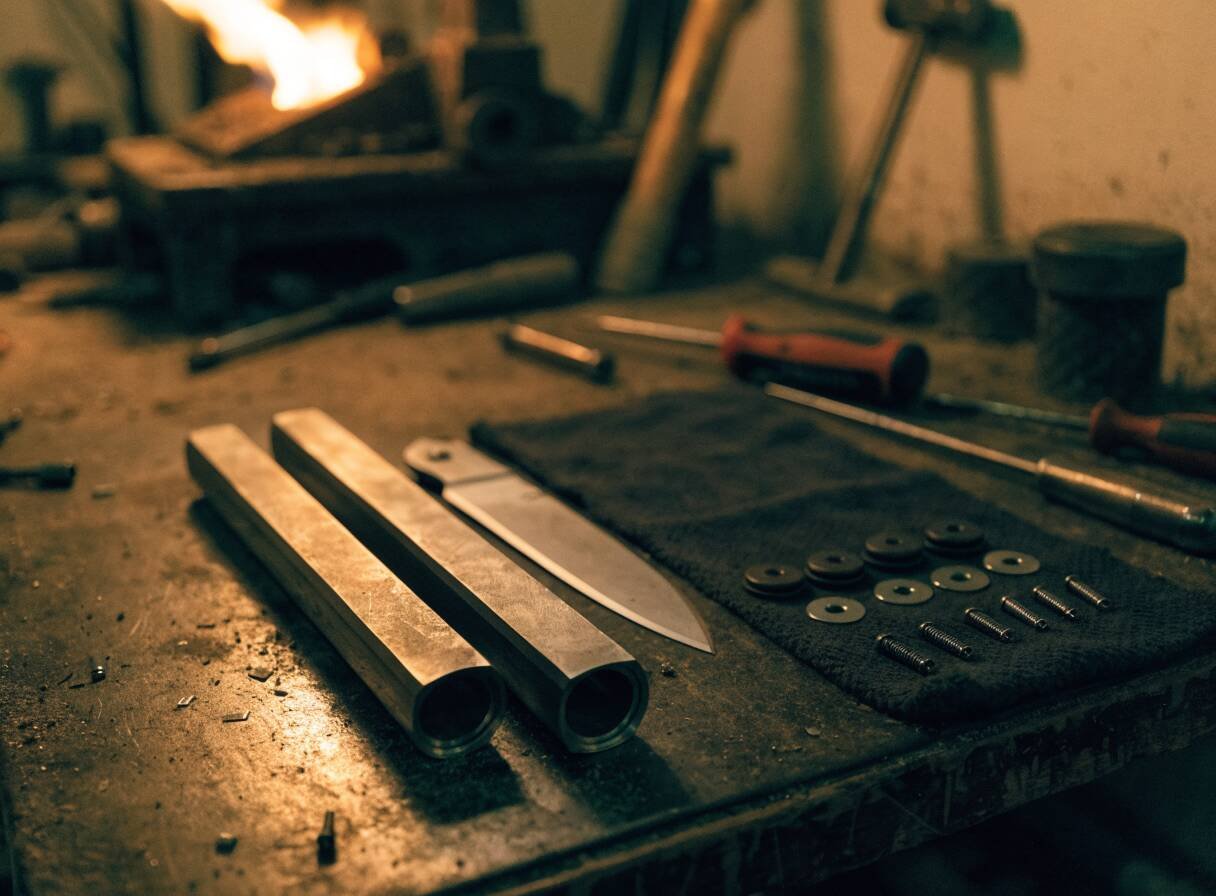
Two handles, one blade and a pivot at each end. Everything about how a balisong feels comes down to choices you are about to make.
Weight, balance and pivot type decide whether the knife rolls fast or hangs and swings. Handle construction decides how it sounds. Steel and inserts decide how it looks on a shelf. There is no single right answer here, only the difference between a knife built for a flipper and a knife built to be owned.
1. Blade profile
Flippers usually want a lighter profile so the knife comes round faster. Collectors usually want the grind that looks hardest to make.
2. Blade steel
3. Size
The 29cm is the length old Batangas smiths called the veinte y nueve. It is the traditional one, and it is slow and heavy in the hand.
4. Handle construction
5. Bolsters
6. Handle inserts
Horn and hardwood were what the first Batangas smiths had to hand. They stayed because they feel right.
7. Pivots
This is the single thing that decides how the knife feels.
8. Pins or screws
9. Latch
10. Pocket clip
11. Engraving
12. Sheath and packaging
13. Leather Color
For any leather pouch or sheath included in your build.
14. How many?
Order 10 or more and a bulk discount is applied automatically.
15. Anything else (optional)
Ten or more - tell us what you need
Corporate gifts, groomsmen sets, restaurant kit. We quote by hand: unit price drops with volume and engraving is set up once for the whole run.
Cannot find it in the list? Design it yourself.
Pick a starting shape, move the sliders and watch the knife redraw with real measurements. Send it over and we quote it by hand.
How the choices actually feel in the hand
Construction
Sandwich handles are layered from separate pieces, which makes them easy to take apart and service. Channel handles are milled from one piece and the blade sits deeper inside, so the knife closes with a duller, heavier sound and feels more solid. Skeletonised handles have material removed, which drops weight and speeds the roll up noticeably.
Pivots
Bushings are the traditional answer and they can be tuned by hand until the action is exactly what you want. Bronze washers are quieter and smoother straight away. Bearings are fastest out of the box and stay fast, and they are also the option that needs the most cleaning if the knife lives in a pocket.
Size
The eleven and a half inch length is the one old smiths in Batangas called the veinte y nueve, after its twenty-nine centimetres. It is the traditional size, and it is heavy and slow in the hand compared with the shorter builds. Most people who flip daily settle on the nine and a half.
Where the balisong comes from
The knife takes its name from a village in Taal, in Batangas province in the Philippines, where families forged them for generations. The oldest ones were made with the blade and tang from a single bar of steel and the handles built around it. Horn and native hardwood were not chosen for looks: they were what the smith had. They stayed because they turned out to be right.
It was a working knife and a pocket tool long before anyone flipped one. The tricks, the aerials and the rollovers grew up around it much later, mostly in the United States. A well-tuned balisong still serves both: a thing to own, and a thing to move.
Questions people ask first
Is a heavier or lighter build better for flipping?
Lighter comes round faster and is easier to learn on. Heavier is more forgiving of a sloppy hand and feels better once you can already flip. A skeletonised nine and a half in stainless bolsters is the combination most people end up happiest with.
Should I get a latch or not?
A latch keeps the knife shut in a pocket and is what tradition expects. It also swings around while you flip and can catch your hand. If the knife will be flipped rather than carried, most people go without.
Pins or screws?
Pins are sealed and traditional and cannot loosen. Screws let you take the knife apart, clean it and adjust the action yourself. If you like tinkering, take the screws.
Can you make a trainer version?
Yes. Ask in the notes and we build the same knife with an unsharpened blade, at the same price. It is the sensible way to learn.
How tight will the action be when it arrives?
Tuned to a middle setting that suits most hands. Tell us in the notes if you want it looser or tighter and we set it before it leaves.
Would rather have one ready to ship? See our balisong knife collection.
Please check your local law before ordering.
- You uploadUp to 5 pictures and your instructions.
- You pay $50A refundable deposit. It puts your brief in the queue.
- We quoteA written price, steel, size and lead time, inside two working days.
- You decideGo ahead and the $50 comes off. Say no and it is refunded.
- It is a review deposit, not a payment for a knife. Nothing is ordered yet.
- If you approve our quote, the full $50 is taken off the price of the build.
- If we cannot agree on price, or we do not think we can make it properly, or you simply change your mind, it is refunded in full to the card you paid with.
- We will not copy another maker’s trademarked design or anything we are not allowed to forge. If that is what the picture shows, we will say so and refund you.
Your pictures are only ever seen by our shop. Please check your local law before ordering.
