
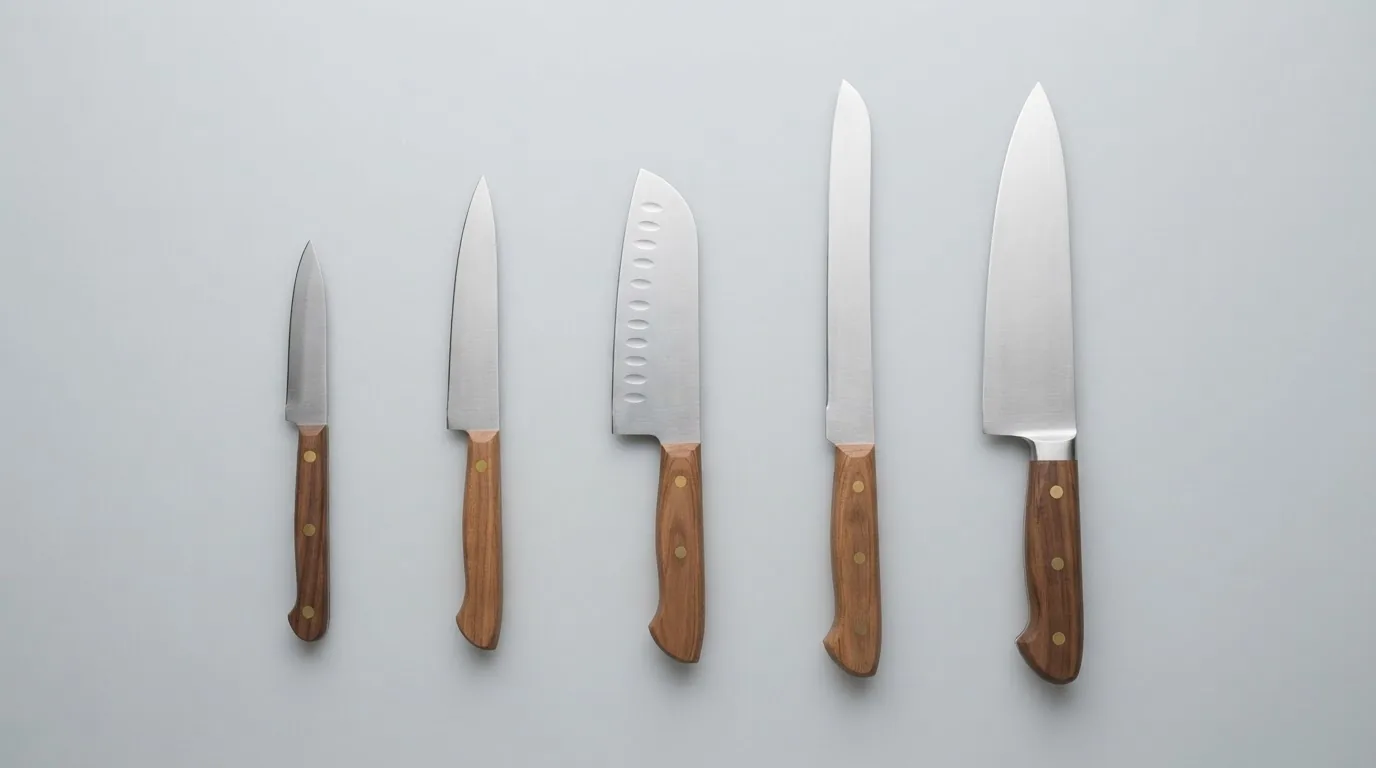
Short answer: stop shopping by blade length and start shopping by handle. A knife fits your hand when your fingers wrap the handle and the tips land near the pad of your thumb, without a gap and without overlapping. Get that right and a 3 inch blade will out-work a 5 inch blade you cannot control. Almost every complaint we hear about a knife being "too big" is actually a handle that is too thick.
Measure your hand before you look at a single knife
Two numbers matter, and you can get both with a tailor's tape in about a minute. Nobody sells knives this way, which is exactly why so many end up in a drawer.
Palm width. Lay your hand flat, fingers together. Measure straight across the knuckles, not including the thumb.
Grip circumference. Make a loose fist as if you were holding a broom handle. Wrap the tape round the outside of your closed fingers at the middle knuckles.
| Palm width | Hand size | Handle length that fits | Handle circumference |
|---|---|---|---|
| Under 2.9 in | Extra small | 3.6 to 4.0 in | 3.0 to 3.4 in |
| 2.9 to 3.2 in | Small | 3.9 to 4.3 in | 3.3 to 3.7 in |
| 3.2 to 3.5 in | Medium | 4.2 to 4.6 in | 3.6 to 4.0 in |
| Over 3.5 in | Large | 4.5 in and up | 3.9 in and up |
Most factory fixed blades are built to the medium and large rows and nothing else. That is not a conspiracy, it is a production decision: one handle mould covers the widest market. It is also why a great many people are quietly using a knife that does not fit them.
Handle circumference matters more than blade length
Blade length is the number on the product page, so it is the number people argue about. It is the wrong number. A knife handle is a cylinder your fingers have to close around, and the distance around that cylinder decides whether you get a locked grip or a slipping one. Two knives with an identical 4 inch blade can feel completely different if one handle measures 3.2 inches around and the other measures 4.4.
Here is the test that costs nothing. Wrap your hand around the handle in a normal hammer grip. Look at where your fingertips land. If the tips press into the pad at the base of your thumb, the handle fits. If there is a visible gap between fingertips and palm, the handle is too fat for you and your hand is doing extra work on every cut. If your fingers overlap and ride up onto themselves, the handle is too thin and the knife will roll in your hand under load.
Handle shape then decides how forgiving that number is. An oval or slightly flattened cross section fills a smaller hand better than a fat round one, because it gives your fingers something to index against. A pronounced finger groove is the opposite: grooves are cut for one specific hand size, and if your fingers do not land in them the knife fights you the whole time. For smaller hands, a smooth contoured handle almost always beats an aggressively sculpted one.
What actually goes wrong when a knife is too big for your hand
This is the part nobody puts in a buying guide because it is not flattering to the industry. An oversized handle does not simply feel awkward. It changes how you cut, and every one of those changes is a small safety problem.
- You grip harder to compensate. More grip pressure means a tired forearm inside ten minutes, and a tired hand is a clumsy hand.
- Your wrist takes over. When the handle is long, the pivot point moves away from your palm and you steer the blade with your wrist instead of your whole arm. Control drops exactly when the cut gets hard.
- The knife rolls. A handle you cannot close your fingers around rotates under lateral load. On a skinning cut or a batoning job, that roll is how the edge ends up somewhere it should not be.
- You choke up onto the blade. People with smaller hands instinctively slide their grip forward to regain control, which puts fingers closer to the edge than the design intended.
None of that shows up in a five minute unboxing. It shows up on hour three of processing a deer, or on the fortieth onion of the week.
Blade length by job, not by preference
Once the handle fits, blade length becomes a job question rather than a hand question. Smaller hands are not restricted to small blades. They are restricted to blades they can steer. This table is what we tell people on the phone.
| Job | Blade length that works | Why |
|---|---|---|
| Everyday carry and opening boxes | 2.5 to 3.25 inches | Legal in most places, disappears in a pocket, and a small folding knife is easier to close one handed with short fingers. |
| Skinning and caping | 3 to 3.5 inches | Short blade, deep belly. Control at the tip matters more than reach, which is why a small hunting knife often outperforms a big one. |
| General camp and bushcraft | 3.5 to 4.5 inches | Enough spine to baton kindling without a handle so long it levers out of your palm. |
| Kitchen prep | 6 to 7 inches | Yes, longer. A chef knife is driven with a pinch grip at the bolster, so the handle length barely matters and a short blade makes you saw. |
| Self defence carry | 3 to 4 inches | A small dagger or push dagger keeps the point close to your hand, which is the only reason those shapes exist. |
Notice the kitchen row breaks the pattern. That is not an error, and it is the single most useful thing on this page.
Grip style changes what size you need
Most guides pretend there is one way to hold a knife. There are four in common use, and each one moves the load to a different part of your hand. If you know which grip your work demands, you can size the handle for that grip instead of guessing.
| Grip | Used for | What smaller hands need |
|---|---|---|
| Hammer grip | Chopping, batoning, heavy camp work | Handle circumference under 4 inches. This is the grip that punishes a fat handle hardest. |
| Pinch grip | Kitchen knives, precision slicing | A thin bolster or no bolster at all. Handle size is nearly irrelevant here. |
| Saber grip | Skinning, carving, detail work | A defined thumb ramp with jimping placed close to the guard, not two inches back. |
| Reverse grip | Push daggers, tactical and rescue use | A short handle with a real guard, so the knife cannot slide forward when the point stops. |
Kitchen knives for smaller hands
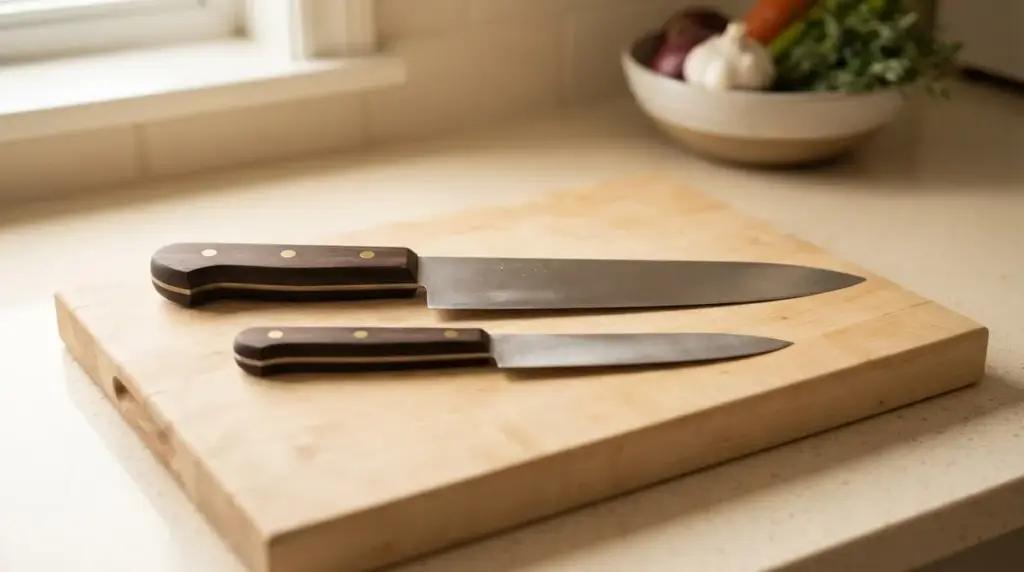
The kitchen is where most of the bad advice lives. People with smaller hands get told to buy a 6 inch chef knife, and then they wonder why prep takes forever. The problem was never the length of the blade, it was that nobody taught them the pinch grip.
Pinch the blade between thumb and forefinger just ahead of the handle, and wrap the remaining three fingers around the handle behind it. Now the blade is controlled by your fingertips and the handle is only stopping the knife sliding backwards. Handle circumference stops mattering, and an 8 inch chef knife becomes usable by almost anyone. What does matter is a bolster that is not a thick rounded lump, because a fat bolster physically blocks the pinch.
For everything else in the kitchen, small is genuinely better: a 3.5 inch paring knife and a 5 inch utility knife will do eighty percent of daily prep with far less fatigue.
Pocket and folding knives for smaller hands
A folding knife adds a second fit problem: you have to open and close it. A frame lock or liner lock that sits deep in a wide handle needs a long thumb to disengage, and that is where most people with small hands give up on a knife they otherwise liked.
What to look for in a folding pocket knife if your hands are on the smaller side:
- A thumb stud or hole placed low and close to the pivot, so you are not stretching across the handle to start the blade.
- A slim handle profile. Under half an inch thick keeps the lock reachable and the knife pocketable.
- A three finger handle is fine. If your little finger curls under the butt rather than onto the handle, nothing is wrong. That is how the knife was designed to be held by a smaller hand.
- Skip the assisted opener if the spring is heavy. A stiff spring needs force you may not want to apply one handed.
Womens knives are a fit category, not a colour
Search for a womens pocket knife and you get pink handles. That is marketing, not engineering. What actually makes a knife work for a woman, or for a man with smaller hands, or for a teenager learning to carve, is handle circumference, weight distribution and grip security. Nothing else.
Our womens knives collection is built on that basis: knives with handles in the 3.6 to 4.2 inch circumference range, blades kept light enough that the balance point sits at or just behind the guard, and grip surfaces that hold when your hands are wet. Several of them are also the best small knives we sell for anyone, which is rather the point.
Five things to avoid
- Deep finger grooves. Cut for one hand size. If your fingers do not land in them, they actively hurt.
- A heavy pommel. Weight behind your hand makes the blade feel dead and forces you to grip tighter to steer it.
- Polished handle scales with no texture. Fine in a display case, terrible with wet hands or gloves.
- Buying by blade length alone. The number on the listing tells you nothing about how the knife will sit in your palm.
- Assuming a smaller knife is a weaker knife. A full tang 3.5 inch blade in 440C will out-work a 6 inch blade you cannot hold steady.
Where to start on our site
If you want to skip straight to knives that suit a smaller hand, these are the pages worth your time. Womens knives for handles sized deliberately small. Folding pocket knives for slim everyday carry. Kitchen and chef knives for paring and utility blades that do not fight you. Neck knives when you want a fixed blade with almost no handle to manage. Hunting knives for short bellied skinners, and push daggers when the point needs to stay close to your fist.
Every fixed blade in those collections ships with a hand stitched leather sheath, and if you are buying for someone else, engraving is available at checkout as a paid option.
Questions people ask
How do I know if a knife handle is too big for my hand?
Close your hand around the handle in a normal grip and look at your fingertips. If they cannot reach the pad at the base of your thumb, the handle is too big. If they overlap and ride onto each other, it is too small. A gap of more than about a quarter inch is enough to cost you control on hard cuts.
What is the best blade length for small hands?
For a fixed blade, 3 to 4 inches covers almost everything, and 3 to 3.25 inches is the sweet spot for an everyday carry folder. Kitchen knives are the exception: a 6 to 7 inch chef knife is still correct because it is held with a pinch grip at the blade, not by the handle.
Are womens knives actually different from mens knives?
The good ones are, but not in the way the colour suggests. A knife built for a smaller hand has a shorter and slimmer handle, a lighter blade so the balance point stays near the guard, and a grip texture that works without brute force. A pink handle on a standard sized knife changes nothing.
How do I measure my hand for a knife?
Measure the width of your palm across the knuckles with the thumb tucked in, and measure the circumference of your closed fist around the fingers. Palm width under 2.9 inches puts you in the extra small band and points you toward handles around 3.6 to 4 inches around.
Is a small knife weaker than a big one?
Not if it is full tang. Strength comes from the tang running the whole length of the handle and from the steel and heat treatment, not from overall size. A full tang 3.5 inch 440C blade will handle more abuse than a longer partial tang knife, and it will do it while you still have control of it.
Which grip should I use if my hands are small?
Match the grip to the job rather than to your hand size. Hammer grip for chopping, pinch grip for kitchen work, saber grip with the thumb on the spine for skinning and carving, reverse grip for push daggers. The pinch grip is the one most people with smaller hands have never been shown, and it changes kitchen work completely.
Can a woman use a full size hunting knife?
Yes, and plenty do. The question is whether that particular handle fits, not whether the knife is full size. A short bellied skinner with a 3.5 inch blade is usually the better tool for anyone doing detailed work, regardless of who is holding it.
Are small daggers practical or just decorative?
A small dagger keeps the point close to your hand, which is the whole design intent. It is a short reach shape, so it is not a field knife, but for carry and for collections it is a real category and the smallest sizes suit smaller hands better than any full length dagger will.
More from the workshop
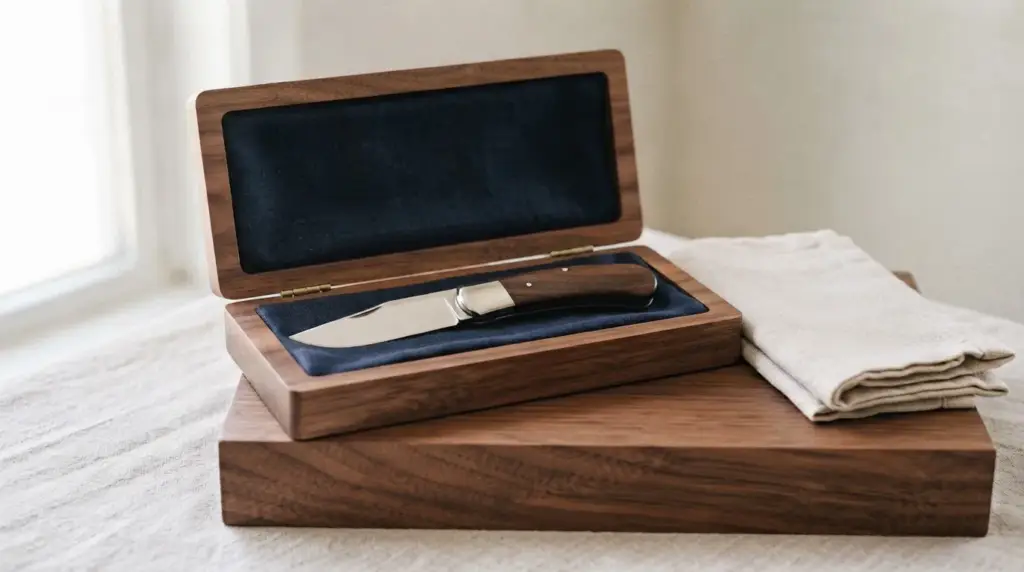
Engraving a Knife: What Works and What Ruins the Blade
What engraving costs, what fits in 20 characters, and why the handle beats the blade.
Field Dressing a Deer: The Cuts and the Knives
The field dressing sequence in order, sorted by which knife is in your hand, with the published cooling and CWD guidance.
Sharpening a Serrated Edge Without Ruining It
The one procedure a general sharpening guide cannot cover, scallop by scallop with a tapered rod.
