
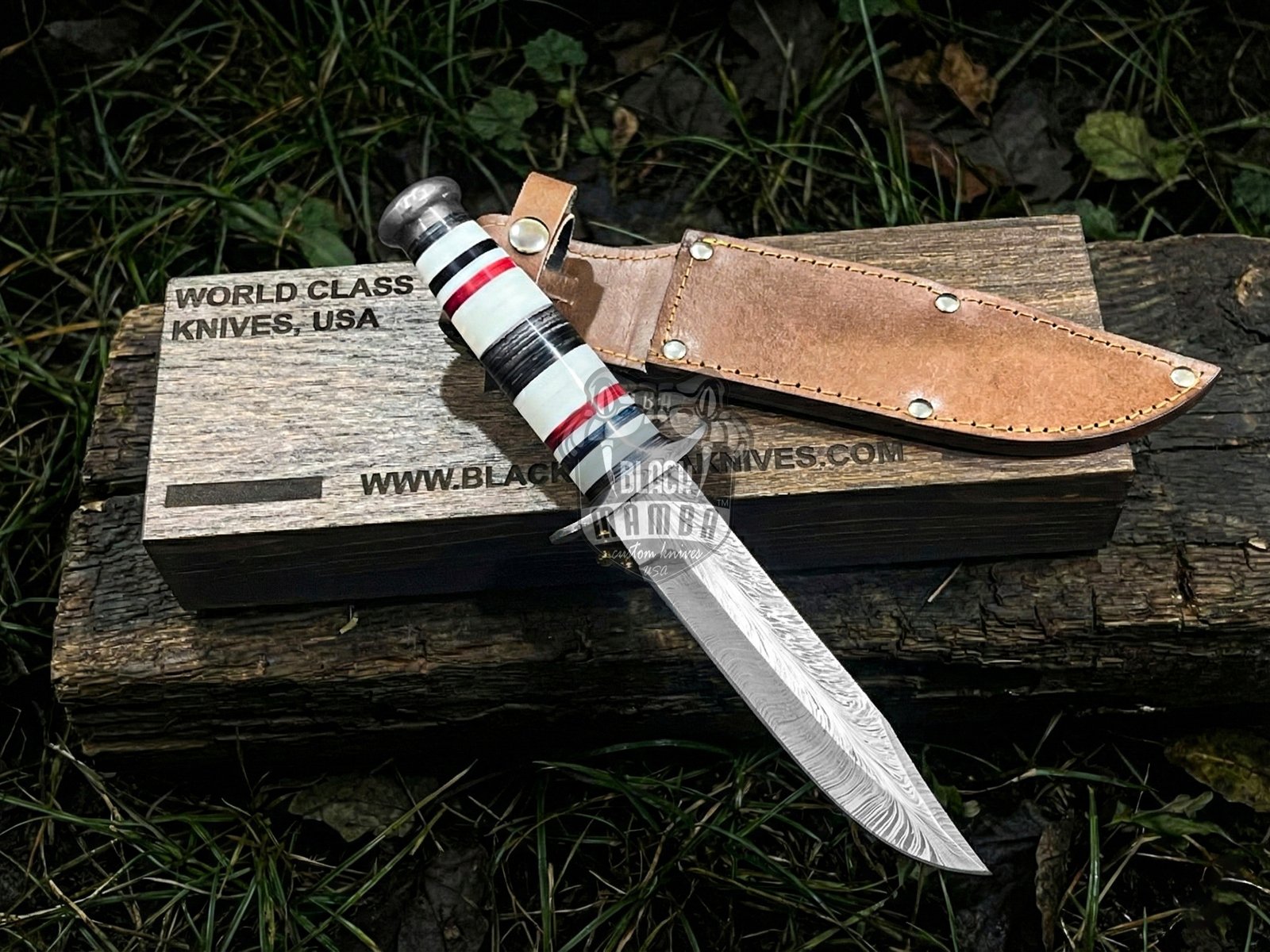
Short answer: a Damascus hunting knife gives you a very keen, easily restored edge and a pattern no two of which are alike. What it asks in return is that you dry it and oil it. If you will do that, it is the best hunting edge you can carry. If you will not, buy stainless.
What you are actually buying
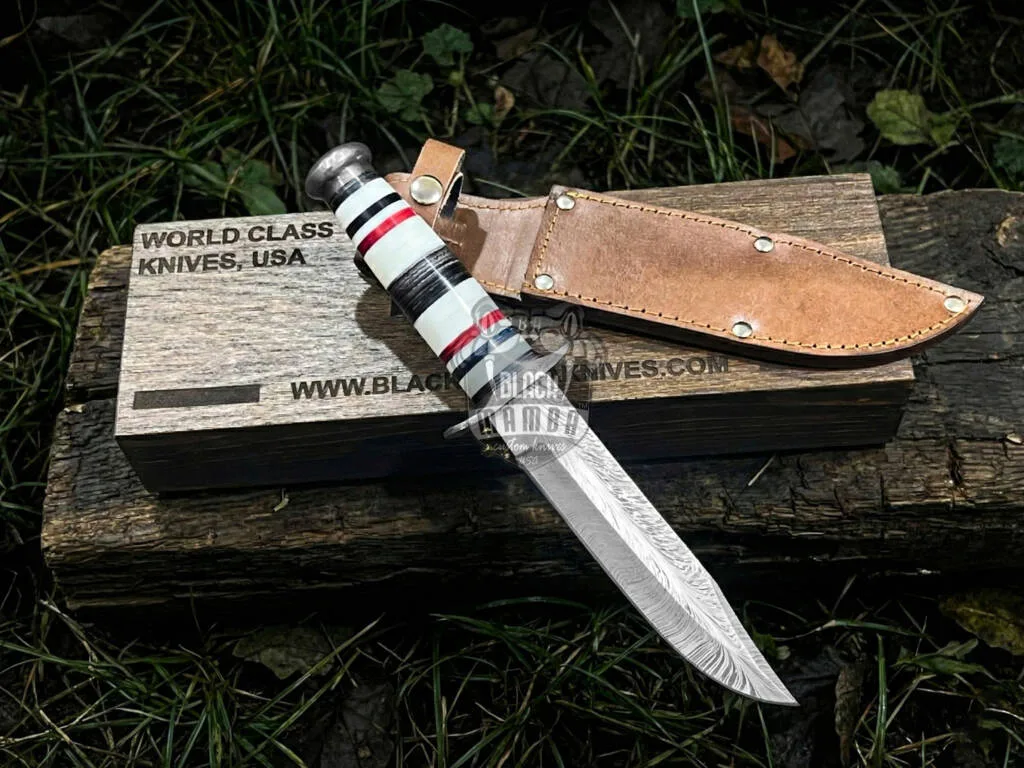
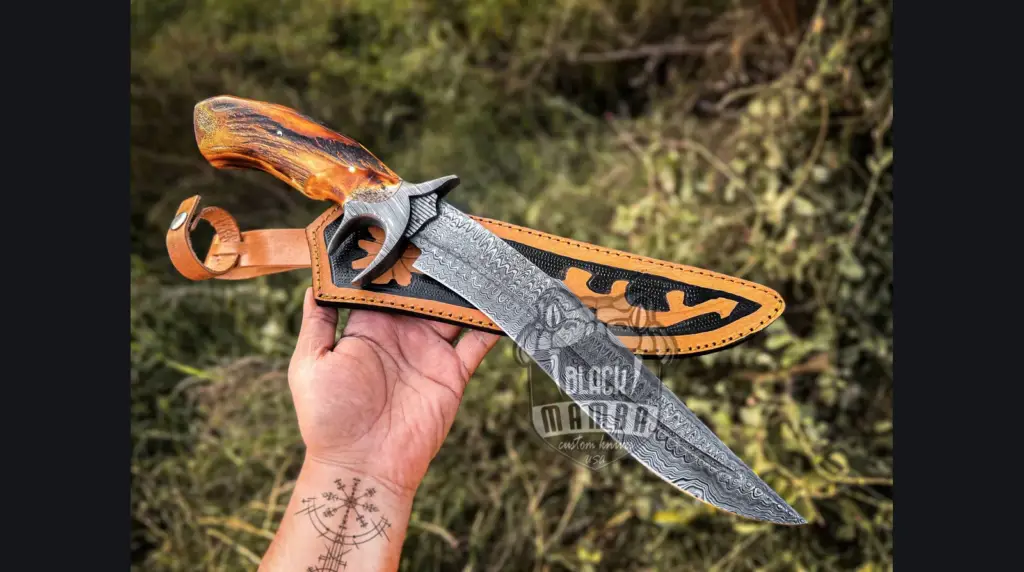
Our billets are 1095 and 15N20 forge welded, drawn out and folded to 352 layers, then hardened to 58 to 60 HRC and oil quenched.
The nickel in the 15N20 resists the acid etch, which is what leaves the bright layers standing against the near-black 1095. That is the whole mechanism, and it is why the pattern is in the steel rather than on it. A printed or surface-etched pattern wears off. This one cannot.
Why it suits hunting specifically
Hunting asks two things of an edge: get very sharp, and come back quickly in the field with whatever you have in a pocket.
Carbon steel does both. The fine, uniform grain takes a thinner edge than a high-chromium stainless will, and there are no large hard carbides to grind through, so a pocket stone restores it in minutes on a tailgate.
The 58 to 60 HRC range matters here too. Harder holds longer but chips on bone, and bone is exactly what a hunting knife meets.
Choosing the blade
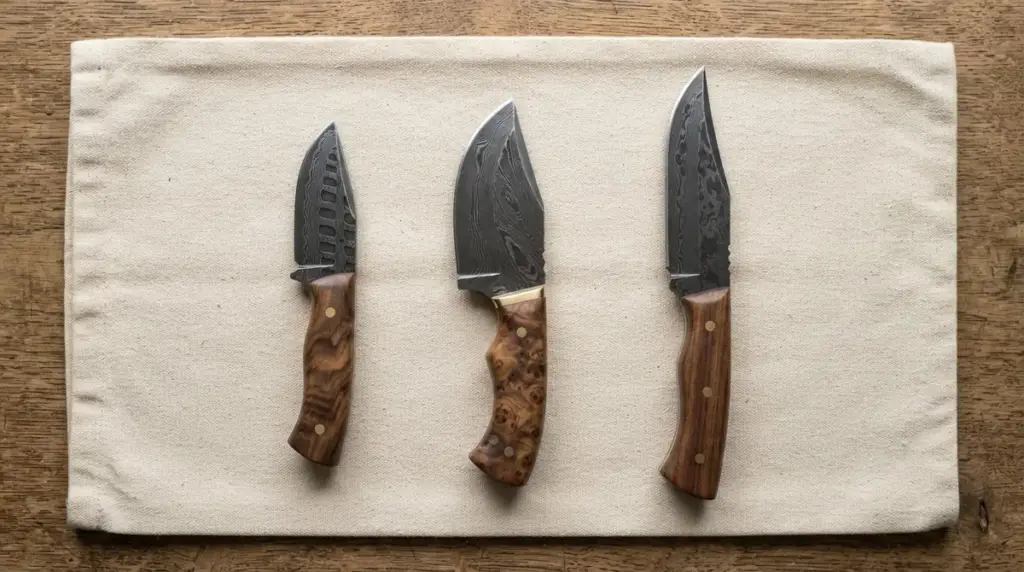
Drop point, 3.5 to 4.5 inches. If you are buying one knife for deer, this is the answer. The lowered tip is much less likely to nick the stomach wall than a clip point.
Skinner if you process several animals a season. See our skinning knife guide.
Gut hook if you dress more than a couple a year.
Longer blades photograph well and get in the way inside a rib cage. Full breakdown of profiles in blade shapes explained.
Full tang, always
You will lever against joints and put lateral load on the blade. That force concentrates where the blade meets the handle, and that is where knives break. Every fixed blade we make runs the steel the full length and width of the handle. More on why in full tang vs partial tang.
Handle, for cold wet hands
This is not a detail. Your hands will be wet, greasy and cold, and that is exactly when a polished handle becomes dangerous. Micarta and textured G10 grip when wet. Stag and bone have natural texture and warm in the hand. A pronounced guard or choil stops a slipping hand running onto the edge.
The honest downside
It will patina, and it will spot if you put it away wet. Blood is salty and will pit carbon steel overnight.
The routine is genuinely small: wash the same day, dry completely, wipe on a little oil, and never store it in the leather sheath in the off season. Leather is tanned with acidic compounds and holds moisture, and that is how most good hunting knives are lost. Full method in the care guide.
If that routine is not going to happen, be honest with yourself and take 440C stainless instead. It is a better knife for you than a Damascus blade you will not look after.
Choosing by game size
The animal decides the knife, and most people buy for the largest thing they might ever shoot instead of what they take every season.
| Small game and birds | 3 to 3.5 inches. You are working around thin skin and small joints, and anything longer is in the way. |
| Deer, antelope | 3.5 to 4.5 inch drop point. The single most useful hunting knife there is, and it will field dress and skin a whole season without complaint. |
| Hog, sheep, goat | 4 inches with a stout tip and a real guard. Hog hide is abrasive and dulls an edge faster than deer. |
| Elk, moose, bear | 4 to 5 inches, thicker stock, plus a saw or an axe for the heavy work. A bear hunting knife needs edge retention through greasy fur more than it needs length. |
Nothing on that list is longer than 5 inches. A long hunting knife is a camp and brush tool, not a field dressing tool, and inside a rib cage it is a liability.
Fixed blade or folder
For hunting, a fixed blade hunting knife is the better tool and it is not close. There is no pivot to pack with hair, fat and blood, nothing to fail under lateral load at a joint, and you can clean it properly in cold water with numb hands. Every serious field knife we build is full tang for that reason.
A folder earns its place as a second knife. It rides in a pocket all season, handles the small jobs on the way in and out, and some hunters prefer a folding blade for caping because the shorter handle gives closer control. The honest rule is that a folder supplements a fixed blade rather than replacing it.
Blade length and shape by job
Field dressing. 3.5 to 4 inches, drop point, rounded tip. You are opening a cavity without nicking the paunch, and a lowered tip is the whole safety margin. A gut hook does the same opening cut in one pull if you dress several animals a year.
Skinning. 3.5 to 4 inches with a pronounced belly. The curve does the work, sweeping under the hide rather than cutting into it. A dedicated skinning knife is worth it if you process more than a couple of animals a season.
Caping. 2.5 to 3 inches, fine tip, thin behind the edge. Working around eyes, lips and ears for a mount is detail work, and a general purpose blade is too thick to do it cleanly.
Quartering. 4 to 5 inches of thicker stock, and a bone saw for the rest. Do not use a knife as a chisel on bone. It is how good edges are chipped.
Why Damascus works as a hunting steel, and what it costs you
The reason is grain, not pattern. Forge-welded 1095 and 15N20 at 58 to 60 HRC has a fine, uniform structure with no large hard carbides, so it takes a thinner edge than a high-chromium stainless and it comes back on a pocket stone in minutes. That matters on the third animal of a weekend, when nobody is going home to a bench grinder.
The trade is real and it is worth stating plainly. It is carbon steel. Blood is salty, fat goes acidic, and a blade put away wet will spot overnight. It will also take a patina, a stable grey-blue film that protects the steel and is not the same thing as rust. Nobody sells the pattern without the maintenance, whatever the listing says. More on how the billet is made in how Damascus steel is made.
Sheath and retention in the field
The sheath is where cheap knives are exposed. It has to hold the blade through a day of climbing, kneeling and dragging, and let go when you want it.
Leather is quiet, traditional and comfortable on a belt, and it is a carrying device only. Never store a blade in it. Kydex holds by friction with an audible click, sheds water and blood, and can be washed out, which makes it the practical field choice. Nylon is light and cheap and holds damp against the steel. Whatever the material, look for a retention strap over the guard or a positive click, a belt loop that will not tear at the stitch, and a drainage hole at the tip.
Handles that hold in a wet glove
Assume cold hands, thin gloves and grease. A handle needs a guard or deep choil so a slipping hand cannot run onto the edge, and a slight palm swell so it does not rotate under load. Texture beats shape: micarta and coarse G10 stay grippy soaked, stag and bone have natural relief, and polished burl wood becomes a bar of soap.
Size it to a gloved hand, not a bare one, and add a lanyard hole. Dropping a knife into snow or leaf litter is how they are lost.
A field care routine that takes two minutes
Wipe the blade with a cloth or grass as soon as the work stops, before blood dries into the ricasso and the guard. At camp, wash in clean water, dry completely, and touch the edge up with a few passes on a pocket stone. At home, wash again, dry, wipe the whole blade with oil, and hang the sheath separately to dry out. Store the knife out of its sheath, not in it. Full sharpening method is in how to sharpen a knife, and storage in how to store knives.
Buying a working knife, not a display piece
A lot of what is sold as a handmade Damascus hunting knife is built to photograph, and the tells are consistent. Ask for the steels and the hardness, and treat any seller who cannot name both as a reseller rather than a maker. Look for full tang construction and pins you can see. Check the edge geometry behind the bevel, because a thick, obtuse grind polished to a mirror is a wall knife. Be sceptical of very high layer counts sold as a performance figure, of brass fittings on a knife that will meet bone, and of a spine ground so thin the blade flexes.
If where a knife was made matters to you, ask directly and expect a straight answer about who forged the billet and who did the heat treatment. A custom hunting knife maker will tell you without hesitating. The difference between a forged blade and a stamped one is covered in hand forged vs factory.
Questions people ask
Is Damascus stronger?
No. That is a myth left over from when forge welding was used to even out inconsistent steel. Today it is chosen for the pattern and for a good balance of edge and toughness.
How do I know it is real?
Four checks you can do before buying, in how to tell real Damascus from a printed pattern.
Will the pattern fade?
The pattern cannot. The etch that makes it visible can dull with heavy use, and it comes back in about ten minutes at home.
Is it legal to carry?
Fixed blade carry rules differ by state and city. Please check your local law before ordering.
Ready to look at what we make? Browse the full range of Damascus hunting knives, or have one built to your own spec on the hunting knife builder.
If your hunting takes you through ranch country, a cowboy or bull cutter knife doubles as an all-day utility blade alongside your hunting kit.
For the field-dressing step itself, a Damascus gut hook knife opens the hide in one pull — the cleanest start to any skinning job.
What size hunting knife do I need for deer?
A 3.5 to 4.5 inch drop point covers everything a deer asks of a knife: field dressing, skinning and breaking down. Shorter gets tiring on a large animal, longer gets in your way inside the rib cage where you are working blind by feel. If you only ever buy one hunting knife, buy that one and add specialist blades later.
Is a fixed blade hunting knife better than a folder?
For field work, yes. A fixed blade has no pivot to pack with hair, fat and dried blood, nothing to fail when you lever at a joint, and it can be washed properly with cold hands. A folder is the better second knife for small jobs and for close caping work. Most hunters end up carrying one of each rather than choosing.
Do I need a hunting knife with a gut hook?
Only if you field dress more than a couple of animals a year. A gut hook opens the hide in one pull without risking the paunch, which is genuinely faster and cleaner. The cost is that it is awkward to sharpen and it adds nothing to the rest of the job. A steady hand with a drop point does the same cut.
How do I sharpen a hunting knife with a whetstone?
Hold about 20 degrees per side, keep it constant, and use light pressure. Work one side until a burr forms along the whole edge, switch and repeat, then alternate lighter passes to remove the burr. A medium stone is enough in the field. Carbon Damascus at 58 to 60 HRC comes back quickly, which is why a small pocket stone is worth carrying.
What blade do I need for caping?
Something short and thin: 2.5 to 3 inches with a fine tip and little thickness behind the edge. Caping means working around eyes, ears and lips without cutting through the hide, and a general purpose hunting blade is too thick to steer accurately there. Use your main knife for the skinning and swap for the detail work.
How can I tell a working hunting knife from a display piece?
Ask for the steels and the hardness. A maker will say 1095 and 15N20 at 58 to 60 HRC without pausing; a reseller will talk about layer counts instead. Then look for a full tang with visible pins, a grind that is thin behind the edge rather than mirror polished and obtuse, and a sheath with real retention.
Design your own hunting knife →
More from the workshop
Damascus Knife Care and Sharpening
Stop the rust, sharpen it correctly, and bring a faded etch back in ten minutes.
The Hunting Dagger: Double Edge, Boar Blades and Why It Fell Out of Use
Why the double edge fails at skinning, where the pattern came from, and what our nine daggers really are.
Steak Knives: Serrated, Straight and What a Forged Set Costs
Straight edge against serrated, how many you need, and the real arithmetic of a forged set of four.
