
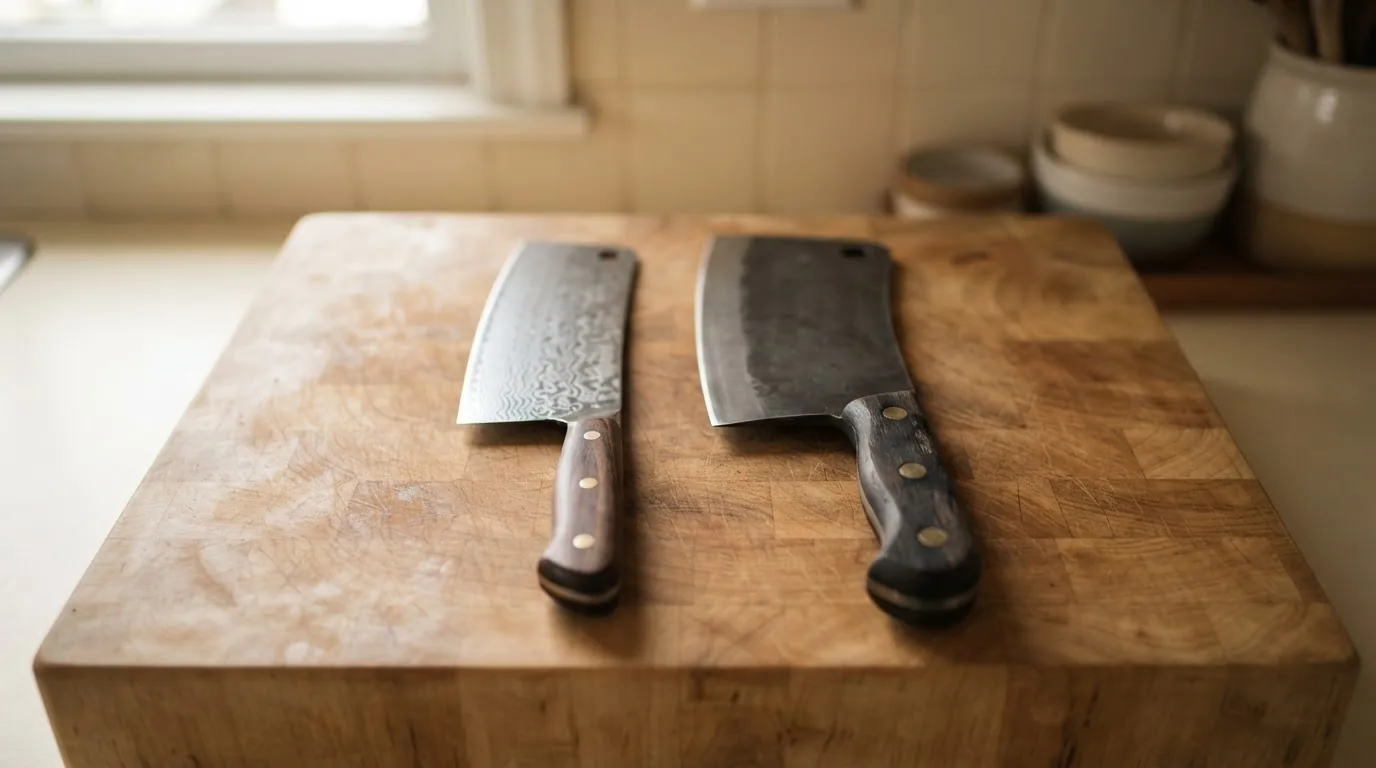
Short answer. There are two completely different knives sharing the word cleaver. The Chinese vegetable cleaver, or caidao, is a thin, light, flat bladed slicer for vegetables and boneless meat, ground at a keen angle and easily damaged on bone. The Western bone cleaver is a thick, heavy wedge meant to be swung through joints and small bones at a blunt angle. Most people who buy a cleaver want the first and are sold a picture of the second. If you buy a thin Damascus cleaver, do not put it through bone.
The two cleavers, and why the confusion is expensive
The word cleaver describes a shape, a broad rectangular blade, and says nothing about what is behind the edge. Behind the edge is the only thing that matters.
A Chinese vegetable cleaver is essentially a chef's knife with a tall rectangular profile. It is ground thin, tapers gradually to the edge like a chef's knife would, and is used for slicing, fine chopping and mincing vegetables, fish and boneless meat, plus flattening garlic and ginger and scooping prepared food off the board. Blade lengths in domestic use typically fall around 7 to 11 inches overall.
A bone cleaver, called a gudao in the Chinese kitchen, is a different tool entirely. It has a much thicker blade and a blunt, robust bevel, and it exists to chop through pork ribs, joints and hard shelled seafood. It works by mass and momentum, not by sharpness.
Between them sits a middle grade chopper, thicker than a slicer, thinner than a bone cleaver, and suitable for thin soft bones at most. The classic buying mistake is to see a beautiful thin cleaver, assume that a rectangular blade means a bone tool, and then discover on the first pork rib that the edge has chipped. That is not a defect. It is the wrong tool.
How to tell them apart in three seconds
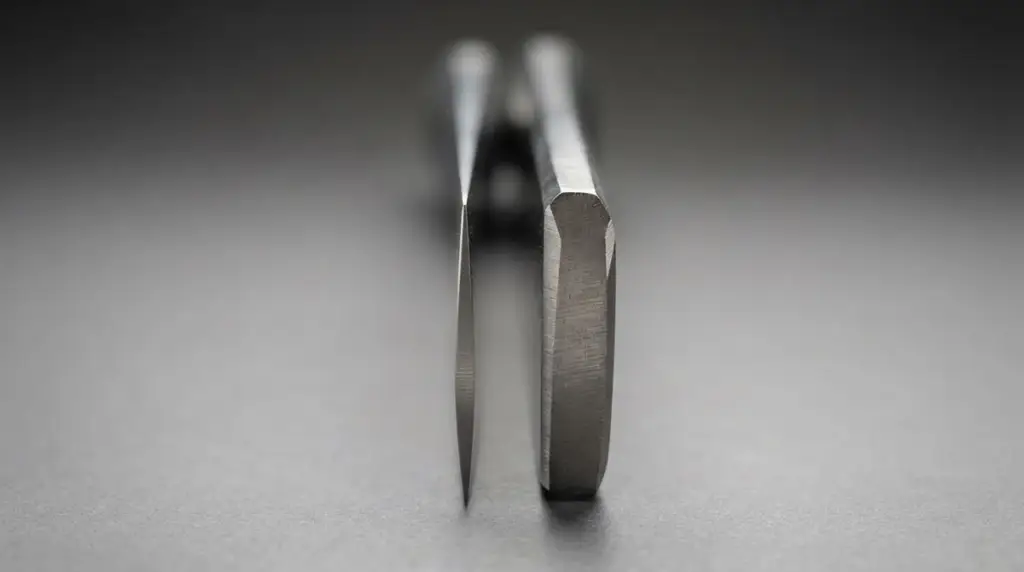
Feel the spine at the heel, and look at the edge angle. A slicing cleaver has a spine you can pinch comfortably between finger and thumb, in the region of a chef's knife spine, and an edge ground somewhere around 15 to 25 degrees per side. A bone cleaver has a spine that feels like an axe, and an edge in the region of 22 to 30 degrees per side, sometimes with a visible secondary bevel. Weight is the other giveaway: a slicer feels balanced in the hand, a bone cleaver feels front heavy on purpose.
| Chinese vegetable cleaver | Middle grade chopper | Bone cleaver | |
|---|---|---|---|
| Typical edge angle per side | About 15 to 25 degrees | About 20 to 25 degrees | About 22 to 30 degrees |
| Spine feel | Thin, like a chef's knife | Noticeably thicker | Wedge, close to a hatchet |
| What it does well | Vegetables, boneless meat, mincing, scooping | General chopping, thin soft bone | Ribs, joints, shellfish |
| What ruins it | Any bone | Heavy bone, frozen food | Nothing much, but it slices badly |
| Sharpening | Fine stones, keep the angle low | Medium stones | Coarse, blunt angle, do not chase a fine edge |
Figures for edge angles are the commonly published ranges rather than measurements of a specific knife. We have not measured the factory edge angle on every one of our own cleavers, so treat those numbers as guidance and check the bevel on whatever you actually own before you put it on a stone.
What our own 16 cleavers actually measure
Our Damascus steel cleaver category held 16 published products on 30 August 2026. Ten of them state length and blade length in the product name, and nine also state weight in ounces, which is unusually specific for this trade. Here is what that data looks like.
| Overall length | Blade length | Weight where stated | How many |
|---|---|---|---|
| 10 inches | 5 inches | 14 ounces | 1 |
| 12 inches | 7 inches | 16.5 ounces | 4 |
| 12 inches | 7 inches | 18 ounces | 2 |
| 13 inches | 8 inches | 17 ounces on one, not stated on the other | 2 |
| 14.5 inches | 9 inches | 18 ounces | 2 |
| Not stated in the title | Not stated | Not stated | 5 |
Read that table properly and it tells you two things. The commonest size we sell is 12 inches overall with a 7 inch blade at 16.5 ounces, and the range runs from 14 to 18 ounces, meaning roughly 400 to 510 grams. That is heavy for a slicer and light for a serious bone cleaver. These are chopping knives with real mass, not delicate vegetable knives, and they are not axes either.
The second thing it tells you is that five of our sixteen cleavers do not state their dimensions at all. That is our fault, not yours, and if you are choosing between two of them you should email and ask rather than guess. Across the whole catalogue only 98 of 609 products carry a stated blade length in structured attributes.
Steel, and the one that surprises people
The steel mix in that category is not what most buyers assume from the category name. Of the 16, six are Damascus, six are 440C stainless, three are listed as a mirror polished super steel described as VG, and one is a carbon coated chopper. So less than half of the Damascus cleaver category is Damascus.
| Steel as listed | Products of 16 | What it means in a kitchen |
|---|---|---|
| Hand forged Damascus | 6 | High carbon, patterned, will rust if left wet |
| 440C stainless | 6 | Stainless, easier to live with, held to 58 to 60 HRC |
| Mirror polished, listed as super steel VG | 3 | Stainless, polished finish, easy to wipe clean |
| Carbon, coated | 1 | Carbon steel with a protective coating on the flats |
Our published hardness positions are 58 to 60 HRC for 1095 and 15N20 Damascus and 58 to 60 HRC for 440C. We do not publish a hardness figure for the VG listed pieces, and we are not going to invent one, so treat that as unverified until the supplier data is confirmed.
For a kitchen knife that lives near a sink, stainless is the easier life. Carbon and Damascus both develop a patina and will spot with rust if left wet, and the acids in onion, tomato and citrus accelerate it. Our guide on carbon and stainless kitchen knives goes through the trade properly.
The rule about Damascus cleavers and bone
This is the single most important line on the page. Do not chop bone with a thin, hard, high carbon Damascus cleaver.
The reason is metallurgy, not marketing. A blade at 58 to 60 HRC holds a keen edge because it resists deformation. The same property means that when the apex meets something harder than it can cut, it does not roll, it chips. Bone is dense, irregular and unforgiving, and the impact loads at the edge of a swung cleaver are far higher than in any slicing cut. A softer, thicker, blunter edge deforms slightly and survives. A thin hard edge takes a bite out of itself.
If you need to break down bone regularly, buy a purpose made bone cleaver with a thick spine and a blunt bevel, and keep the Damascus for everything else. If you only meet bone occasionally, use a bone saw or ask your butcher to do it, which costs nothing.
Prices, and what you are paying for
Counted on 30 August 2026, our cleaver category ran from 123 dollars to 531 dollars with a median of 155 dollars. Our wider kitchen and chef knife category held 44 products with a median of 142 dollars, so cleavers sit slightly above our kitchen average.
| Group | Products | Lowest | 25th percentile | Median | 75th percentile | Highest |
|---|---|---|---|---|---|---|
| Damascus steel cleavers | 16 | 123 | 155 | 155 | 351 | 531 |
| Kitchen and chef knives | 44 | 90 | 119 | 142 | 261 | 694 |
| Steak knives | 15 | 102 | 107 | 126 | 140 | 164 |
| Whole catalogue | 608 priced | 55 | 114 | 155 | 251 | 1,631 |
All figures in US dollars. The interesting number is the 25th percentile and the median both landing on 155 dollars, which means a large block of our cleavers are priced identically. What separates the 155 dollar pieces from the 351 dollar ones is mostly finish and fittings, not cutting ability. Being blunt about it: if your goal is a knife that cuts vegetables well, the cheaper end of this category will do it, and the money above that buys appearance.
How to actually use a Chinese cleaver
The grip is the part nobody explains. Pinch the blade between thumb and forefinger just ahead of the handle, exactly as you would with a chef's knife, and wrap the remaining fingers around the handle. Holding a cleaver by the handle alone gives you no control over the tip and makes the knife feel far heavier than it is.
The cutting motion is a push cut or a gentle rock, not a chop. The blade is tall enough that the knuckles of your guiding hand rest against the flat, which is a genuine safety advantage over a low profile chef's knife. Let the height do the work and keep the edge in contact with the board.
The flat of the blade is a tool in itself. Use it to crush garlic and ginger, to flatten chicken, and as a bench scraper to carry food from the board to the pan. Do not use the flat to hammer bone, and do not use the spine as a mallet on anything that will spring back.
Sharpening a cleaver without wrecking it
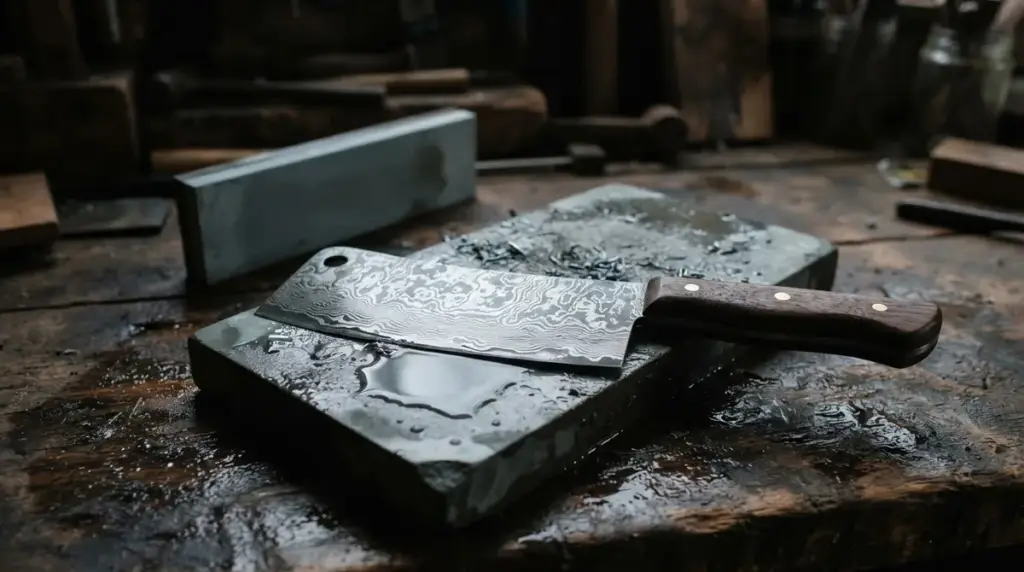
Find the existing angle before you touch a stone. The best sharpening angle for almost any knife is the one already on it, and a cleaver punishes guesswork more than most because a thin cleaver and a thick one need very different treatment. Colour the bevel with a marker, take one light pass, and look at where the marker came off. If it lifted at the shoulder only, your angle is too high. If it lifted at the apex only, too low.
For a Damascus cleaver there is a second consideration. The etch that shows the pattern only penetrates the top few thousandths of an inch, so grinding the bevel back will leave a bright band where the pattern used to be. It does not affect performance and it is not damage, but it is permanent until the blade is re etched. Use finer abrasives and remove as little metal as possible. Our guides on how to sharpen a knife and honing against sharpening cover the technique.
Never put any cleaver in a dishwasher. Heat, detergent and steam attack handle materials, loosen scales and rust carbon steel, and a heavy blade rattling in a rack damages everything around it as well as itself.
Choosing between a cleaver and a chef's knife
If you are buying one knife for a kitchen, buy a chef's knife. It is more versatile, it handles round produce and boneless proteins better, and the tip does work a cleaver cannot. Our guide on chef knife bevels covers what to look for.
Buy a cleaver as the second knife when you do a lot of vegetable prep, when you like the knuckle clearance a tall blade gives you, and when you want a single tool that also scoops and crushes. Buy a dedicated bone cleaver only if you regularly break down whole birds or joints at home, and accept that it is a specialist that slices badly.
A note against our own interest: a 155 dollar hand forged cleaver is not going to cut vegetables meaningfully better than a well sharpened 40 dollar factory cleaver. What it gives you is a hand forged blade, a fitted handle and a patterned billet. Those are real things to want. Better cutting is not one of them.
Questions people ask
Can I chop bone with a Damascus cleaver?
No. A thin hard Damascus blade at 58 to 60 HRC will chip rather than deform when the edge meets bone. Use a purpose built bone cleaver with a thick spine and a blunt bevel, or a bone saw.
What is the difference between a Chinese cleaver and a Western cleaver?
The Chinese vegetable cleaver, or caidao, is a thin slicer with a gradual chef's knife style bevel, for vegetables and boneless meat. The Western butcher's cleaver is a thick heavy wedge for chopping through bone. They share only a silhouette.
What size cleaver should I buy?
For general kitchen use, a blade of around 7 inches on a knife of about 12 inches overall is the commonest size we sell and a sensible default. Larger 9 inch blades on 14.5 inch knives suit people with big boards and long counters, and are unwieldy in a small kitchen.
How heavy should a kitchen cleaver be?
Our own stated weights run from 14 to 18 ounces, roughly 400 to 510 grams, with 16.5 ounces the most common. Lighter than that tends to mean a thin vegetable slicer. Much heavier means a bone tool that will feel clumsy on an onion.
What angle should I sharpen a cleaver at?
Match the angle already on the knife. As a general guide, thin vegetable cleavers are commonly finished around 15 to 25 degrees per side and heavy bone cleavers around 22 to 30 degrees per side. Chasing a razor angle on a bone cleaver is how people chip them.
Is a cleaver better than a chef's knife?
No, it is different. A chef's knife is the more versatile single knife because of its tip and its rocking curve. A cleaver is better at high volume vegetable prep, gives better knuckle clearance, and doubles as a scraper and a crusher.
Do all Damascus cleavers rust?
High carbon Damascus will spot and patina if left wet, and acidic food speeds it up. Wash, dry and oil after use. If that sounds like a chore, choose a stainless option instead. Six of our sixteen cleavers are 440C stainless and three more are stainless with a mirror finish.
Why do some cleavers have a hole in the corner?
It is a hanging hole. Cleavers are awkward in a knife block and heavy on a magnetic strip, so a hole and a hook is the traditional storage answer. Storing a heavy blade loose in a drawer is how edges get chipped and fingers get cut.
Can I use a cleaver on frozen food?
No. Frozen material behaves like stone at the edge and will chip almost any hardened blade, including a bone cleaver. Thaw it, or use a saw designed for the job.
How do I stop food sticking to the blade?
You mostly cannot, because a tall flat blade has a lot of surface for wet food to cling to. A very thin blade and a light coat of oil help a little. Cleavers do not have the dimples or hollow ground reliefs some chef's knives use, so plan on scraping the blade as you go.
More guides. Read chef knife bevels explained, carbon against stainless kitchen knives, how to sharpen a knife and how to store knives, or browse our Damascus steel cleavers and kitchen and chef knives. Please check your local law before ordering.
More from the workshop
Damascus Karambits: Ring, Curve and Who They Are For
The ring is a retention device and the curve is a farming shape. What that means before you buy one of our eleven.
San Mai and Damascus: Two Different Laminates
A three layer core and jacket against a stack of hundreds, and what each one really does.
Sharpening a Damascus Knife Without Wrecking the Pattern
What changes when the blade is pattern welded: the bright band on the bevel, grit choice, re etching and stropping.
