
Short answer: The United States semiquincentennial fell on 4 July 2026, two hundred and fifty years after the Declaration of Independence. A great many commemorative objects were made for it and most of them will never be worth more than they cost. Three things occasionally change that: a genuinely small and documented run, a maker whose ordinary work is already collected, and a knife kept unused and complete with its box. We make three knives in our own 250 Anniversary category, priced from one thousand two hundred and twenty three to one thousand six hundred and thirty one dollars, and we cannot tell you what they will be worth in thirty years.
What the 250th anniversary actually is
Semiquincentennial is the formal word for a two hundred and fiftieth anniversary. In the American case it refers to 4 July 2026, two hundred and fifty years after the Declaration of Independence was adopted in 1776. Congress set up the United States Semiquincentennial Commission, generally known as America250, under Public Law 114 196, enacted on 22 July 2016, which gave the country a decade of lead time to plan.
It is worth being clear about the comparison people reach for. The bicentennial in 1976 marked two hundred years. The semiquincentennial marks two hundred and fifty. They are the same event counted from the same day, half a century apart, and the 1976 commemorative market is the single most useful piece of evidence anyone has about what happens to commemorative objects made for a national anniversary.
The dates that matter
The 4 July date is not the only 250th in this cycle, and if you are buying for somebody who served, the service anniversaries are often the more meaningful hook.
| Event | Founded or adopted | 250th anniversary |
|---|---|---|
| United States Army | 14 June 1775 | 14 June 2025 |
| United States Navy | 13 October 1775 | 13 October 2025 |
| United States Marine Corps | 10 November 1775 | 10 November 2025 |
| Declaration of Independence | 4 July 1776 | 4 July 2026 |
Note what that means for anyone reading this in late 2026: three of the four dates are already behind us, and the national one passed in July. That matters commercially, and we come back to it at the end.
Why most commemoratives never appreciate
The mechanism is not mysterious. A commemorative is made because a date is coming, and everybody who can make one makes one. Supply arrives all at once, aimed at a burst of attention, and then the attention ends. Demand afterwards is drawn from the same pool of people who already bought at the time. The 1976 bicentennial produced an enormous quantity of commemorative plates, coins, medallions, flatware and knives, and the general experience of that market since has been that ordinary examples trade at or below their original price in real terms.
We should mark our own claim honestly. There is no published price index for commemorative knives that we could point you at, and we did not find one while researching this page. So treat the statement that most commemoratives do not appreciate as our reading of a market we work in, not as a measured statistic. What is well documented is the general principle collectors and dealers state plainly: value comes from rarity, from a maker who is already collected, and from condition, and a commemorative theme by itself supplies none of the three.
The three things that occasionally make one collectable
A genuinely small run, documented. Limited means nothing without a number. A run of fifty with serial numbers stamped on the blade and a register kept by the maker is scarce. A run described as limited with no published figure is not a scarcity claim at all, it is a marketing word. Ask for the number, and ask whether the piece is serialised.
A maker whose ordinary work is already collected. Collector demand attaches to makers before it attaches to themes. A commemorative from a bladesmith whose standard work already resells above retail inherits that demand. A commemorative from a shop whose standard work resells below retail does not become an exception because it has an eagle on it.
Condition and completeness. This is the one entirely in the buyer's control. Collectors pay a premium for knives that are clean, complete and documented, which means unused or lightly handled, with the original box, sheath, papers and any certificate. A commemorative that has been sharpened, carried and separated from its box has lost most of whatever premium it had. If you intend to keep it as a keepsake with an eye on value, keep the packaging with it from the day it arrives.
Our own three, and what they actually are
We publish three knives in the 250 Anniversary category. Here they are with the figures taken from their own listings rather than from a brochure.
| Reference | Price | Overall | Blade | Steel | Notes from the listing |
|---|---|---|---|---|---|
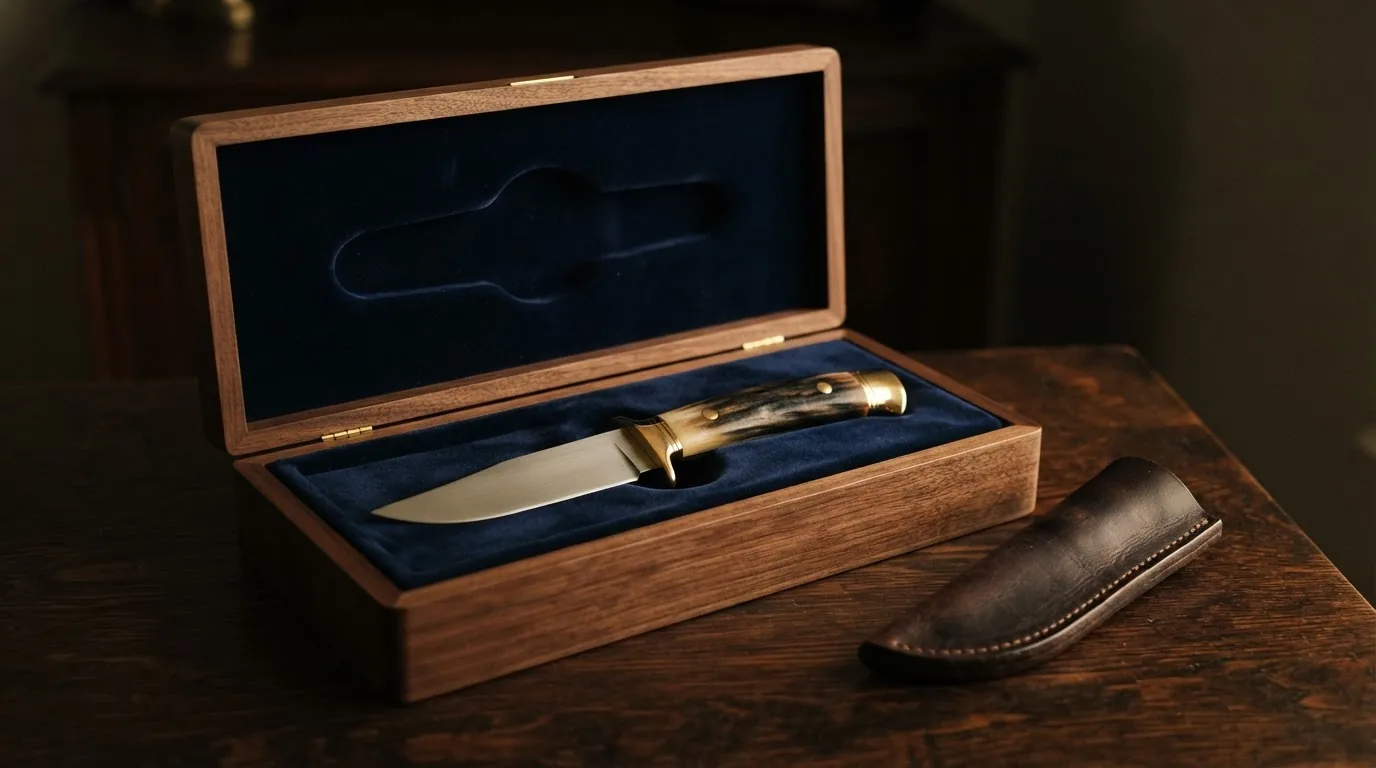
| BMK-739 | $1,631 | 11 inches | 6 inches | 1095 and 15N20 Damascus | Gold plated engraving reading 250 Years of America, 1776 to 2026, a Liberty Bell at the ricasso, eagles in the scroll, buffalo horn scales, gold engraved bolsters, fitted presentation case with a brass plaque |
| BMK-740 | $1,387 | 12 inches | 7 inches | 1095 and 15N20 Damascus | Gold plating on the fittings, engraved bolsters, buffalo horn handle |
| BMK-741 | $1,223 | 12 inches | 7 inches | 1095 and 15N20 Damascus | Engraving on the fittings that is not put on standard models |
All three are hunting patterns rather than display only pieces, and all three carry a working heat treat. The listings put our Damascus at 58 to 60 HRC, which is the same specification as the rest of our Damascus, so nothing about the commemorative finish changes the edge or the geometry. BMK-739 at one thousand six hundred and thirty one dollars is the most expensive knife in our catalogue of six hundred and nine published products.
What that costs against the rest of the shop
| Comparison | Figure |
|---|---|
| Published products across the whole catalogue | 609 |
| Catalogue price floor | $55 |
| Catalogue median price | $155 |
| Hunting knives category median | $201 |
| 250 Anniversary category | 3 products, $1,223 to $1,631 |
| Multiple of the catalogue median | About eight to eleven times |
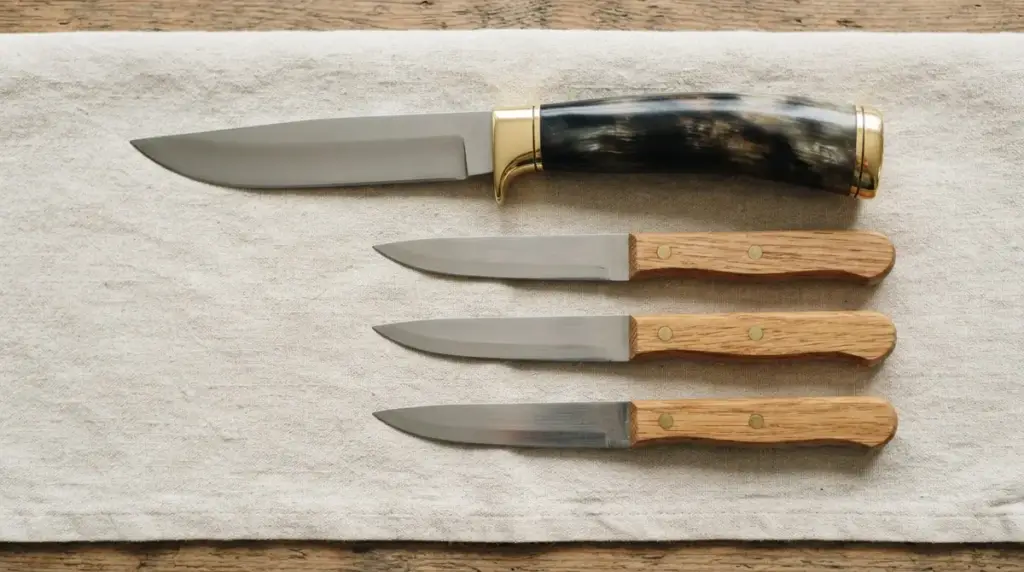
Read that table before you read anything else on this page. A commemorative from us costs roughly ten times what a typical knife from us costs, and the extra is paying for gold plating, engraving, a presentation case and hand work on the fittings. It is not paying for a better blade. The blade is the blade we put on knives that cost two hundred dollars.
Gold plating, engraving and what happens to them over time
Gold plating is a surface layer over engraved metal. It is thin by nature, it wears where it is touched and rubbed, and it cannot be restored at home. On a knife that lives in a case that is a non issue for a lifetime. On a knife carried in a sheath against a belt it will show wear at the high points within a year or two. If you want a commemorative that ages gracefully through use, choose one where the decoration is engraving into steel rather than plating over it, because cut metal stays cut.
Underneath the decoration these are high carbon pattern welded blades and they behave like it. They will corrode if they are stored damp, and a presentation case with a foam or velvet lining will hold moisture against a blade quite happily if the case lives somewhere humid. Oil the blade, keep the case somewhere with stable indoor humidity, and do not seal it in plastic. Our guides to Damascus knife care and storing knives go through that properly.
Edition size, and a question we cannot answer
Here is the part that is inconvenient for us. Our own product listings describe this as a limited run and do not publish an edition number, and they do not describe the knives as serialised. We could not find a stamped serial number or a stated run size in the product data while writing this page.
By the standard set out earlier in this guide, that is a weakness. If you are buying one of ours as a keepsake for somebody who served, or because you like the object, the missing number does not matter at all. If you are buying it because you expect a documented limited edition to appreciate, you should ask us for the run size before you order and hold us to the answer, because we are not publishing one and you should not assume it.
Buying one as a gift rather than as an investment
This is the use case that actually works, and it is where we would point almost everybody. A commemorative knife is a very good retirement gift, a very good gift for somebody who served, and a very good fiftieth birthday present for a person who already owns everything practical. It is a bad savings account.
If you are buying as a gift, the presentation matters more than the specification. A knife arriving in a fitted case with a plaque reads as an occasion. The same knife in a padded envelope does not, whatever the steel is. Ask what the piece ships in before you order, from us or from anybody.
Personalising it is possible and it comes with a hard rule. Our engraving is a flat twenty nine dollars a knife for up to twenty characters, it adds one to two business days to production, and an engraved knife cannot be returned, because the text makes it unique to you. On a knife at this price that is a serious commitment, so check the spelling of the name against a document rather than from memory. We do not offer free engraving.
Condition, box and papers
If you take one thing from this guide, take this. The difference between a commemorative that holds some value and one that holds almost none is usually not the knife, it is everything that came with it. Keep the box. Keep the sheath. Keep the paperwork and any certificate. Keep the receipt, because provenance in twenty years means being able to show where and when it was bought.
Do not sharpen it. A commemorative arrives sharp and an amateur regrind is the fastest way to remove value from any collectable blade. If you want to use it, use it and enjoy it, but make that decision knowingly rather than by drifting into it. And keep it out of direct sunlight, which fades case linings and can lift the finish on a horn or wood handle over years.
Buying after the date has passed
The semiquincentennial itself is now behind us, and that changes the market in two directions at once. Retail attention drops, so discounting appears, and pieces that did not sell during the run become available. That is good for a buyer. At the same time the argument for buying quickly disappears, so there is no reason to rush.
Our honest advice is to buy a commemorative after the anniversary rather than before it if you are buying for yourself, and to buy before it only if the date itself is the occasion for the gift. The three knives we publish are still listed and still in stock at the time of writing, which tells you something about how many of these objects the market absorbs. You can see them on the 250 Anniversary knives category page.
Questions people ask
What is the 250th anniversary of America?
The United States semiquincentennial, marking two hundred and fifty years since the adoption of the Declaration of Independence on 4 July 1776. The anniversary date was 4 July 2026. Congress created the United States Semiquincentennial Commission, known as America250, under Public Law 114 196, enacted in July 2016.
Do commemorative knives go up in value?
Most do not. Supply arrives all at once and demand fades with the occasion. We could not find a published price index for commemorative knives to cite, so treat that as our reading of the market rather than a measured figure. The exceptions are pieces that are genuinely scarce and documented, made by a maker who is already collected, and kept unused and complete.
What makes a commemorative knife collectable?
Three things. A small run with a published number and ideally a serial on the piece. A maker whose ordinary work already resells strongly. And condition with completeness, meaning unused, with the original box, sheath and papers.
How many 250th anniversary knives do you make?
We publish three in the category, priced at one thousand two hundred and twenty three, one thousand three hundred and eighty seven and one thousand six hundred and thirty one dollars. Our listings describe the run as limited but do not publish an edition number, and we do not describe the knives as serialised. If the run size matters to you, ask before ordering.
Are the 250th anniversary knives usable?
Yes. They are hunting patterns in 1095 and 15N20 Damascus with the same heat treat as the rest of our Damascus, listed at 58 to 60 HRC. Using one will reduce whatever collector value it has, so decide deliberately rather than by accident.
Will gold plating wear off a knife?
It will wear where the knife is handled or rubbed, because plating is a thin surface layer, and it cannot be restored at home. In a display case it will last indefinitely. Carried in a sheath it will show wear at the high points fairly quickly.
Which other 250th anniversaries fall in this period?
The Army marked its 250th on 14 June 2025, the Navy on 13 October 2025 and the Marine Corps on 10 November 2025, with the national semiquincentennial on 4 July 2026. For a gift to somebody who served, the service date is often the more meaningful one.
Should I have a commemorative knife engraved?
Only if the personalisation is the point of the gift. Our engraving is twenty nine dollars a knife for up to twenty characters and adds one to two business days to production. An engraved knife cannot be returned, and engraving a piece bought partly for resale usually narrows the market for it later.
Is it too late to buy a 250th anniversary knife?
No. The date has passed, which mostly works in a buyer's favour: attention drops, discounts appear and unsold pieces become available. If the anniversary date itself was the occasion for a gift, buying before it mattered. If the object is the point, there is no rush.
How should I store a commemorative knife?
Oiled, in stable indoor humidity, in its case with the papers, out of direct sunlight and not sealed in plastic. A lined presentation case will hold damp against a carbon Damascus blade if the case itself lives somewhere humid, which is the most common way these knives are damaged.
More guides: read hand forged versus factory for what actually separates a hand built knife from a finished one, and what a Damascus knife should cost for the pricing logic behind the figures above. Damascus knife care and how to store knives cover keeping one in the condition that matters, Christmas knife gifts covers gift buying more broadly, and the 250 Anniversary knives category lists the three described here.
More from the workshop
Corporate Knife Gifts: Engraved Logo Knives for Employees and Clients
Gift ideas for employees and clients, logo engraving that survives the blade, volume tiers and the dates to order by.
Damascus Knife Care and Sharpening
Stop the rust, sharpen it correctly, and bring a faded etch back in ten minutes.
Knife vs Dagger: What Is the Difference?
Every dagger is a knife, not every knife is a dagger. One edge or two changes everything, including what you can legally carry.
