
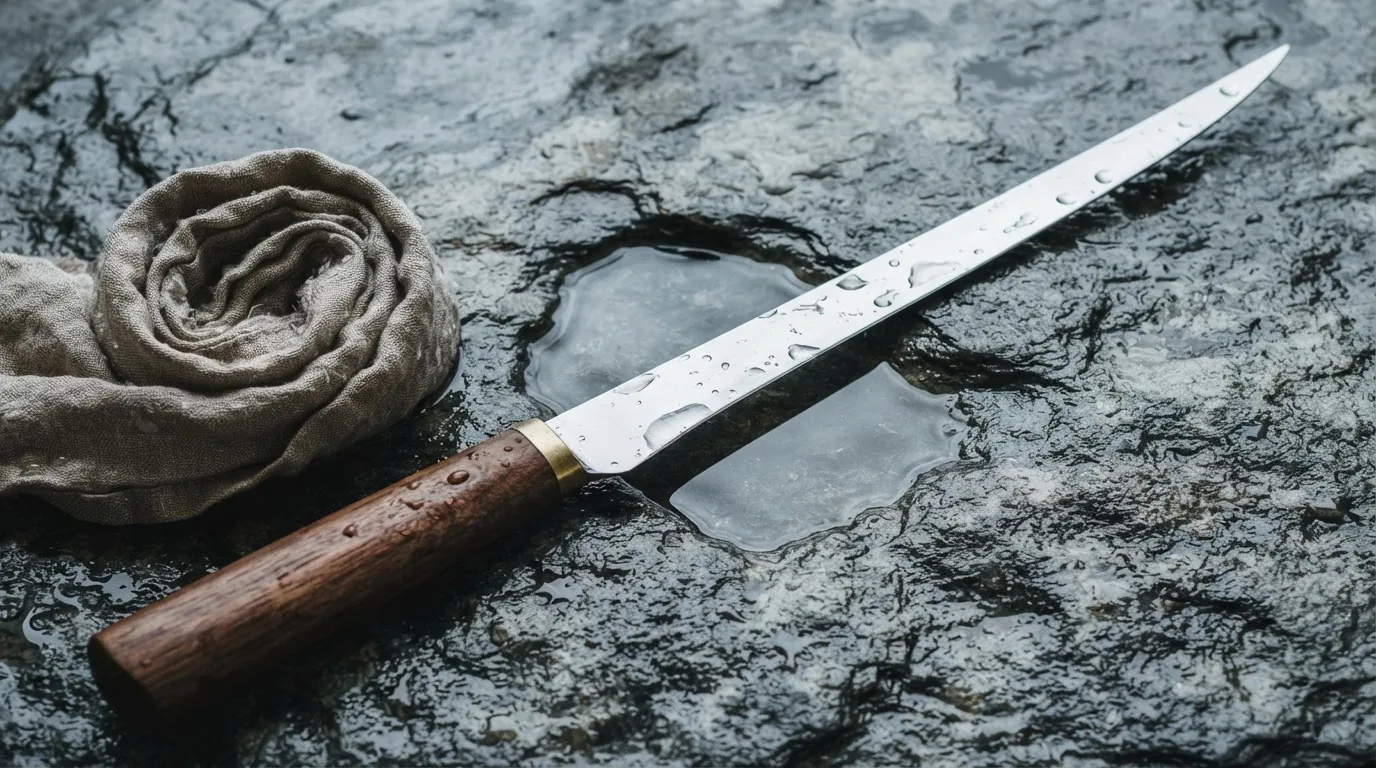
Short answer: most anglers need two knives, not one. A flexible fillet blade sized to the fish you actually catch, and a stubby bait knife you will not mind ruining. If you fish salt water, the steel matters more than the shape, and carbon Damascus is the wrong answer. We say that knowing every knife in our own fishing category is carbon Damascus.
The knives a fishing kit actually needs
Tackle shops sell fishing knives as a single category, which hides the fact that the jobs are completely different. Cutting bait is chopping. Filleting is slicing along a curved bone structure. Cutting line is a squeeze. Prying a hook is not a knife job at all.
| Job | What it needs | What fails at it |
|---|---|---|
| Cutting bait | Short stiff blade, 4 to 6 inches, cheap enough to abuse on a board | A long flexible fillet blade, which flexes away from the cut and gets chipped on shell and bone |
| Filleting | Thin blade with controlled flex, 6 to 12 inches depending on the fish | A thick stiff blade, which cannot follow the rib cage and wastes meat |
| Skinning a fillet | Longer, stiffer, straight edge held nearly flat | A very flexible tip, which lifts and cuts through the skin |
| Cutting line and leader | Scissors or a small plain edge kept only for line | Your fillet knife. Monofilament dulls an edge fast and unevenly |
| Anything involving prying | Pliers | Any knife. Blades break sideways |
Buy the fillet knife carefully and buy the bait knife cheaply. That order round the wrong way is the most common mistake we see in this category.
Fillet blade length by fish
Blade length should track the fish, not the angler. A blade roughly as long as the fish is deep lets you make one pass along the backbone instead of sawing. On the water published guidance sizes it like this, and it matches what we hear from customers.
| Blade | Typical fish | Flex |
|---|---|---|
| 6 inches | Panfish, sea bass, fluke, scup, tautog | Narrow and flexible, close to a boning knife |
| 8 to 9 inches | Striped bass, small bluefish, walleye, snapper | Slight flex, the most generally useful setting |
| 10 inches | Bluefish, cod, mahi | Stiffer, because you are skinning as much as filleting |
| 12 inches | Tuna, swordfish, shark | Long and thicker, flex only near the tip |
Flex is not a virtue on its own. A blade that flexes too easily follows the path of least resistance, which is into the meat, and you leave a strip on the frame. Too little flex and you cannot ride the rib cage. The 8 to 9 inch blade with a slight flex is the one most people should own if they only own one.
If you are choosing between a boning knife and a fillet knife for kitchen work rather than dockside work, we have a separate page comparing the two. They look similar and they are not the same tool.
What is actually in our fishing category
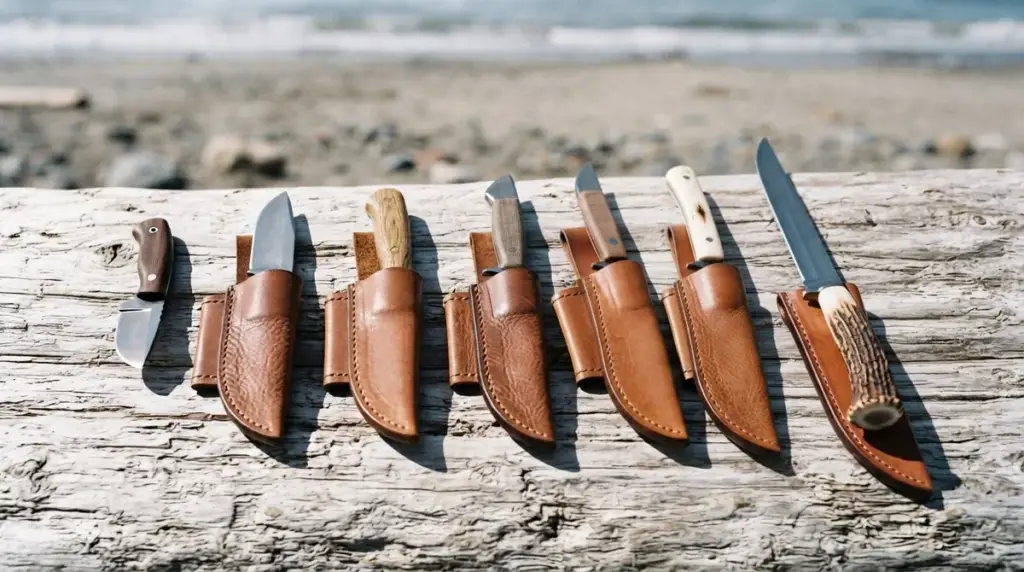
We pulled every published product in our fishing knife category on 30 August 2026. There are seven. Here they are with the numbers straight from each listing.
| Listing | Blade | Overall | Price | Steel as listed |
|---|---|---|---|---|
| Damascus fish fillet knife with leather sheath | 6.5 inches | 11 inches | $135 | 1095 and 15N20 Damascus |
| Fish shaped folding knife with brass handle | 3 inches | 7.5 inches | $155 | Damascus, layer count not stated |
| Shishamo fillet and utility knife | 7 inches | 12 inches | $120 | 1095 and 15N20 Damascus, 352 layers |
| Colorado Snake fillet and utility knife | 7 inches | 12 inches | $140 | 1095 and 15N20 Damascus, 352 layers |
| Green Mamba fillet and utility knife | not stated | 14 inches | $120 | 1095 and 15N20 Damascus, 352 layers |
| Sea Urchin fillet knife | 8 inches | 13 inches | $113 | 1095 and 15N20 Damascus |
| Chihuahuan Snake gut hook fixed blade | 4.6 inches | 8.7 inches | $155 | 1095 and 15N20 Damascus, 352 layers |
Two things about that table are inconvenient for us and worth saying plainly. The last entry is a gut hook hunting knife that has been filed into the fishing category, and it is not a fishing knife. And all seven are carbon Damascus. We do not currently sell a stainless fishing knife of any kind.
The prices run $113 to $155 with a median of $135, so the category is narrow in price as well as in count. Every one of the seven includes a hand stitched leather sheath.
Why carbon Damascus is wrong for salt water
Stainless steel is defined by a chromium content of at least 10.5 percent. That chromium forms a microscopically thin chromium oxide film on the surface which blocks oxygen from reaching the metal beneath and reforms itself when scratched. Below that threshold there is no film and no self repair.
1095 has effectively no chromium. 15N20 carries about 2 percent nickel and, again, effectively no chromium. A pattern welded blade of the two has no passive layer whatsoever. Then you take it into an environment full of chloride ions, which are the specific thing that attacks steel surfaces hardest, and you leave fish slime and blood on it while you finish the drift.
The result is not a slow patina. It is orange spotting inside a single afternoon if the knife is left wet, and pitting along the edge within a season if that becomes a habit. The acid etch that makes the pattern visible has already left the surface chemically active, which does not help.
D2, which we use on 109 listings across the site, is often called semi stainless and it is not stainless either. Nominal chromium is about 11 to 12 percent, but so much of it is locked into chromium carbides by the high carbon content that the chromium actually available in solution tops out around 9.3 percent. Published calculations put the figure needed to make D2 genuinely stainless at 16.6 percent chromium or higher. On a boat, treat D2 as a carbon steel that rusts a little more slowly.
What we would actually take on a boat
If you fish salt water regularly and you asked us across the counter, we would point you at 440C or VG10 rather than at anything in our fishing category. Across the whole catalogue, 593 of our 609 published listings state a blade steel, and the split is this.
| Steel family | Listings | Share | Salt water verdict |
|---|---|---|---|
| 1095 and 15N20 Damascus | 352 | 59 percent | No. No chromium, no passive layer |
| D2 tool steel | 109 | 18 percent | Only with discipline. Semi stainless at best |
| Plain high carbon | 77 | 13 percent | No |
| 440C, VG10 or stated stainless | 52 | 9 percent | Yes, with a rinse |
| Other or unstated | 19 | 3 percent | Ask before buying |
Nine percent of our catalogue is genuinely stainless, and none of that nine percent sits in the fishing category. We list 36 knives in 440C or VG10 and every one is filed under kitchen, hunting, folding or cleaver. If you want one of ours for a boat, that is where to look, not by the name on the tin, and you will be buying a knife that was not designed for filleting.
The straight recommendation, which costs us a sale: for a working saltwater fillet knife, buy a purpose built stainless one. Buy one of ours for freshwater, for the dock table at home, or because you want a hand forged blade and you are willing to look after it.
Bait knives and why cheap is correct
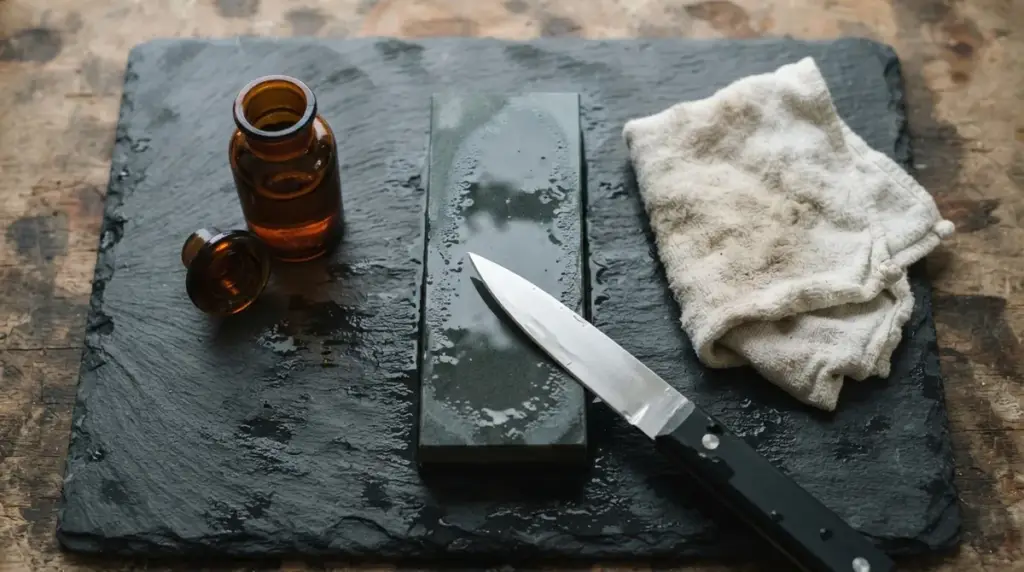
A bait knife hits a cutting board through frozen squid, cuts across the grain of a mullet, and occasionally scrapes barnacle. It should be 4 to 6 inches, stiff, with a plain edge and a handle you can hold with a wet glove.
It should also be a knife you do not care about. The single most reliable way to ruin a good fillet blade is to use it for bait. Buy the fillet knife you want and buy the ugliest serviceable bait knife you can find, and keep them apart in the bag.
Serrations are worth considering here and nowhere else in a fishing kit. They chew through frozen bait better than a plain edge and they are a nuisance to sharpen, which does not matter on a knife you intend to replace.
Folding fishing knives
A folder on the water is a compromise. The pivot traps salt water and fish slime, and unlike a fixed blade you cannot see or reach the inside of it. Every folder on a boat needs rinsing under running fresh water with the blade open, then drying, then oiling at the pivot.
We list one folder in the fishing category, a 3 inch Damascus folder with an engraved brass handle at $155. It is an attractive object. It is not the knife to hand somebody with a bluefish on a rolling deck. The wider folding pocket knife category has 111 listings, of which 87 are carbon Damascus, so the same corrosion warning applies to nearly all of them.
If you want a folder for the tackle bag rather than for the fillet table, look for a blade you can open with one wet hand and a handle with real texture. Neither is something our current listings state, so ask before ordering.
Sheaths, lanyards and knives lost overboard
All seven of our fishing knives ship with a hand stitched leather sheath. Leather is the wrong material near salt water and we should say so. It soaks, it holds salt against the blade, it stiffens as it dries and it will mark a light coloured deck.
If you take one of ours out on a boat, leave the leather at home and carry the knife in a plastic or Kydex sheath, or in a dedicated slot in a tackle box. Rinse the blade before it goes back in anything.
A lanyard is worth the small annoyance. A dropped fillet knife on a deck is a foot injury and a dropped fillet knife over the side is gone. A simple loop through a hole in the handle, or a wrist tether on a short cord, solves both.
Care after a saltwater day
The routine is short and it is not optional on carbon steel. Rinse the blade in fresh water while it is still on the boat if you can. Wash it in warm water with a drop of dish soap when you get home. Dry it completely, including the ricasso and any file work, because those are the places that stay damp.
Then oil it. A food safe mineral oil is fine for anything that touches fish. Our page on choosing a knife oil covers what to use and what to avoid. If you have already left it a week and there is orange on the blade, the rust removal page will get most of it back, though pitting is permanent.
Sharpen after the season rather than after every trip. Fish bone and skin dull a blade less than the cutting board does. Our sharpening guide covers the thin flexible blade case, which is where most people roll an edge over by pressing too hard.
Gutting, scaling and the jobs between
Gutting is a shallow cut, not a deep one. You want the point only, entered under the vent and drawn forward against the resistance of the belly wall, which is why a fine tip matters more than length. A fillet blade will do it, but the tip is the part you are most likely to snap, so a small stiff blade is the safer tool if you are cleaning a lot of fish.
Scaling is not a knife job either, though everybody does it with one. A dedicated scaler with a serrated head takes a fraction of the time and does not blunt an edge on a hundred small hard plates. If you insist on the knife, use the spine, held at a shallow angle, working from tail to head, and accept the mess.
Two habits save more edges than any steel choice. Cut on wood or plastic and never on a metal deck or a stone dock. And stop cutting when the blade stops going where you point it, because forcing a dull thin blade through a rib cage is how thin blades bend permanently.
One more that costs us nothing to say and saves you money: the knife you already own, sharpened properly, will outperform a new knife that is not. If your current fillet blade feels wrong, put it on a stone before you put a new one in a basket.
Questions people ask
What size fillet knife should I buy first
An 8 to 9 inch blade with slight flex. It handles striped bass, walleye and snapper and it is not unusable on panfish. Go to 6 inches only if you fish almost entirely for small fish, and to 12 inches only for tuna and shark.
Is Damascus a good steel for a fishing knife
For fresh water and a home fillet table, yes, if you dry and oil it. For salt water, no. 1095 and 15N20 have no meaningful chromium, so there is no passive layer to resist chloride attack. All seven knives in our fishing category are this steel, which is a limitation of our range rather than a recommendation.
What steel should a saltwater knife be
Something with at least 10.5 percent chromium in solution. 440C and VG10 both qualify. D2 does not, despite a nominal 11 to 12 percent chromium, because carbide formation leaves only about 9.3 percent available.
How many fishing knives do you sell
Seven published listings as of 30 August 2026, priced $113 to $155 with a median of $135. One of the seven is a gut hook hunting knife that sits in the category by a filing error rather than by design.
Do I need a flexible blade
Some flex helps you follow the rib cage without cutting into it. Too much flex means the blade wanders and you leave meat on the frame. Slight flex is the useful setting for most fish, and stiffer is better for skinning.
Can I use a fillet knife for bait
You can, and it is the fastest way to wreck it. Frozen bait, shell and cutting boards chip thin edges. Keep a separate stiff 4 to 6 inch knife for bait and accept that it will look terrible.
Why does my fishing knife rust so fast
Because salt water is full of chloride ions and carbon steel has no oxide film to stop them. Fish slime and blood hold moisture against the steel as well. Rinse, dry and oil the same day, every day you use it.
Are leather sheaths bad for fishing knives
Near salt water, yes. Leather absorbs and holds salty moisture directly against the blade. Every knife in our fishing category ships with one, so plan to store the knife somewhere else if it is going on a boat.
What hardness are your fishing knives
The 1095 and 15N20 blades we sell are held to 58 to 60 HRC, oil tempered. That is a sensible band for a fillet blade because it keeps the edge without making a thin blade brittle.
Do I need a knife at all for catch and release
No. Long nose pliers or a dedicated hook remover do that job better and more safely for the fish and for you. Carry a small knife for line and leader only.
More guides
Keep reading: boning knife against fillet knife, how to remove rust from a knife, carbon against stainless, the best knife oil and how to sharpen a knife. The fishing knife category is here.
More from the workshop
Corporate Knife Gifts: Engraved Logo Knives for Employees and Clients
Gift ideas for employees and clients, logo engraving that survives the blade, volume tiers and the dates to order by.
Damascus Katana and Samurai Sword Guide
Pattern welded versus traditional, the stainless warning, tang checks and real price bands.
Damascus Pocket Knives: What You Get and What You Give Up
What a Damascus folder is, what 111 of our own listings show, and what it does worse than stainless.
