
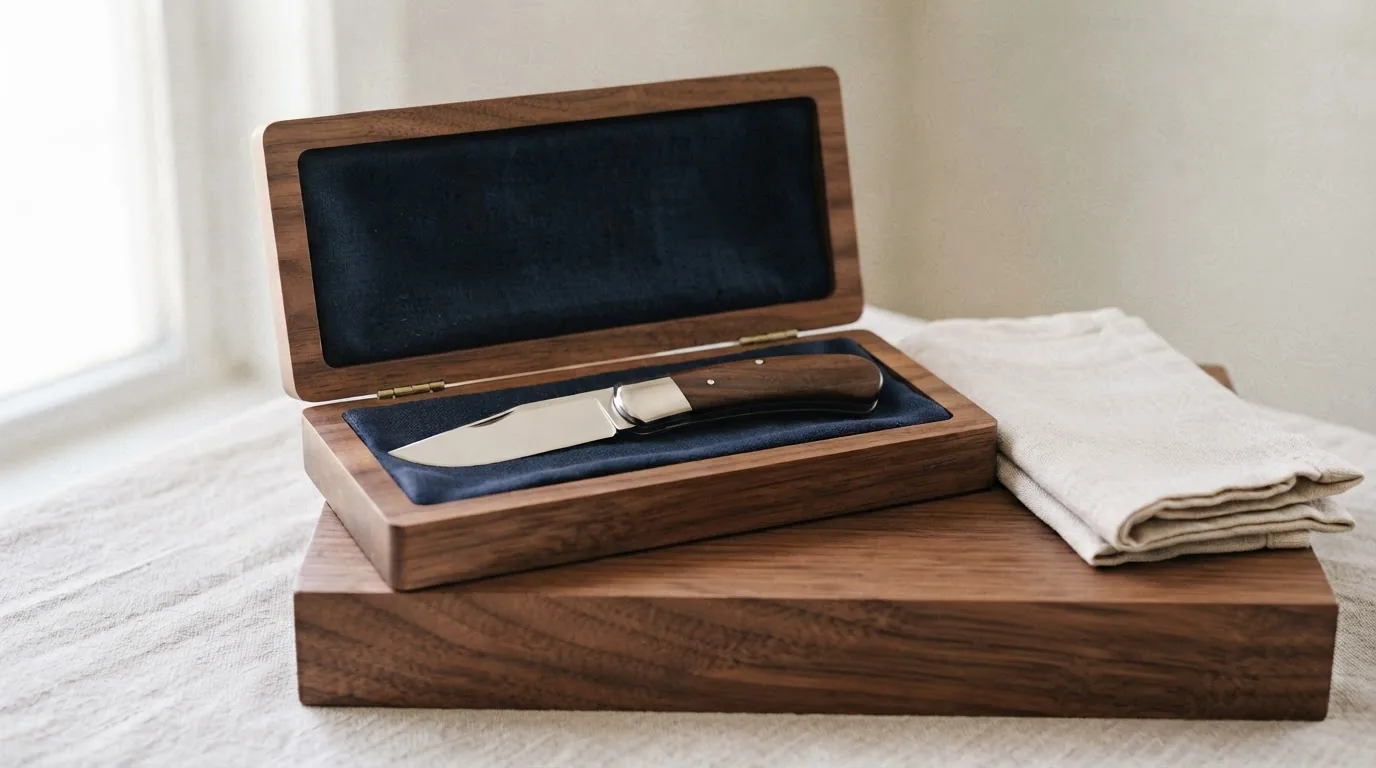
Short answer. Engraving on our knives costs 29 dollars flat per knife, allows up to 20 characters, and adds one to two business days to production. You tick the option above the Add to Cart button on a product page, type your text, and choose the blade, the handle, or let the smith decide. The part nobody selling engraving tells you is mechanical: a hardened, acid etched Damascus blade is the worst surface in the shop for a legible mark, because the mark has to compete with a pattern that is already there. Brass bolsters and wood handles hold a mark far better. And once a knife is engraved it cannot be returned.
What our engraving costs and what you actually get
These figures are from our own engraving page and they are what applies today. If anything on this page ever disagrees with the checkout, the checkout is right.
| Item | What applies |
|---|---|
| Price | 29 dollars, a flat fee, charged per knife |
| Character limit | 20 characters maximum |
| Added production time | One to two extra business days |
| Where you order it | A tick box directly above Add to Cart on the product page. It opens the text field and adds the fee to that knife |
| Placement choices | Blade, handle, or leave it to the smith |
| Fonts | Write the font name in the engraving instructions alongside your text. Script, block, serif and gothic are all handled |
| Logos and artwork | Order with the engraving option ticked, then email the file with your order number |
| Returns | None. An engraved knife is one of one and cannot be returned |
| Accuracy | We engrave exactly what you type, including spelling, spacing and punctuation |
| Availability | Offered on most knives in the shop, not all of them |
There is no free engraving offer here and there never has been. If you see one advertised somewhere, look at what happened to the price of the knife.
The four ways a knife gets marked
Almost every article on this subject treats engraving as one thing. It is four things and they behave very differently.
Hand engraving uses a graver, a hammer and a lot of practice to cut metal away. Relief work leaves the design standing proud, intaglio cuts it in, line work is pure outline, stippling builds tone out of dots. It is beautiful, it is slow, and on a fully hardened blade it fights back, which is why traditional hand engraving is usually done on softer furniture: bolsters, guards, pommels and butt caps.
Fibre laser marking is what most shops now mean by engraving on metal. A pulsed beam heats a very small area and either oxidises the surface to a dark grey or ablates a shallow trench. It is fast, it is repeatable, it holds fine detail, and it is the only sensible method for a run of matching knives.
Rotary or diamond drag marking pushes a stylus through the surface. It gives a bright scratched line rather than a dark one and it needs a fairly flat area to sit on, which rules out most blade profiles.
Acid or chemical etching masks the surface and lets acid do the work. It is cheap and it is how a lot of mass produced logos appear. On a blade that has already been acid etched to bring up a Damascus pattern, this is exactly the wrong tool, for reasons in the next section.
| Method | Mark appearance | Best surface | Behaviour on etched Damascus | Removable |
|---|---|---|---|---|
| Hand engraving | Cut line, catches light | Brass, nickel silver, soft bolsters | Difficult. Hardened steel resists the graver | No |
| Fibre laser | Dark oxide or shallow ablation | Steel, hardened or not | Works, but contrast is poor against the pattern | No |
| Rotary or diamond drag | Bright scratched line | Flat metal, awards and plates | Poor. Needs a flat field a blade rarely offers | No |
| Acid or chemical etch | Frosted recess | Plain flat stock | Worst option. It attacks the same layers the pattern etch already attacked | No |
Why a Damascus blade is the hardest thing in the shop to mark
This is the section that sells fewer engravings for us, and it is the reason this page exists.
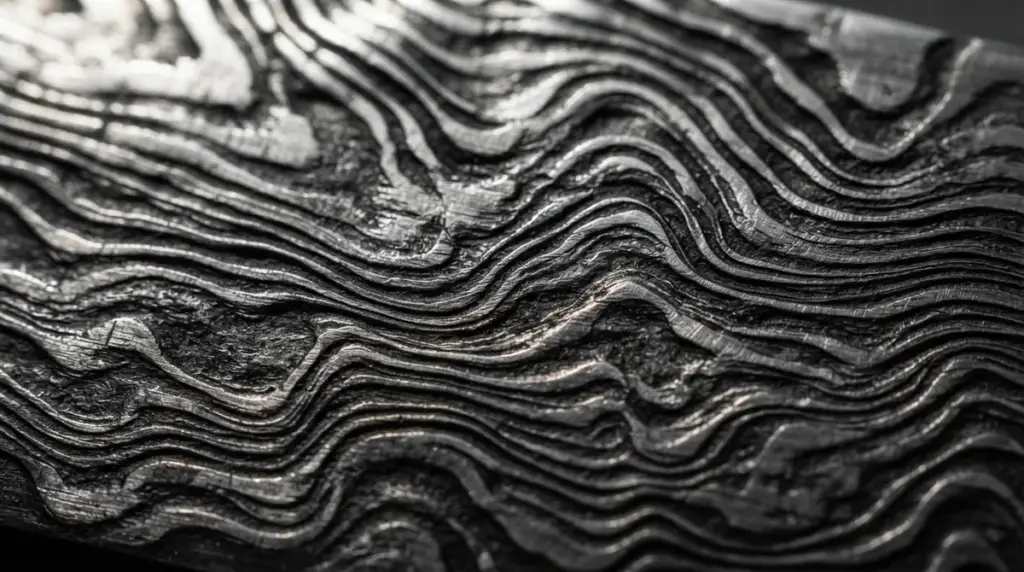
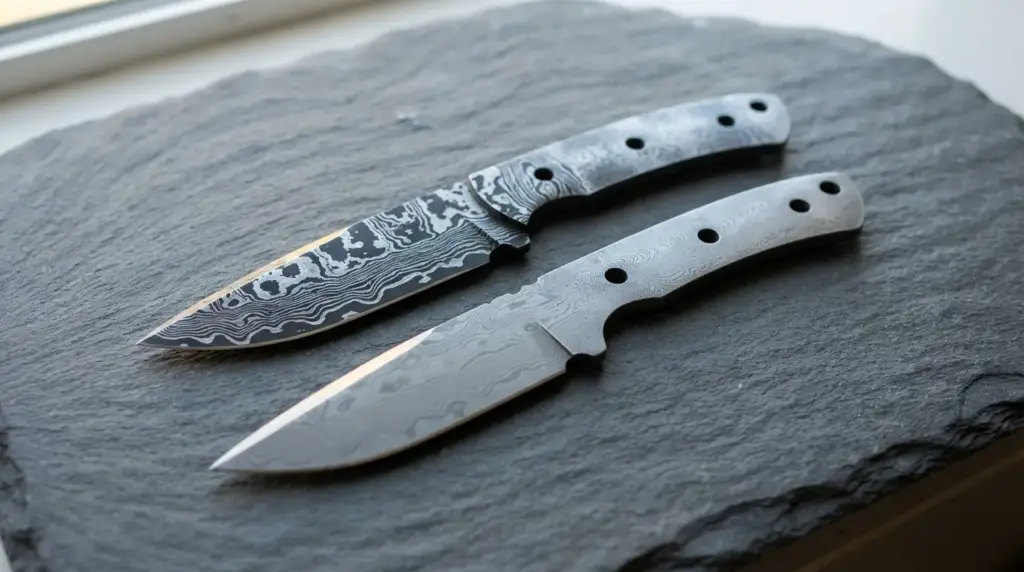
A pattern welded blade gets its look from an acid bath. The acid attacks the two steels in the billet at different rates. On our billets that is 1095 and 15N20. The 1095 is eaten faster and sits slightly lower, the 15N20 stands slightly proud and stays brighter, and the eye reads the height and colour difference as a pattern. So the finished blade is not flat and it is not one tone. It is a fine relief map with high contrast already printed across it.
Now put a mark on top of that. A laser darkens steel by oxidising it, but half the surface it lands on is already dark and the other half is already bright, and the mark crosses both. A hand cut line disappears into the layer boundaries running at their own angle. An acid etch attacks the softer layers preferentially all over again and the letters bloom unevenly. The result is legible from twelve inches in good light and nearly invisible across a room, which is not what a person paying for a personalised gift is picturing.
There is a second problem. Marking hardened steel puts heat into a very small volume. On the flat of a blade, well back from the edge, that is harmless. Close to the edge it is not, which is why the sensible rule is to keep any mark on the spine or the flat and never near the cutting edge. Held hardness on our Damascus is 58 to 60 HRC and we are not going to risk a soft spot on the working part of a blade to fit a longer word.
The third problem is corrosion. Our Damascus is a carbon steel and it rusts if you let it. A mark is a discontinuity, a place where the finish is broken and moisture can sit. On a blade that lives in a drawer that is a non issue. On a blade that gets carried, it is one more spot to oil.
Handles and bolsters take a mark better than blades do
The counterintuitive advice, and the one that will actually make your gift look better, is to move the text off the blade.
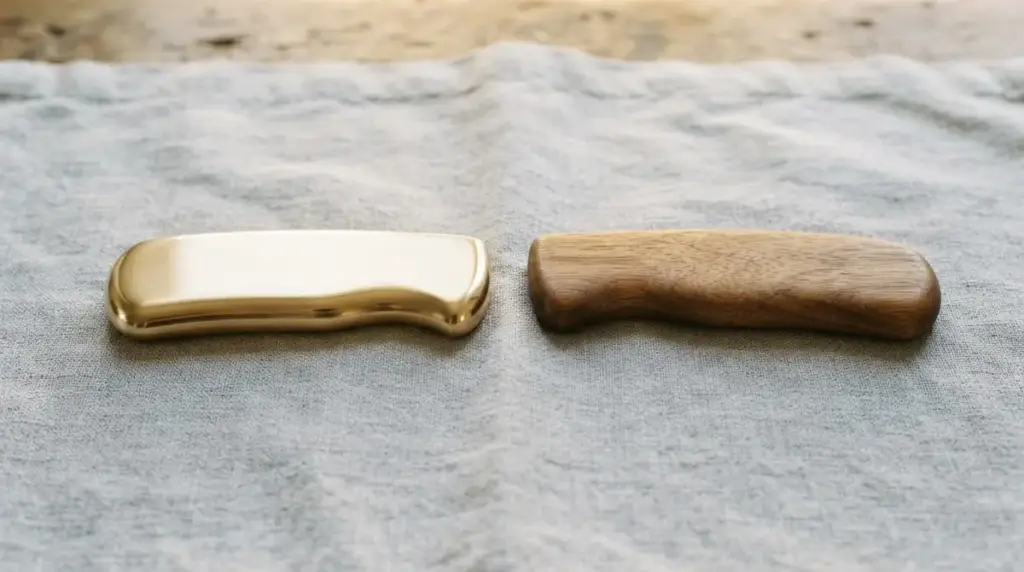
Brass is the best surface we have for this. It is soft enough to cut cleanly, it is one uniform tone so a mark has full contrast, and it patinas around the cut in a way that makes the mark more visible with age rather than less. We have 121 published products with brass in the specification, mostly as bolsters and pins.
Wood is next. A laser burns wood dark and holds fine detail, and a wooden handle is a flat and generous surface compared with a blade. We have 158 published products with a wood handle. The caveat is that oily and very dense woods burn less evenly than open grained ones.
Bone, stag and horn are more variable. They mark, and the contrast can be excellent, but the material itself is irregular and a mark laid across a colour change looks accidental. We have 138 products in that group.
| Surface | Contrast achieved | Risk | Our published count |
|---|---|---|---|
| Brass bolster or guard | High and improves with patina | Small area, so short text only | 121 |
| Wood handle | High on open grained woods | Uneven burn on oily or very dense woods | 158 |
| Bone, stag or horn | Variable | Natural colour variation can swallow a mark | 138 |
| Plain polished steel blade | Good | Heat near the edge, and a visible break in the finish | Most non Damascus stock |
| Etched Damascus blade | Poor | The mark competes with the pattern | 320 of our 609 |
Twenty characters is a real constraint, so write the text first
Twenty characters including spaces and punctuation is less than people expect. Write your line before you pick the knife, count it, and count it again. Here are real examples with their actual counts.
| Text | Characters | Fits |
|---|---|---|
| Dad | 3 | Yes |
| R.J.K. | 6 | Yes |
| Est. 1987 | 9 | Yes |
| Semper Fi | 9 | Yes |
| J. A. MORRIS | 12 | Yes |
| For Dad, 2026 | 13 | Yes |
| ALWAYS FORWARD | 14 | Yes |
| To Michael, from Dad | 20 | Exactly at the limit |
| Congratulations Michael | 23 | No |
| Happy Retirement Dad 2026 | 25 | No |
Short reads better anyway. A mark you take in at a glance survives thirty years of looking at it. A sentence squeezed onto a bolster looks like a warning label. If your text will not fit, cut the occasion and keep the name, or cut the name and keep the date.
One more thing: we engrave exactly what you type. Spelling, spacing, capitals and punctuation all go through as entered. Read the field twice before you check out, because the next section explains why there is no second chance.
Logos, crests and your own artwork
Company logos, club crests, unit insignia and your own drawing are all possible, and the process is not what most people guess. You do not upload a file at checkout. You tick the same engraving option, place the order as normal, and then email sales@blackmambaknives.com with your order number and the artwork attached. PNG, JPG and PDF all work, and a larger file gives a cleaner result. We prepare the artwork and confirm placement with you before anything touches the knife.
Two practical notes. Fine detail does not survive scaling down to a bolster, so a logo with thin strokes or small type inside it will need simplifying, and we will tell you if that is the case. And a logo on an etched Damascus blade runs into exactly the contrast problem described above, only worse, because a logo has more edges to lose than three initials do.
What engraving does to the knife, honestly
It does four things, and only the first is good.
It makes the knife specific to one person, which is the entire point and is worth the money if that is what you want. It removes any possibility of return, because a knife with your brother's name on it cannot go back into stock. It puts a permanent break in the surface finish that you will need to keep oiled on a carbon steel blade. And it makes the knife harder to resell, which matters more than people think on the higher priced pieces.
Placement also shifts. Size and position vary with blade shape and the space available, so the mark on a wide bowie and the mark on a slim folder will not sit identically even with the same text. If exact placement matters to you, say so in the instructions and we will confirm it before the work is done.
Who should not order engraving
We would rather you skipped it in three situations.
If you are not certain of the spelling of a name, do not order it. This is the single most common way an engraved gift goes wrong and there is no recovery from it. If you are buying a gift for someone whose taste you are guessing at, do not engrave it, because an unengraved knife can be exchanged and an engraved one cannot. And if you are buying an expensive piece as an investment or with any thought of selling it later, leave it plain.
Engrave when you know the person, know the spelling, and know that the knife is being kept.
Which knife to put the text on
The 29 dollar fee is flat, so as a share of the price it hurts least on a more expensive knife and most on a cheap one. Our folders start at 70 dollars with a median of 128, our hunting fixed blades run to a median of 201, and the catalogue median across all 609 published products is 155.
For a first engraved gift, a folder is the safe answer. It has a bolster, it gets carried and looked at, and it is the category where the recipient is most likely to actually use the thing rather than shelve it. For a retirement or a milestone, a fixed blade with a brass guard gives you a bigger and better marking surface. For a set of matching gifts, a run of the same model with the same font is the only way to get a consistent result, and that is worth a conversation before you order.
Lead time and gift timing
Engraving adds one to two business days to production. That is the shop time for the marking itself and it stacks on top of whatever the normal production and shipping time for the knife is. Business days means business days, so an order placed on a Friday afternoon does not gain anything over the weekend.
If a logo is involved, add more. We confirm artwork and placement with you by email before the work starts, and that exchange runs at the speed of whoever replies slowest. For a dated occasion with artwork, give yourself a week of slack you do not expect to need.
Questions people ask
How much does knife engraving cost here?
29 dollars as a flat fee per knife. It does not scale with the number of characters or the placement you choose.
How many characters can I have?
Twenty, including spaces and punctuation. That is a hard limit, not a guideline.
Can I get engraving for free?
No. We do not offer free engraving and we never have. Where you see it offered elsewhere it is usually priced into the knife.
Can I return an engraved knife?
No. Your text makes the knife one of one, so engraved knives cannot be returned. This is the reason to check your spelling before checkout rather than after.
Should I put the text on the blade or the handle?
On a plain polished blade, either works. On an etched Damascus blade, the handle or the bolster will look better, because the mark on the blade has to compete with the pattern for contrast. You can also leave the choice to the smith and we will put it where it sits best on that particular piece.
How long does engraving add to my order?
One to two business days on top of normal production. Add more if you are sending artwork, because we confirm the layout with you first.
Can you engrave a company logo?
Yes. Tick the engraving option, place the order, then email sales@blackmambaknives.com with your order number and the file. PNG, JPG or PDF, and the bigger the file the cleaner the result. Very fine detail may need simplifying and we will say so before we start.
Can I choose the font?
Yes. Write the font name in the engraving instructions with your text. Script, block, serif and gothic are all handled. If you have no preference, say so and we will pick something that suits the piece.
Will engraving weaken the blade?
Not where it is placed sensibly. A mark on the flat or the spine, well back from the edge, does not affect how the knife cuts. A mark near the cutting edge is a different matter, which is why we do not put one there.
Does an engraved knife need different care?
Slightly, on carbon steel. The mark is a break in the finish and moisture can sit in it, so it is one more place to wipe and oil. On a knife that lives in a display case it makes no practical difference.
More guides. The full terms and the current options are on our custom engraving page. For gift ideas by occasion, see Christmas knife gifts and knives as wedding and groomsmen gifts. If you need a run of matching pieces with a logo, start at wholesale and custom logo knives. To understand why the pattern fights the mark, read how Damascus steel is made.
Marking a coloured or coated blade brings its own problems, and those are covered in pride knives and rainbow blades.
Design your own knife and add the engraving →
More from the workshop
Native American Knives: What Is Authentic and What Is Not
What the Indian Arts and Crafts Act allows a seller to say, what Native made blades actually were, and how to find genuine work.
Stainless Damascus and Carbon Damascus: Which Steels Are in the Billet
The steels in each billet, why the contrast comes from the etchant, and what we actually stock.
Wootz, Crucible Steel and the History Behind the Name
Wootz, the crucible steel trade, and why modern Damascus only borrowed the name.
