
Short answer: in most of the United States a butterfly knife is treated the same as any other folding knife, and the law has moved steadily in that direction since 2010. A small number of states still single them out, and a few cities have their own rules even where the state does not. This page explains how the rules are structured so you can check your own quickly.
Please check your local law before ordering. This is general information, not legal advice, and knife law changes often.
Federal law barely touches you
The Federal Switchblade Act of 1958 (15 U.S.C. 1241 to 1245) is written around interstate commerce, importation and federal land. It is not a general possession rule, and it does not decide what you may own inside your own state. A balisong has no spring and no button. It opens because the two handles swing on pivots and you move them. That mechanical difference is why most state statutes written about automatic knives do not, on their face, reach a butterfly knife at all.
The practical point: your state statute and your city ordinance decide this, not Washington.
The two federal rules that do apply
Having said that federal law rarely decides your question, there are two places where it does, and neither of them is about what you may own.
Importing. The customs regulation at 19 C.F.R. 12.95 defines a switchblade for import purposes and names balisong and butterfly knives explicitly, alongside gravity and ballistic knives. This is the one piece of federal text that mentions the word balisong in black letter, and it is why a butterfly knife ordered from overseas can be seized at the border while the identical knife made domestically is sold openly.
The mail. Under 18 U.S.C. 1716(g) a knife that opens by operation of inertia or gravity is non-mailable through the United States Postal Service, with narrow exceptions for government procurement and for suppliers filling those orders. Private carriers are the normal route instead. If a seller tells you they cannot send a balisong by USPS, they are not being difficult, they are reading the statute.
Neither rule creates a federal offence for owning one. The Federal Switchblade Act itself, at 15 U.S.C. 1242, reaches introduction into interstate commerce rather than possession, and there is no federal possession charge for a butterfly knife.
The direction of travel since 2010
This is the part most articles miss. Knife law in America has been getting simpler, not stricter. Knife Rights, the advocacy group that does most of this work, reports 46 bills enacted repealing knife restrictions across 30 states and more than 175 cities and towns since 2010. Texas repealed most of its blade restrictions in 2017. New York repealed its gravity knife rule in 2019. Hawaii, which had one of the strictest positions in the country, repealed its butterfly knife rule in 2024.
If you are reading an article written before about 2022, assume it is out of date.
Hawaii, and why it matters everywhere else
Hawaii is the clearest recent example. In 2023 a Ninth Circuit panel held in Teter v. Lopez that Hawaii's butterfly knife rule did not survive Second Amendment scrutiny after the Supreme Court's decision in Bruen. The following year the legislature settled the matter directly: Governor Green signed HB2342 as Act 021 on 14 May 2024, repealing the restrictions on the manufacture, sale, transfer, possession and transport of butterfly knives, switchblades and gravity knives.
One footnote that most write-ups get wrong: because Hawaii changed the law while the case was still running, the Ninth Circuit sitting en banc dismissed Teter as moot and vacated the panel decision. There is therefore no binding appellate holding that butterfly knife bans violate the Second Amendment. The win in Hawaii came from the legislature, not from the court.
One important detail survived that repeal: Hawaii kept its rule on carrying such knives concealed. In practice that means open carry there rather than concealed. It is a good illustration of the general pattern, which is that possession and carry are two separate questions almost everywhere.
The four questions that decide your answer
Every jurisdiction answers these separately, and this is why a simple yes or no about a state is usually wrong.
1. Can you own one at home? In the overwhelming majority of states, yes, without qualification.
2. Can you carry it openly? Usually yes, sometimes with a blade length limit.
3. Can you carry it concealed? This is where most restrictions actually sit. Concealed carry of a folding knife is treated differently from open carry in a large number of states, and a butterfly knife is a folding knife.
4. Does your city have its own rule? See preemption below.
States that treat butterfly knives as a special category
As of 2026 the list is short. New Mexico is the strictest, treating balisongs within its switchblade statute. California, Connecticut, Iowa, Oregon and the District of Columbia each have restrictions that reach butterfly knives in some form, and Hawaii retains its concealed carry rule after the 2024 repeal.
California is worth spelling out because it is the most misunderstood. A California appellate court held that a butterfly knife falls inside the state's switchblade definition at Penal Code 17235, which is written around blades of two inches or longer that can be released with one hand. Penal Code 21510 then addresses carrying such a knife, possessing it in the front of a vehicle in a public place, and selling, loaning or giving it away. Blade length is the hinge the whole thing turns on, so read the statute rather than a summary of it.
Everywhere not named above, the general folding knife rules for your state apply, and those are usually about blade length and concealment rather than about the mechanism.
What we could verify, state by state
Most pages on this subject print a table of all fifty states. We are not going to, because nobody has read fifty criminal codes this month and the tables you see are copied from each other. What follows is only what we could trace to a statute, a regulation or a named case, checked in August 2026. Where we could not verify something, it says so.
| State | Position | Where it comes from |
|---|---|---|
| New Mexico | Strictest. Bare possession is a petty misdemeanour. | NMSA 30-7-8, read onto balisongs by State v. Riddall (1991). |
| California | Legal at home. Carrying, keeping one in the passenger area of a car in public, or selling or giving one away is a misdemeanour, but only at a blade of two inches or longer. | Penal Code 17235 and 21510; People v. Quattrone (1989). The ban was upheld by the Ninth Circuit in Knife Rights v. Bonta in January 2026. |
| Hawaii | Possession, sale and open carry lawful since 2024. Concealed carry is still a misdemeanour. | HRS 134-53 as amended by Act 21 of 2024. Note that several official code websites still show the old text. |
| Oregon | Possession and open carry lawful. Concealed carry is a Class B misdemeanour. | ORS 166.240, which covers blades opening by centrifugal force. No Oregon case squarely on balisongs was found. |
| District of Columbia | Carrying one is very likely chargeable. | D.C. Code 22-4504 and 22-4514, plus United States v. Vinton (2010), which treated a butterfly knife as a dangerous weapon. |
| New Jersey | Risky. Possession without a lawful purpose is a fourth-degree crime. | N.J.S.A. 2C:39-3(e). The statute mentions centrifugal force but no New Jersey case applying it to a balisong was found. |
| Washington | Unverified. Sources genuinely conflict. | RCW 9.41.250 has an exception for knives requiring hand or wrist exertion, which may or may not cover a balisong. No case law or attorney general opinion found. A 2026 bill would remove the provision entirely. |
| Connecticut, Iowa, Rhode Island | Unverified for butterfly knives specifically. | Each has a switchblade or blade-length rule. Whether it reaches a balisong is not settled in anything we could read. |
| Alaska | Not treated as automatic. | Alaska v. Strange (1990): opening requires several motions, so it is not an automatic knife. |
| Virginia | Not a dirk. | Thompson v. Commonwealth (2009). The concealed switchblade ban was repealed in 2023. |
| New York | Gravity knives removed from the penal law in 2019. New York City still limits blade length and visible carry. | Penal Law 265.01 as amended, plus city administrative code. |
| Everywhere else | Not individually verified. | No state other than Hawaii has ever named butterfly knives in statute, so the rest turn on how their switchblade and gravity knife definitions are read. Check your own code. |
What changed between 2023 and 2026
If you last checked this five years ago, four states have moved and one court has not moved at all.
- Virginia, 2023. Concealed carry ban on switchblades repealed.
- Hawaii, 2024. Act 21 repealed the possession, sale and transport bans on butterfly knives, switchblades and gravity knives, keeping only concealed carry.
- Massachusetts, 2024. The Supreme Judicial Court struck down the switchblade carry ban on Second Amendment grounds in Commonwealth v. Canjura. What that means for balisongs specifically has not been tested.
- Vermont, 2025. The switchblade ban was repealed and prior convictions expunged.
- Delaware, 2025. Section 1446 repealed outright, and the ordinary pocketknife allowance raised from three inches to three and three quarter inches.
- California, 2026. The one going the other way. The Ninth Circuit upheld Penal Code 21510 and denied rehearing in July 2026, so the California position is settled for the foreseeable future.
Several states have also passed knife preemption laws in this period, which stop cities writing their own stricter rules: Nebraska in 2023, Idaho, Louisiana, West Virginia and Iowa in 2024, and Arkansas and Ohio in 2025. Preemption is quietly the most useful thing that can happen to a knife owner, because it removes the city ordinance problem entirely.
Last verified August 2026. Knife law changes faster than most pages that cover it, so treat the date as part of the information.
Preemption: why the state answer is not always the final answer
Preemption means the state legislature has reserved knife law to itself, so a city cannot write its own stricter rule. Where a state has preemption, checking the state statute is enough. Where it does not, a city ordinance can be stricter than the state and you have to check both.
States that have adopted knife law preemption include Alaska, Arizona, Arkansas, Georgia, Idaho, Indiana, Kansas, Louisiana, Montana, New Hampshire, Ohio, Oklahoma, South Carolina, Tennessee, Texas, Utah, West Virginia, Wisconsin and Wyoming.
States without it include California, Colorado, Connecticut, Delaware, Florida, Hawaii, Illinois, Kentucky, Maine, Maryland, Massachusetts, Michigan, Minnesota, Missouri, Nebraska, Nevada, New Jersey, New York, North Carolina, North Dakota, Oregon, Pennsylvania, Rhode Island, Vermont, Virginia and Washington. In those, look up the city as well. New York City, Denver, Chicago, Philadelphia, Boston and New Orleans are the ones that catch people out most often.
Places the rules change regardless of your state
Some locations run on their own rules and no state statute helps you. Airports and aircraft, which means a knife travels in checked baggage or not at all. Schools and college campuses. Courthouses and government buildings. Federal buildings and most federal facilities. National parks vary by park. Crossing an international border resets everything to the rules of the country you are entering.
Age
Several states set a minimum age to buy or possess a knife, commonly 18, and some apply it only to certain knife types. Where there is no state age rule, individual retailers and marketplaces usually set their own. If you are buying for someone under 18, check your state first.
How to check your own state in five minutes
Search for your state name together with the phrase knife law preemption, and separately for your state's criminal code section on dangerous or deadly weapons. Read the definitions section before the offence section, because the definition is what decides whether a butterfly knife is inside the statute at all. Then check whether the rule is about possession, open carry, concealed carry or sale, since those are four different answers. If your state has no preemption, check your city code as well.
Two organisations track this properly and update it: the American Knife and Tool Institute, and Knife Rights. Both publish state summaries with citations. Use those as your starting point and the statute itself as your authority.
Questions people ask
Is a butterfly knife the same thing as a switchblade?
Mechanically, no. A switchblade has a spring and a release. A balisong has two free handles and pivots, and nothing happens unless you move them. Legally, a few states have chosen to fold balisongs into their switchblade definitions anyway, which is why the mechanical answer and the legal answer can differ in the same sentence.
Are trainers treated differently?
A trainer has an unsharpened blade. Some statutes are written around a cutting edge and some are written around the mechanism, so a trainer is not automatically exempt everywhere. Check the definition in your own statute.
Does blade length matter?
Very often it is the only thing that matters. California's threshold sits at two inches. Many states set carry limits somewhere between three and four inches. Measure your blade before assuming.
What about carrying one at work?
An employer can set a stricter rule than the law on its own premises, and that rule is a condition of employment rather than a criminal matter. The same goes for most private property.
Where do I find the actual text?
Every state publishes its criminal code online for free. Search the state name plus the code section rather than relying on a summary. Summaries, including this one, go out of date.
Are butterfly knives illegal in the US?
Not federally, and not in most states. There is no federal offence for owning one. New Mexico is the only state we could verify with a genuine possession ban. Everywhere else the question is about carrying rather than owning, and often about blade length and concealment rather than the mechanism.
Are butterfly knives illegal in California?
Owning one at home is lawful. Carrying it, keeping it in the passenger area of a car in public, or selling, loaning or giving one away is a misdemeanour under Penal Code 21510, and the definition at 17235 only bites at a blade of two inches or longer. The Ninth Circuit upheld that ban in January 2026 and denied rehearing in July 2026.
Where are butterfly knives illegal in the US?
New Mexico for possession. California, Oregon, the District of Columbia and probably New Jersey for carrying. Hawaii for concealed carry only, since its 2024 repeal. Washington, Connecticut, Iowa and Rhode Island have rules that may or may not reach a balisong, and we could not verify those from a statute or a case.
Can a butterfly knife be shipped to me?
Not through the United States Postal Service, which treats inertia-opening knives as non-mailable under 18 U.S.C. 1716(g). Private carriers are the usual route. Importing one from overseas is a separate problem, because the customs regulation at 19 C.F.R. 12.95 names balisong and butterfly knives directly.
The short version
Most of the country treats a butterfly knife as an ordinary folding knife. The restrictions that remain are concentrated in a handful of states and a handful of cities, and they usually turn on blade length and on whether the knife is concealed rather than on the mechanism itself. The law has been loosening, not tightening, for fifteen years.
Once you know where your state stands, Balisong Butterfly is a good place to see how many styles of balisong there actually are.
Please check your local law before ordering.
More guides
- Damascus vs D2 vs 440C vs VG10: Which Steel
- Damascus Knife Care and Sharpening
- How to Tell Real Damascus from a Printed Pattern
- Hand-Forged vs Factory Made Knives
- What 352 Layers Actually Means
Ready to pick one? Browse our balisong knives for sale and check your state rules first.
Shop the knives
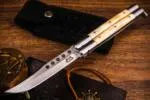 D2 Tool Steel Filipino Balisongs Butterfly Stainless Steel Bone Inserts Black Mamba Knives World Class Knives | BMK-476
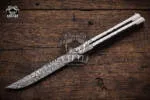 Damascus Balisong Butterfly Knife Original Traditional Filipino Butterfly Batanga Knife with Handmade Steel and Raindrop Handle Black Mamba Knives USA | DB-12
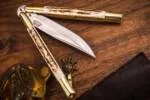 D2 Tool Steel Filipino Balisongs Butterfly Stainless Steel Dye Bone Inserts Black Mamba Knives World Class Knives | BMK-481
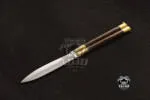 High Carbon Steel Filipino Balisongs Butterfly Brass with Ebony Wood Inserts Black Mamba Knives World Class Knives | BMK-609
 Damascus Balisong Butterfly Knife with Beautiful Wooden Handle Rain Drop Pattern Handmade Original Traditional Filipino Butterfly Batanga Knife Black Mamba Knives USA | DB-29
Check the law in your state and city before you order.
More from the workshop
1095 or D2: Two Steels We Actually Sell
The pairwise comparison the steel charts skip, from a catalogue holding 111 D2 knives and 320 Damascus.
Corporate Knife Gifts: Engraved Logo Knives for Employees and Clients
Gift ideas for employees and clients, logo engraving that survives the blade, volume tiers and the dates to order by.
Knives and Swords as Wedding Gifts: Groomsmen, Cake and Budget
Why a set of swords is usually the wrong call, what a party of eight actually costs, and the engraving rules in full.
