
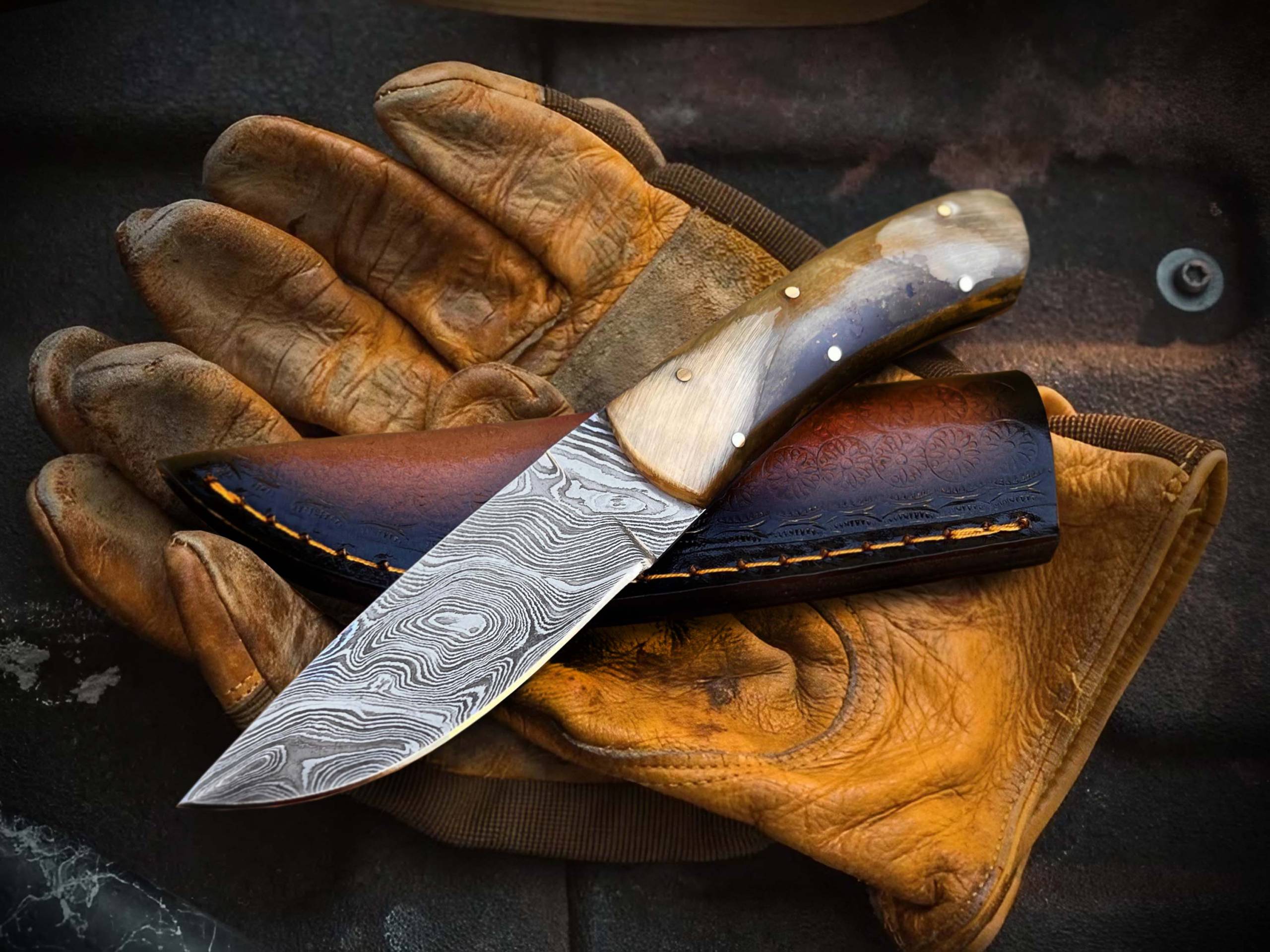
Short answer: a skinning knife trades tip for belly. The wide sweeping curve does the cutting, and the low blunt point is deliberate so you do not puncture the hide from the inside. Three to four inches of blade is plenty.
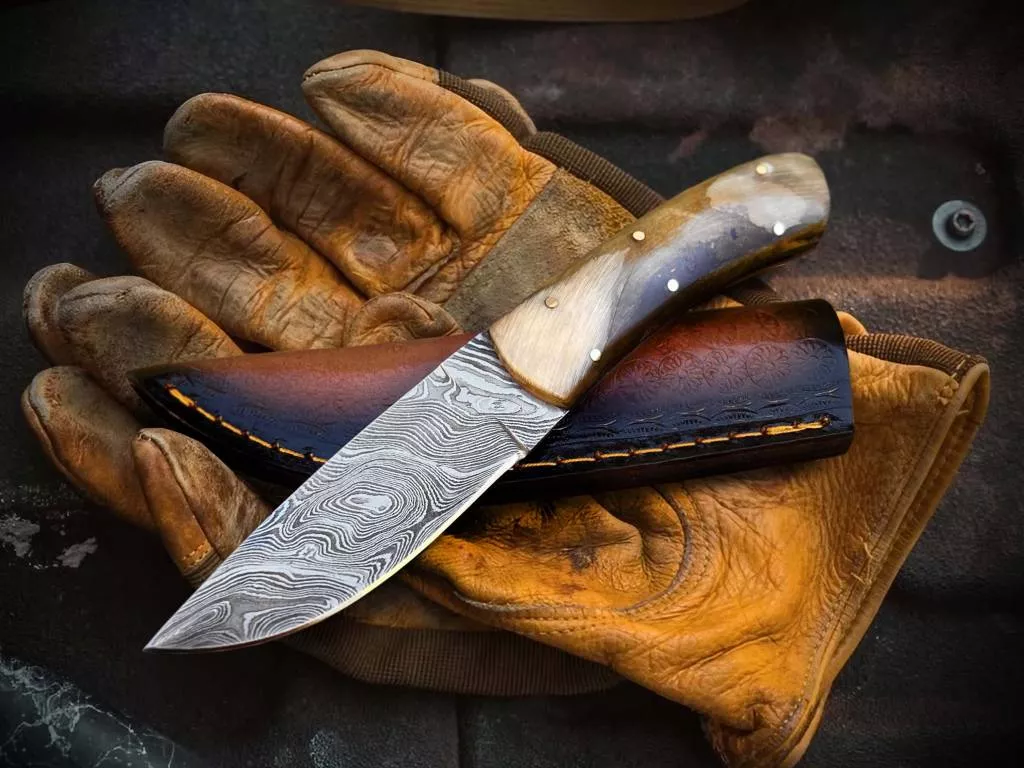
Why the shape looks the way it does
Skinning is not cutting, it is separating. You slide the edge into the thin layer between hide and muscle and pull, letting the curve of the belly do the work while your other hand keeps tension on the hide.
A pointed knife fights you in that job. The tip snags, punctures the hide, and nicks the meat. A skinner puts the useful part of the edge exactly where the work happens and keeps the point out of the way.
Blade length
Three to four inches. That is it. A longer blade gives you nothing for skinning and makes the knife clumsy on smaller animals and awkward around the legs and head.
The size you need scales with the animal much less than people expect. The same four inch skinner handles a whitetail and an elk. What changes is how often you stop to sharpen.
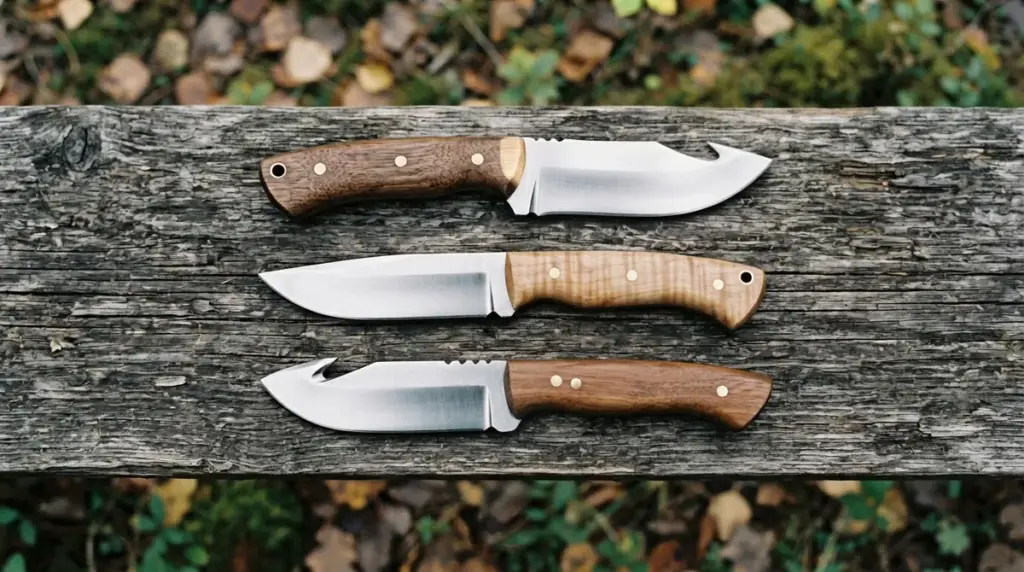
Skinner, drop point or gut hook
| Dedicated skinner | Best at the job, poor at everything else. Worth it if you take several animals a season. |
| Drop point | Skins well, and also field dresses, cuts cord and prepares food. The right answer if you carry one knife. |
| Gut hook | Opens the belly along a controlled line without the point dipping into the stomach. Worth it above a couple of animals a year. |
Handle matters more here than anywhere
Your hands will be wet, greasy and cold. That is the exact condition in which a beautiful polished handle becomes dangerous.
Micarta and textured G10 grip when wet. Stag and bone have natural texture and warm up in the hand. A smooth polished wood or a slick synthetic is the wrong choice for this one knife, however good it looks on a shelf.
A finger guard or a pronounced choil matters too, because a slippery hand sliding forward onto the edge is the most common serious knife injury in the field.
Steel and edge
Hide is abrasive and full of grit and hair. A skinning edge dulls faster than almost any other job.
Our Damascus is 1095 and 15N20 at 58 to 60 HRC. That hardness is chosen deliberately: harder holds an edge longer but chips when it meets bone, softer rolls. It also means you can bring the edge back in the field with a pocket stone rather than needing a bench setup.
If the knife lives in a wet climate or a boat, 440C stainless is more forgiving.
After the work
Wash it the same day. Blood is salty and it will pit carbon steel overnight. Dry completely, oil the blade, and never store it in the leather sheath for the off season. Full routine in the care guide.
Skinner, hunting knife and bowie: what actually differs
A skinning knife differs from a general hunting knife in four measurable ways: more belly, a faster sweep, a higher point and a shorter blade. A bowie moves all four the other way.
Belly is the curved section of edge ahead of the handle. On a drop point hunter it is a gentle arc; on a skinner knife it is close to a quarter circle, and that curve holds the edge against the hide through a whole pulling stroke. Sweep is how fast the curve turns. A fast sweep concentrates the work into a short length of edge, which is why a skinner cuts with one spot and dulls there first.
Point height is the giveaway. On a bowie the tip sits low and forward for reach and piercing. On many skinning knife designs the tip is level with the spine or above it, a trailing point, so the belly leads and the tip trails out of trouble. The old buffalo skinning knife took that furthest, and most vintage skinning knife patterns descend from it.
| Belly | Skinner, deep and fast. Hunting drop point, shallow arc. Bowie, long shallow curve into a clip. |
| Point | Skinner, high and blunt. Hunter, centred. Bowie, low and sharp for piercing. |
| Grind | Skinner, thin behind the edge to part membrane. Bowie, thicker for chopping. |
| Typical blade | Skinner 3 to 4in. Hunter 3.5 to 5in. Bowie 7in and up. |
More on the family of shapes in our blade shapes guide.
Blade length by game size, honestly
Blade length scales with the work, not the weight of the animal. An elk carries more hide than a whitetail, but the layer you separate is the same thickness: you cut for longer, not deeper.
| Whitetail and mule deer | 3 to 4in, and 3.5in is the blade most hunters keep. |
| Elk, moose, large hogs | 3.5 to 4in. Tougher hide and more of it, so sharpen more often rather than buy longer. |
| Antelope, sheep, small hogs | 3 to 3.5in. Thinner hide, less room around the legs. |
| Rabbit, squirrel, small game | 2.5 to 3in. A full size skinner is clumsy and will nick the meat. |
| Birds | 2 to 3in, where a fine point helps more than belly does. |
Over 4in is being carried for reasons other than skinning.
Gut hook or no gut hook
A gut hook earns its place if you open several animals a season. It rides under the hide, the sharpened inside edge cuts, and the stomach wall stays where it should be. That is the whole case for a skinning knife with gut hook.
The case against is honest too. A gut hook packs with hair and fat and stops cutting halfway up, and you cannot clear it with a thumb. It needs a round ceramic or tapered rod, not a flat stone. It also snags when you are caping, and it uses spine that would otherwise be plain edge.
One deer a year, dressed carefully, and a plain skinner does the same job with a finger under the hide. Five a year, and a deer skinning knife with gut hook saves real time. Some carry a separate skinning hook on the sheath instead.
The caping knife, and why small wins at the head
A caping knife is a short blade, usually 2 to 2.5in, used to take the hide off the head and neck for a taxidermist. Small wins because the work is close and unforgiving.
Around the eyes, lips, nostrils and ear bases there is almost no margin. A 4in belly cannot follow those contours, so it lifts off the bone and cuts through the cape. A short blade lets you cut with the first inch of edge and steer with your fingertips against the skull. Carry it as well as the skinner, not instead of it.
Grip when everything is greasy
Fat is a lubricant and blood is worse than water, so grip is technique as much as materials. Choke up into a pinch grip, thumb on the spine, finger against the choil. Control then comes from your wrist, and your hand stays behind the guard when the blade breaks free of a membrane. Cut edge upward from underneath where you can, and wipe the handle often.
Field dressing, in plain terms
- Position the animal so gravity helps, head uphill.
- Open the hide from sternum to pelvis, edge up, lifted on your fingers or the gut hook so the point never goes deeper than skin.
- Free the cavity contents in one piece, cutting the diaphragm round its edge.
- Roll the contents out and away rather than lifting them, blade clear of bladder and bowel.
- Drain, wipe out with a clean cloth, and prop the cavity open to cool. Cooling matters more than speed.
- Skin from the legs inward with pulling strokes, tension held by your other hand, using a fist against the membrane where the hide releases cleanly.
Methodical beats fast, with short, shallow, controlled pulls throughout.
Sharpening the sweep
A skinner is sharpened at the same angle as any other knife but with a different stroke, because a curved edge cannot lie flat on a stone. Push it straight down the stone and you sharpen the middle and round off the tip.
Sweep the handle as you go. Start with the heel on the stone and, as you draw the blade along, lift and rotate the handle so the contact point travels round the belly to the tip, one motion at even pressure. On the deep part of the curve the handle finishes noticeably higher than it started, and the burr should run the whole curve rather than the middle only. Full method in how to sharpen a knife. A round ceramic rod handles the gut hook, which no flat stone will reach.
Before it goes back in the pack
Wipe, dry, oil. Thirty seconds in the field prevents damage that takes an hour to fix at home.
Wipe blade and choil on a cloth rather than the hide, getting into the guard and the front of the handle where blood collects. Dry it, tang line included, then leave a light film of oil on the steel. A carbon steel skinning knife or hand forged Damascus spots within hours in a warm pack. Our knife oil guide covers what is safe on a blade that touches food.
Leather holds moisture and salt, so sheath the knife for the walk out and take it back out at the truck. The Damascus skinning knives we make are fixed blade, full tang, and supplied with a sheath.
Questions people ask
Do I need a separate skinning knife?
If you take one or two deer a year, no. A four inch drop point does everything. If you process several animals, yes, and you will notice the difference in your wrists.
Should the knife be full tang?
Yes. You lever against joints and put lateral load on the blade, and a partial tang is where knives break. Everything we make in a fixed blade is full tang.
How often will I sharpen during a job?
On a whitetail, once, roughly halfway. Carry a pocket stone or a ceramic rod. See how to sharpen a knife.
Looking for a working blade built for ranch duty as well as game? Our cowboy and bull cutter knives use the same skinner-friendly blade geometry with a longer working edge.
Can you sharpen a gut hook in the field?
Yes, but not on a flat stone. The inside curve of a gut hook only meets a round abrasive, so carry a tapered ceramic rod or a small round diamond file if you use a skinning knife with gut hook. Two or three light passes on each side of the inside edge is usually enough. Clear packed hair out first, or you are polishing debris rather than steel.
What is a caping knife, and do I need one?
A caping knife is a 2 to 2.5in blade for taking the hide off the head and neck without cutting through it. You need one only if the cape is going to a taxidermist. Around the eyes, lips and ear bases the margin is a few millimetres, and a 4in belly cannot follow that shape. Carry it alongside the skinner, not instead of it.
Are Damascus skinning knives practical for hunting, or just for show?
Practical, provided the pattern is forged rather than etched on. Our Damascus is 1095 and 15N20 at 58 to 60 HRC, which is a working hardness: it holds a skinning edge and still takes a pocket stone in the field. Damascus skinning knives do need drying and oiling after use, because the same carbon steels that make the pattern will rust if you leave them wet.
Carbon steel or stainless for a skinning knife?
A carbon steel skinning knife sharpens faster and comes back to a working edge with less effort, which matters when you stop halfway through an animal. It will patina and it will rust if neglected. Stainless such as 440C at 58 to 60 HRC is more forgiving in wet country, on a boat, or if the knife lives in a truck. Both skin equally well when sharp.
Is a hand forged skinning knife better than a factory one?
Not automatically. What you get from a hand forged skinning knife is control over geometry: the thickness behind the edge, the depth of the belly, the fit of the handle to your hand. Those are the things that make skinning easier. Plenty of factory knives are perfectly serviceable. Judge any of the handmade skinning knives you are looking at on grind and geometry rather than on the word handmade.
What sheath should a skinning knife have?
A fixed blade skinner wants a sheath that holds the knife with the belly covered and the handle clear, so you can draw it with a wet hand. Leather is comfortable and quiet but holds salt and moisture, so it is for carrying rather than storing. Every skinning knife with sheath should be taken out, dried and oiled once you are back, not left sheathed for the season.
Can you use a skinning knife for quartering and butchering?
For quartering, partly. The deep belly is good at separating muscle groups along their seams, which is most of the work. It is poor at anything needing a point, and it should never go near bone or a joint, because a thin skinning edge chips. Keep a stouter drop point or a small saw for that, and let the skinner do hide and seams.
Design your own skinning knife →
More from the workshop
Wootz, Crucible Steel and the History Behind the Name
Wootz, the crucible steel trade, and why modern Damascus only borrowed the name.
Fixed Blade or Folder: Which One You Should Actually Carry
Cleaning and the law decide this, not strength. Which one most people should carry.
How to Buy Knives Wholesale: Minimums, Margins and Lead Times
Order tiers, realistic lead times, duty lines and margin maths for anyone buying knives in volume.
