
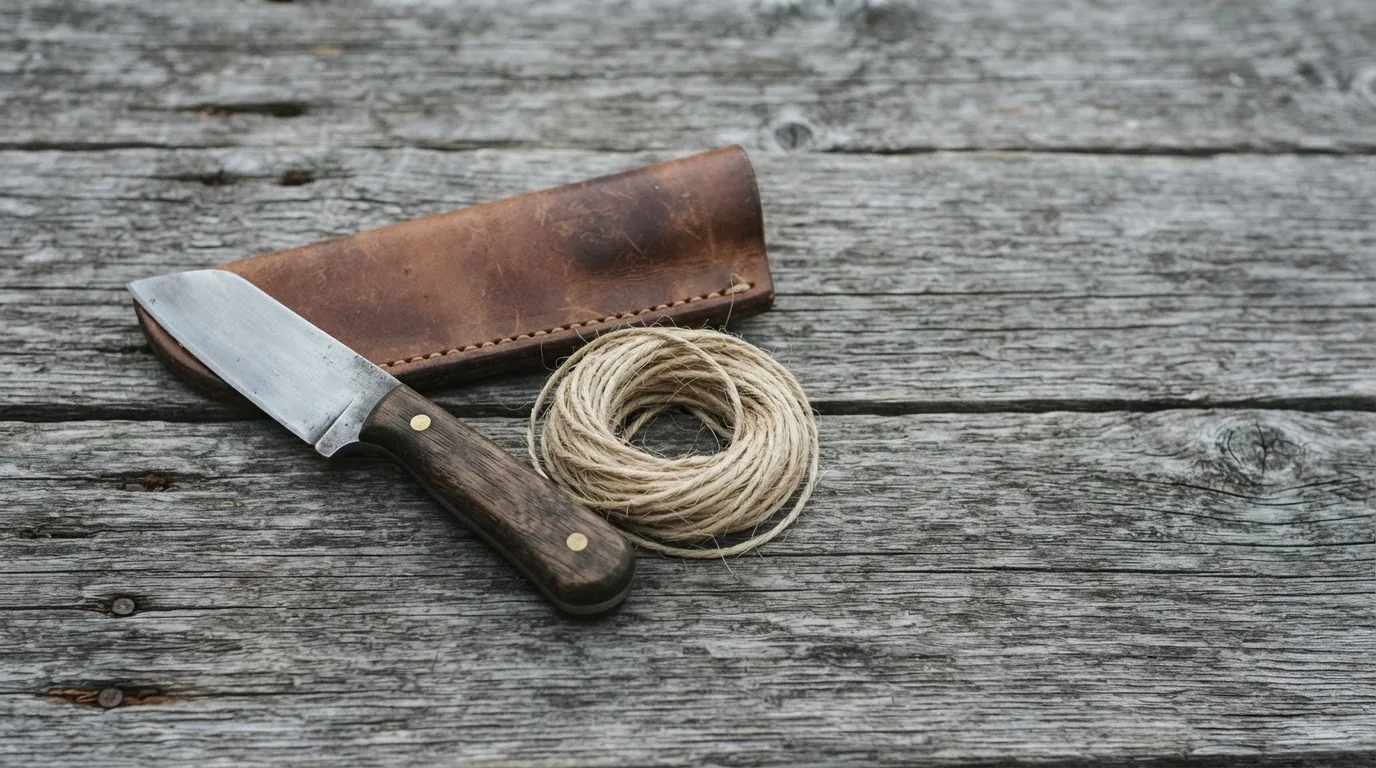
Short answer: a bull cutter is a small ranch knife with a broad blade and a rounded, almost pointless tip. The shape exists because the original job was castrating calves, where a sharp point is a hazard to the man holding the knife and to the animal. Today it is bought mostly as a general ranch and camp knife with a blade around three and a half inches. Our own thirty two listings run from $73 to $825 with a median of $94, and the ones actually built on the pattern sit between $83 and $135.
What a bull cutter actually is
The name is blunt and that is the whole problem with it. A bull cutter, sometimes sold as a cowboy bull cutter or a nutter knife, was a knife kept for marking and castrating calves. Knife people who have done the work describe it plainly. On the Bushcraft USA forum one member sums the pattern up in a sentence: "Bull cutter, for castrating calves. No point on the tip so you don't poke yourself or the animal." That is the entire design brief. Everything else about the knife follows from removing the point.
The pattern is not an isolated oddity. The spey blade, the short stubby blade with the upswept belly and the cut off tip that sits on a traditional stockman or trapper, was ground for exactly the same task. When sellers today call a knife a bull cutter, they are naming a job rather than describing a mechanism, which is why the term is so poorly defined in the market.
One more thing worth saying up front, because most sellers skip it. The men who actually did this work on a working outfit generally used whatever pocket knife was in their jeans. As one rancher put it on the same thread: "The cutters, usually the old men, use pocket knives, not custom knives." A hand forged knife with a stag handle is a beautiful object. It is not what the job historically required.
Why the tip is blunt
A pointed blade is a stabbing instrument first and a cutting tool second. In livestock work you are making shallow, controlled cuts on an animal that is moving, usually while somebody else holds it and usually in poor light. A point in that situation buys you nothing and can cost you a great deal. Take the point away and the blade can only do what you steer it into doing with the edge.
That is why the classic profile is a sheepsfoot or something very close to it: a straight edge, a spine that curves down to meet it, and a tip that is rounded rather than sharp. You get full contact along the edge for a draw cut, and you can put a finger or thumb on the spine right up near the tip without touching anything sharp. Our own bull cutters are ground as sheepsfoot blades with the tip taken off, which is the correct historical shape.
The practical consequence for a buyer is that this is a poor piercing knife and it will never be a good one. You cannot start a hole in a tarp with it, you cannot drill out a knot, and you will struggle to open a taped box by stabbing the seam. If piercing matters to you, a drop point does that work and this pattern does not.
The notched choil, and what it is really for
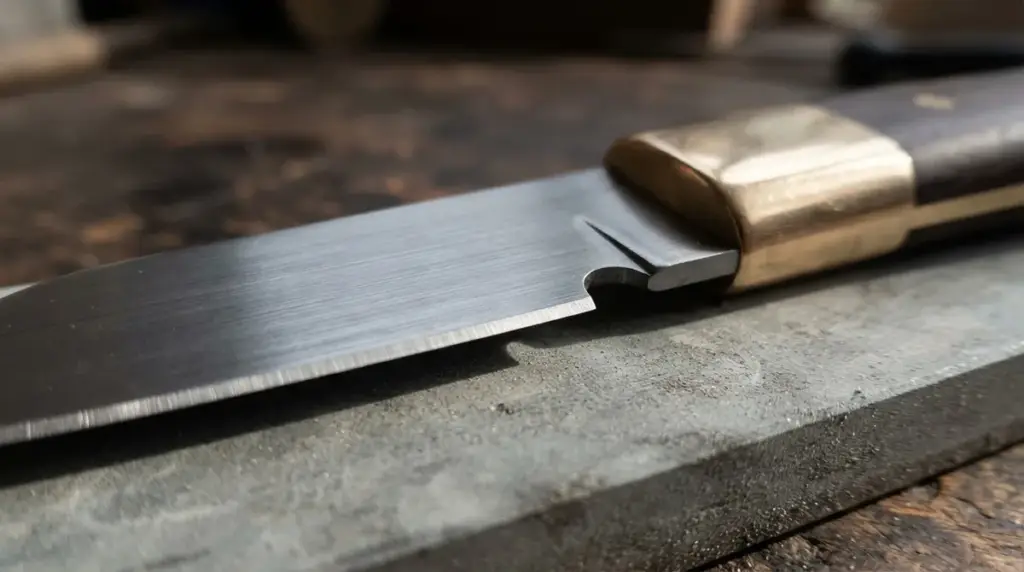
Every current generation bull cutter we build has a notched choil cut into the base of the edge, and most sellers describe it as a finger notch for choking up on the blade. That is not what it is. BLADE Magazine defines the choil as "the cut-away area between the edge and the tang of a pocketknife blade and between the edge and the guard of a straight knife," and the magazine is explicit that the main purpose is a sharpening stop. It marks where the cutting edge ends so that you can take a stone all the way to the back of the edge without running your abrasive up onto the tang or the bolster.
It does incidentally give you somewhere to put a forefinger. On a blade this short that grip is genuinely useful for fine work, and we are not going to pretend otherwise. But if a listing sells you the notch as an ergonomics feature and never mentions sharpening, the person writing that listing has not sharpened many knives. The notch matters most on the day the edge is dull, not the day you buy it.
There is a small cost to it as well. A notched choil is a place where cardboard, cord and hide will catch on a long pull. On a narrow cut with a lot of material moving past the blade you will feel it snag. That is the trade you are making for a clean sharpening stop.
Slip joint or fixed blade: what we sell and what we do not
This is the part of the page that costs us money, so here it is early. A great many people searching for a bull cutter are looking for a folder, because the traditional working pattern was a slip joint pocket knife and because the spey blade lives on folding knives. We checked our own catalogue against that expectation. Of the twenty one current generation bull cutters on the site, zero are slip joints. Every one of them is a fixed blade with a full tang and a leather belt sheath.
If a slip joint is what you came for, we do not have one in this category and we will not invent one for you. Our folding knives sit in a separate part of the catalogue, and our multi-blade patterns, which is where a genuine spey blade would live, are covered in a different guide. That is a real gap in our range and it is honest to name it.
The second thing worth knowing is that the category page itself is not clean. Thirty two products carry the bull cutter category, but eleven of those are other patterns that were filed there over the years: fixed blade hunters, skinners, a tracker, a bowie and one custom commission deposit. The pattern count that matters is twenty one. We are fixing the tagging, but on the day you read this the category will show you knives that are not bull cutters.
What thirty two bull cutters cost
Prices below are pulled from our own live catalogue rather than from a market survey. The first table is the whole category as it is tagged today. The second is the twenty one knives that are genuinely built on the pattern, which is the number you should actually plan against.
| Measure | All 32 listings in the category | The 21 true bull cutters |
|---|---|---|
| Products | 32 | 21 |
| Lowest price | $73 | $83 |
| 25th percentile | $89 | $87 |
| Median | $94 | $92 |
| 75th percentile | $108 | $102 |
| Highest price | $825 | $135 |
Read the two columns against each other and you learn something useful. The $825 top of the category is a custom commission deposit, not a bull cutter you can add to a basket. Strip the misfiled listings out and the real pattern is a tight band: eighteen of the twenty one sit between $83 and $108. If somebody quotes you $300 for a bull cutter, they are charging you for the handle material, not for the knife.
Steel in our own bull cutter rack
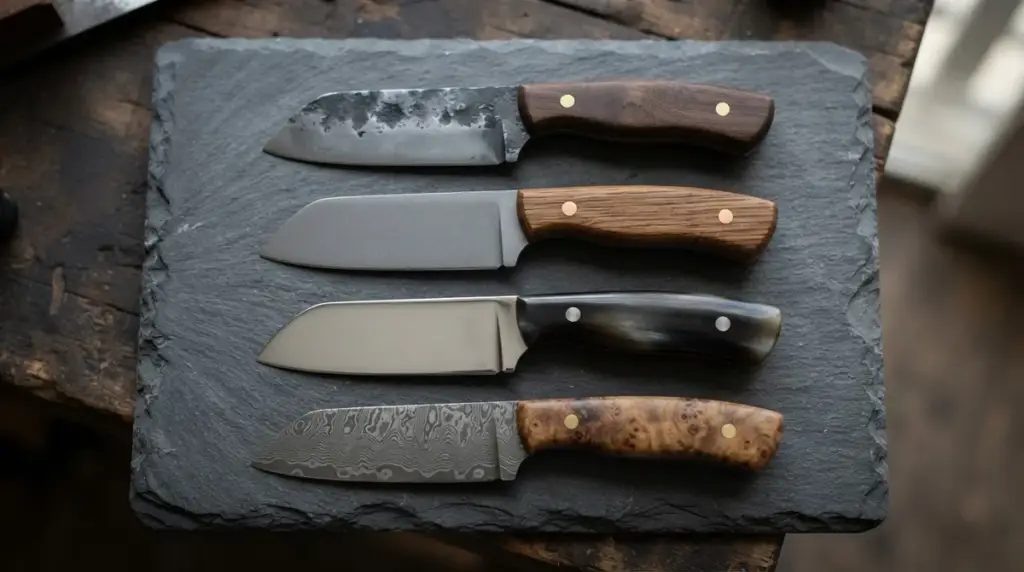
Four steels appear across the twenty one. The counts and the hardness figures we hold to are below. We publish hardness as a range because that is what heat treating a batch by hand actually produces.
| Blade steel | Knives | Hardness we hold to | Corrosion behaviour | Price span |
|---|---|---|---|---|
| D2 tool steel | 9 | 58 to 62 HRC | Semi stainless. Will spot if left wet, far slower than carbon | $86 to $130 |
| High carbon steel | 4 | Not published per batch | Will patina and will rust if neglected | $83 to $92 |
| High carbon spring steel | 4 | Not published per batch | Tough, flexes rather than chips, rusts readily | $84 to $92 |
| Damascus, 1095 and 15N20 | 4 | 58 to 60 HRC | Carbon based. The etch itself is a rust risk if stored damp | $102 to $135 |
For a knife that lives in a truck or a barn, D2 is the sensible pick and it is also the most common steel in our rack, which is not a coincidence. Damascus on a working bull cutter is a decorative choice. The pattern is real, the layers are real, and the steel is genuinely 1095 and 15N20, but the etched surface is a carbon steel surface and it will show every drop of blood and every wet afternoon you leave on it. Buy Damascus here because you want to look at it, not because you think it cuts better.
Note the honest gap in that table. We publish a hardness range for D2 and for our Damascus because those heat treats are controlled and repeatable. We do not publish a per batch hardness figure for the plain high carbon and spring steel blades, and we are not going to guess one to fill a cell. If a competitor gives you a single confident number for a hand forged carbon blade, ask them how it was measured.
Handle materials, and which ones survive a ranch
The twenty one break down into five material families. This is where nearly all of the price spread comes from.
| Handle family | Knives | Examples in our range | How it behaves in real use |
|---|---|---|---|
| Wood | 10 | Oak, walnut, walnut burl, rosewood, ebony, olive burl | Warm and grippy dry, slick when wet or bloody. Needs oil once or twice a year |
| Micarta | 5 | Canvas micarta in olive, desert tan, burgundy, black and orange | The most weatherproof option here. Grips better wet than dry |
| Horn, bone and antler | 5 | Buffalo horn, ram horn, stag antler, camel bone | Handsome and traditional. Moves with humidity and can crack if it dries out |
| Mother of pearl | 1 | A single genuine pearl handled model | Chips under impact. This is a collector handle, not a work handle |
If the knife is going to a working ranch, buy micarta and accept that it looks like a tool. If it is going in a display case or a gift box, the horn and antler models are the ones people react to. The pearl model is the most beautiful knife in the group and the worst possible choice for anything involving a fence post.
Size, and why 7.5 inches keeps coming up
Twenty of the twenty one measure 7.5 inches overall with a 3.5 inch blade and a 4 inch handle. One is a shorter build at 7 inches overall with a 3 inch blade. That consistency is deliberate on our side and it is worth understanding before you order.
A 3.5 inch blade is long enough to break down a bale, cut hoof trimmings, open feed sacks and handle small game, and short enough to stay legal to carry in most of the United States where blade length caps exist. A 4 inch handle is the shortest handle that a large hand in a glove can still hold in a full grip. Go shorter and the pattern turns into a caping knife. Go longer and it stops being a pocketable ranch tool.
The flipside, and this is the inconvenient version, is that you are not choosing between different knives when you shop our bull cutters. You are choosing a steel and a handle on the same blade. If you need a different geometry, this category will not give it to you.
What a bull cutter is genuinely good at
Away from livestock the pattern earns its keep on anything that involves cutting on a surface you do not want to damage. A straight edge with no point sits flat, so you can cut baling twine against a hand, slice open a feed sack against a knee, trim a hoof, cut tape off a package on a tailgate, or board a rope without digging into whatever is underneath.
It also happens to be one of the safest knives to hand to somebody who is not experienced with blades. There is no point to drive into a palm on a slip.
What it is bad at
Piercing, as covered. Also detail work near a tip, because there is no tip: caping around an eye socket or trimming a fine seam wants a drop point or a clip. It is a mediocre skinning knife because the belly is shallow and the point that would let you get under a hide is gone. Batoning is possible on the full tang models but the blade is short and the handle is short, so a hatchet does that job better.
And one plain warning, since we sell these. If you actually intend to castrate livestock, a decorative Damascus knife is the wrong instrument. That is a veterinary procedure with real welfare and infection consequences, purpose made and sterilisable tools exist, and the correct advice is to use them and to talk to a vet. We sell a pattern named after a job. We are not telling you to do the job with it.
Sharpening a sheepsfoot edge
Straight edges are the easiest geometry in the knife world to sharpen and the easiest to ruin. Because there is no belly to sweep through, you do not roll the knife at all. You lay the whole edge flat on the stone and push, keeping the angle constant from the choil to the end of the edge.
Two mistakes account for most damaged bull cutters. The first is lifting the handle at the end of each stroke as if you were sharpening a drop point, which grinds a false belly into a blade that is supposed to be dead straight. The second is stopping short of the choil, which leaves a dull heel that then makes every draw cut feel worse than it is. Take the stone into the notch. That is what the notch is there for.
On D2 you want a diamond or a good ceramic. D2 has enough carbide volume that a soft natural stone will glaze before it bites. On the carbon steels and the Damascus a standard waterstone is fine, and both take an edge quickly, and both want oil on the blade afterwards.
Questions people ask
What is a bull cutter knife used for?
Originally for castrating and marking calves, which is why the tip is rounded off. Today most buyers use it as a general ranch, farm and camp knife: twine, feed sacks, tape, hoof trimmings, rope and food prep. It is a cutting knife, not a piercing knife.
Why does a bull cutter have no point?
Because a point is a hazard in the job the pattern was ground for. Working around a moving animal, a sharp tip can injure the handler or the animal without adding any cutting ability. Removing it turns the knife into a pure edge tool.
Is a bull cutter the same as a spey blade?
They were ground for the same job but they are not the same object. A spey is a short blade on a folding stockman or trapper with an upswept belly and a cut off tip. A modern bull cutter, including ours, is usually a fixed blade sheepsfoot. The link is the task, not the shape.
Are your bull cutters slip joints?
No. All twenty one current generation bull cutters on this site are fixed blade, full tang knives with a leather belt sheath. We do not currently make a slip joint bull cutter. If a folder is what you want, look at our folding pocket knives instead.
How much should a bull cutter knife cost?
Across our own catalogue the median is $94 and the true pattern knives run $83 to $135. Eighteen of the twenty one sit between $83 and $108. Above roughly $150 you are paying for handle material or for Damascus, not for a better cutting tool.
What is the notch at the back of the blade for?
It is a choil, and its documented purpose is a sharpening stop so the edge can be taken all the way to the tang without the stone riding up on the bolster. It doubles as a forefinger rest for fine work. It will occasionally snag cord or cardboard on a long pull.
Which steel should I pick for a working knife?
D2 for anything that lives outdoors, because it is semi stainless and holds an edge well at 58 to 62 HRC. Damascus at 58 to 60 HRC cuts perfectly well but the etched carbon surface needs wiping and oiling. Nine of our twenty one are D2, which reflects what people actually buy for use.
Is a Damascus bull cutter better than a plain one?
Not functionally. Our Damascus is genuine 1095 and 15N20 and it takes a fine edge, but it is a carbon steel that will spot if you put it away wet. You are buying pattern and appearance. A D2 blade at $86 will do the same work with less maintenance.
How long is a typical bull cutter blade?
Ours are 3.5 inches on twenty of the twenty one, with one shorter model at 3 inches. Overall length is 7.5 inches with a 4 inch handle. Blade length caps vary by state and city, so check your local rule before you carry one.
Can I use a bull cutter for skinning?
You can gut and quarter with one at a push, but it is not the right tool. Skinning wants belly and a usable tip to work under hide. A dedicated skinner will be faster and cleaner. The bull cutter is better on the twine and the tarps than on the animal.
More guides. Multi-blade pocket knives, where the spey blade actually lives, full tang and partial tang explained, blade shapes and what each one is for, how to sharpen a knife, and the cowboy bull cutter category itself.
More from the workshop
Knife Steel Chart
Four properties that fight each other. Improve one and you give up another.
San Mai and Damascus: Two Different Laminates
A three layer core and jacket against a stack of hundreds, and what each one really does.
Starting a Knife Collection Without Wasting Money
Four knives, one rule, a budget that holds, and the truth about resale value.
