
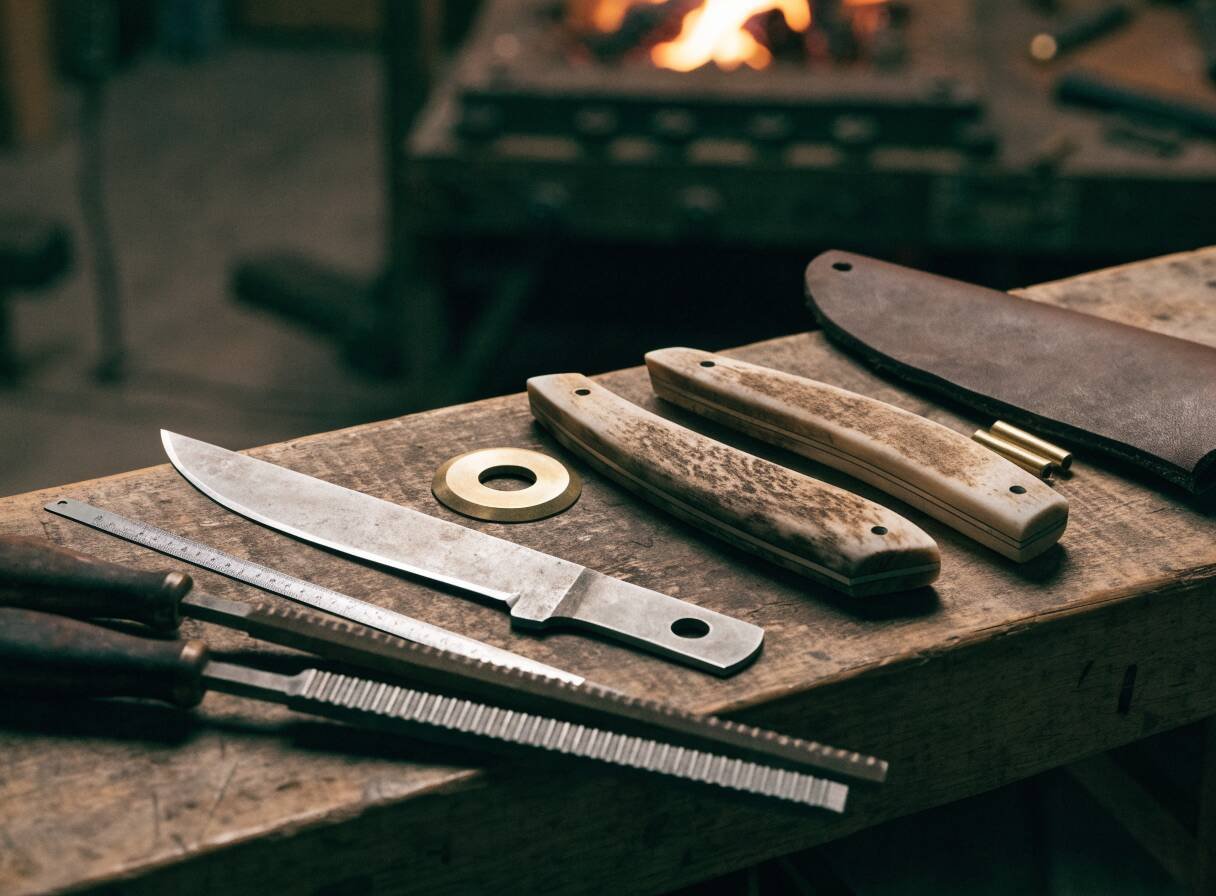
A hunting knife earns its keep on maybe four days a year, and on those four days nothing else will do instead. Build the one that suits how you actually hunt.
Start with the profile. A drop point is the knife you reach for if you only own one. A skinner has the long sweeping belly that does the job in half the strokes. A gut hook opens without piercing, which matters more than it sounds. Then pick your steel, your handle, and the sheath that will carry it on your belt for the next thirty years.
1. Blade profile
What the knife has to do decides this more than looks. A skinner sweeps, a drop point does everything, a gut hook opens without piercing.
2. Handle style
The shape decides how the knife sits in your hand after an hour of work. Straight suits most people, grooves lock the grip in.
3. Guard and bolster style
How the front of the handle meets the blade. A guard stops your hand sliding forward onto the edge, a bolster adds weight and balance.
4. Blade steel
Carbon steel takes the keenest edge and asks you to look after it. Stainless forgives neglect. Damascus is folded carbon steel, so it behaves like carbon.
5. Blade length
Measured from the guard to the tip. Four and a half inches covers most hunting work.
6. Blade finish
7. Handle material
Every scale is cut, fitted and finished by hand, so no two are identical.
8. Guard material
9. Pins
10. Sheath
Cut and stitched to your finished knife, not to a template.
11. Engraving
A name, a date, coordinates, a callsign. Pick one and a text box appears.
12. Packaging
13. Leather Color
For any leather sheath included in your build.
14. How many?
Order 10 or more and a bulk discount is applied automatically.
15. Anything else (optional)
Ten or more - tell us what you need
Corporate gifts, groomsmen sets, restaurant kit. We quote by hand: unit price drops with volume and engraving is set up once for the whole run.
Cannot find it in the list? Design it yourself.
Pick a starting shape, move the sliders and watch the knife redraw with real measurements. Send it over and we quote it by hand.
Choosing your steel, honestly
Carbon steel takes the keenest edge of anything here and it will go grey and then brown over a season. Hunters who like that call it a patina and let it happen, because that same darkened surface protects the steel underneath. If you would rather not think about it, take stainless. It is not a lesser knife, it is a different bargain.
Damascus is folded carbon steel. It behaves like carbon steel, patinas like carbon steel, and the pattern is what you are paying for. It is not harder or sharper than a plain carbon blade from the same bar, and anyone who tells you otherwise is selling.
What we would build
If someone walked into the shop with no fixed idea, this is what we would talk them into: a four and a half inch drop point in 1095, a stonewash finish so field scratches disappear, stag or micarta scales, brass pins and a plain leather belt sheath. It comes out around two hundred dollars, it will outlive you, and there is nothing on it that can fail in the cold.
Questions people ask first
Full tang or hidden tang?
Every fixed blade we make is full tang unless you ask otherwise. The steel runs the entire length of the handle. It is heavier and it is the reason these knives get handed down instead of replaced.
How sharp does it arrive?
Shaving sharp, finished by hand on stones. We do not ship a knife that needs work before you can use it.
Can I get a left-handed sheath?
Yes, at no extra cost. Put it in the notes box and the sheath is cut and stitched the other way round.
Will the handle material hold up in the wet?
Micarta and pakkawood do not care about water at all. Stag, horn and oiled hardwoods want drying and an occasional wipe of oil, the same as any natural material. All of them last decades if you do that.
What is the difference between a skinner and a drop point?
A skinner has a longer curved belly and a tip that stays out of the way, so it separates hide without nicking through. A drop point does that job slightly less well and everything else considerably better.
Please check your local law before ordering.
- You uploadUp to 5 pictures and your instructions.
- You pay $50A refundable deposit. It puts your brief in the queue.
- We quoteA written price, steel, size and lead time, inside two working days.
- You decideGo ahead and the $50 comes off. Say no and it is refunded.
- It is a review deposit, not a payment for a knife. Nothing is ordered yet.
- If you approve our quote, the full $50 is taken off the price of the build.
- If we cannot agree on price, or we do not think we can make it properly, or you simply change your mind, it is refunded in full to the card you paid with.
- We will not copy another maker’s trademarked design or anything we are not allowed to forge. If that is what the picture shows, we will say so and refund you.
Your pictures are only ever seen by our shop. Please check your local law before ordering.
