
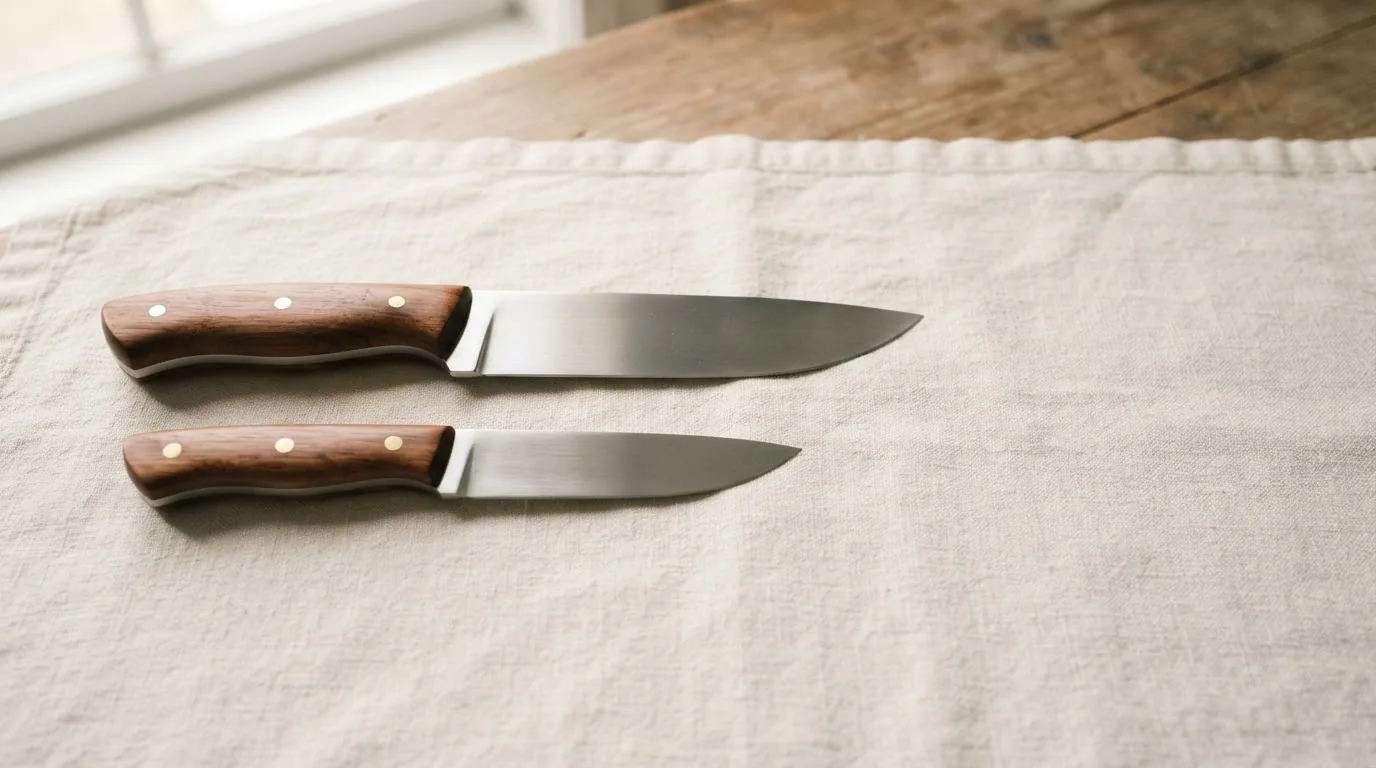
Short answer. Buy two knives that fit two different hands, not one design in two colours. The measurement that actually differs between most couples is handle length and grip circumference, not blade length, and the average difference is smaller than the knife industry pretends. Pair by what each person will cut and how big their hand is, then unify the pair with a shared handle material or finish. And know this before you start: we do not sell a matched pair as a single item, and two hand forged Damascus knives will never have the same pattern, so a truly identical pair is not a thing anyone can sell you.
What "matching" should actually mean
There are three honest ways to make two knives belong together and only one of them involves them being the same.
Matched by material. Two different knives that share a handle material, a hardware colour and a sheath. This is the one that works. The pair reads as a set on a shelf and each knife suits its owner.
Matched by function. Two knives that do the same job at two different sizes. A pair of drop point hunters, one with a 3 inch blade and one with a 4 inch. Same tool, correctly scaled.
Matched by being identical. Two of the same product. This is what "his and hers" usually means in practice and it is almost always the wrong answer, because it takes a knife sized for one person and gives it to two people.
The rest of this page is about avoiding the third option without ending up with two knives that look like they came from different shops.
The problem with "his and hers"
The standard his and hers knife set is one design produced in two finishes, usually a darker one and a lighter one, at one size. That solves a photography problem, not a fit problem. The two people holding those knives will very often have hands that differ by enough to matter, and the set has ignored it.
The opposite failure is just as common: a "ladies" knife that has been shrunk in every dimension at once. Shorten the handle by an inch and the blade by an inch and you have not made a knife for a smaller hand, you have made a smaller knife, which is a different thing. A smaller hand needs a shorter, slimmer handle. It does not necessarily need a shorter blade, because the blade length is set by what you are cutting, not by who is holding it.
That distinction is the single most useful idea on this page, and it is the reason a well chosen pair often has two similar blades on two quite different handles.
What the hand measurements actually say
The most widely cited anthropometric figures for adult hands come from NASA data. They are averages, so they tell you about a population and not about your partner, but they set the scale of the difference.
| Measurement | Average adult man | Average adult woman | Difference |
|---|---|---|---|
| Hand length, wrist crease to middle fingertip | 7.6 in | 6.8 in | 0.8 in |
| Hand breadth across the knuckles | 3.5 in | 3.1 in | 0.4 in |
| Hand circumference around the palm | 8.6 in | 7.0 in | 1.6 in |
Read those three rows in order and the pattern is clear. Length differs by less than an inch. Breadth differs by less than half an inch. Circumference, which is the measurement that decides how thick a handle can be before the fingers stop meeting the palm, differs by more than an inch and a half. That is more than twice the length difference.
Which tells you where to spend your attention. If you are choosing between two knives for two people, the thickness and girth of the handle will make more difference to how each knife feels than any other single dimension. A handle that a large hand finds comfortably filled will feel like a rolling pin to a small one, and a handle that a small hand wraps neatly will feel like a pencil to a large one.
The other honest point: these are averages across a whole population, and the variation within each group is far larger than the gap between them. Plenty of women have larger hands than plenty of men. Measure the two hands you are actually buying for. It takes thirty seconds with a tape measure and it makes every other decision on this page easier.
Handle length is the variable, not blade length
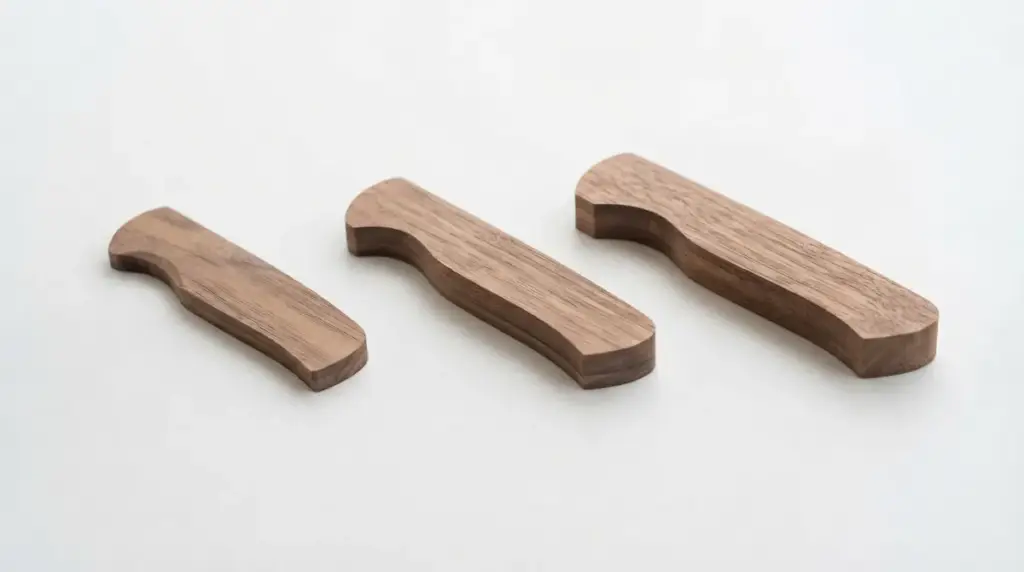
A useful working rule from knifemaking practice: a fixed blade handle should be at least as long as the hand is broad across the knuckles, plus enough to keep the little finger on the handle rather than hanging off the end. For an average adult woman that lands around 3.5 to 4 inches. For an average adult man it lands around 4 to 4.75 inches. Above that you are into two handed or chopping territory, and below it the grip loses the last finger, which is the one that stops a knife rotating.
Blade length, by contrast, is set by the job. A knife for opening parcels and cutting cord wants 2.5 to 3 inches whoever is holding it. A hunting knife that has to reach through a body cavity wants 4 inches whoever is holding it. Scaling a blade down for a smaller hand does not make the knife easier to use, it makes it worse at the task while leaving the actual fit problem, which is in the handle, completely unaddressed.
So a good pair often looks like this: two blades of similar length, on two handles that differ by half an inch to an inch, in the same material.
What our own two ranges measure
We pulled these numbers out of our own product database on 30 August 2026. Handle length here is calculated as published overall length minus published blade length, so it includes the small amount of tang covered by the bolster where there is one.
| Range | Products | Handle length, shortest to longest | Median handle | Blade length band | Price low, median, high |
|---|---|---|---|---|---|
| Women's knives | 20 | 3.25 in to 4.25 in, measured on 14 of them | 4.0 in | 2.75 in to 3.75 in fixed, 2.9 in to 3.05 in folders | 77, 114, 265 dollars |
| Hunting knives | 133 | 3.0 in to 7.0 in, measured on 124 of them | 5.0 in | Wide, mostly 3 in to 8 in | 73, 201, 938 dollars |
| Folding pocket knives | 111 | Folder handles are the closed length, not comparable | Not comparable | 1.5 in to 7 in, median 3.0 in, measured on 95 of them | 70, 128, 845 dollars |
Two things fall out of that table that we would not have guessed before running it.
The first is that the median handle difference between our women's range and our hunting range is exactly one inch. That is larger than the average difference in hand breadth, which was 0.4 inches, and larger than the average difference in hand length, which was 0.8 inches. In other words, our two ranges are separated by slightly more than the anthropometry justifies. If you have a hand at the larger end of average for a woman, a knife from our hunting range may well fit you better than one from our women's range, and nothing about the category names will tell you that.
The second is that blade lengths overlap almost completely. Our women's fixed blades run 2.75 to 3.75 inches. The median folder blade across the whole site is 3.0 inches. The blade is not what makes a knife a "ladies" knife in our catalogue. The handle and the finish are.
Four ways to pair two knives
Each of these is built from two separate products. Prices are the bands the ranges sit in as of 30 August 2026 and will move.
| Pairing | What to buy | Rough pair budget | Who it suits |
|---|---|---|---|
| Same job, two handle sizes | Two drop point fixed blades in the same handle material, one with a handle around 4 in and one around 5 in | 150 to 200 dollars | Couples who both spend time outdoors. The most useful pairing on this list |
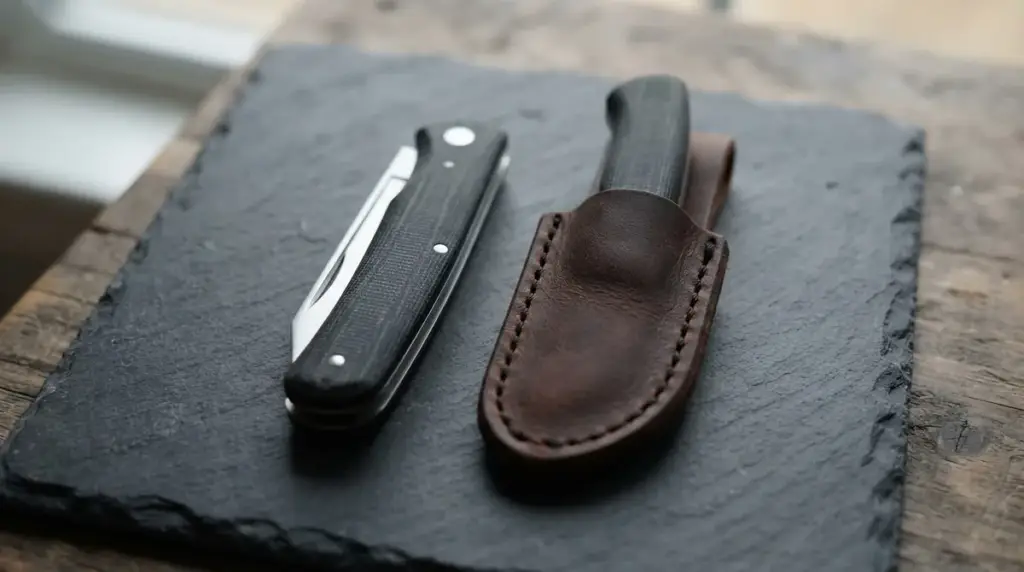
| Two jobs, one look | A folder for the person who carries every day, a fixed blade for the one who does not, matched on handle material | 150 to 320 dollars | Where only one of the two actually wants a knife on them daily |
| Kitchen pair | Two kitchen blades of different lengths that cover different tasks, in one handle material | 180 to 300 dollars | Couples who cook together. Two identical chef knives is the classic wasted gift |
| One nice, one useful | A collector or display piece for one, a working knife for the other | Anything upwards of 160 dollars | When the two people want genuinely different things and pretending otherwise helps nobody |
Start from our women's knives and folding pocket knives and filter by handle material first, then by size, then by price. Filtering by price first is how people end up with two knives that do not match and do not fit.
Matching the look without matching the knife
Handle material is the strongest visual link between two different knives, stronger than blade shape and much stronger than price. Two knives in the same rosewood, with the same brass pins, read as a pair even if one is twice the size of the other.
Hardware colour is the second lever. Our knives come with stainless screws or gold coloured stainless screws, and pins in brass, steel or mosaic. Getting those to agree across two knives is worth more visually than getting the blades to agree.
Then there is the thing that cannot be matched, and this is the part a shop selling 320 Damascus knives has to be straight about. No two hand forged Damascus blades have the same pattern. Every billet is folded separately and the pattern that emerges is a consequence of that particular billet and that particular grind. Two Damascus knives from the same batch will be recognisably the same family and visibly different individuals. If you want two blades that look identical, do not buy Damascus. Buy two knives in a plain steel with a consistent finish, such as a stone washed D2, where the two really will look the same.
What to check before you buy two
- Measure both hands across the knuckles and around the palm. Write the two numbers down. Every decision afterwards gets easier.
- Decide what each person will actually cut. Not what they might. Blade length follows from the task.
- Check the published handle length rather than the overall length. If a listing gives only overall and blade, subtract.
- Pick the handle material first if you want the pair to look like a pair.
- Check whether both will carry it. A fixed blade needs a belt and a sheath. A folder needs a pocket. A knife nobody carries is an ornament.
- Check the law where both people live and travel. Rules on blade length, lock type and carry differ by state and by country, and giving somebody a knife they cannot legally carry is an awkward gift. Please check your local law before ordering.
Budgets, honestly
Across our catalogue the floor is 55 dollars and the median product is 155 dollars, so a sensible pair budget starts around 150 dollars and there is no upper limit worth naming. The useful thing to know is where the money stops buying fit and starts buying decoration.
Below roughly 150 dollars for the pair you are choosing from a narrow set and you will probably have to compromise on either fit or matching. Between 150 and 350 dollars for the pair you can have both, choosing two knives with the right handles in a shared material. Above that you are buying pattern, handle exotics and finish, which are real things to want but which do not make either knife fit better.
One more piece of arithmetic worth doing before you buy. Two knives at 90 dollars that both fit will be used. One knife at 180 dollars that fits and one at nothing will be used half as much. Splitting a gift budget evenly across two people is usually better than concentrating it, and we say that knowing perfectly well that it argues for a smaller order.
Buying a pair from us, specifically
We do not have a matched pair as a stock item. There is no "his and hers" product to add to a basket. If you want two knives from us you buy two knives, and the pairing is something you do rather than something we sell you. That is a genuine gap in our range and we would rather say so on this page than let you search the site for something that is not there.
What we do have is 20 knives in the women's range from 77 to 265 dollars, 111 folders from 70 to 845 dollars, and 133 hunting knives from 73 to 938 dollars, which between them cover every pairing described above. If you want help choosing two that go together, our guide to knives for smaller hands is the best starting point for the fit question.
Questions people ask
What is the best matching knife set for a couple?
Two different knives that share a handle material and hardware, sized to each person's hand. An identical pair is easier to buy and worse to own, because one of the two knives will be the wrong size for its owner. Pair by hand and by task, then unify the look.
Should a woman's knife have a shorter blade?
Not necessarily. Blade length is set by what you are cutting. Handle length and thickness are what should change with hand size. Shrinking the blade as well is a common mistake that makes the knife worse at its job without improving the fit.
How do I know what handle length fits a hand?
Measure the hand across the knuckles. The handle should be at least that long, plus enough for the little finger to stay on it rather than hanging over the end. For most adults that means around 3.5 to 4 inches for smaller hands and 4 to 4.75 inches for larger ones.
Can you get two Damascus knives with the same pattern?
No. Every hand forged billet is folded separately, so every blade has a unique pattern. Two knives from the same batch will look like relatives, not twins. If you want two blades that genuinely look identical, choose a plain steel with a consistent finish instead.
Is a knife an appropriate gift for a partner?
For most people yes, and it is a common wedding and anniversary gift. Some people are superstitious about giving blades and traditionally include a coin so the knife is nominally bought rather than given. Whether that matters is a question about the person, not about the knife.
Do you sell a his and hers knife set?
No. We do not have a matched pair as a single product. You buy two knives and pair them yourself, which this page is written to help with. It also means you can size each one properly, which a fixed set would not let you do.
What should a pair of knives cost?
Across our catalogue the floor is 55 dollars and the median product is 155 dollars, so a realistic pair budget starts around 150 dollars. Between 150 and 350 dollars for the two you can get correct fit and a shared look. Above that you are paying for pattern and handle materials rather than fit.
Are folding knives or fixed blades better for a couple?
It depends entirely on whether each person will carry one. A folder gets carried and used; a fixed blade mostly gets used where it is stored. A mixed pair, one folder and one fixed blade in the same handle material, is often the most honest answer.
What handle material should we choose for a pair?
Whichever one you both like, because material is the strongest visual link between two different knives. Wood and bone look warmer and need a little more care. G10 and micarta are chemically indifferent and shrug off water. Consistency across the two knives matters more than which one you pick.
Can we buy two knives that match but in different sizes?
Yes, and it is the pairing we would recommend first. Two knives of the same type and material with handles differing by half an inch to an inch will look like a set and fit two different hands. It is more work to assemble than clicking one product, and it is the reason this page exists.
More guides
For the fit question in detail, read choosing a knife for smaller hands. If this is a present, our knife gift guide covers what actually gets used. Knife blade shapes explains why blade length follows the task, and how to choose an EDC knife helps if only one of you will carry daily. The two ranges to start from are women's knives and folding pocket knives.
If you want a pair that reads as a set without being identical, the pride knives are poured resin, so two knives out of the same batch never run their colours in the same order.
More from the workshop
Engraving a Knife: What Works and What Ruins the Blade
What engraving costs, what fits in 20 characters, and why the handle beats the blade.
Steak Knives: Serrated, Straight and What a Forged Set Costs
Straight edge against serrated, how many you need, and the real arithmetic of a forged set of four.
Balisong History and Origins
Batangas, the disputed origin, what balisong really means, and how to tell a traditional knife from a modern one.
