
Short answer: carbon steel takes a keener edge and sharpens far more easily. Stainless resists rust and forgives neglect. For a kitchen knife the honest answer is that carbon is better to cut with and stainless is better to own, and which one suits you depends entirely on whether you dry your knives.
What the word stainless actually means
Stainless steel contains at least around 11 per cent chromium. The chromium forms an invisible oxide layer on the surface that blocks moisture from reaching the iron underneath. That is the whole trick.
It means rust resistant, not rustproof. Leave a stainless knife wet in a sink overnight, or in salt air, and it will spot. It simply takes far more neglect to get there.
Why carbon steel cuts better
Chromium is added for corrosion resistance, and it forms large hard carbides in the steel. Those carbides are excellent for wear resistance and they are the reason stainless is harder to sharpen: you are grinding through them.
A simple carbon steel like 1095 has a finer, more uniform grain. It takes a thinner, keener edge, and it takes it quickly. You can bring a carbon blade back to shaving sharp on a stone in a couple of minutes; a hard stainless takes longer and wants better stones.
The trade is obvious: nothing is protecting the iron.
The patina, and why not to fight it
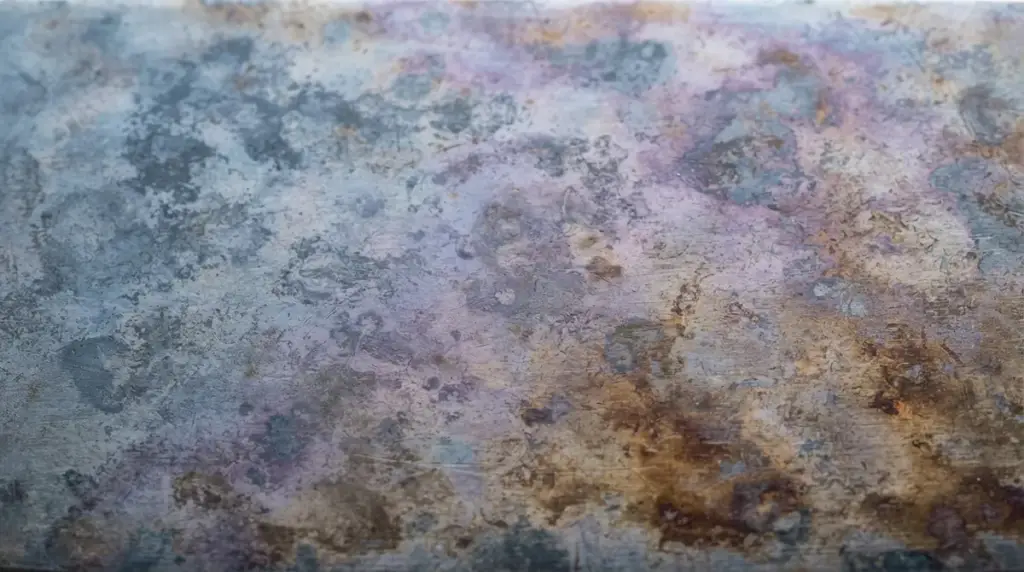
Use a carbon blade on onions, tomatoes and citrus and it goes grey, then blue-grey, then almost black in patches. That is a patina, and it is protective. It is a stable oxide layer that slows further corrosion.
Do not scrub it off. Orange rust is a problem; grey patina is the knife doing its job. Some cooks force a patina deliberately with vinegar or mustard on a new blade.
Which one for your kitchen
| Take carbon if | You wash and dry knives as you go, you sharpen your own, and you want the finest edge available. |
| Take stainless if | Knives sometimes sit in the sink, other people use them, or you live somewhere humid or coastal. |
That is the real decision, and it is about habits rather than about steel.
Where Damascus sits
Our Damascus is 1095 and 15N20 forge welded, both carbon steels, hardened to 58 to 60 HRC. It behaves like carbon steel: superb edge, easy to sharpen, and it will patina and can spot if stored wet.
The 15N20 carries about two per cent nickel, which resists the acid etch and is what makes the bright layers in the pattern. It does not make the blade stainless.
If you want the pattern with more corrosion resistance, our 440C and D2 kitchen blades are the practical compromise. D2 is technically semi-stainless at around 12 per cent chromium and sits neatly between the two.
Caring for a carbon kitchen knife
It is genuinely easy, it is just a habit. Wipe the blade during prep if you are working with acidic food. Wash and dry immediately after use, never leave it in the sink, never put it in a dishwasher, and wipe a little food grade mineral oil on it if it is going away for a while. See the knife oil guide.
Carbon steel vs stainless steel knife: the answer for any blade, not just kitchen ones
Across every knife type, a carbon steel vs stainless steel knife comes down to one trade: carbon steel sharpens faster and takes a keener edge, stainless steel survives moisture and neglect. Everything else is detail.
The kitchen is only one setting. The same choice turns up in a pocket knife you carry daily, a hunting knife used wet, a bushcraft blade asked to baton wood, and a collection piece that sits in a drawer. Whether you want a carbon or stainless steel knife depends less on which steel is better and more on where the knife lives and how much maintenance you will genuinely give it.
Put the other way round, stainless steel vs carbon steel knife is a question about your habits and your climate. Neither material wins on paper.
Property by property
The carbon vs stainless steel knife comparison reads better as properties than as a verdict. Each line is a generalisation across the two families, and individual steels move within it.
| Edge retention | Set by hardness and carbide content rather than by the carbon or stainless label. High carbide stainless and tool steels usually stay usable longest; simple carbon steels get sharper first but need touching up sooner. |
| Toughness | Simple carbon steels are generally tougher and less prone to chipping. Big carbide stainless tends to be more brittle at the same hardness. |
| Ease of sharpening | Carbon wins clearly. A basic stone brings it back quickly. Hard stainless needs better abrasives and more patience. |
| Corrosion resistance | Stainless wins clearly, and it is the only category where the gap is not arguable. |
| Cost | Carbon steel is cheaper as raw stock and more forgiving to forge and heat treat, so a carbon blade of a given quality usually costs less. |
| Maintenance | Carbon needs a routine: dry it, oil it, do not store it wet. Stainless tolerates being forgotten, up to a point. |
If you want the same information across a wider range of alloys, the knife steel comparison sets them side by side.
The steels themselves
Labels matter less than the specific alloy in your hand. These are the ones you will actually meet.
Carbon steels. 1095 is the classic: fine grained, very easy to sharpen, tough enough for most work, and the reason so many field and camp knives use it. 1075 has less carbon, so it holds an edge slightly less well but is tougher, which suits larger choppers. 5160 is a spring steel, high in resilience, used for machetes and heavy bowies where bending matters more than edge life. 80CrV2 is 1075 with small chromium and vanadium additions that refine the grain, adding edge stability without losing much toughness. All four rust if you let them.
Stainless and semi-stainless. D2 sits at roughly 12 per cent chromium, which makes it semi-stainless: far more corrosion resistant than 1095, not immune. Its hard carbides hold an edge a long time and resist wear, and make it harder to sharpen. We run ours at 58 to 62 HRC. 440C is a true stainless with enough carbon to harden properly, the steel most people mean by high carbon stainless; we run it at 58 to 60 HRC. 14C28N is fine grained with small carbides, so it takes a keen edge and sharpens more like a carbon steel while still resisting rust. VG-10 is a Japanese stainless common in kitchen knives, good for a fine edge and corrosion resistance, with a reputation for chipping if treated roughly.
Our Damascus is 1095 and 15N20, both carbon steels, at 58 to 60 HRC, and it behaves like carbon in every respect that matters. There is more on the alloy in the 440C steel guide.
Which one for which job
- EDC folder. Stainless, in most cases. A pocket knife lives against your body, collects sweat and lint, and rarely gets dried. 14C28N or 440C is the sensible choice. See the folding pocket knives.
- Hunting and field. Either works. Carbon is easier to touch up at camp; stainless copes better with blood, which is salty, and with a knife sheathed damp.
- Bushcraft and chopping. Carbon, usually. Toughness and easy field sharpening matter more than rust resistance, and 1075, 5160 or 80CrV2 are all at home here.
- Kitchen. Covered above. Carbon cuts better, stainless forgives more.
- Coastal or humid climates. Stainless, unless you enjoy maintenance. Salt air will find a carbon blade through a sheath.
- Collection pieces. Carbon Damascus, almost always, because the pattern only appears through etching and the eye wants contrast. Store it oiled and dry.
Four myths worth putting down
"Carbon steel is always sharper." Carbon usually gets sharper faster and with less effort. It is not inherently capable of a finer edge than a fine grained stainless like 14C28N, which can be taken very keen indeed.
"Stainless cannot take a good edge." It can. What it cannot do is take that edge as quickly, and coarse abrasives on a big carbide stainless tear the edge rather than refine it. The fault is usually the stones, not the steel. The sharpening guide covers what works.
"Stainless never rusts." No stainless is rustproof. Salt, standing water, acidic food left on the blade and a closed damp sheath will all mark stainless eventually. If it has already happened, see how to remove rust from a knife.
"High carbon stainless is a contradiction." It is not. Carbon is what lets a steel harden; chromium is what resists corrosion. A steel can have both, and every good stainless knife blade does.
Forcing a patina, honestly
A forced patina on a carbon blade is cosmetic and slightly protective. It does not replace drying and oiling.
Mustard dabbed on in patches gives a mottled, uneven grey and is the most decorative. Vinegar, applied warm on a cloth or as a short dip, gives a fast, flat, even grey. Coffee, strong and hot, gives a browner, softer tone over half an hour or more. In every case the blade must be degreased first or the finish will be patchy, and results vary with the steel and the surface finish.
Two cautions. A forced patina is controlled oxidation, so leaving acid on too long or rinsing badly turns it into orange rust rather than grey oxide; neutralise with soapy water and dry thoroughly afterwards. It also darkens an etched Damascus pattern unevenly and can flatten the contrast, so do not do it to a patterned blade on a whim.
Questions people ask
Is high carbon stainless a real thing?
Yes. It means a stainless steel with enough carbon to harden properly, which is what you want in a knife. 440C is the classic example. A stainless with too little carbon will not hold an edge no matter how it is treated.
Does carbon steel affect the taste of food?
A brand new unpatinated carbon blade can leave a faint metallic taste on very acidic food. Once the patina forms it stops.
Which holds an edge longer?
A hard stainless usually holds slightly longer. A carbon blade gets sharper in the first place and takes a fraction of the time to restore, which most people find matters more day to day.
Should I buy a carbon or stainless steel knife for everyday carry?
Stainless, for most people. A pocket knife sits against your body, picks up sweat and pocket lint, and almost never gets dried after use. A fine grained stainless such as 14C28N, or 440C, gives you a knife that tolerates that treatment. Choose carbon for a carried folder only if you are happy to wipe and oil it as a routine.
Is the carbon steel vs stainless steel knife choice different for a hunting knife?
Yes. Blood is salty and will mark a carbon blade quickly, and a hunting knife often goes back into a sheath damp, which is the worst place for carbon steel to sit. Stainless is the safer default for field dressing. Carbon still earns its place if you sharpen at camp, because it comes back to a working edge in a couple of minutes on a simple stone.
Which is tougher, carbon steel or stainless steel?
Simple carbon steels are generally tougher. Steels like 1075, 5160 and 80CrV2 bend and absorb shock rather than chipping, which is why they are used for machetes, choppers and large bowies. Big carbide stainless steels are more wear resistant but more brittle at the same hardness, so they are better suited to slicing than to batoning or prying.
Can I use the same sharpening stones on both?
Up to a point. Carbon steel responds to almost any stone. A high carbide stainless or a tool steel like D2 wants diamond or good ceramic abrasives, because softer natural stones glaze over and tear the edge instead of cutting the carbides. If a stainless knife has felt impossible to sharpen, the abrasive is usually the problem rather than the steel.
Does a patina mean I can stop oiling a carbon blade?
No. A patina slows corrosion, it does not stop it. A patinated blade left wet, stored in a damp sheath, or used on salt and then put away will still develop orange rust under and around the grey oxide. Treat the patina as a bonus layer rather than a replacement for drying the blade and giving it a light oil before storage.
Is D2 stainless or carbon steel?
Neither, strictly. D2 is a high carbon tool steel with roughly 12 per cent chromium, which puts it just below the usual stainless threshold, so it is described as semi-stainless. In practice it resists corrosion far better than 1095 but will still spot if neglected in salt air or left wet. It holds an edge a long time and asks for good abrasives in return.
Which lasts longer overall, a carbon or a stainless knife?
The one that gets looked after. Stainless survives being forgotten, so it usually outlives a carbon knife owned by someone who leaves knives in the sink. A carbon blade that is dried, oiled and stored properly will outlast its owner, and because it sharpens so easily it loses less steel over its life than a hard stainless ground back on coarse abrasives.
More from the workshop
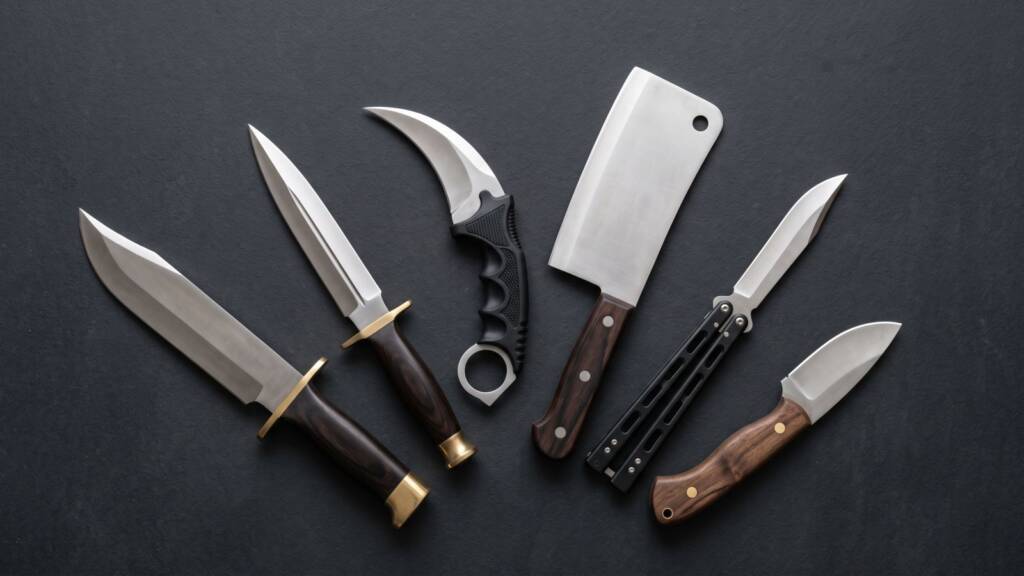
Knife Types Explained
Every knife family in one place: what it is, what it was invented for, and whether it still answers that question.
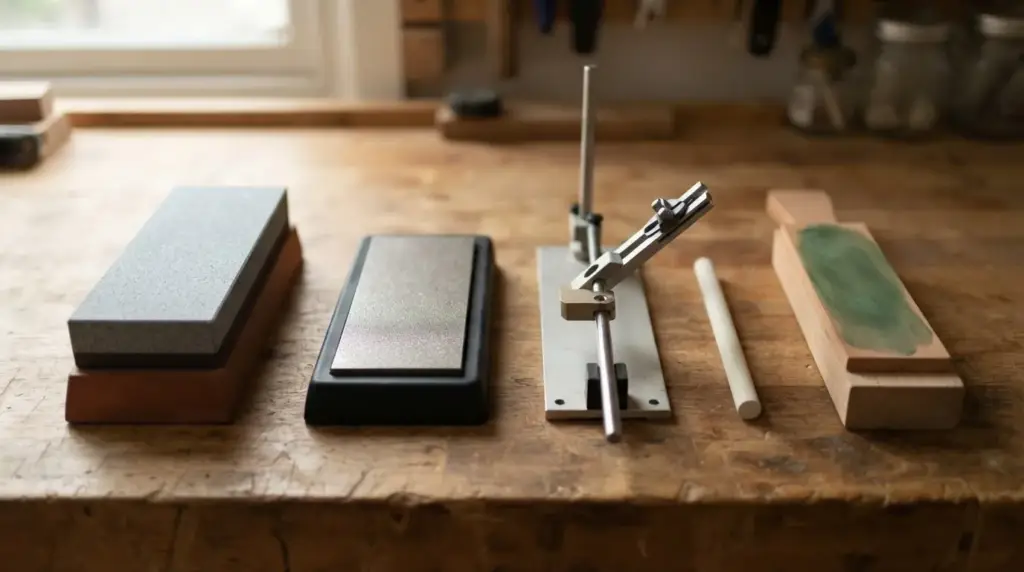
Whetstone, Pull Through, Guided or Rolling: Which Sharpener
Six sharpening systems graded on cost, steel removed per session and who should buy which.
