

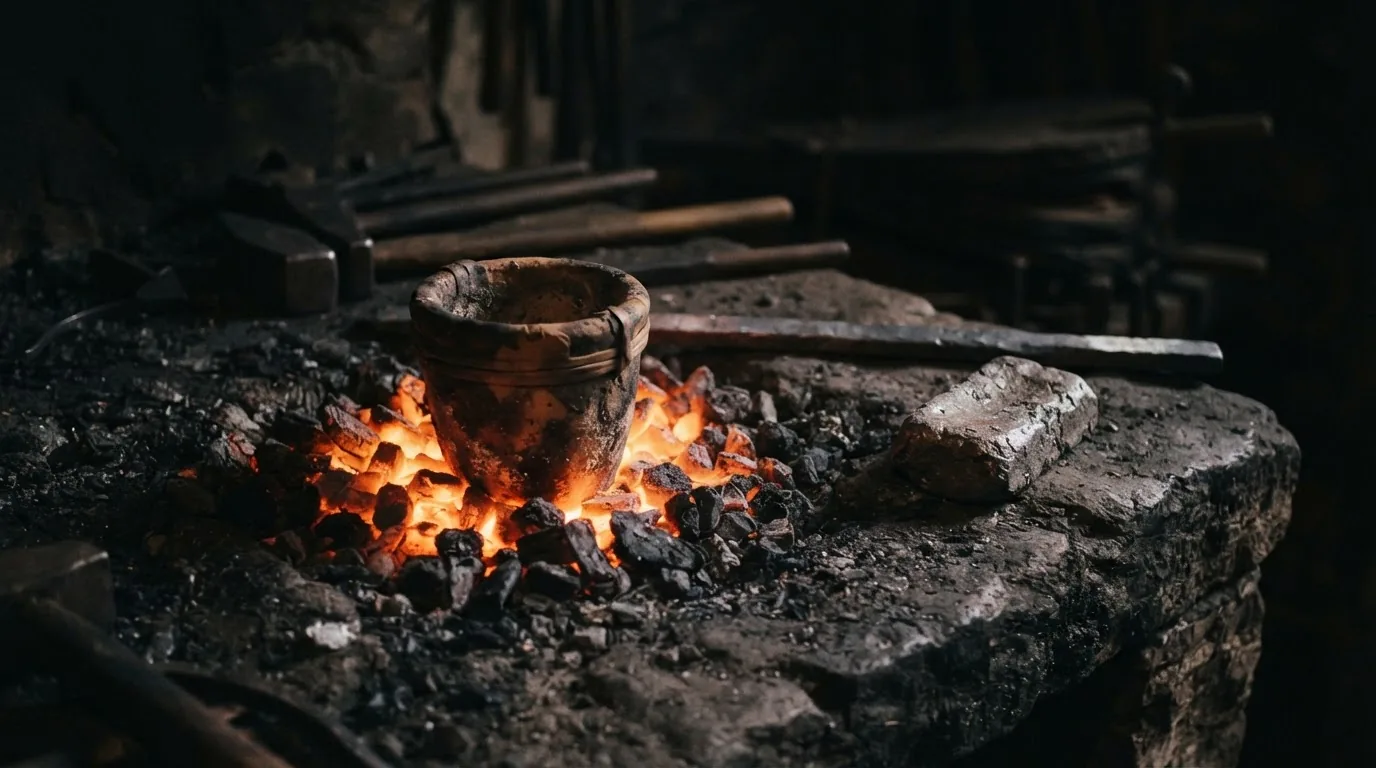
Short answer. The steel that made the name famous was wootz, a high carbon crucible steel cast in South India and Sri Lanka and traded west as ingots, where smiths forged it into blades. Its surface pattern came from bands of carbide inside one piece of steel, not from welding two steels together. The technique fell out of use and the last recorded production was around 1900. What every modern maker sells as Damascus, including us, is pattern welded steel, a different process with a similar looking surface. It borrowed the name in 1973 and it has no unbroken lineage back to wootz.
What the name actually refers to
There are three competing explanations for the word and no settled winner. The first is descriptive. The Arabic root damas carries a sense of watered fabric, and blades of this steel were called watered steel in several languages because the pattern looks like moving water. The second is geographic. The ninth century writer al Kindi described swords produced and forged in Damascus as Damascene, although he did not describe them as patterned. The third is personal. Al Biruni mentions a swordsmith called Damasqui who worked in crucible steel.
The most common modern reading is that Damascus was a trading and forging centre rather than a production centre. There is evidence of imported steel being forged into swords in Damascus and no evidence of crucible steel being made there. That is worth sitting with, because it means the city the steel is named after may never have made any of it.
Wootz, the steel the story starts with
Wootz is the English rendering of a South Indian word for steel. The Tamil is urukku, the Kannada and Telugu is ukku, and the sense is steel or melted metal. Production is dated to the mid first millennium BCE. Crucible fragments excavated at Kodumanal in Tamil Nadu are dated to roughly the third century BCE and the early centuries CE. In Sri Lanka, iron production at Anuradhapura is dated to at least 900 BCE, and a 2018 excavation at Yodhawewa found furnace remains that radiocarbon dating placed between the seventh and eleventh centuries CE.
The process, as far as the surviving descriptions and the archaeology agree, was this. Black magnetite ore went into a sealed clay crucible with a carbon source, often bamboo and leaves from plants such as Avarai. The crucible went into a charcoal furnace. The charge melted, absorbed carbon, and cooled slowly into an ingot. Carbon content in wootz is usually given as one to two percent, and blades examined from the historic material tend to sit between about 1.2 and 2.0 percent with an average near 1.5 percent. That is very high. Most modern knife steels sit under one percent.
Those ingots travelled. Steel was shipped from South India to the Middle East from roughly the third century to the seventeenth, and wootz was exported to production centres including Khorasan and Isfahan, where local smiths forged it into blades.
Crucible steel and forge welding are two different things
This is the distinction the whole page turns on, so it is worth being blunt about it.
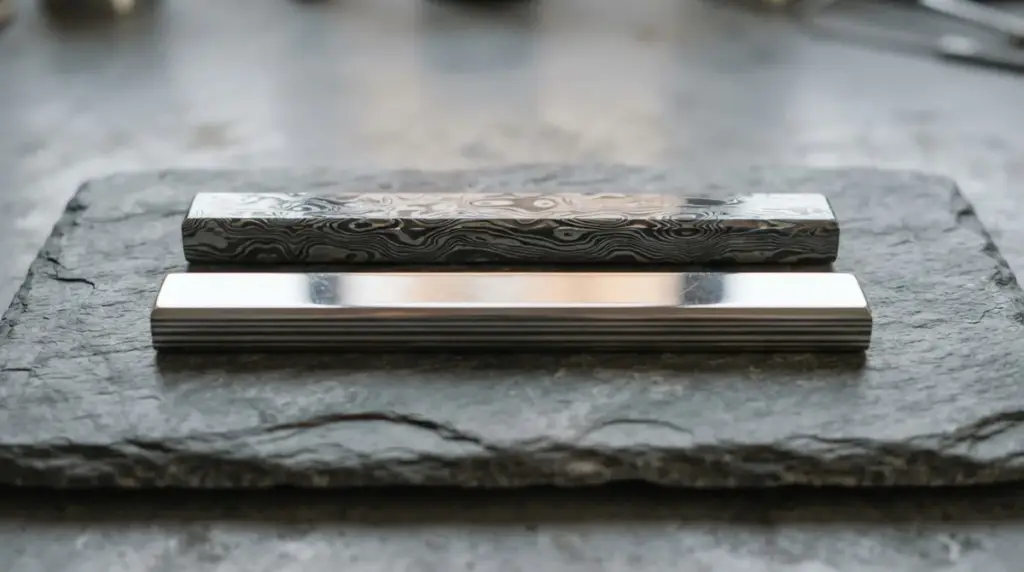
Wootz is one steel. The pattern is inside it. You melt a charge, you get an ingot with an uneven internal distribution of carbon and carbide forming elements, and careful forging and thermal cycling at moderate temperature brings that distribution to the surface as visible banding. Nothing is welded to anything.
Pattern welded steel is two or more steels. You stack alternating layers, forge weld them into one billet, draw it out, fold it, manipulate the stack, grind the blade and etch it. The pattern is the boundary between two different alloys revealed by acid that eats one faster than the other. That is what we do, and it is what every workshop selling Damascus today does.
| Property | Historic wootz | Modern pattern welded billet |
|---|---|---|
| Number of steels | One | Two or more, commonly 1095 with 15N20 |
| Origin of the pattern | Carbide bands inside a cast ingot | Boundaries between welded layers, revealed by acid |
| Typical carbon | About 1.0 to 2.0 percent | Around 0.95 percent in the 1095 layers, lower in the 15N20 |
| Key process step | Slow cooled crucible melt, then thermal cycling | Forge welding and folding |
| Pattern depth | Runs through the section | Runs through the section, but visible only after etching |
| Currently produced | Only as modern reconstructions | Yes, at scale, worldwide |
What actually makes the pattern in wootz
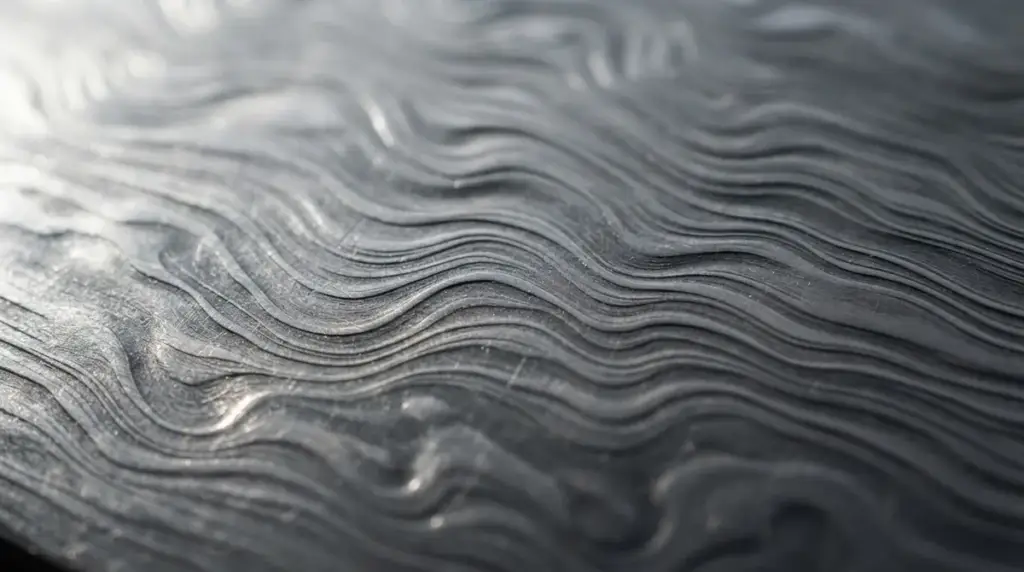
The best supported explanation is carbide banding. During slow cooling, the melt segregates. Some regions end up richer in carbon and in carbide forming elements than others. When the ingot is then forged and thermally cycled at a moderate temperature, cementite particles coarsen in the rich bands and shrink in the lean ones. Under the microscope the signature is spheroidised cementite arranged in dendritic and interdendritic regions. Polished and etched, that reads to the eye as flowing bands.
The important consequence is that the pattern can be destroyed and recovered. Heat the steel high enough to dissolve the carbides and the visible pattern disappears. But the underlying chemical segregation of the carbide forming elements survives that heat, because those elements do not disperse at the same temperature. Cycle the steel back down and the pattern returns. That is a genuine finding and it does a lot of work in explaining how the material behaves.
Verhoeven, Pendray and the reproductions
John Verhoeven, a metallurgist, and Alfred Pendray, a bladesmith, spent years attempting to reproduce the composition, microstructure and appearance of the historic material. Their work is documented in a paper published in the Journal of Metallurgy in 1998. The finding that has held up best is the thermal cycling recovery described above.
The other finding they are known for is the trace element hypothesis. They concluded that carbide forming elements present as impurities in the original ore, vanadium in particular, were doing essential work in organising the carbide bands. Modern reconstructions add a carbide former deliberately. Some use vanadium, some use niobium instead. A modern crucible run described in the current literature runs something like this: electrolytic iron, a pig iron carbon source and a carbide former go into a crucible under a green glass slag, the charge is taken to roughly 2900 degrees Fahrenheit, cooled slowly, then forged through repeated thermal cycles.
Modern reconstructions do get to a microstructure that resembles the ancient material. Whether that makes them wootz is a definitional argument that has not been resolved, and we come back to it below.
Where the record is genuinely contested
Most pages on this subject present a single clean story. The honest position is that several parts of it are disputed by people who have looked at the actual metal. Here is what is argued about, laid out beside what the evidence supports.
| Question | One account | The competing account | Our reading |
|---|---|---|---|
| Where the name comes from | From damas, meaning watered, describing the surface | From the city of Damascus as a trading and forging centre, or from a named smith | Unsettled. All three appear in the sources and none is proved |
| Carbon nanotubes in the blades | A German team reported nanowires and carbon nanotubes in a Damascus blade in 2006 | Not confirmed by later work. Verhoeven suggests the structures are cementite, which itself forms rods | Treat the nanotube claim as unconfirmed. It is the single most repeated overclaim on this topic |
| Why production ended | The knowledge of the thermal cycling technique was lost | The ore sources with the right trace impurities ran out, or the ingot trade was disrupted | Probably several causes at once. Nobody can currently rank them with confidence |
| Whether modern reconstructions are wootz | They match the microstructure, so yes | They use different carbide formers and modern feedstock, and some plain steels band too, so the word has stopped meaning much | Unsettled, and the definition itself is the argument |
| Faraday's aluminium finding | Faraday reported 0.01 to 0.07 percent aluminium in wootz | Later work attributed it to slag contamination | Disputed. Faraday's interest in the material from the 1790s onward is documented, that particular result is not reliable |
Why the technique stopped
Production declined gradually and ceased by around 1900, with the last account coming from Sri Lanka in 1903. That much is on the record. The reasons offered are trade disruption, the loss of ore bodies carrying the necessary trace impurities such as tungsten, vanadium and manganese, the loss of the thermal cycling knowledge itself, and disruption to mining under the British Raj. We are not going to pick one for you. Every one of them is plausible, and a craft that depends on a specific ore, a specific fuel and an undocumented sequence of heats can die from any of them.
What matters commercially is the consequence. There is no living unbroken tradition of wootz production. Nobody inherited the recipe. Everything made today under that name is a reconstruction, made by people working backwards from analysis of old blades.
How the word moved to pattern welded steel
Pattern welding is old and independent. Smiths across Europe and Asia were forge welding strips of iron and steel together for centuries, and the resulting surface looks broadly like the surface of a wootz blade. That resemblance caused a long running confusion in which modern smiths assumed the historic blades had been made by welding. Many early medieval sword blades from Northern Europe were built this way, and if that is the part of the story you came for, Ransack Viking sells Damascus Viking swords handmade in the Czech Republic.
The commercial turning point is dated. In 1973 the American bladesmith William F. Moran presented pattern welded blades as Damascus knives, and the term stuck. It is technically the wrong word and it is now the universally accepted trade word. We use it. Everyone uses it. The difference between wootz and pattern welding is well documented and well understood today, which means anyone still blurring the two is choosing to.
The legends, sorted
| Claim you will read | Where it comes from | Status |
|---|---|---|
| A Damascus blade could cut through an iron bar without damaging its edge | Reputation and repeated retelling | Legend. Not documented |
| A Damascus blade could cut a wisp of silk falling across it | The same body of reputation | Legend. Not documented |
| The steel was quenched in the body of a slave | Traced to an article in the Chicago Tribune of 4 November 1894 | A hoax. The name attached to the story belongs to a legendary German prankster |
| Beowulf describes a Damascus blade | Some modern English translations use the word damascened | Ambiguous. Damascene also means an inlay decoration, which is a different thing entirely |
| Our shop holds a recipe handed down from the ancient smiths | Marketing | False wherever it is claimed, including if we ever claimed it |
| Damascus steel was made in Damascus | The name | Not supported. The evidence points to imported ingots forged there |
What all of this means for a knife you buy from us
We should be direct, because this is the part that is inconvenient for us. Of our 609 published products, 320 carry Damascus in the name, and the median price across the catalogue is 155 dollars. Not one of them is wootz. They are pattern welded billets of 1095 and 15N20, folded to the layer counts we publish, hardened to 58 to 60 HRC and etched to bring the pattern up. That process is genuinely skilled and it produces a good knife. It is not the process this page has been describing and there is no lineage between them.
So the practical rule is simple. Ancient recipe language is a tell. If a listing claims a blade is made to a lost formula, or implies a chain of transmission from the crucible smiths, the seller is either confused or selling you a story. Ask which crucible. Ask what the carbide former was. Nobody selling a 90 dollar folder has an answer.
The other thing worth knowing is that the pattern on a modern blade is cosmetic in the sense that matters here. Layer count is a styling decision, not a performance ladder. What decides whether the knife cuts well is the steel choice and the heat treatment, and neither of those is visible in the pattern. We have written that elsewhere and it remains true.
Questions people ask
Is Damascus steel real?
Both answers are true depending on which thing you mean. Historic wootz was real and it is well studied. Modern Damascus is also real steel, but it is pattern welded, which is a different process. Neither is fake. The dishonest version is a plain blade with a pattern printed or acid stencilled onto the surface, which is a separate problem covered in our guide on real and fake Damascus.
Was Damascus steel actually made in Damascus?
There is no evidence of crucible steel production in Damascus. There is evidence of imported ingots being forged into swords there. The city looks like a forging and trading hub rather than a source.
How old is Damascus steel?
Wootz production in South India is dated to the mid first millennium BCE, with crucible fragments at Kodumanal placed around the third century BCE. The ingot trade to the Middle East ran from roughly the third to the seventeenth century. Any single date you see quoted as the invention of Damascus steel should be treated with caution.
Why did they stop making it?
Production ceased by around 1900 and the last account is from Sri Lanka in 1903. The proposed causes are lost technique, exhausted ore with the right trace impurities, and disrupted trade and mining. The record does not settle which mattered most.
Did Damascus steel contain carbon nanotubes?
A 2006 study reported them. That result has not been confirmed and other metallurgists argue the structures are cementite rods. Treat it as an open question, not a fact, whatever the article you read said.
Is modern Damascus better or worse than wootz?
Neither answer is defensible as a blanket statement. Historic wootz was very high carbon and its performance varied enormously with how well a given ingot was made and forged. A modern pattern welded blade with a controlled heat treatment is more consistent. Consistency is not the same as superiority, and comparative edge testing on this material gives mixed results depending on hardness and test conditions.
Can anyone make wootz today?
Reconstructions exist and they reach a comparable microstructure. Whether they count as the same material is an unsettled argument, partly because the definition of wootz is itself unclear once you allow modern feedstock and a substituted carbide former. Nobody is producing it at commercial knife volumes.
Why do sellers still call pattern welded steel Damascus?
Because in 1973 William F. Moran presented pattern welded blades under that name and the market adopted it. It is now the standard trade term. We use it too, for the plain reason that nobody searches for pattern welded steel.
Does the layer count tell me anything about quality?
Not much. Layer count changes the look of the pattern. Beyond a certain point extra folds make the pattern finer and tell you nothing about hardness, edge retention or toughness. We publish our counts because customers ask, not because a higher number is a better knife.
What should I ask a seller who claims ancient Damascus?
Ask what steels are in the billet, what hardness the blade is finished at, and whether the pattern is welded or etched onto the surface. A shop that forges its own material will answer all three without hesitating. A shop selling a story will move to talking about history instead.
More guides. If you want the process rather than the history, read how Damascus steel is made and our note on what 352 layers actually means. To check a blade before you buy, use real versus fake Damascus. For the money question, see are Damascus knives worth it and the knife steel chart.
More from the workshop
Balisong Construction Explained
Every part of a balisong, and the two structural ways a handle actually gets built.
Fishing Knives: Bait, Fillet, Folding and Saltwater
Sizing a fillet blade, why carbon Damascus loses to salt water, and what our seven fishing listings really are.
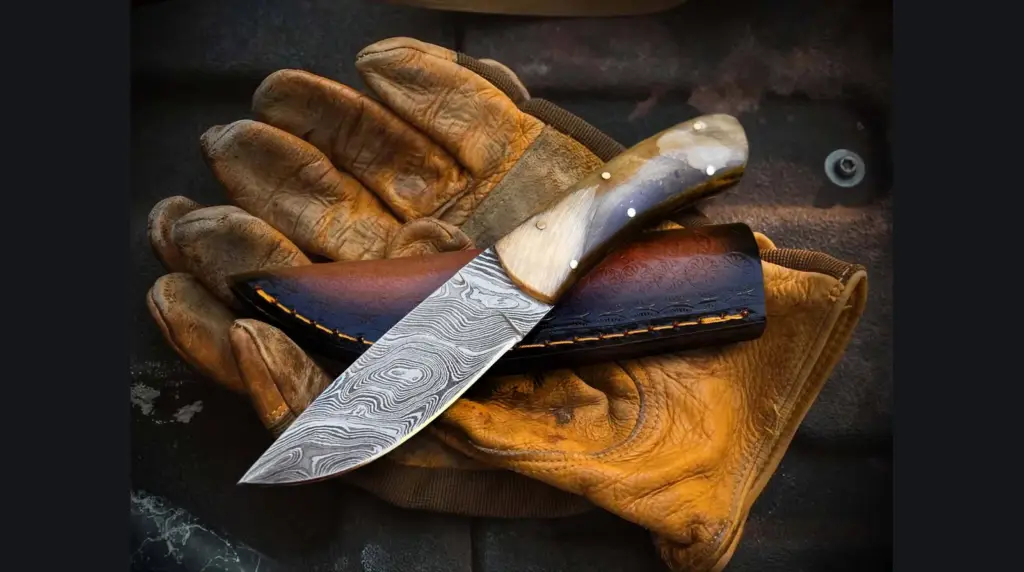
What 352 Layers Actually Means
Where the layer count comes from, and why a bigger number is not a better blade.
