
Short answer: honing straightens an edge that has rolled over. Sharpening removes steel to create a new edge. You hone often and sharpen rarely, and confusing the two is why most people think their knives go dull quickly.
What actually happens to a dull knife
A knife edge is a very thin ribbon of steel. Under normal use it does not wear away first, it bends. Push it against a cutting board a few hundred times and that ribbon leans over to one side. The steel is all still there, it is just no longer pointing where you need it.
That is a rolled edge, and it feels exactly like a blunt knife. A honing rod pushes the ribbon back upright in about fifteen seconds and the knife cuts like new.
Eventually the ribbon fatigues and breaks off, or you chip it on a bone. At that point there is nothing left to straighten and you have to grind a fresh edge. That is sharpening.
How to use a honing rod
Hold the rod vertically with the tip on a cutting board. Set the blade near the top at roughly the sharpening angle, about 20 degrees, and draw it down and toward you so the whole edge travels across the rod. Alternate sides. Four or five light passes each side is plenty.
Pressure is the mistake everyone makes. The weight of the blade is enough. Leaning on it bends the edge the other way instead of straightening it.
Steel rod, ceramic rod or diamond
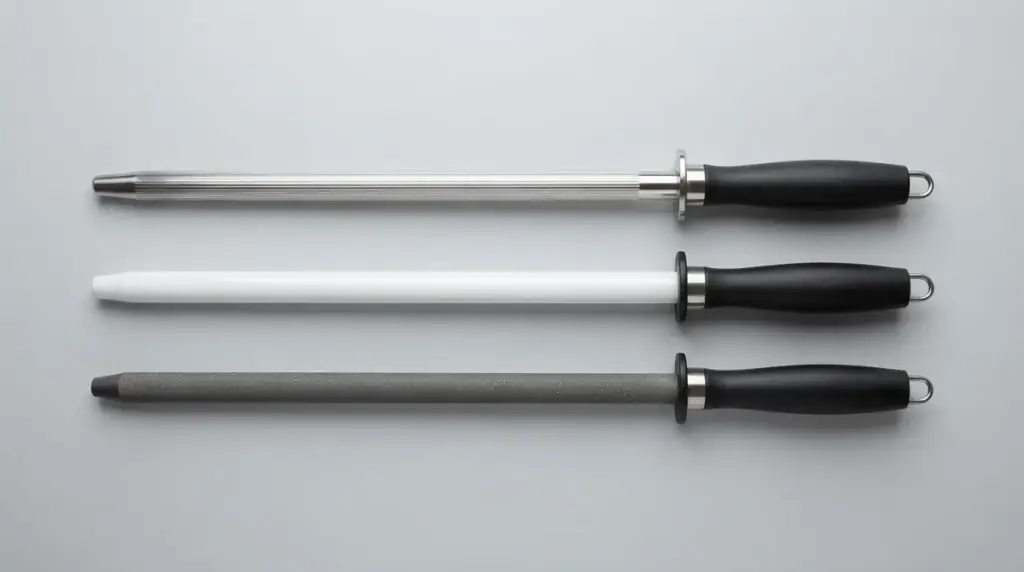
A grooved steel rod is the traditional choice and it only realigns. A smooth ceramic rod realigns and removes a whisper of steel, which is the most useful all-rounder for a home kitchen. A diamond rod genuinely cuts steel, so it is a sharpener wearing a rod's clothing, and it is the wrong tool for daily use on a good knife.
How often
| Kitchen knife, daily use | Hone every few uses. Sharpen every 1-2 months. |
| Pocket knife, everyday carry | Strop weekly. Sharpen every 1-2 months. |
| Hunting knife | Touch up during the job, sharpen properly after. |
| Fillet knife | Strop before every session. This one should be the sharpest thing you own. |
Where stropping fits
A leather strop does the same job as honing but gentler, and it is the better choice for a very fine edge. Spine-first, almost no pressure, ten passes. If you only ever learn one maintenance habit, make it this one.
What is a honing rod, and what does it actually do
A honing rod is a straight rod of hardened steel or ceramic, fitted with a handle and a finger guard, used to push a bent knife edge back into line. That is the whole purpose of a honing rod: not to make a new edge, but to straighten the one you already have.
Look at a used edge under magnification and it is rarely worn flat. The apex has leaned over to one side into a wire-thin lip. Your fingers read that lip as bluntness because the part of the blade meeting the food is now the shoulder of the bevel rather than the point of it. A rod does not cut that lip away. It presses it back onto the centreline. No new steel is created and, on a proper honing rod, almost none is removed.
That is also why honing a blade takes fifteen seconds and sharpening takes fifteen minutes. One is a nudge, the other is a rebuild.
Honing a blade, step by step
There are two common methods and they produce the same result. Pick whichever one keeps your angle steady.
Method one, tip on the board. Stand the rod vertically with its tip resting on a cutting board or a folded towel, handle in your weak hand.
- Set the heel of the blade against the top of the rod at roughly 20 degrees, the same angle you sharpen at.
- Draw the knife down and toward you in one steady sweep so the whole edge, heel to tip, passes across the rod.
- Swap to the other face of the rod and repeat. Alternate every single stroke rather than doing five on one side then five on the other.
- Four or five passes per side is enough. If ten strokes have not helped, the rod is not the tool you need.
Method two, rod held in the air. Hold the rod out in front of you, tip angled slightly up and away from your body, and bring the blade down across it in the same sweeping motion. This is the version you see butchers use. It is faster and it lets you feel the contact better, but nothing stops the knife if your angle slips, so learn it after the board method, not before.
Pressure is where people go wrong. The weight of the blade alone is close to right. If the rod rings loudly or the blade skips, you are pushing. Heavy pressure bends the edge past straight and over the other way, which is exactly the problem you sat down to fix.
To check your work, draw the edge lightly through a sheet of paper held at one corner. A straightened edge slices cleanly from heel to tip. If it tears, snags in one spot, or slides off, honing has done all it can.
Rod types, and which one is secretly a sharpener
The name on the box is not a reliable guide, so judge the rod by what its surface does to steel.
| Grooved steel rod | Realigns only. The ridges bite and feel effective, but they also leave fine scratches down the bevel. |
| Smooth steel rod | Realigns only, more gently, and leaves a tidier bevel. Slower to show results. |
| Ceramic rod | Realigns and takes off a whisper of steel. The best all-rounder for most kitchens. |
| Diamond rod | Genuinely abrades steel. This is sharpening in a rod's shape, and daily use will eat a good blade. |
People often ask about sharpening steel vs honing steel as though they were two products. In most shops they are the same object under two names, and the traditional butcher's steel hones rather than sharpens. A diamond rod is the real exception, because it removes metal rather than moving it. Use one for occasional repair work, not for a touch-up before dinner. The full grinding method is in how to sharpen a knife.
What changes how often you need the rod
Frequency is set by the blade, not by the calendar. Four things push it up:
- A thin grind. Thinner edges cut better and roll sooner. A slicing knife needs the rod more than a camp knife.
- Softer steel. Softer edges bend readily and straighten readily. Harder steel resists both. See the hardness figures in the knife steel chart.
- Hard surfaces. Glass, stone and ceramic boards roll an edge in a single session. Wood and plastic do not.
- Twisting cuts. Levering through squash or joints stresses the apex sideways, which is what bends it.
Signs the knife needs sharpening, not honing
Honing stops working when there is no longer any leaning steel left to move. The bent apex work-hardens each time it flexes, then fatigues and breaks off, leaving a rounded edge with nothing to realign.
- The knife improves after honing but only for a few minutes.
- It will not start a cut in tomato skin or a pepper without sawing.
- You can see a fine line of light reflecting along the apex. A sharp edge has no width to catch the light.
- There are visible chips or a rolled section you can feel with a thumbnail dragged across, not along, the edge.
- Paper tears rather than slices immediately after a full honing.
Any one of those means the rod is finished for now and a stone is next.
Hard steels, Damascus and serrations
Honing rods are safe on hard steels if you keep the pressure light. Our D2 blades run 58 to 62 HRC and our 1095 and 15N20 Damascus runs 58 to 60 HRC. At that hardness an edge is more likely to chip than to fold, so a grooved steel rod is the wrong choice; a smooth steel or ceramic rod is kinder and does the same job.
Damascus needs no special treatment on the rod. The pattern runs through the body of the steel rather than sitting on the surface, so honing the bevel cannot rub it off. What a grooved rod can do is scratch the flats if you let the whole blade slap against it, so keep the contact on the edge and dry the blade afterwards, as covered in Damascus knife care.
Serrated blades are the exception. A straight rod only touches the points of the scallops and rounds them off, which makes the knife worse. Serrations are maintained one gullet at a time with a tapered ceramic rod, or left alone until they genuinely need sharpening.
Questions people ask
Can honing make a knife sharp again?
If the edge is rolled, yes, and dramatically. If the edge is actually worn or chipped, no amount of honing will help and you need a stone. Full method in how to sharpen a knife.
Does honing damage the blade?
Light honing does not. Heavy-handed honing on a grooved steel rod scratches the bevel and can roll the edge in the opposite direction.
Do hard steels need honing?
Less often. Our blades run 58 to 60 HRC, hard enough to resist rolling but not so hard that the edge chips on bone. Softer steel rolls more and needs the rod more.
Do honing rods sharpen knives?
No, not in the strict sense. A honing rod straightens an edge that has rolled over rather than grinding a new one, so it restores cutting performance without removing meaningful steel. The exception is a diamond rod, which does abrade the edge and is really a sharpener. If a knife does not improve after honing, it needs a stone rather than more rod work.
What is a honing rod used for?
The purpose of a honing rod is routine maintenance between sharpenings. You use it to push a bent edge back into line, usually every few uses in a kitchen, so the knife keeps cutting the way it did when it was last sharpened. It cannot repair chips, fix a worn edge, or change the bevel angle. Those all need abrasives.
Is a sharpening steel the same as a honing steel?
In practice, yes. The two names describe the same tool, and the traditional butcher's sharpening steel hones rather than sharpens. The confusion is historical rather than technical. What matters is the surface: grooved and smooth steel rods realign the edge, ceramic realigns and lightly abrades, and diamond genuinely cuts steel.
How do I know I am honing a blade at the right angle?
Match the angle the knife was sharpened at, which is about 20 degrees per side on most kitchen and hunting knives. A rough guide is to set the blade at a right angle to the rod, halve it, then halve it again. Too steep and you only touch the shoulder; too shallow and you scratch the bevel without reaching the apex.
How many strokes should you use on a honing rod?
Four or five light passes per side, alternating with every stroke, is enough for a normal touch-up. Honing is not cumulative in the way sharpening is, so twenty strokes do not straighten an edge twice as well. They just fatigue the steel faster. If the edge has not come back within about ten strokes, stop and sharpen it instead.
Can you hone a serrated knife?
Not with a standard straight rod. It contacts only the tips of the serrations and rounds them off, which reduces the bite that makes a serrated blade work. The scallops are maintained individually with a tapered ceramic rod worked into each gullet, at the angle of the original grind, and the flat back of the blade is only ever deburred.
Why does honing eventually stop working?
Because there is nothing left to straighten. Each time the apex bends and is pushed back, the steel work-hardens a little. Eventually it fatigues and breaks away, leaving a rounded edge with no leaning ribbon to realign. At that point the knife needs metal removed to form a fresh apex, which is sharpening rather than honing.
More from the workshop
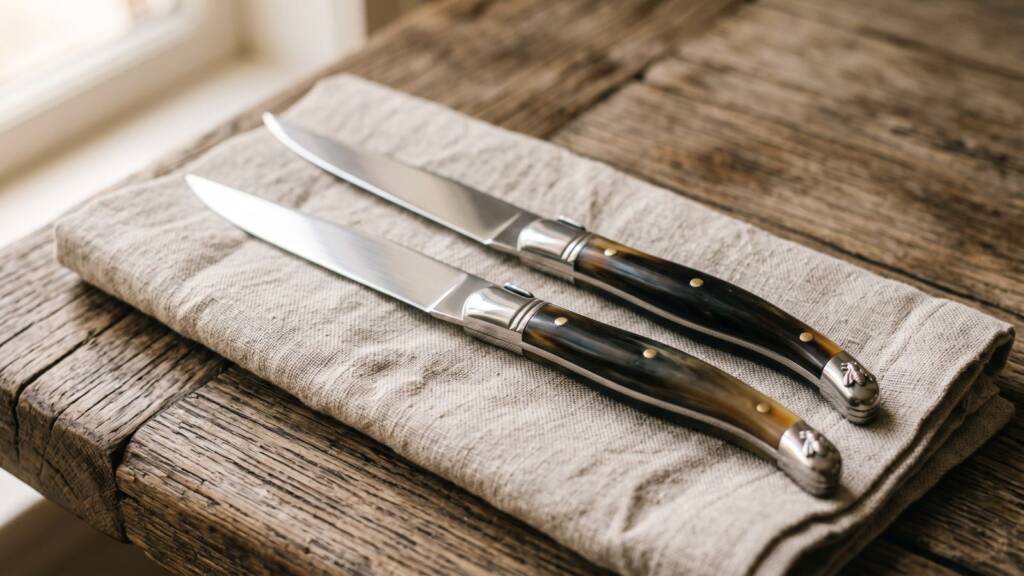
Laguiole Knives Explained
A pattern, not a protected origin. The bee, the cross, the court cases and how to tell a good one.
Pride Knives and Rainbow Blades: Where the Colour Comes From
The four ways a knife ends up rainbow, which of them survive being owned, and how to buy a pride knife as a gift without getting a coated novelty.
