
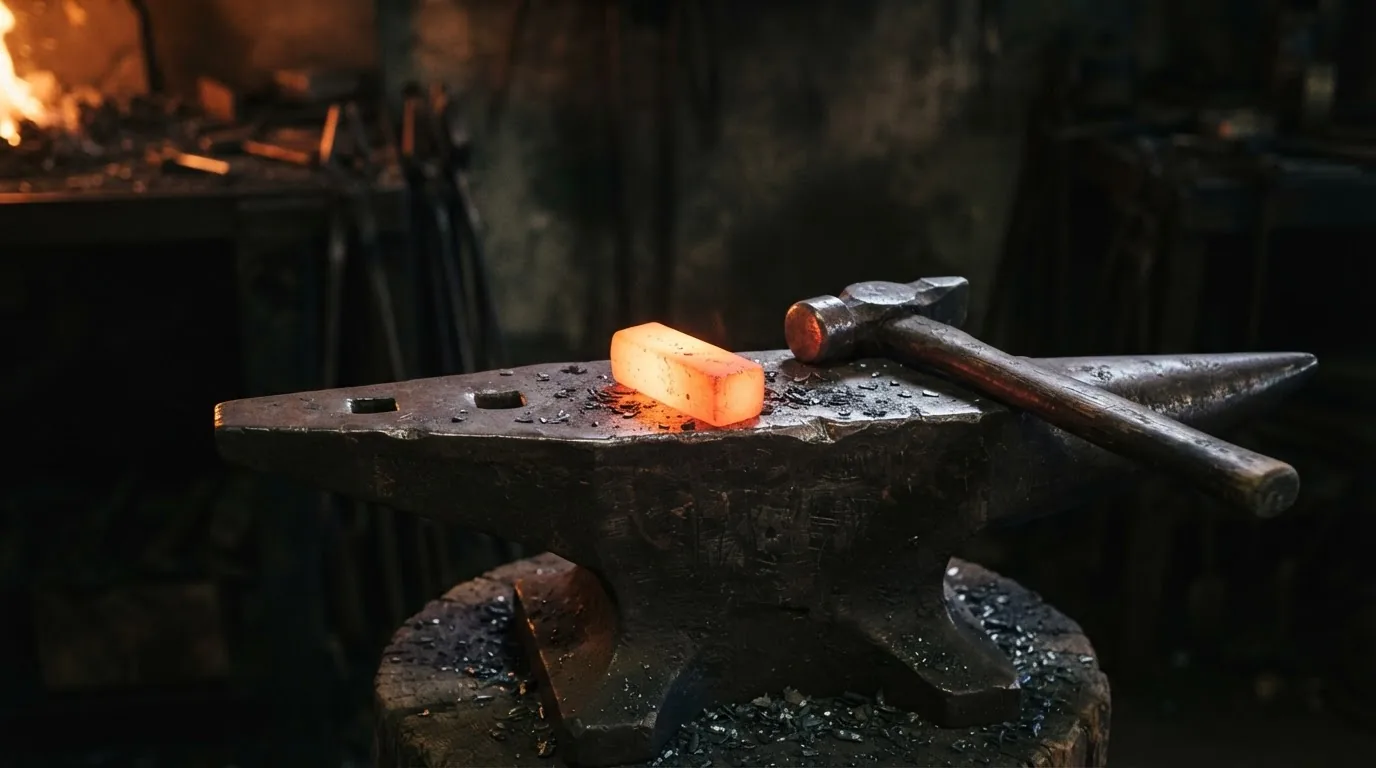
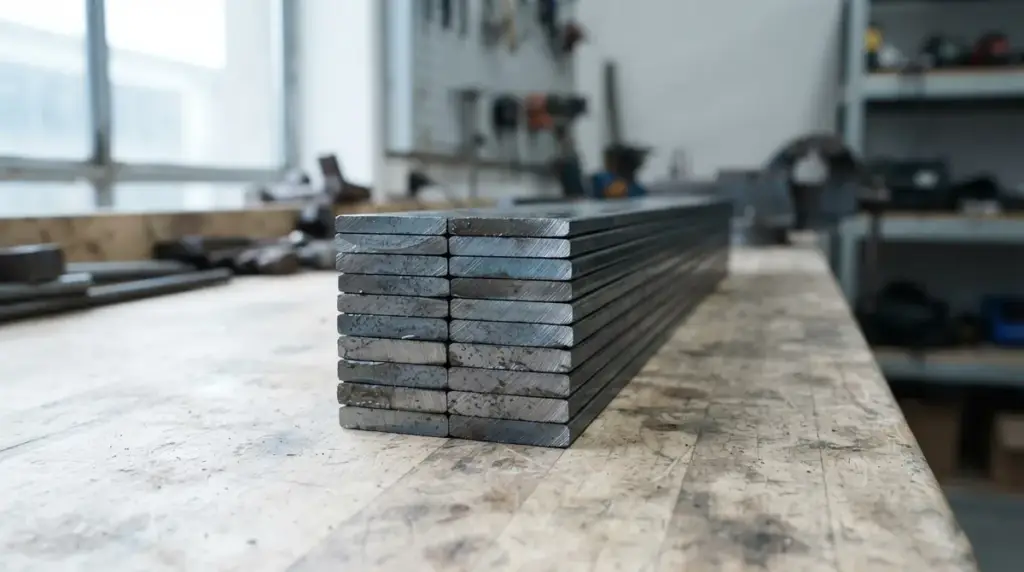
Short answer. Forging heats a bar until the steel is plastic and moves that metal into the shape of a blade with a hammer. Stock removal starts with flat bar already at the finished thickness and cuts the blade out of it cold, with a saw and a belt grinder. Both routes end at the same heat treat, and the heat treat is the step that decides whether the knife is any good. We forge, and this page still says plainly that a well ground stock removal blade will beat a badly forged one every time, and that most of the grain flow argument made for forging does not survive testing.
What forging actually is, step by step
A forged blade begins as a bar of round or square stock, usually thicker and shorter than the finished knife. The sequence in a working shop runs roughly like this.
Heat. The bar goes into a coal or propane forge and comes up to a bright orange, somewhere near 2,000 degrees Fahrenheit for a plain carbon steel. At that temperature the steel behaves like very stiff clay. Nothing is being cut. The mass at the end of the day is close to the mass at the start, minus the scale that burns off the surface.
Draw. The smith lengthens and thins the bar towards where the edge will be, leaving the spine heavy. This is where a distal taper gets put in, meaning the blade is thicker at the ricasso than at the tip. On a forged blade that taper is moved into the steel. On a ground blade it has to be cut out of a parallel sided bar.
Profile and bevel. The outline of the blade is worked in, and a rough bevel is hammered or pressed close to final. A skilled forger gets what is called forged to shape, where very little grinding is left. Most working shops, ours included, forge close and then grind, because a hammered bevel is not straight enough to sell.
Thermal cycling. Forging is hot work and hot work grows grain. So the blank is normalised, meaning heated above critical and air cooled, usually two or three times at falling temperatures, to undo what the forge did to the grain structure. This step is not optional on a forged blade. It is what makes the later hardening behave.
Grind, heat treat, finish. From here the forged blank and the ground blank meet on the same road. Both get their bevels finished, both get hardened and tempered, both get handles.
What stock removal actually is, step by step
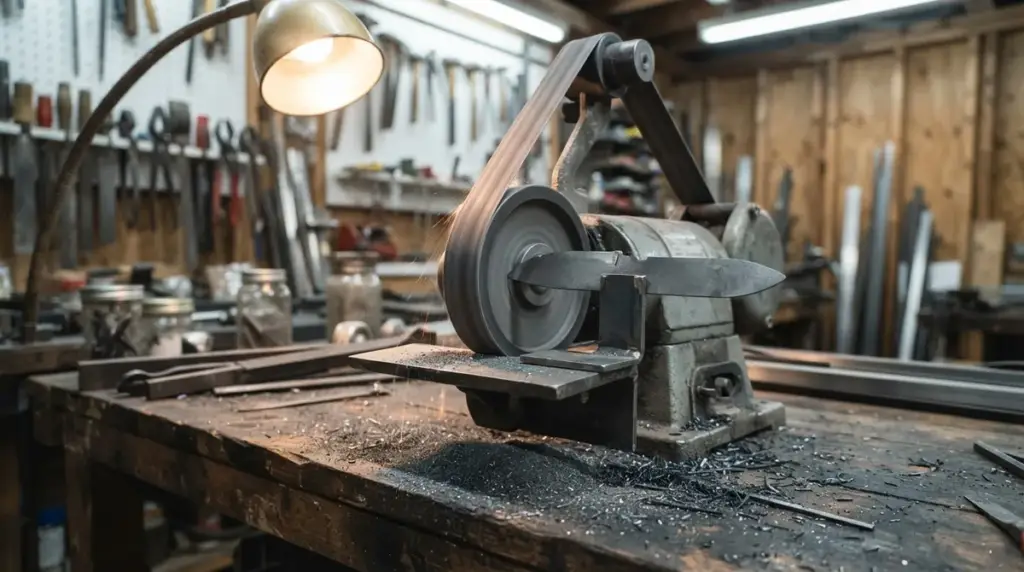
Stock removal starts with annealed flat bar in the finished thickness. The maker traces the profile, cuts it out with a bandsaw or an angle grinder, drills the tang holes, then grinds the bevels on a belt grinder, very often with the blank clamped in a jig so both sides match.
Nothing is heated until the heat treat. That is the whole point. The steel arrives from the mill in a known, tested condition, and the maker does not disturb it until the moment it is supposed to be disturbed.
The waste is real. Grinding a deep hollow or a heavy distal taper out of flat bar turns a large fraction of the bar into sparks and dust. Forging moves that same steel instead of throwing it away. That is a cost argument and a material argument. It is not a performance argument.
The risk in stock removal is heat where you do not want it. A blade that has already been hardened can be ruined on a grinder in about four seconds if the belt is dull and the maker is impatient. The edge goes blue, the temper is drawn locally, and the knife will not hold an edge along that stretch no matter how it is sharpened. Good makers grind wet, grind with fresh belts, and keep a bucket of water on the bench.
The grain flow claim, and what the testing shows
The strongest claim made for forging is grain flow: that hammering aligns the internal structure of the steel along the blade, so the edge and the tip end up tougher than the same steel simply ground to shape. It is repeated on almost every page that ranks for this question.
It does not hold up as stated. Larrin Thomas, the metallurgist who publishes Knife Steel Nerds, has gone through this in detail and the conclusions are uncomfortable for forgers. Every knife steel you can buy has already been forged and rolled at the mill, so the elongated features already run along the length of the bar. Forging a blade out of that bar does not create the alignment. At best it preserves it. And because forging means reheating to a high temperature, grain growth is the more likely outcome than grain refinement, which is exactly why normalising cycles afterwards are compulsory rather than optional.
The directional effect itself is real, and it is worth seeing the size of it. These are Charpy toughness figures published by Knife Steel Nerds for samples cut along the rolling direction and across it. Note that the difference exists in plain unforged bar stock too. It is a property of the mill product, not a gift from the hammer.
| Steel | Longitudinal toughness | Transverse toughness | Source |
|---|---|---|---|
| CruForgeV | 45 ft lbs and above | about 30 ft lbs | Knife Steel Nerds |
| Z-Tuff | 45.7 ft lbs | 29.2 ft lbs | Knife Steel Nerds |
| Vanadis 4 Extra | 13 ft lbs | 9 ft lbs | Knife Steel Nerds |
Two honest readings of that table. First, direction matters a great deal. Second, a knife blade is already cut along the length of the bar in both methods, so both methods already get the good number. The forging does not add it.
There is one place where hammering genuinely helps the microstructure, and it is not the one people cite. Heavy reduction from a large ingot can break up and refine the coarse carbides in high alloy steels. Thomas notes that almost nobody forging knives is doing that with the steels that would benefit, and that in low alloy steels such as 1095, W1 and 52100 the difference between a heavily forged and a lightly forged sample is hard to find. Edge packing, the idea that hammering compresses the edge into something denser, is not a real phenomenon.
What forging does change: scale, decarburisation and yield
Three things change for certain when steel goes in a forge, and only one of them is good news.
Yield. Forging uses less steel per knife than grinding the same shape out of flat bar. On a heavy bowie with a deep clip and a thick spine that difference is large. This is the honest, boring reason a lot of big blades are forged.
Scale. Every heat in an open forge burns iron oxide off the surface. It flakes, it is abrasive, and it has to be ground away, which is why a forged blank is left oversize.
Decarburisation. This is the one that hurts. At forging heat, carbon leaves the surface of the steel into the atmosphere. What is left is a skin of low carbon steel, typically a few thousandths of an inch deep, which will not harden however perfect the quench is. Grind past it and the blade is fine. Leave it on and the customer gets a knife that goes blunt in an afternoon and never comes back, no matter what the sharpening looks like. Decarburisation is the single most common way a forged blade is quietly ruined, and it is invisible once the blade is polished.
What forging cannot do
Forging is a shaping process with limits, and they are geometric.
You cannot hammer a hollow grind. A concave bevel is cut by the radius of a contact wheel and has to be ground. You cannot hammer flat parallel faces to the tolerance a folder needs, which is why folding knife blades and liners are cut and surface ground, not forged to shape. You cannot hammer a precise recurve into a thin blade without warping it. You cannot forge a high alloy stainless or a powder metallurgy steel without a great deal of trouble, because those alloys have narrow working temperature windows, crack readily and gain nothing from being moved.
And you cannot hammer consistency. Two blades from the same smith on the same day will differ by a fraction of a millimetre in bevel height. That is charm on a hunting knife and a defect on a chef knife set.
What stock removal cannot do
Stock removal has its own wall.
It cannot make pattern welded Damascus. Damascus is a forging process by definition, because the pattern comes from forge welding layers together and then manipulating them. A stock removal maker buys the billet from someone who forged it. Our own guide to how Damascus steel is made walks that sequence.
It cannot make an integral bolster, meaning a bolster that is part of the same piece of steel as the blade rather than a separate part pinned on. That has to be upset and moved in the forge, or machined out of a very thick bar at great expense.
It cannot economically produce a thick spined blade with a long taper, because the bar has to start at the thickest dimension and almost all of it becomes dust.
| Feature | Forging | Stock removal |
|---|---|---|
| Distal taper | Moved into the steel, cheap | Possible, but heavy material loss |
| Hollow grind | No, must be ground | Yes, native to the method |
| Pattern welded Damascus | Yes, only way | No, billet must be bought in |
| Integral bolster | Yes | Only from very thick bar |
| Folder blades and liners | Poor, tolerances too loose | Yes, standard practice |
| High alloy stainless and powder steels | Difficult, rarely worth it | Yes, the correct choice |
| Repeatable matched sets | Difficult | Yes, jigs make it routine |
| Material used per blade | Lower | Higher |
Where the steel decides the method
Ask what the steel wants before you ask what the maker prefers. A simple high carbon steel forges beautifully and forgives a wide temperature window. A high chromium tool steel does not.
| Steel | Usual route | Why |
|---|---|---|
| 1095, 1084, W1 | Forging or stock removal | Wide forging range, shallow hardening, simple oil quench |
| 15N20 | Forging, as a Damascus partner | Nickel content resists the etch and gives the bright layer |
| 5160, 52100 | Forging or stock removal | Traditional forging steels, both routes common |
| D2 | Stock removal | High chromium and vanadium, narrow forging window, air hardening |
| 440C, VG10, 14C28N | Stock removal | Stainless grades, forged only with difficulty and no gain |
| Powder metallurgy steels | Stock removal | Fine carbide structure is the point, hammering does not improve it |
This is why the question is usually decided before anyone picks up a hammer. If a seller offers you a forged S30V knife, ask why.
Heat treat is the common ending, and the real variable
Forged or ground, every blade meets the same three stages: harden, quench, temper. That is where the hardness number comes from and where most of the performance sits. A perfectly forged blade with a botched quench is a bad knife. A plain ground blank with a controlled, tested heat treat is a good one. If you only get to ask one question of a maker, ask about the heat treat and not the hammer. We wrote that out in full in our knife steel chart.
Drop forged, hot forged and other words that are not hand forging
Factories forge too. Drop forging means a heated billet is struck between two dies in a press, producing hundreds of identical blanks an hour. It is forging in the metallurgical sense and it is nothing like a smith at an anvil. Hot forging and press forging describe the same industrial family.
So a knife can be honestly described as forged and still have been made by a machine that never saw a human hand. It can also be described as hand forged when a machine did the drawing out and a person did the finishing. There is no legal definition of the term in the United States, and there is no certifying body that checks it. The American Bladesmith Society tests individual smiths, not products, so its ratings tell you something about a maker and nothing about a random knife on a marketplace listing.
How to tell which one you are holding
You often cannot, and anyone who says otherwise is guessing. But there are tells.
A forged blade very often has a distal taper you can feel by pinching the spine at the ricasso and again near the tip. Ground blades from flat bar frequently have a parallel spine all the way to the point. Hammer texture left on a spine or a ricasso is a sign of hand work, though it is also easily faked with a texturing die. Perfectly matched bevels on both sides, with plunge lines that are identical mirror images, point to a jig and therefore to stock removal. Slight asymmetry in the plunge points to hand work. None of this is proof. Our page on hand forged versus factory knives covers the buying decision that sits on top of this question.
What we do, and what our catalogue actually says
We make every knife ourselves, in our own Memphis shop. Damascus billets are forge welded here, and our fixed blades in 1095 and 15N20 start as forged blanks. The stainless and tool steel blades are ground here from bar stock instead, because hammering those steels causes more trouble than it solves. Counting the published catalogue on 30 August 2026, 609 products are live and the steel named in the specification breaks down like this.
| Steel named in the listing | Products | Usual route |
|---|---|---|
| 1095 with 15N20 Damascus | 321 | Forged billet, forged or ground blade |
| D2 tool steel | 112 | Stock removal |
| Plain high carbon steel | 76 | Mixed |
| Stainless, unspecified grade | 31 | Stock removal |
| 440C stainless | 26 | Stock removal |
| VG10 stainless | 11 | Stock removal |
| High carbon spring steel | 5 | Mixed |
| 14C28N stainless | 4 | Stock removal |
| No steel named anywhere in the listing | 23 | Unknown, and that is our fault |
Two things in that table are inconvenient for us. The first is that roughly 184 of our 609 listings carry a stainless or high chromium tool steel that is made by stock removal, so not every Black Mamba knife came off an anvil. Every one of them still came out of our own shop, ground rather than hammered. The second is the last row. Twenty three live listings name no steel at all, which means we are asking people to buy a blade without telling them what it is made of. That is a catalogue fault and we are working through it.
Questions people ask
Is a forged knife better than a stock removal knife?
Not by virtue of being forged. At the same steel, the same geometry and the same heat treat, the two perform the same. What separates knives in practice is heat treatment and edge geometry, and both methods can get those right or wrong.
Does forging make steel stronger?
Not in the way the phrase implies. Forging cannot add carbon or alloy that is not in the bar, and it does not compress the edge into anything denser. Working steel hot and then normalising it can produce a fine grain, but modern bar stock already arrives with a fine grain, so forging is restoring what forging disturbed rather than adding something new.
What is grain flow and does it matter?
Grain flow describes the direction of elongated features left by rolling and forging. It matters, because steel is measurably tougher along that direction than across it. It just does not favour forged knives, because the bar already has the alignment and both methods cut the blade along the bar.
Why do most makers use stock removal?
Equipment cost, repeatability, and steel choice. A belt grinder and a heat treat oven will make excellent knives. A forge adds fuel, floor space, noise, scale and a second set of skills, and it buys nothing at all if the steel is a modern stainless.
Can you forge stainless steel?
You can, and there is very little reason to. High chromium stainless grades have a narrow forging temperature window, crack readily, and gain no performance from being hammered. They are designed to be cut to shape and then heat treated to a schedule.
Is stock removal cheating?
No. It is a different craft with its own difficulty, and many of the most respected individual makers work that way. The person grinding a flawless bevel freehand on a 2x72 is not taking a shortcut.
What is decarburisation and how do I spot it?
It is the loss of carbon from the surface of hot steel, leaving a soft skin that will not harden. You cannot spot it on a finished knife. It shows up later as a blade that will not take or keep an edge. The only defence is buying from someone who grinds past it.
Does a forged blade need normalising?
Yes. Forging heat grows grain, and coarse grain is the enemy of toughness. Two or three normalising cycles at falling temperatures after forging, before hardening, are standard practice and are not optional.
Can a folding knife be forged?
The blade can in principle, but almost none are. A folder needs flat parallel faces and tight pivot tolerances, which come from ground bar stock and not from a hammer. Where a folder is described as forged, it usually means the Damascus billet was forged and the blade was then cut and ground from it.
Which method do you use?
Both, and all of it happens in our own Memphis shop. Our Damascus billets are forge welded and our carbon steel fixed blades begin as forged blanks. Our D2, 440C, VG10 and 14C28N knives are stock removal, because that is the right way to make them, and that is 153 of the 609 products currently live.
More guides. If you want the buying decision rather than the process, read hand forged versus factory. For the forge welding sequence in detail, see how Damascus steel is made. For the step that decides more than either method, see knife heat treatment explained. For the alloys themselves, the knife steel chart and the knife steel comparison have the numbers.
Design your own knife from scratch →
More from the workshop
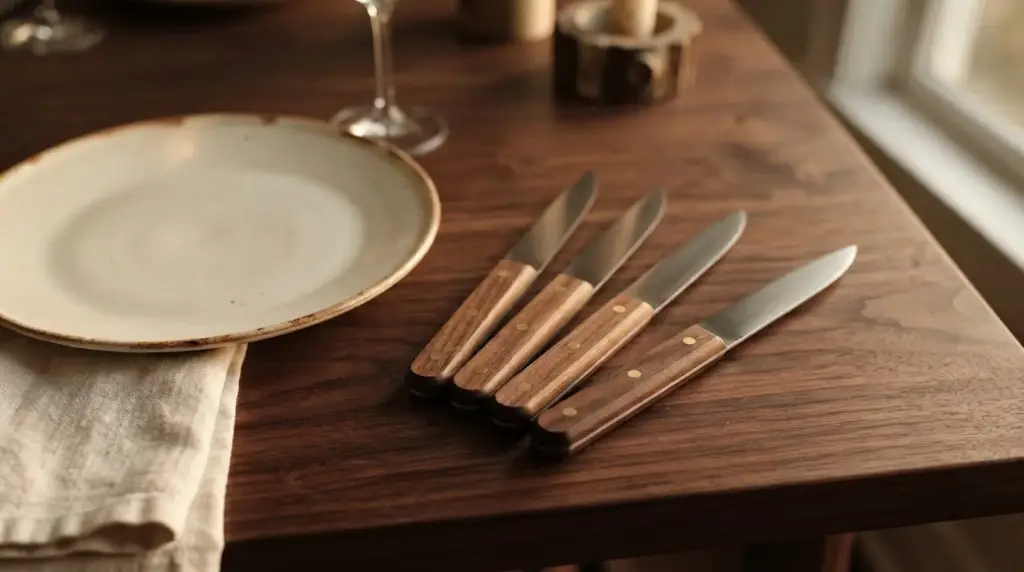
Steak Knives: Serrated, Straight and What a Forged Set Costs
Straight edge against serrated, how many you need, and the real arithmetic of a forged set of four.
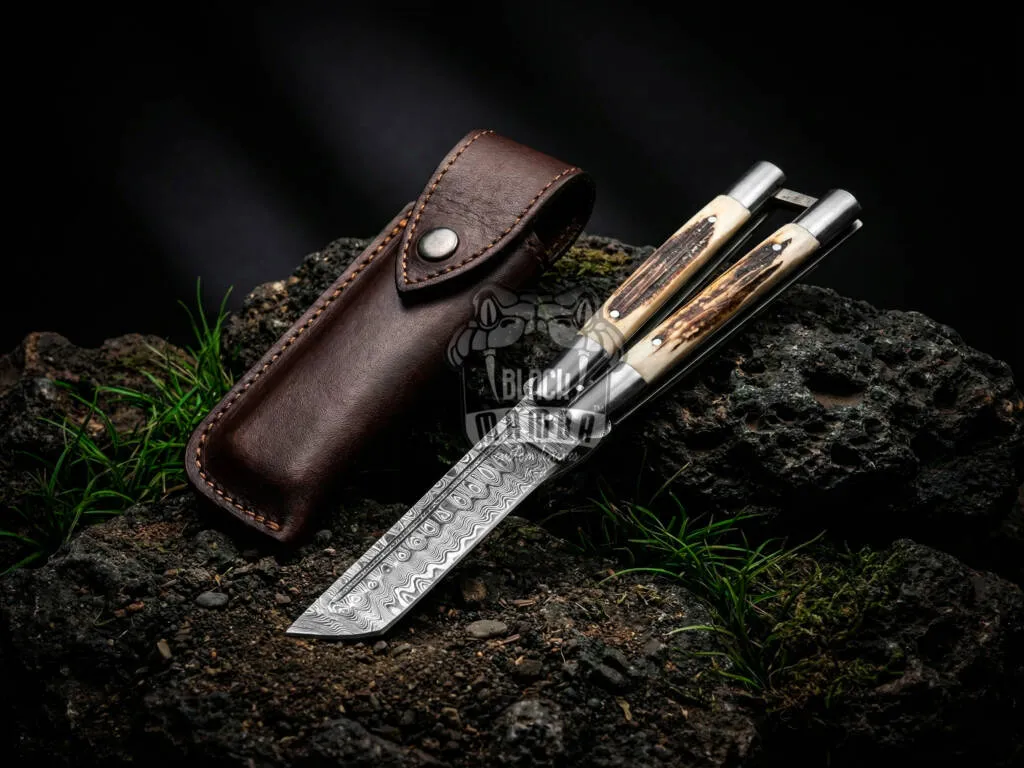
Butterfly Knife Tricks for Beginners
Start on a trainer, get smooth before fast, and learn the close before the open.
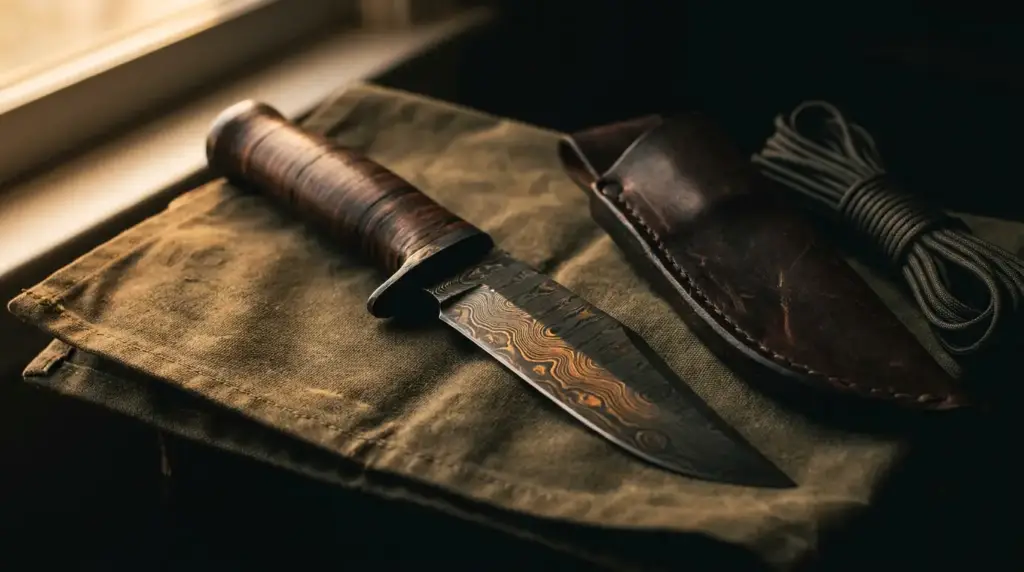
Military Knives: The Complete Buying Guide
The 1942 service pattern explained, choosing by branch and steel, engraving and unit orders, what the rules are on base, and how to claim the 15% military discount in about a minute.
