
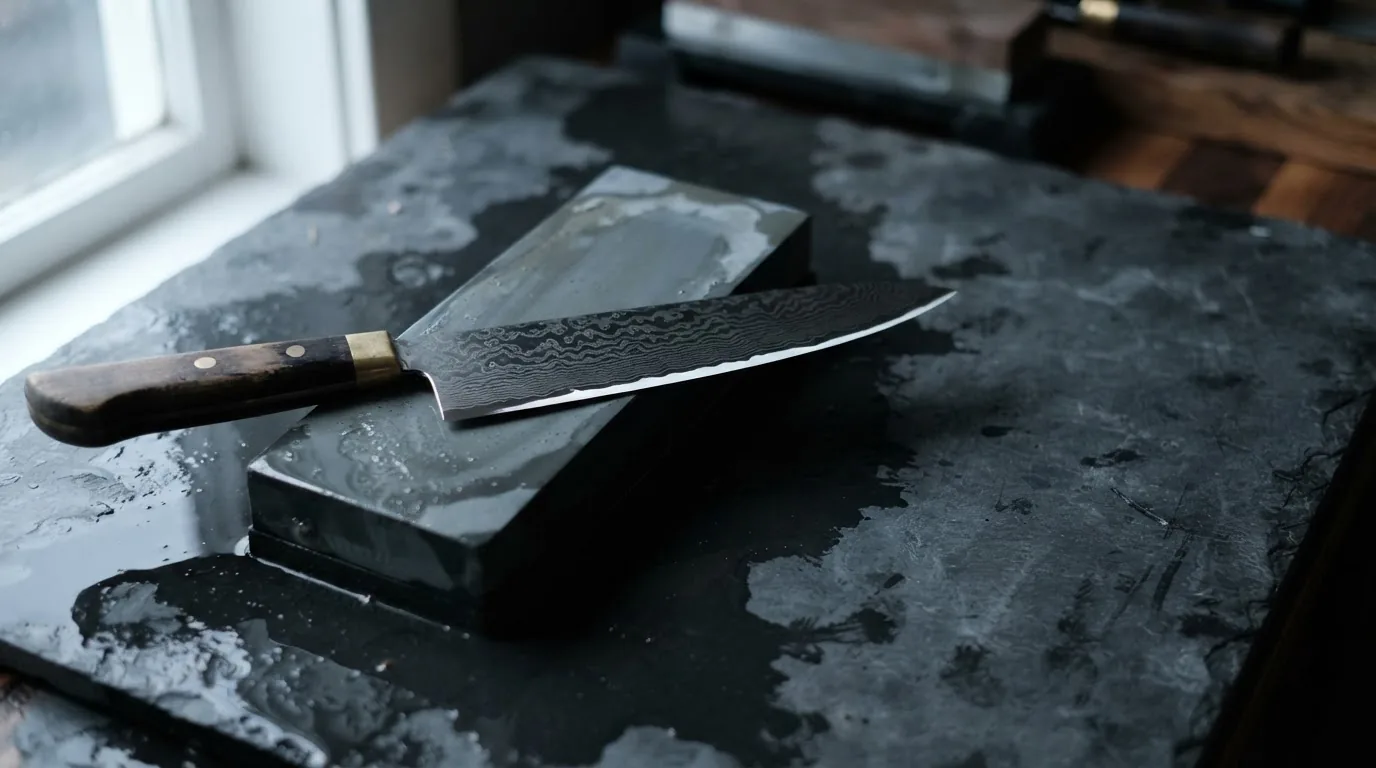
Short answer. A Damascus knife sharpens exactly like any other knife of the same hardness, on the same stones, at the same angles. What is different is cosmetic and it is real: the visible pattern is produced by an acid etch that lives in roughly the top thousandth of an inch of the surface, so the moment a stone touches the bevel that etch is gone and you are left with a bright silver band along the edge. The pattern is still in the steel underneath, but the contrast is not, and it only comes back if you re-etch. This page is about managing that band. For the actual mechanics of using a whetstone, read how to sharpen a knife instead, because we are not going to repeat it here.
What is actually different about a Damascus blade
The first is that a pattern welded blade is two steels, not one. On our knives that is 1095 and 15N20, held to 58 to 60 HRC. Both layers are simple carbon steels of similar hardness after heat treatment, so a stone does not feel a difference between them. Some sharpeners claim to feel the nickel layers dragging. At the scale of a 352 layer billet the layers are thinner than a coarse stone scratch, so what you are feeling is the stone, not the steel.
The second is the etch, which is the subject of this page and is dealt with below.
The third is that the pattern is a selling point, which changes what people are willing to do to the blade. That is a behavioural difference rather than a metallurgical one, but it shapes every practical decision below. Everything else you may have read about Damascus needing special stones or a special technique is wrong.
The pattern is in the steel, the contrast is on the surface
One camp says the pattern is only surface deep and sharpening destroys it. That is false. In a genuine forge welded billet the layers run through the full thickness of the blade. The other camp, which includes most sellers, says the pattern goes all the way through so sharpening cannot affect it at all. That is also false, and it is the more misleading of the two, because it is the one buyers hear from people taking their money.
Here is what is really going on. The layers are in the metal. The visible contrast between them is not. It is created at the end of manufacture by soaking the finished blade in acid, normally ferric chloride diluted around 3:1 or 4:1 with distilled water, for a few short passes with a scrub between each. The acid eats the 1095 layers back and darkens them while the nickel bearing 15N20 layers resist and stay bright. What you are looking at is a very shallow topography plus an oxide film. Makers who deep etch for a strongly textured feel are still working in thousandths of an inch, and a normal display etch is shallower than that.
So: a stone removes steel. Even a fine finishing stone removes a few microns per pass. Two dozen passes on a 1000 grit stone will take off more than the etch was ever deep. The layers under the new surface are untouched, but they are unetched, so they are all the same colour. Silver.
Where the bright band comes from, and how wide it gets
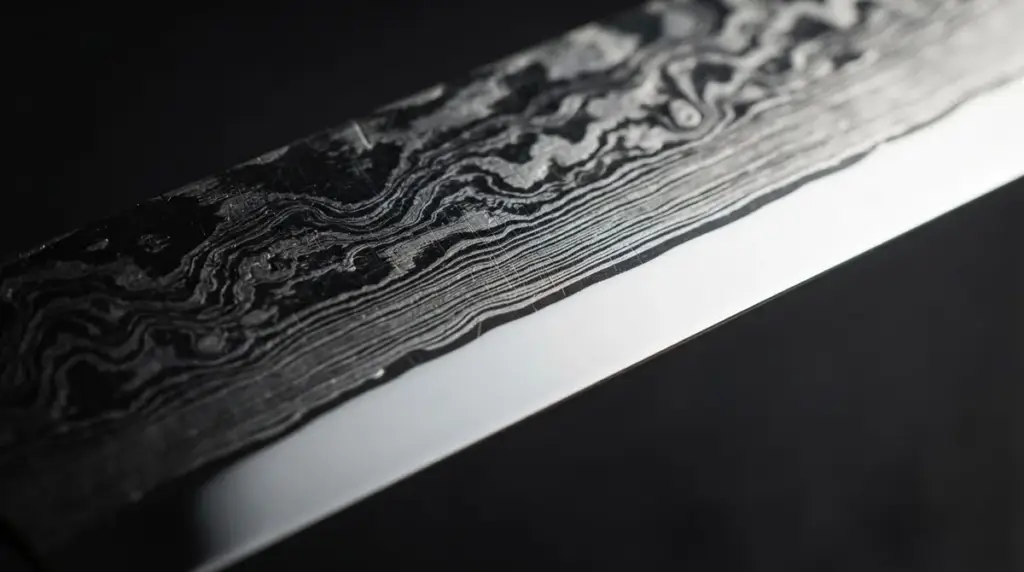
Look along the edge of any Damascus knife sharpened a few times and you will see a narrow bright strip running the length of the bevel, ending at the shoulder where the etched flat begins. That is the band. Its width is the width of your bevel, and you control it.
| What you do | Steel removed from the bevel face | What the bevel looks like afterwards |
|---|---|---|
| Strop on plain leather | Effectively none | No change. Etch survives |
| Strop with a fine compound, ten passes a side | A fraction of a micron | Etch survives on all but the last sliver at the apex |
| A few light passes on a 3000 grit or finer stone | Microns | A hairline bright line at the very apex. Most people never notice it |
| A full sharpening session on 1000 grit | Tens of microns | A clear bright band the full width of the bevel |
| Reprofiling on 220 or 400 grit | Hundreds of microns | A wide bright band, plus visible scratch pattern, plus a shifted bevel shoulder |
| Belt grinder or buffing wheel across the flat | Whatever you let it | The pattern on the flat is gone as well, not just on the bevel. This is the one that is not recoverable without a full refinish |
The rule that falls out of this table is simple and it is the single most useful thing on this page: never take a coarse stone to a Damascus knife unless the geometry genuinely requires it. Most blades that feel dull do not need coarse work. They need the burr removed and the apex refined, which is a fine stone and a strop, and which leaves the etched flats and most of the bevel alone.
Angle and grit for 1095 and 15N20 at 58 to 60 HRC
Our Damascus is held to 58 to 60 HRC, hard enough to hold a fine edge and soft enough that a thin edge rolls rather than chips when abused.
The sensible angles are conventional: around 20 degrees per side for a hunting or camp blade, 15 to 17 for a kitchen blade, 17 to 20 for a folder. Consistency beats precision, since an edge held sloppily at 18 is worse than one held exactly at 22.
The grit decision is where the Damascus part bites. Because every stone pass widens the bright band, the aim is to spend as little time as possible on anything coarse.
| Condition of the edge | Where to start | Why |
|---|---|---|
| Slides off a fingernail, will not catch | 400 to 600 grit, briefly | The apex is rounded over and needs to be re established. Accept the band |
| Catches on a nail but will not slice paper | 1000 grit | Enough to raise a burr without widening the bevel much |
| Slices paper but tears at the end of the cut | 3000 grit or a strop | Deburring work only. The band barely changes |
| Feels fine, just not scary | Strop only | Realigns the apex and removes nothing measurable |
| Chipped or badly rolled | 400 grit and accept a refinish later | Cosmetics are secondary. A chipped edge is a broken tool |
One more angle note that is genuinely Damascus specific. If you sharpen at a slightly steeper angle than the factory bevel, the stone contacts only near the apex and the band stays narrow. If you sharpen shallower, the stone rides on the shoulder and the band grows towards the flat every time. So when in doubt, go slightly steeper, not shallower. The edge will be a fraction less keen and the blade will keep looking like the one you bought.
The burr behaves normally, the polish does not
Burr formation on 1095 and 15N20 is completely ordinary. You work one side until a burr runs the full length, flip, match the passes, then take the burr down with light alternating strokes. If you are unsure what a burr feels like, the general sharpening guide covers it properly.
What is not ordinary is the polish. A mirror bevel next to a dark etched flat is a very loud visual break, because you have put the shiniest possible surface immediately beside the darkest one. Some owners love it and polish the bevel deliberately to frame the pattern. Others think it looks like a repair. If you want the bevel to disappear instead, stop at a middling grit around 1000 to 2000 and leave a satin finish, which sits much more quietly against an etched flat. It is worth deciding this before you spend an hour polishing something you will then dislike.
Keeping the band narrow: microbevel and convex
Two approaches genuinely reduce how much of the pattern you lose over the life of the knife.
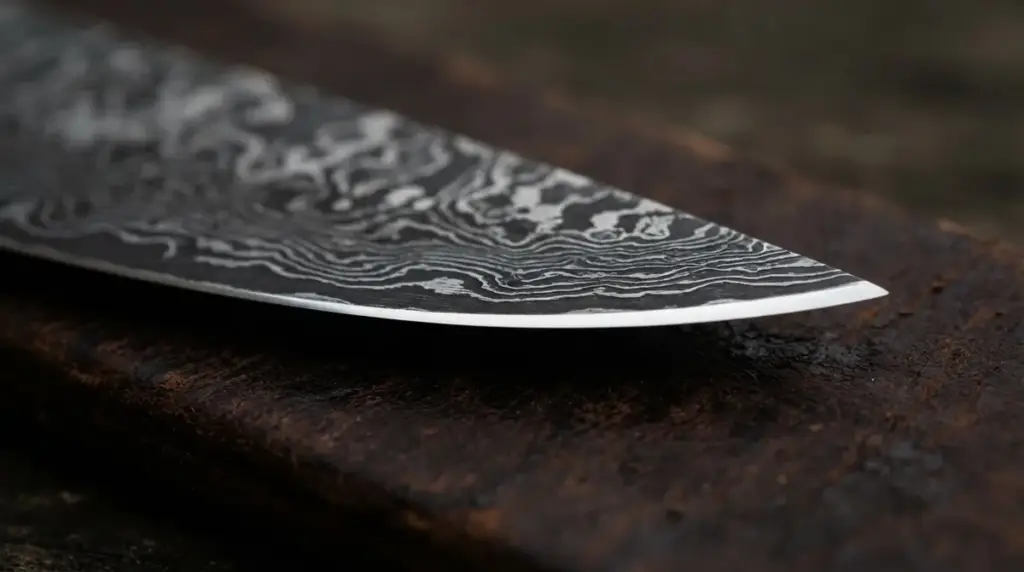
The microbevel. Sharpen the main bevel once, properly, then finish with two or three passes at about five degrees steeper. From then on, maintenance touches only the microbevel, which is a fraction of a millimetre wide. The main bevel keeps its etch for years because nothing ever touches it. The cost is that the edge is very slightly thicker behind the apex, which you will not notice on a hunting knife and might notice on a thin kitchen blade.
The convex. Sharpening on a leather or fabric backed strop with compound, or on a stone with a very slight rocking motion, produces a rounded transition instead of a hard shoulder. Because the abrasive pressure is spread and falls off away from the apex, the etch fades gradually rather than ending in a hard line, which reads far better on a patterned blade. It is also the traditional approach for thick fixed blades. The cost is that a convex edge is harder to maintain repeatably by hand and almost impossible on a clamped guide.
Both approaches accept the same premise: the pattern near the apex is going to go, so the job is to keep the affected strip as narrow as possible.
Stropping, and why it matters more here
Stropping earns its place on any knife. On a Damascus knife it earns it twice, because a strop is the only maintenance step that sharpens without removing enough steel to touch the etch.
Plain leather with no compound realigns a rolled apex and takes off almost nothing. Leather with a fine compound removes a little steel and will eventually widen the band, but so slowly that a knife stropped after every use may go a year between stone sessions. Trailing strokes only, spine first, ten to twenty passes a side, light pressure, because heavy pressure rounds the apex. Strop early and often and the pattern on your bevel will last far longer than it otherwise would.
Re-etching: what it involves and when not to bother
Restoring the pattern on a carbon Damascus blade is a genuine home job, unlike on stainless Damascus where the acids involved are considerably less friendly. The outline, drawn from what practising makers describe:
- Strip the blade back to a clean, even surface with abrasive paper, working up to something in the 1000 to 2500 range. This is also the step that removes any scratch marks from the sharpening.
- Degrease completely. Fingerprints resist the acid and will print themselves into the finished pattern.
- Mask the handle and anything you do not want etched with vinyl electrical tape.
- Mix ferric chloride roughly 3:1 or 4:1 with distilled water, never tap water. Add acid to water, not the reverse.
- Etch in short passes of three to five minutes, lifting and scrubbing the black oxide off between each, until the contrast is where you want it. Fifteen minutes of total etch time is a common figure.
- Neutralise in water with baking soda, rinse, dry completely.
- Optionally soak in cold instant coffee for an hour or two to deepen the dark layers, then oil.
- Resharpen, because the whole exercise will have dulled the apex.
Now the part a shop is not supposed to say. Most people should not do this. It is an afternoon of work with an acid that stains everything it touches, to fix a cosmetic issue on a strip of steel three millimetres wide that nobody but the owner will ever look at closely. If the knife is a user, sharpen it, strop it, and let the bevel be bright. A bright bevel on a Damascus knife is not damage, it is evidence that the knife works for a living.
Re-etching is worth it for a display piece, a knife being passed on or sold, or a blade where somebody has taken sandpaper or a buffing wheel to the flats. That last one is a refinish rather than a touch up, and it is why the flats are the one part of a Damascus blade you should never abrade.
Things that genuinely wreck a Damascus blade
- Sanding or buffing the flats. The single most common way a Damascus knife is ruined. The etch is only on the surface of the flats and there is nothing under it but silver steel. Clean the flats with a cloth and oil, never with abrasive.
- Powered grinders without heat control. Overheating draws the temper. You can soften the apex badly before the steel shows any colour, and once it is soft no amount of sharpening fixes it.
- Pull through sharpeners. They tear steel rather than cut it, set an angle you did not choose, and produce a ragged edge. Bad on any knife, expensive on this one.
- Leaving it wet after sharpening. A freshly sharpened Damascus bevel is bare, unoxidised carbon steel. It will spot faster than the rest of the blade. Dry and oil it as part of the sharpening routine, not afterwards. Our knife oil guide covers what to use.
How the answer changes by knife type
Across the 320 Damascus knives on this site, the blade lengths we could measure run from 1.5 inches to 14 inches, with a quarter under 3.1 inches, a median of 4 inches and a quarter over 6 inches. That spread means the same advice does not fit all of them.
| Knife | Angle per side | Maintenance routine | Pattern loss to expect |
|---|---|---|---|
| Kitchen and chef blades | 15 to 17 degrees | Rod or strop after most sessions, stone a few times a year | Fastest, because these get sharpened most. A microbevel pays for itself here |
| Hunting and skinning fixed blades | 18 to 20 degrees | Strop after each outing, stone once a season | Slow. Most of these show a thin band after years |
| Folders and EDC | 17 to 20 degrees | Strop weekly, stone twice a year | Slow, but the bevel is short so the band is very visible |
| Bowies and large fixed blades | 20 degrees, or convex | Convex on a loaded strop suits these best | Least visible, because the bevel is wide and the transition is gradual |
| Display and collector pieces | Leave them | Wipe and oil only | None, if you resist the urge |
One honest note about the layer count. We advertise 352 layers on most of our Damascus, and 223 of our Damascus listings state that figure. At the apex of a sharpened edge, that number does nothing for you. The layers are far thinner than the width of the cutting edge and they do not saw, grip or self sharpen, whatever you may have read. The layers are why the knife looks like that. The heat treatment is why it cuts. Those are separate claims and we would rather you hold us to both separately.
Questions people ask
Does sharpening a Damascus knife ruin the pattern?
It removes the visible contrast along the bevel, leaving a bright silver band, but it does not remove the pattern from the steel. The layers still run through the blade. The contrast comes from an acid etch on the surface, and a stone takes the surface off. Re-etching brings the contrast back.
What angle should I sharpen Damascus at?
The same angle you would use on any other knife of the same hardness and purpose: about 15 to 17 degrees per side for kitchen blades, 18 to 20 for hunting and camp knives, 17 to 20 for folders. Our Damascus is held to 58 to 60 HRC, which handles all of those comfortably.
Why has the pattern faded near the edge of my knife?
Because the edge is where the sharpening happens. That strip has been ground back below the depth of the original etch, so those layers were never in the acid. It is normal and it happens to every used Damascus knife. It is not a sign of a fake.
Can I use a pull through sharpener on Damascus?
You can, and we would rather you did not. Pull through sharpeners tear metal instead of cutting it, impose their own angle regardless of your bevel, and take off far more steel than a stone would for the same result. On a knife where every micron of removal costs you pattern, that is a poor trade.
Do the layers help the knife cut, like a serrated edge?
No. This is one of the most persistent myths in the trade. The layers in a 352 layer billet are far thinner than the apex of a sharpened edge, and carbon migrates between the layers during forging so they end up at similar hardness anyway. The pattern is visual. Cutting performance comes from geometry and heat treatment.
How do I re-etch a Damascus blade at home?
Sand the surface back and clean it, degrease thoroughly, mask off the handle, then etch in ferric chloride diluted about 3:1 or 4:1 with distilled water in passes of three to five minutes, scrubbing the oxide off between each. Neutralise with baking soda in water, dry, oil, then resharpen. Wear eye protection and gloves and do it outdoors or with real ventilation.
Will a diamond stone hurt a Damascus knife?
No more than any other abrasive of the same grit. Diamond plates cut faster, which means they widen the bright band faster for the same number of passes. That is a reason to use fewer passes, not a reason to avoid diamond.
Should I strop a Damascus knife?
Yes, and more often than you think. Stropping is the only maintenance step that keeps an edge working without removing enough steel to affect the etch. A knife stropped after each use may go a year between visits to a stone. Trailing strokes, spine first, light pressure.
My Damascus knife rusted along the sharpened edge. Why there?
Because that is the only part of the blade with no oxide film on it. The etched flats carry a thin protective layer from the acid and whatever oil was applied at the end of manufacture. A freshly ground bevel has neither. Dry and oil the edge as part of sharpening. There is more in our Damascus knife care guide.
Is honing enough, or do I need to sharpen?
If the edge still bites into a fingernail and only fails at the end of a slice, it is rolled rather than dull and a rod or a strop will fix it without touching the pattern. If it slides off a nail, it needs a stone. Honing versus sharpening goes into how to tell the two apart.
More guides
The mechanics of stones, burrs and angles are covered properly in how to sharpen a knife, and the difference between rod work and stone work in honing versus sharpening. For everything that happens between sharpenings, read Damascus knife care and do Damascus knives rust. If you want to know what the layer count means, 352 layers explained takes the number apart.
More from the workshop
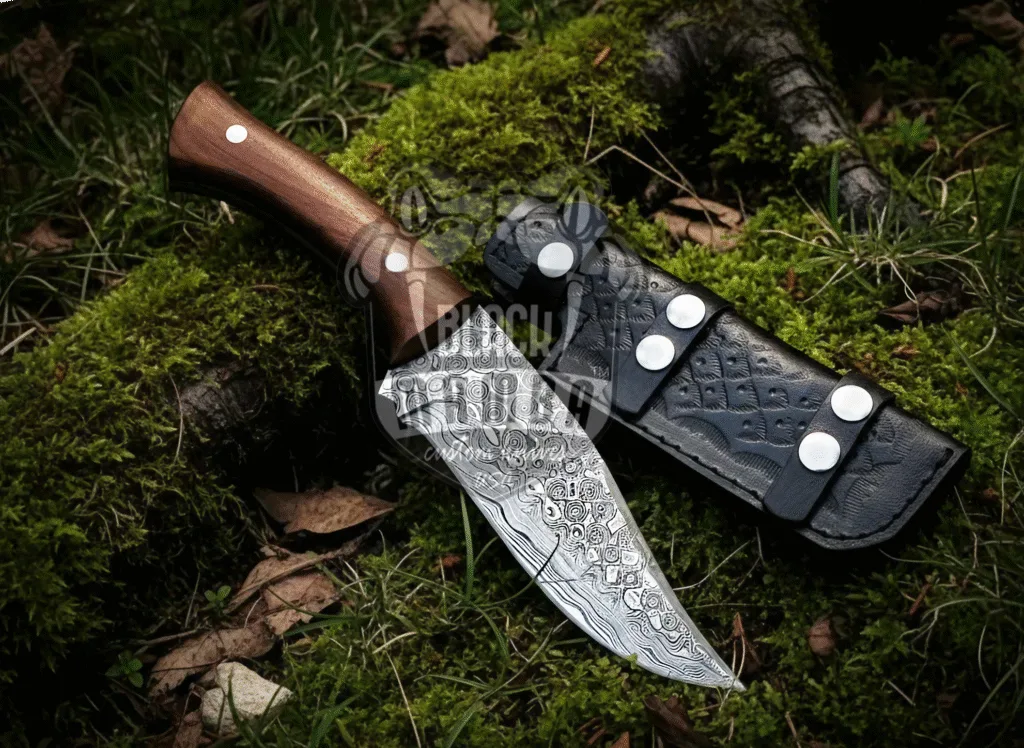
Full Tang Knife Guide: Full Tang vs Partial Tang
Knives break where the blade meets the handle. Tang is what carries that load.
How Damascus Steel Knives Are Made
Billet to blade: forge welding, folding, pattern work, heat treat and the acid etch.
Laguiole Knives Explained
A pattern, not a protected origin. The bee, the cross, the court cases and how to tell a good one.
