
A kitchen knife is the only tool in the house you touch every single day. It is worth having one made for your hand.
Start with what you are actually short of. If you own nothing, build the eight inch chef and it will handle most of what a kitchen throws at it. If you already have one, the knife that changes your week is usually a nakiri or a good paring knife, not a second chef. Then set the grind, choose a handle you will still like in ten years, and decide how it travels.
1. Which knife
If you only ever buy one, make it the chef. If you already own one, the second knife most cooks reach for is a paring or a nakiri.
2. Handle shape
3. Bolster style
A bolster sits where the handle meets the blade. A full bolster runs down to the heel, a half bolster leaves the heel free for sharpening.
4. Blade steel
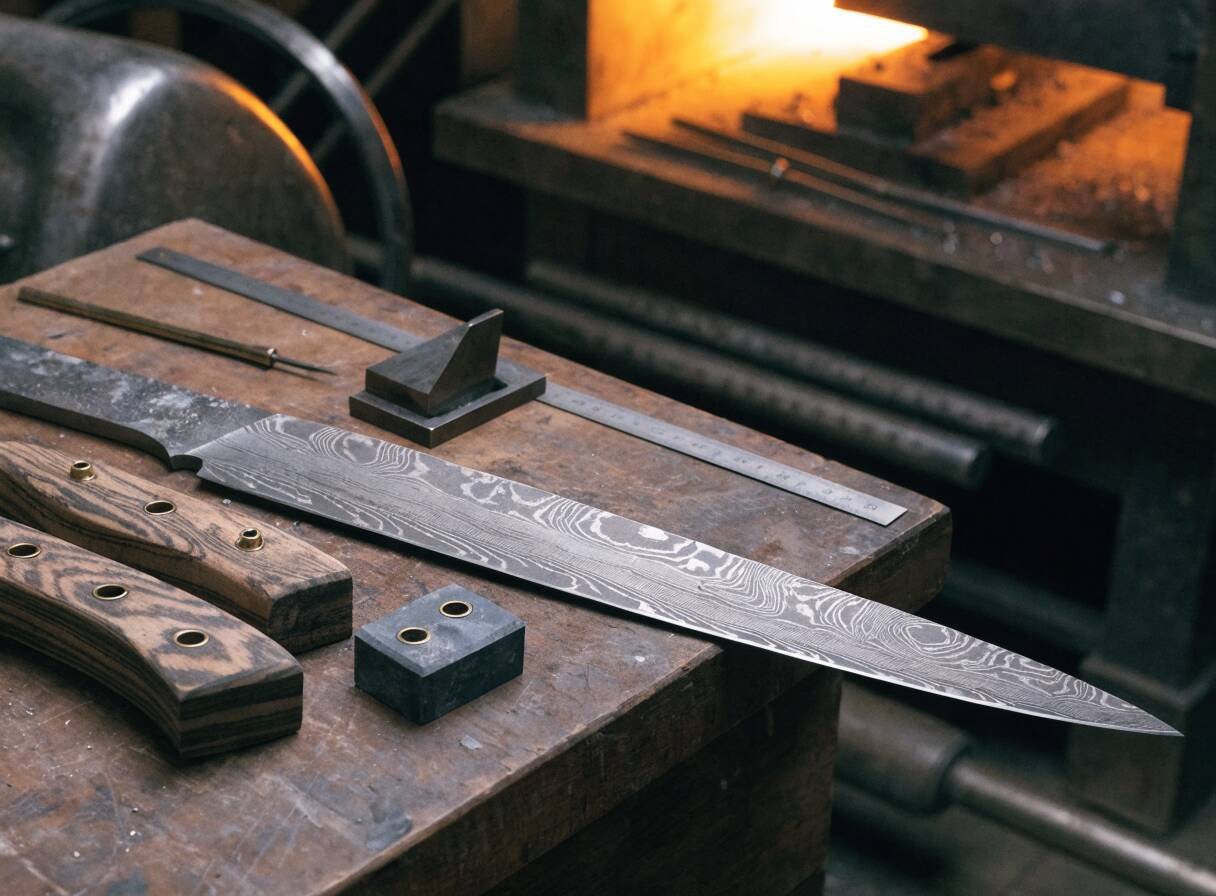
Carbon steel gets sharper and stains. Stainless stays clean and needs sharpening less often than people think. Damascus here is folded carbon steel.
5. Edge grind
A 70/30 edge steers slightly and cuts thinner. Tell us in the notes if you are left handed and we mirror it.
6. Blade finish
7. Handle material
Oiled woods want a wipe and a dry. Micarta and resin can live in a wet kitchen without thinking about it.
8. Bolster material
9. Pins
10. Engraving
Restaurant name, a wedding date, or just whose knife it is so it comes back.
11. How it travels
12. Leather Color
For any leather blade guard or roll included in your build.
13. How many?
Order 10 or more and a bulk discount is applied automatically.
14. Anything else (optional)
Ten or more - tell us what you need
Corporate gifts, groomsmen sets, restaurant kit. We quote by hand: unit price drops with volume and engraving is set up once for the whole run.
Cannot find it in the list? Design it yourself.
Pick a starting shape, move the sliders and watch the knife redraw with real measurements. Send it over and we quote it by hand.
Carbon or stainless in a kitchen
Carbon steel gets sharper and stays sharp longer at a given hardness, and it will discolour the first time it meets an onion. That grey-blue film is not damage, it is what stops the steel rusting underneath. Cooks who grew up with carbon steel would not swap. Cooks who leave a knife wet in the sink should not buy one.
Stainless is the honest recommendation for a busy household. 440C sharpens easily, forgives a night on the drainer and never marks a white board. VG-10 san mai gives you a hard cutting core wrapped in a softer jacket, which is the best of both and priced accordingly.
The grind matters more than the steel
A 50/50 double bevel works for anyone in either hand. A Japanese 70/30 edge is thinner, glides through a shallot and steers very slightly to one side as it leaves the food, which is exactly why some cooks love it and others hate it. A full convex edge is thickest at the spine and thinnest at the edge, so food falls away instead of sticking. If you are left handed, say so in the notes and we mirror the grind at no charge.
What we would build
The knife we would hand to someone setting up their first serious kitchen: eight inch chef, 440C stainless, hand satin finish, 50/50 grind, pakkawood handle in a rounded western shape, no bolster so there is nowhere for food to hide, and a leather guard. It costs less than a mid-range factory knife and it was made by one person.
Questions people ask first
Can it go in the dishwasher?
No, and neither can any good knife. The heat loosens handles and the detergent is hard on both steel and wood. Wash it, dry it, put it away. That is the whole maintenance routine.
How often will it need sharpening?
With home use and a wooden or plastic board, a few times a year on a stone, with a honing rod in between. Glass and stone boards will ruin any edge in a week, so do not use them.
What is the difference between a santoku and a chef knife?
A santoku is shorter, flatter along the edge and has a blunter tip. It chops beautifully and rocks badly. A chef knife rocks. Pick by how you cut, not by which looks nicer.
Can you engrave a restaurant name on a set?
Yes, and it is the most common thing we are asked for. For a set of ten or more use the quote route in the quantity step. The engraving is set up once and applied across the run, which is why it costs much less per knife.
Do you make left-handed knives?
Every knife here can be built left-handed. Say so in the notes and we mirror the grind and the handle shaping.
Please check your local law before ordering.
- You uploadUp to 5 pictures and your instructions.
- You pay $50A refundable deposit. It puts your brief in the queue.
- We quoteA written price, steel, size and lead time, inside two working days.
- You decideGo ahead and the $50 comes off. Say no and it is refunded.
- It is a review deposit, not a payment for a knife. Nothing is ordered yet.
- If you approve our quote, the full $50 is taken off the price of the build.
- If we cannot agree on price, or we do not think we can make it properly, or you simply change your mind, it is refunded in full to the card you paid with.
- We will not copy another maker’s trademarked design or anything we are not allowed to forge. If that is what the picture shows, we will say so and refund you.
Your pictures are only ever seen by our shop. Please check your local law before ordering.
