
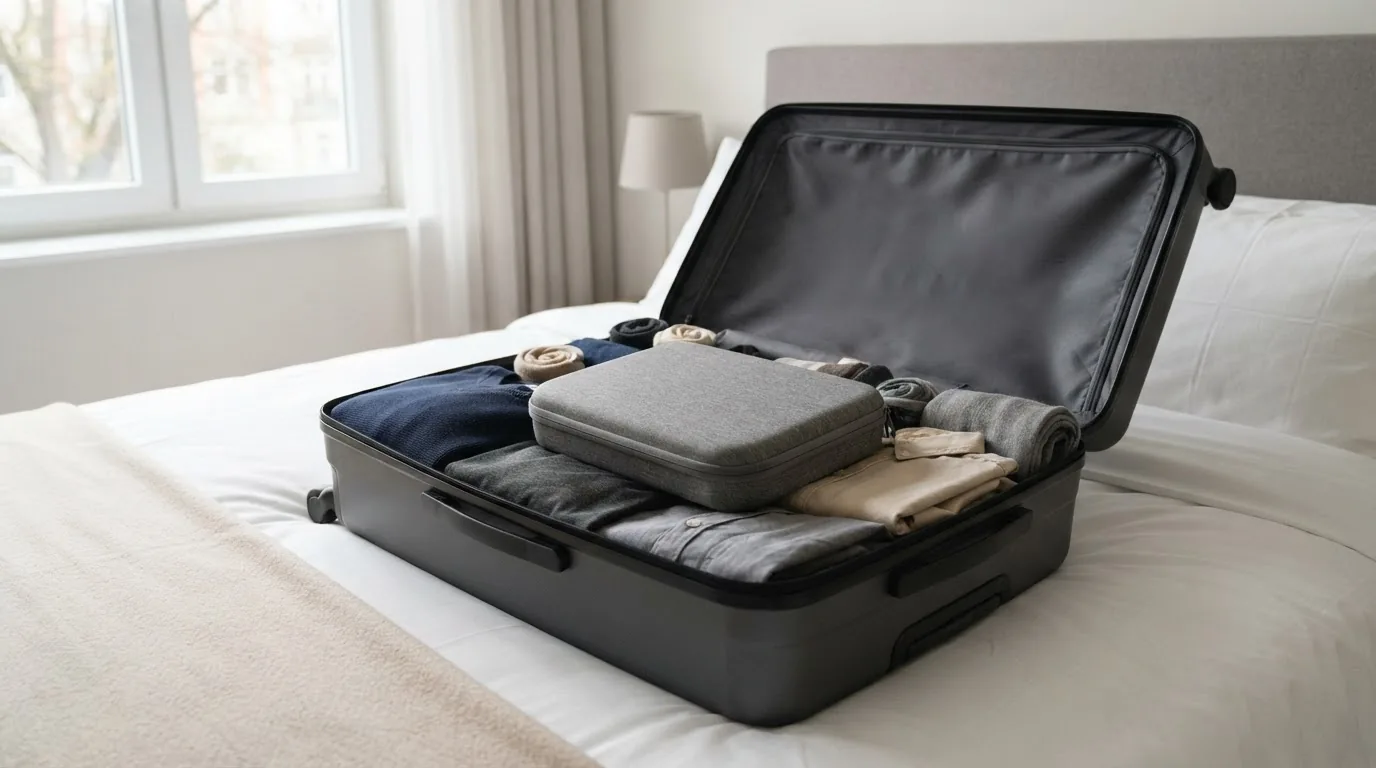
Short answer: In the United States a knife travels in your checked bag, never your carry-on, and it must be sheathed or securely wrapped. The only blades TSA lets through the checkpoint are round-bladed butter knives with blunt, unserrated edges, and plastic cutlery.
The one-line rule, and the only exceptions
TSA's "What Can I Bring?" listing gives knives a flat No for carry-on and a Yes for checked bags, with this instruction attached: "Except knives with rounded-blades, blunt edges without serration/teeth such as butter knives, or plastic cutlery. Any sharp objects in checked bags should be sheathed or securely wrapped to prevent injury to baggage handlers and inspectors."
That is the whole cabin rule. There is no blade-length allowance in the US, and no exception for a slipjoint you have carried through that airport before. Folder, fixed blade, kitchen knife, cleaver, sword — same answer at the checkpoint, all fine in the hold.
| Knives | Carry-on no, except round-bladed butter knives and plastic cutlery. Checked yes, sheathed or wrapped. |
| Multi-tool with a blade | Carry-on no. Checked yes. Bladeless is fine in the cabin. |
| Scissors | Carry-on yes under 4 inches from the pivot. |
| Loose razor blades, box cutters, cleavers, swords | Carry-on no. Checked yes. |
The legal backbone is 49 CFR 1540.111, which bars an individual from carrying a weapon while being screened, inside a sterile area, or aboard an aircraft. It is written around "weapons, explosives, and incendiaries" rather than naming knife patterns; the item-level detail sits in TSA's prohibited items list and its interpretive rule at 68 Federal Register No. 31. Its only exceptions are on-duty law enforcement and similarly authorised personnel.
What happens at the checkpoint if you forget
The knife does not fly with you. What you are offered varies by airport — walking it back to a car, handing it to someone not flying, or giving it up. TSA's public pages do not set out those options, so do not count on any of them at 6am.
What travellers underestimate is the civil penalty. TSA's civil enforcement guidance sets a range of $390 to $2,250 for bringing weapons and knives to a checkpoint, its list for that range naming automatic and gravity-opening knives, daggers, cleavers, swords and machetes. A range implies discretion, and an honest mistake with a plain folder is usually handled lightly. But the prohibition is on carrying the item, not on intending to. "I forgot" explains how the knife got in the bag; it does not undo the fact that it did.
Automatics and gravity-openers carry federal and state baggage on top of the aviation rule. Read the most illegal knife in the US and butterfly knife laws first.
How to pack a knife in checked baggage properly
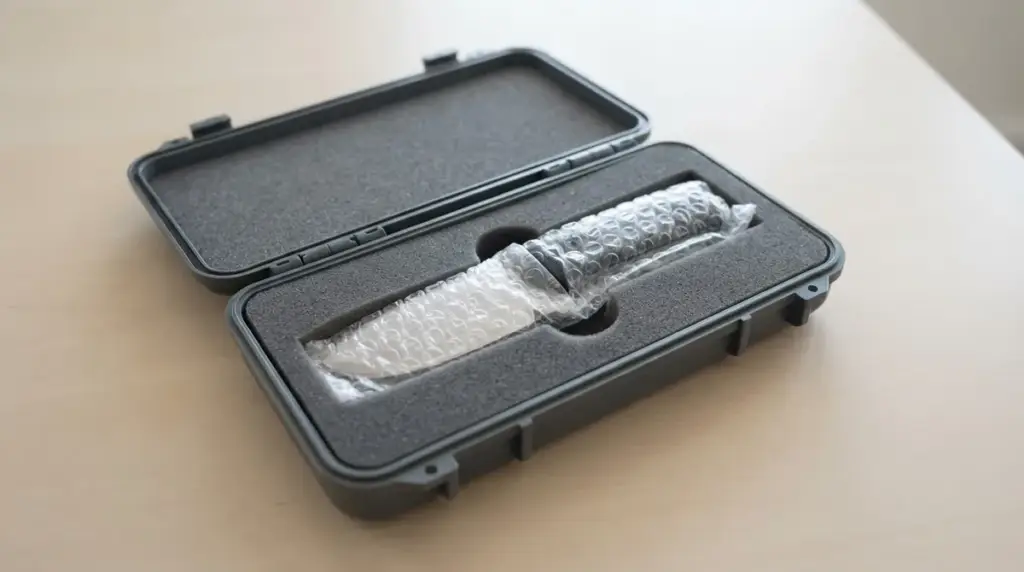
Sheathed or securely wrapped is the standard, and the reason is literal: screeners open checked bags by hand, so someone's fingers will be in there.
- Sheath first. Use the sheath it came with and fasten the retention strap so the blade cannot walk out in transit.
- Then wrap it. A sheath alone is not "securely wrapped". Add bubble wrap, a rolled towel or a padded pouch, taped shut.
- Guard the edge if there is no sheath. A slit length of garden hose, folded cardboard taped over the edge, or a blade guard. Cover the point too.
- Hard case for multiples. Loose blades knocking together chip tips and roll edges. A foam-lined case or closed knife roll keeps them apart.
- Centre of the bag. Padded on all sides, not against the outer shell where a compression strap presses it through.
The version that gets flagged is a bare fixed blade rattling loose in a duffel: alarming on the X-ray, and an officer's hands are what resolve it. The same habits protect a knife at home — see how to store knives. Wipe on a film of knife oil first, so a carbon or Damascus blade does not arrive with rust on it.
Locks, declaring, and the slip in your bag
You do not declare a knife the way you declare a firearm. The declaration requirement in 49 CFR 1540.111(c) is written for firearms and ammunition — unloaded, locked hard-sided container, declared at check-in. Knives are just an allowed checked item with a packing instruction, so check in normally.
Locks are a judgement call rather than a rule. TSA's claims guidance makes plain that officers open checked bags for physical inspection. We could not confirm the detail of its lock policy from TSA's own published guidance, so assume any lock you fit may be opened. A printed inspection notice inside the bag means it was hand-searched — the paper trail the claims process turns on, so keep it.
Multi-tools, scissors and razor blades
This is where most people get caught: the answers are not consistent, and the items live in wash bags and jacket pockets rather than luggage you think about.
Multi-tools. TSA is blunt: "Multi-tools (multipurpose tools) with knives of any length are prohibited. Please pack these items in your checked bags." Any length — the one-inch blade on a keychain tool counts. Bladeless tools are fine.
Scissors. Allowed in carry-on if the blades are "less than 4 inches from the pivot point" — measured from the pivot, not overall length.
Razors. Three answers. A disposable razor is fine. A safety razor passes only with the blade removed — "the blade must be removed prior to entering the screening checkpoint". Loose razor-type blades and box cutters are barred outright. The double-edge razor in your wash bag is fine; the packet of blades beside it is not.
Numbers change abroad: the UK and EU use a 6 cm scissor limit from the fulcrum, not 4 inches.
If a checked knife arrives damaged or missing
Against the airline. 14 CFR 254.4 requires a carrier not to limit its liability for a passenger's checked property to less than $4,700 per passenger on domestic flights with large aircraft. That is a floor on the limit, not a promise of payment, and carriers routinely restrict liability for fragile and valuable items.
Against TSA. You may claim for property lost or damaged during screening. TSA says investigation can take up to six months, that an acknowledgement letter and control number should reach you in four to six weeks, and that claims are denied where officers did not open the bag. It also tells travellers to "contact your airline for lost or missing baggage": its exposure is screening damage, not handling.
So photograph the knife before it goes in, keep the receipt and the inspection slip, and report damage before you leave the airport. A knife you cannot document is one you cannot claim for.
International and connecting flights
The airline's baggage rule gets the knife into the hold. The destination's import and possession law governs the moment you land, and a knife that was legal to check can be illegal to own or carry where you touch down. Verified examples:
- Canada. CATSA allows a blade of 6 cm or less in carry-on within Canada or to non-US destinations, but "knives of any type or length are not permitted in your carry-on on flights to the U.S." Knives opening automatically, by gravity or by pressure on a button or spring are No in carry-on and No in checked baggage, with authorities notified and possible Criminal Code charges — banned from the hold, not just the cabin.
- United Kingdom. Hand luggage guidance bars a knife with a sharp or pointed blade and/or a blade longer than 6 cm, allowing it in the hold subject to your airline. Possession law is stricter than visitors assume: the only knife you may carry in public without a good reason is a non-locking folder with a cutting edge under 3 inches. Flick, gravity and butterfly knives are banned outright.
- European Union. Attachment 4-C of Commission Implementing Regulation (EU) 2015/1998 bars from the cabin "knives with blades of more than 6 cm", scissors over 6 cm from the fulcrum, box cutters, swords and sabres. Its hold list, Attachment 5-B, covers explosives and does not restrict sharps.
- Germany. Under § 42a of the Waffengesetz, fixed blades over 12 cm and one-hand-opening knives may not be carried, and 2024 changes banned all knives at public events and on long-distance public transport. The statute's exception is transport in a locked container — a fair description of how your knife should leave the airport.
- Australia. Home Affairs bars knives and "knife-like items (whether or not made of metal) strong enough to be used as a weapon" from the cabin, allowing only plastic cutlery, blunt-ended scissors under 6 cm and a safety razor. It publishes no knife-by-knife hold list, so state possession law is what to check on landing.
Connecting itineraries inherit the strictest rule on the route: if any leg touches a country that bans the pattern outright, the knife should not be on the trip. Carrier policy can be tighter than the regulator's, and there is no consistent position across airlines that we could verify, so read your airline's conditions of carriage. This is general information, not legal advice — check your current local law and your airline before flying.
Buying a knife at your destination and getting it home
Buying abroad is the easy half. Getting it home is where US import law takes over. Under 19 CFR 12.95 to 12.103, importing a switchblade is "contrary to law" and the knife is subject to forfeiture, with narrow exceptions under 15 USC 1244 for armed forces contracts, service members on duty, and a person with one arm carrying a non-ballistic switchblade under 3 inches. The definition is broad: blades opening by button, inertia or gravity, and conversion kits.
A souvenir automatic can therefore be seized at the US border even though the airline flew it in the hold quite happily. An ordinary fixed blade or slipjoint is different: check it, wrap it, declare the purchase on your customs form. Do not carry a new knife in your pocket through the terminal — that is the commonest way a legally bought knife becomes a checkpoint problem.
What a normal traveller should do
Empty the bag you are about to carry on, physically, the night before — pockets, laptop sleeve, the zip pouch you never open. Most surrendered knives are not smuggled, they are forgotten. Put anything with an edge in the checked bag, sheathed and wrapped, in the middle of the case. Leave automatics and balisongs at home unless you have checked the law along the whole itinerary.
Then ask whether a knife you would grieve for needs to be on this trip. A modest folding pocket knife travels better; choosing an EDC knife is a sensible start, and our knife guides cover care and sharpening once you land.
Questions people ask
Can you bring a pocket knife on a plane?
Not in your carry-on. TSA lists knives as prohibited in the cabin with no blade-length allowance, so even a small slipjoint goes in checked baggage. The only blades that clear the checkpoint are round-bladed butter knives with blunt, unserrated edges, and plastic cutlery.
Can you fly with a knife in checked baggage?
Yes, in the United States. TSA permits knives in checked bags with one instruction: any sharp object should be sheathed or securely wrapped to prevent injury to baggage handlers and inspectors. There is no declaration step and no length limit. Your airline and the law where you land are the real constraints.
Is a Swiss Army knife or multi-tool allowed in carry-on?
Not if it has a blade. TSA's wording is that multi-tools with knives of any length are prohibited and must go in checked bags, so the one-inch blade on a keychain tool counts. A bladeless multi-tool is allowed. Canada permits 6 cm or less on domestic and non-US flights, which is why advice conflicts.
What happens if TSA finds a knife in your carry-on?
The knife does not travel with you, and you may face a civil penalty. TSA's civil enforcement guidance sets a range of $390 to $2,250 for bringing weapons and knives to a checkpoint. The prohibition in 49 CFR 1540.111 is on carrying the item, not on meaning to, so forgetting is no defence.
Does TSA offer a mail-back service for knives?
TSA's published guidance does not describe a nationwide mail-back programme, and we could not confirm one. Some airports have third-party mailing kiosks or postal counters near security and some do not, so do not plan around one being there. Keep the knife out of your carry-on instead.
Are scissors and razor blades allowed in carry-on?
Scissors are allowed if the blades are less than 4 inches from the pivot point, and disposable razors are allowed. A safety razor passes only with the blade removed beforehand. Loose razor-type blades and box cutters are barred from the cabin and must be checked. The UK and EU use a 6 cm limit from the fulcrum instead.
Can you take a knife on a flight to Canada or the UK?
In checked baggage, generally yes for ordinary knives, but the pattern matters. CATSA lists knives opening automatically or by gravity as prohibited in both carry-on and checked baggage in Canada, with possible Criminal Code charges. The UK allows knives in the hold subject to your airline, but its carry law exempts only non-locking folders under 3 inches.
Shop the knives
 BLACK MAMBA KNIVES Fallen 3 Inches Blade Damascus Folding Pocket Knife Hunting Tool USA Made | BMK-120
 Dugite 7.2″ Long 3.2″ Blade” 5oz Damascus Pocket Knife Handmade Damascus Pocket Folding Knife Black Mamba Hand Made World Class Knives | BMK-416
 Tsetse Fly 3.5″ Long 1.5″ Blade” 2oz Damascus Neck Knives Handmade Damascus Pocket Folding Knife with Mammoth Tooth Handle Black Mamba Hand Made World Class Knives USA Made | BMK-415
Check the law in your state and city before you order.
More from the workshop
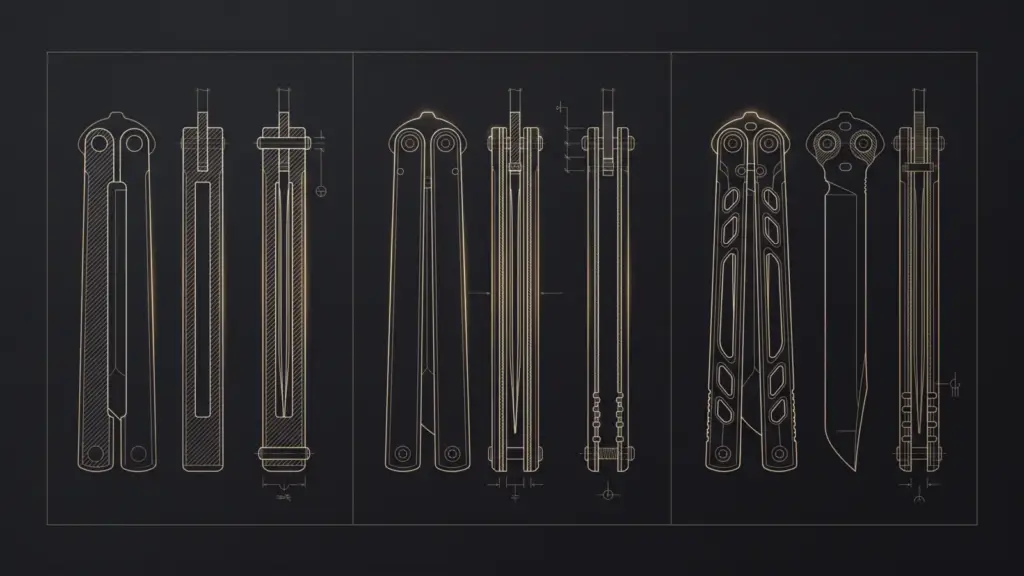
Channel vs Sandwich vs Skeletonized
Channel vs sandwich handles compared, and why skeletonized isn't really a third category.
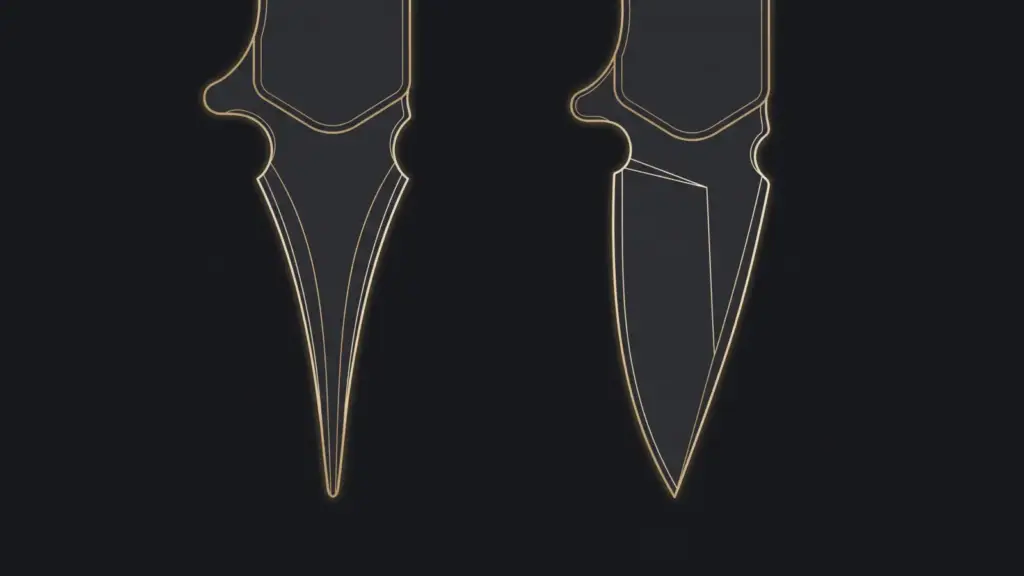
Pocket Knife Bevels Explained
Hollow grind vs sabre grind on a folder, and what each means for everyday carry.
Field Dressing a Deer: The Cuts and the Knives
The field dressing sequence in order, sorted by which knife is in your hand, with the published cooling and CWD guidance.
