
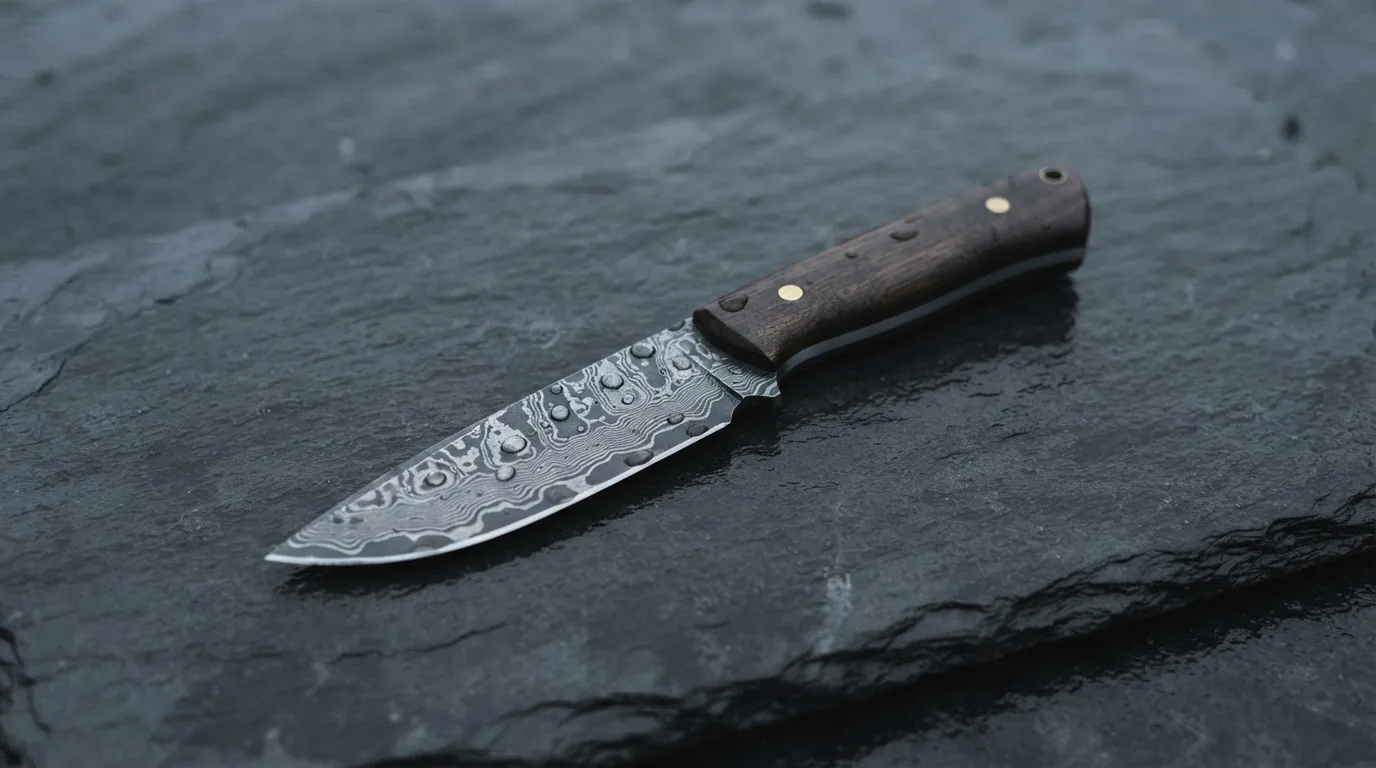
Short answer: Yes. Traditional Damascus is pattern-welded from 1095 and 15N20, and both of those are carbon steels with no meaningful chromium in them, so a Damascus blade will rust if you leave it wet, dirty or bare. It is not stainless, it was never sold as stainless, and the etched pattern that makes it look the way it does is exactly the surface that holds moisture against the steel.
Why 1095 and 15N20 rust
A Damascus billet is two steels forge-welded together and folded. We use 1095 and 15N20 for the same reason nearly every forge does: they weld to each other cleanly, they harden together predictably, and they react differently to an acid etch, which is what produces the light and dark bands.
1095 is a plain high-carbon steel — roughly one per cent carbon, a little manganese, and essentially no chromium. 15N20 is a carbon steel with about two per cent nickel in it. The nickel is there because it resists the etch and stays bright, giving you the contrast. It is not there for corrosion resistance, and at that level it does not provide any.
This is where most of the confusion starts. Nickel and chromium both turn up in stainless alloys, so people assume nickel makes steel stainless. It does not. What makes a steel stainless is chromium — around 10.5 per cent or more, dissolved in the steel, forming a passive oxide film that repairs itself. Two per cent nickel does nothing of the kind. A 1095 and 15N20 billet is a carbon steel billet from end to end, and every part of it will oxidise.
Our Damascus runs 58–60 HRC, which is a hard, keen-edged blade. Hardness has nothing to do with corrosion resistance either. A blade can hold a fine edge for a long time and still spot overnight on a damp bench.
Rust, patina and pitting are three different things
Owners send us photographs of all three and call all three rust. They are not the same, and the response to each is different.
| Patina | A stable grey, blue-grey or near-black film that forms with use. Sits on the surface, does not flake, does not spread on its own. Mildly protective. Leave it. |
| Rust | Orange to red-brown, powdery or flaky, often starting as speckles. It lifts off and takes surface metal with it, and it will keep going. Deal with it now. |
| Pitting | What rust leaves behind once it has eaten into the steel: small craters you can feel with a fingernail. Permanent. Cleaning removes the rust but not the pits. |
The practical test is colour and texture. Grey and smooth is patina. Orange and rough is rust. If you rub the spot with a soft cloth and orange comes off on the cloth, that is rust, and the clock started some time ago.
What actually causes it
- Leather sheaths. The worst offender by a distance. Leather is hygroscopic and holds moisture against the blade, and tanning residues in the hide are chemically unkind to carbon steel. A sheath is for carrying a knife, not storing one.
- Acidic food. Citrus, tomato, onion, vinegar and most marinades will darken a carbon blade in minutes and start real corrosion if left overnight.
- Sweat. Skin salts and chlorides. A blade handled all day and put away unwiped is a blade with salt on it.
- Salt air. Coastal and marine environments corrode carbon steel through nothing more than the atmosphere.
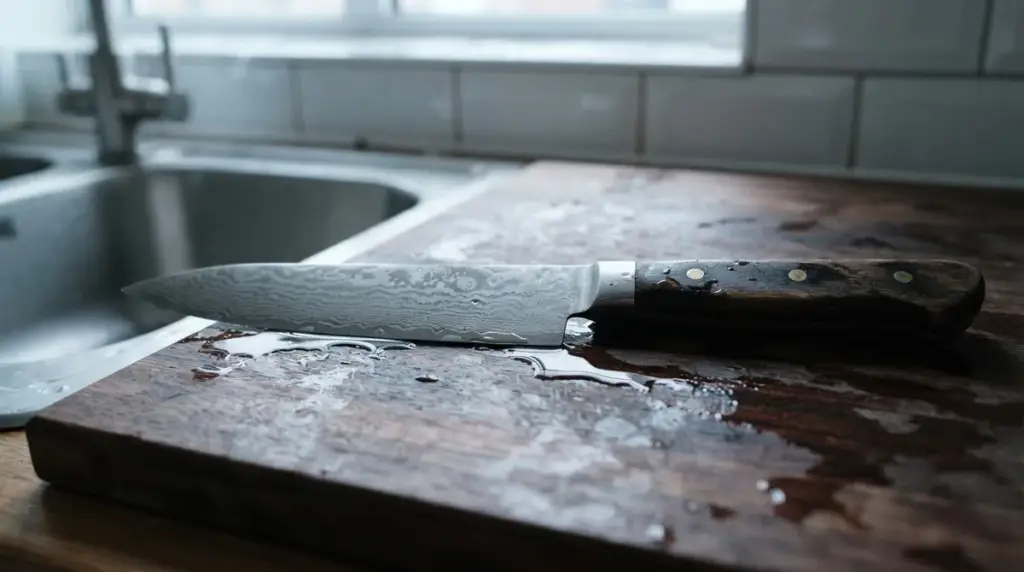
- Putting it away wet. Washed, shaken off, dropped in a drawer. Water in the etch texture, water at the ricasso, water where the blade meets the handle.
- Ambient humidity. Basements, garages, unheated storage and sealed cases with damp trapped inside them. A knife in a closed box in a humid room is worse off than one on a rack in a dry room.
A care routine that matches how you use the knife
The routine is not the same for a kitchen blade and a safe queen, and treating them alike is how people either over-service a display piece or under-service a working one.
- Kitchen. Wipe dry between tasks, not just at the end. Hand wash in warm water, dry immediately and thoroughly, then a thin film of food-safe oil before it goes back on the rack. Never the dishwasher, never left in the sink.
- Hunting and field. Clean and dry the blade the same day it is used, including where it enters the handle. Blood and stomach contents are acidic and salty. Oil before it goes back in the sheath, and take it out of the sheath once you are home.
- Everyday carry. Wipe the blade down every few days, and re-oil after anything wet or after a hot day of handling. Pocket lint holds damp against steel much the same way leather does.
- Display and collection. Check monthly. Handle it with a cloth or wipe fingerprints off afterwards, keep it out of the sheath, and keep the storage dry rather than sealed.
Which oil matters less than whether you actually apply one — we go through the options in best knife oil. Where the knife lives between uses does most of the work: see how to store knives.
Does stainless Damascus exist?
It does. Pattern-welded steel can be made from two stainless alloys instead of two carbon steels, and there are mills producing exactly that, including powder-metallurgy stainless Damascus. If corrosion resistance is your first priority and you want a pattern, it is a real option.
What you give up is contrast. The light and dark of traditional Damascus comes from two steels reacting very differently to an etch — one darkens, one stays bright. Two stainless alloys both resist the etch, so the pattern reads as a subtler play of greys rather than the sharp black-and-silver bands people picture when they think of Damascus. It is also more expensive to buy, and harder to re-etch at home if the finish ever needs refreshing.
We forge 1095 and 15N20. That is a deliberate choice for pattern and edge, and it comes with the maintenance described above.
What rust does to the etched pattern
The pattern is not printed on and it is not a coating. It is a surface state: acid has eaten the 1095 layers slightly deeper and left them dark, while the nickel-bearing 15N20 stayed proud and bright. That contrast lives in the top few microns of the blade.
Rust attacks the 1095 layers preferentially, so corrosion on Damascus tends to follow the pattern — you see orange creeping along the dark bands. Worse, the etched surface has texture, and texture holds moisture and salt. A polished stainless blade sheds a droplet; an etched Damascus blade keeps it.
The part owners are not ready for is what cleaning does. Any abrasive strong enough to lift rust also lifts the darkened layer under it, so a cleaned patch comes back bright and flat while the rest of the blade stays dark. The pattern is still in the steel, but the visible contrast is gone from that area until the blade is re-etched. Rust removal is covered in how to remove rust from a knife; restoring the etch afterwards is covered in Damascus knife care.
The single biggest mistake owners make
Storing the knife in its leather sheath. It is not close.
Every part of it works against you: the leather holds ambient moisture, it presses that moisture against both flats at once, tanning residues sit in contact with the steel, and the whole thing is out of sight so nobody looks at the blade for six months. Knives come back to us with a rust shadow in the exact shape of the sheath mouth, and by then it is usually pitting rather than rust.
Carry it in the sheath. Store it out of the sheath, dry, oiled, with air around it.
If you will not maintain it, buy 440C or D2 instead
This is worth being straight about. Damascus is a maintenance blade. If you know you will not wipe and oil it — if it lives in a truck, on a boat, in a humid workshop, or in the hands of someone who will not think about it — buy a steel that forgives that, and enjoy the knife instead of worrying about it.
| Damascus (1095/15N20) | 58–60 HRC. Carbon steel, no corrosion resistance. Best pattern and contrast. Needs wiping, drying and oiling. |
| 440C | 58–60 HRC. Genuinely stainless, high chromium. The right answer for kitchen, coastal and low-maintenance use. |
| D2 | 58–62 HRC. Tool steel with useful but partial corrosion resistance — far better than carbon steel, not stainless. Will spot if badly neglected. |
Buying Damascus and then never maintaining it gives you the worst of both: a blade that rusts and a pattern that has to be reground and re-etched to look right again. Pick the steel that matches the life the knife will have. We set out how these compare in knife steel comparison, and you can see the two stainless-leaning options at 440C stainless and D2 tool steel.
Questions people ask
Do Damascus knives rust?
Yes. Traditional Damascus is pattern-welded from 1095 and 15N20, both carbon steels with no meaningful chromium, so it corrodes like any carbon blade. Left wet, stored in a leather sheath or used on acidic food without wiping, it will show orange spots. Wiped dry and lightly oiled after use, it stays clean indefinitely.
Is Damascus steel rust proof?
No. Nothing about forge-welding two steels together adds corrosion resistance, and traditional Damascus contains no stainless component at all. Stainless pattern-welded steel does exist, made from two stainless alloys, but it is a different product with a subtler pattern. If a seller calls a 1095 and 15N20 blade rust proof, that is a reason to doubt the rest of what they say.
Does the nickel in 15N20 make Damascus stainless?
No. 15N20 carries around two per cent nickel, and it is there for the etch — nickel resists the acid and stays bright, which is what gives Damascus its light bands. Stainless behaviour comes from chromium at roughly 10.5 per cent or more, forming a self-repairing passive film. Two per cent nickel does not do that.
What is the difference between rust and patina on a Damascus blade?
Patina is a stable grey to near-black film that forms with use, sits on the surface and offers mild protection. Rust is orange or red-brown, powdery, and actively removes metal as it spreads. If you rub the mark with a cloth and orange transfers to the cloth, it is rust. Grey and smooth is patina, and you can leave it.
How do you keep a Damascus knife from rusting?
Wipe it dry after every use, including where the blade meets the handle. Wash by hand in warm water, never a dishwasher. Apply a thin film of oil before it is put away. Store it out of its sheath, in a dry place with air around it, and check it every few weeks if it is not in regular use.
Can you store a Damascus knife in a leather sheath?
Carry it in one, but do not store it in one. Leather holds ambient moisture against both flats of the blade, and tanning residues sit in contact with the steel. Long-term sheath storage is the most common cause of serious rust and pitting we see. Take the knife out when you get home and store it dry and oiled.
Does cleaning rust off Damascus ruin the pattern?
It damages the contrast, not the pattern. The dark bands are a thin etched and oxidised surface layer, and any abrasive that lifts rust lifts that layer too, leaving a bright flat patch. The layered structure is still in the steel — restoring the look means re-etching the blade rather than replacing it.
Should I buy Damascus if I will not maintain it?
No. Buy 440C at 58–60 HRC if you want genuine stainless performance with no routine, or D2 at 58–62 HRC for a tough tool steel with partial corrosion resistance. Damascus rewards a minute of care after each use with a blade nothing else looks like. Without that care it rusts, and the fix is a regrind and a re-etch.
More from the workshop
How to Sharpen a Knife on a Whetstone
Angle, burr and strop: the three things that decide whether a knife gets sharp.

Flying With a Knife
What TSA actually allows, how to pack a knife in the hold, and where the rules change once you land abroad.
Pride Knives and Rainbow Blades: Where the Colour Comes From
The four ways a knife ends up rainbow, which of them survive being owned, and how to buy a pride knife as a gift without getting a coated novelty.
