
Short answer: surface rust comes off with a rust eraser or a cork dipped in oil and a little patience. Pitting does not come off, it only gets smoothed. Start with the gentlest method and stop the moment the orange is gone.
Know which one you have
Surface rust is orange or reddish brown, sits on top of the steel, and comes off. Almost all rust people panic about is this.
Patina is grey, blue or black, forms evenly with use, and is protective. Do not remove it. On a carbon blade a good patina is the steel defending itself.
Pitting is a small dark crater where rust has eaten into the steel. The metal is gone. You can clean and smooth it, but the mark stays.
Method 1: rust eraser
A rubber block loaded with fine abrasive, sold in most hardware and fishing shops. Rub along the length of the blade, never across it, with light pressure. This is the right first choice for almost every case, and it will not wreck a finish the way sandpaper can.
Method 2: cork or wine cork and oil
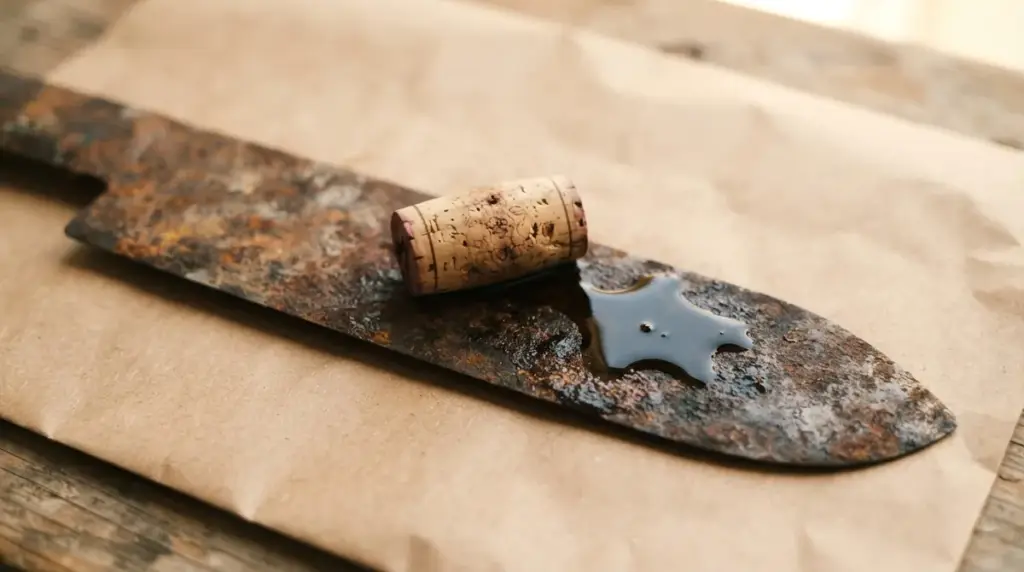
The gentlest method there is. Dip the end of a cork in mineral oil and rub the spot firmly. Cork is just abrasive enough to lift rust and far too soft to scratch steel. It takes longer. It also cannot go wrong, which is why it is what I reach for on a customer's knife.
Method 3: fine abrasive, carefully
For stubborn spots, 1000 grit wet and dry paper with oil as a lubricant, again along the blade. Work up through 1500 and 2000 to blend the area back in. This will lighten the etch on a Damascus blade in that spot, so use it last and only where you must.
What to avoid
Steel wool and wire brushes. They scratch, and on stainless they leave tiny iron particles behind that start their own rust.
Vinegar and lemon soaks. They dissolve rust, and they keep going into the good steel. On a Damascus blade an acid soak will re-etch the surface unevenly and you will not like the result.
Bench grinders and power tools. They generate heat, and heat past about 400 degrees Fahrenheit ruins the heat treatment. A knife you overheat is permanently softer and will never hold an edge again.
Afterwards, always
Wash, dry completely, and oil the blade. Rust that came back a week later means the knife was put away damp, not that the cleaning failed. Full routine in the knife oil guide.
Why it rusted in the first place
Almost always one of three things: it was stored in a leather sheath, it went away wet, or it lives somewhere humid. Leather is the biggest culprit. It is tanned with acidic compounds and holds moisture against the steel for months.
Which method to use, based on how bad the rust is
How to remove rust from a knife comes down to one judgement: how deep it has gone. The best way to remove rust from knives is the gentlest method that will shift it, and nothing harsher. Judge the blade, pick one line from the table, start there. If it works, stop. If not, move down one row, not three.
| Light spotting | A few orange freckles, steel still smooth under a thumbnail. Cork dipped in oil, two minutes. |
| Moderate surface rust | Orange patches you can feel slightly. Rust eraser along the blade, then wash, dry and oil. |
| Heavy rust | Rough orange crust over a wide area. A chelating rust remover to soften it, then a rust eraser, then 1000 grit and up to blend. |
| Pitting | Dark craters that stay dark after cleaning. Clean, oil, and accept the marks. The steel there is gone and no method brings it back. |
Two things decide the outcome more than the product you pick: rubbing along the blade, and stopping as soon as the orange is gone.
Household methods, and an honest verdict on each
Most kitchen remedies for getting rid of rust on a knife work to some degree, because rust is soft and these are either mildly abrasive or mildly acidic. The question is what they do to the good steel underneath.
- Baking soda paste — fine, and genuinely gentle. Mix baking soda with a few drops of water to the consistency of toothpaste, spread it on the rust, leave it ten minutes, then work it along the blade with a cork or soft cloth. It is alkaline, not acidic, so it will not eat the steel or the etch on Damascus. Slower than a rust eraser, and safe on almost anything.
- Potato and dish soap — a folk method that works slowly. Potato contains oxalic acid, which does dissolve iron oxide. Cut it, dip the face in dish soap, rub the spot or stand the blade in it, and give it an hour. Mild enough that you will struggle to ruin a knife with it, and weak enough that heavy rust ignores it.
- Coca-Cola — works, but you are not in control of it. The phosphoric acid in cola converts rust. It also keeps working on bare steel for as long as the blade sits there, and lifts the etch on Damascus unevenly. If you have already tried it, rinse, dry and oil at once.
- Commercial chelating rust remover — the only soak worth using. These bind iron oxide and lift it off without attacking the metal underneath, which makes them the controlled version of an acid soak. Follow the stated time, rinse, dry completely, oil. This is the right answer for a badly rusted blade you were otherwise going to sand hard.
- Naval jelly — too aggressive for a knife. It is designed for structural steel and boat fittings, not for a thin heat-treated edge and a polished finish. It will strip the rust and the look of the blade with it.
How to derust a knife, step by step
To derust a knife properly, work in this order every time and the result looks deliberate rather than scrubbed. The sequence is the same whether you are trying to get rust off a blade with one spot on it or get rust off knives that have sat in a damp drawer for a year.
- Wash the blade in warm water with dish soap and dry it fully, so grease is not in the way.
- Start with the gentlest method from the table above.
- Rub along the length of the blade. Side to side leaves cross-scratches that show forever.
- Check every thirty seconds. Removing rust from a knife goes further than you expect once it lifts.
- Wash again, dry fully including the handle join, and oil the bare steel.
The same order works to derust knives in a batch, but assess each one separately. Do not judge by the worst blade and treat all six that way.
How to get rust off a pocket knife
Rust on a folder is a different job, because the part that rusts first is the part you cannot reach. Moisture sits in the pivot, between blade and liners, and around the lock face. That is where it starts, and a rust eraser cannot reach it.
Flush the pivot with hot water, work the blade open and closed twenty or thirty times, then blow it out and dry it. Repeat with a drop of light oil worked through the same way. That carries loose oxide out rather than grinding it around inside the joint.
Stop when the action is smooth and the visible rust is gone. Do not strip a knife down to chase a spot you cannot see unless you can reassemble and re-tension it, and note that stripping some knives ends the maker's warranty. Full method in the pocket knife cleaning guide, and there is more on folder steels in the folding knives range.
Rust on kitchen and steak knives
To get rust off steak knives, the treatment is the same as any other blade, but the cause is usually one thing: the dishwasher. A dishwasher rusts knives for four reasons at once. The water is hot enough to keep the steel wet for a long cycle, the detergent is strongly alkaline and strips any protective film, the drying phase leaves steam sitting on the blade, and cutlery baskets hold knives in contact with other pieces of steel, which sets off small galvanic spots exactly where they touch.
Even 440C and other stainless steels spot under those conditions. Wash kitchen knives by hand, dry them at once, and store them where air reaches them rather than in a damp block. There is more on that in the knife storage guide.
When rust keeps coming back in the same spot
Rust on knife blades that returns to the same place is not a cleaning failure, it is a moisture trap. The usual traps are the ricasso where blade meets handle, the guard join, a folder's pivot, and anywhere a leather sheath touches steel. They hold water long after the rest of the blade is dry.
Fix the trap, not the rust. Repeat knife rust in one spot always has a physical cause. Dry that area deliberately, oil it more often, and change how the knife is stored. If it lives in leather, take it out between uses. Details on which oils hold up are in the knife oil guide.
Questions people ask
Is a bit of rust ruining my knife?
No. Surface rust is cosmetic and reversible. A blade that has been rusting for years and is pitted through has a real problem; a knife with a few orange spots does not.
Will this remove the Damascus pattern?
A rust eraser or cork will not. Heavy sandpaper will lighten the etch locally. The pattern itself is forged through the steel and cannot be removed by cleaning, only the dark etch that makes it visible.
Can a faded etch be brought back?
Yes, at home, in about ten minutes. It is covered in our care and sharpening guide.
My stainless knife rusted
Stainless means rust resistant, not rustproof. 440C and D2 both spot in salt air or long humidity. Same treatment.
How do you get rust off a knife without damaging the finish?
Use the least aggressive thing that works and rub along the blade, never across it. A cork dipped in oil handles light rust on knives without touching the finish at all. A rust eraser is the next step up and is safe on most blades. Sandpaper and acid soaks are the ones that change how a knife looks, so keep them for rust nothing else will shift.
Does baking soda remove rust from a blade?
Yes, and it is one of the safer options. Mix baking soda with a few drops of water into a thick paste, spread it over the rust, leave it about ten minutes, then work it along the blade with a cork or soft cloth. It is alkaline rather than acidic, so it lifts rust without eating into the good steel or the etch on a Damascus blade. Rinse, dry, oil.
How do you get rust off a pocket knife you cannot take apart?
Flush it rather than scrub it. Run hot water through the pivot, open and close the blade twenty or thirty times to move the water through the joint, then dry it as thoroughly as you can and repeat with a drop of light oil. That carries loose rust out of the pivot instead of grinding it around inside. Stop once the action is smooth and the visible rust is gone.
Why does the dishwasher rust my steak knives?
Four things happen at once. The blade stays wet through a long hot cycle, the detergent is strongly alkaline and strips any protective film off the steel, the drying phase leaves steam sitting on the surface, and knives touching other cutlery form small galvanic spots exactly where they contact. Stainless is rust resistant, not rustproof, so it spots too. Hand wash and dry straight away.
Is a vinegar or Coca-Cola soak a good way to remove rust from knives?
Both work and neither is controlled. Cola contains phosphoric acid and vinegar is acetic, so both convert rust, then carry on into the bare steel for as long as the blade sits there. On Damascus they lift the etch unevenly. If you want a soak, use a commercial chelating rust remover instead. Those bind the iron oxide and leave the metal underneath alone.
Why does rust keep coming back in the same spot?
Because that spot holds moisture. The usual traps are the ricasso where blade meets handle, the guard join, a folder's pivot, and anywhere a leather sheath sits against the steel. The cleaning was not the problem. Dry that area deliberately after every wash, oil it more often than the rest of the blade, and change where the knife is stored between uses.
More from the workshop
How to Choose an EDC Knife
Weight is why people stop carrying. Buy for Tuesday, not for the emergency.
Pocket Knife Laws by State
Statute-cited blade length limits, preemption states and mechanism bans, with every unverified state named.
Damascus Pocket Knives: What You Get and What You Give Up
What a Damascus folder is, what 111 of our own listings show, and what it does worse than stainless.
