
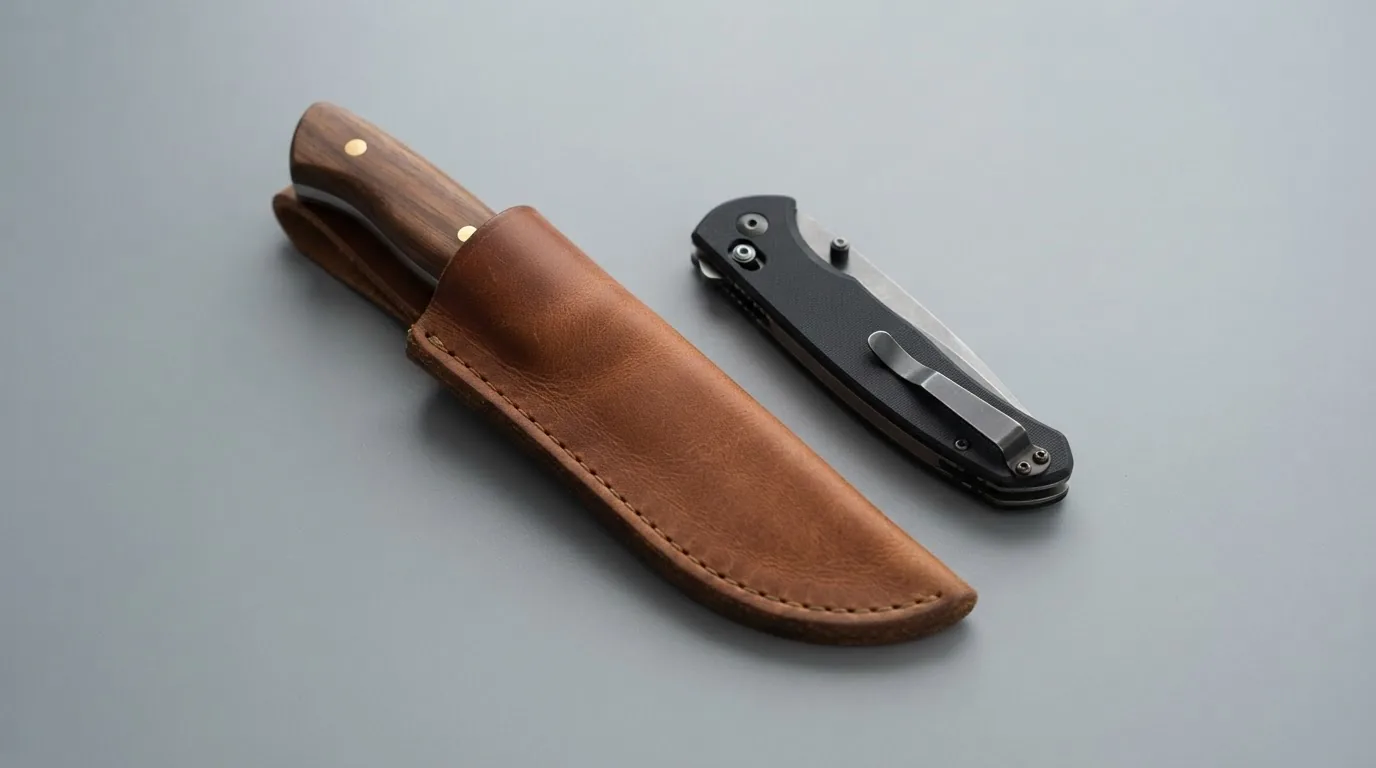
Short answer. For most people, most days, a folder is the right knife to carry. Not because it is stronger, it is not, but because a folder goes in a pocket without a sheath, attracts no attention, and is treated more leniently almost everywhere. A fixed blade wins on two things that matter enormously in a narrow set of jobs: it can be cleaned completely, and it has no mechanism to fail. If you process food or game, buy a fixed blade. If you open boxes and cut string, buy a folder. We sell more fixed blades and they carry the better margin for us, and we still think most buyers should walk out with a folder.
The strength argument is settled, and it is not the point
Every comparison on this subject opens with strength, so let us dispose of it. A full-tang fixed blade is one continuous piece of steel from tip to butt with scales bolted to it. There is no joint. A folder has a pivot and a lock, which means there is a hinge exactly where the leverage is highest. On that basis the fixed blade wins and it is not close.
The reason this matters less than it sounds is that almost nobody loads a knife anywhere near its limit. Cutting rope, opening packaging, trimming a lanyard, breaking down a box, slicing an apple: none of these come close to stressing a modern lock. Locks fail when people pry, baton, stab into hard material or use a knife as a lever, and those are all things you should not do with either kind of knife.
So yes, the fixed blade is stronger. Decide on something else.
Cleaning is the first real difference
A fixed blade has no cavity. You can wash the whole thing, dry the whole thing, and see that you have done it. There is nowhere for anything to hide.
A folder has a slot the blade lives in, a pivot with washers or bearings, a lock face and usually a lock spring, and on most designs the only way to get into all of that is to take it apart. Pocket lint, dust and grit accumulate there over months. If you cut food with it, so does food. If you cut game with it, so does blood and fat, which set hard and then sit against carbon steel.
This is why the food and game answer is not a close call. A folder used for food processing is very hard to actually sanitise, and a folder used on an animal is very hard to sanitise and also very hard to keep from rusting inside where you cannot see it. It is also why kitchens have no folding knives in them at all.
For dry everyday cutting this is a maintenance chore, not a hazard. Flush the pivot, blow it dry, put a drop of oil in, and get on with your life.
The law is the second real difference, and it is the one that catches people
We are not lawyers and this is not legal advice. What we can tell you is the shape of the problem, because it is consistent even though the details are not.
In the United States, knife rules are set at state level and then often again at city or county level, and they vary a great deal. The recurring themes are these. Fixed blades are much more likely than folders to be treated as restricted when carried concealed, because a sheathed blade under a coat is what most concealment language was written about. Blade length limits exist in many places and the number differs from one jurisdiction to the next. Some places distinguish open carry from concealed carry, and a fixed blade worn visibly on a belt may be legal in a jurisdiction where the same knife under a shirt is not. Schools, courthouses, airports, government buildings and many private premises have their own rules that are stricter than the surrounding jurisdiction.
A folder in a pocket sits inside almost every one of those allowances. A fixed blade very often does not. That single fact decides the question for a lot of people before any of the performance arguments get a hearing. Please check your local law before ordering, and check it for the specific city you actually live in rather than the state.
Carry: a sheath is a commitment
A folder disappears. It clips inside a pocket or drops into one, it weighs a few ounces, and nobody sees it until you use it. That is why folders get carried every day and fixed blades get carried on the days you planned for.
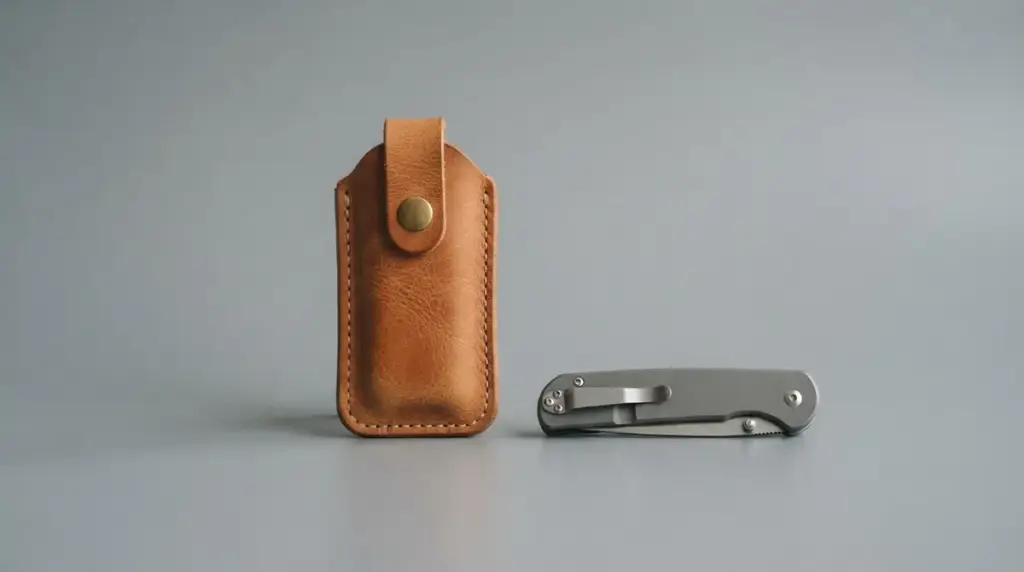
A sheath has to go somewhere. On a belt it needs belt space and it prints through a shirt. On a pack it is not on you when you set the pack down. Around the neck it works for a small blade and becomes silly for a large one. In a bag it is safe and legal in more places and also slower to reach than a knife in a pocket.
The honest test is not which knife you would rather own. It is which one you will still have on you in six weeks. Most people answer that with a folder, and the best knife is the one that is present.
Deployment, and the case for the fixed blade being simpler
A fixed blade is ready. Draw and cut. There is nothing to operate and nothing to get wrong, and that stays true with cold hands, wet hands, gloves, or one hand occupied holding whatever you are cutting.
A folder needs opening, and then it needs closing, and closing is where people get cut. The edge travels back through the handle your fingers are wrapped around, and doing that in a hurry or with slippery hands is how most folder injuries happen. A one hand opening feature helps with the first half of that problem and does nothing about the second.
If your use case involves gloves, cold, wet, or one hand already full, that is a genuine argument for a fixed blade regardless of everything else on this page.
What our own catalogue actually says
These are our published numbers as of today, not industry averages.
| Figure | Folding pocket knives | Hunting fixed blades |
|---|---|---|
| Published products | 111 | 133 |
| Lowest price | 70 dollars | 73 dollars |
| Median price | 128 dollars | 201 dollars |
| Highest price | 845 dollars | 938 dollars |
| Typical carry method | Belt sheath | |
| Cleaning | Pivot needs flushing and oiling | Wash and dry the whole knife |
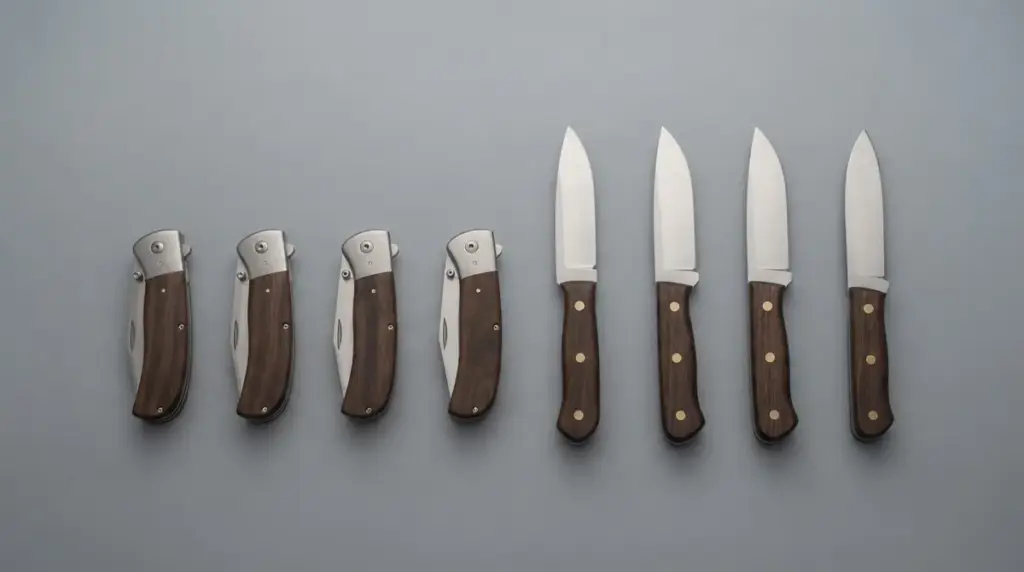
Two things fall out of that. The first is that a fixed blade from us costs meaningfully more at the median, and the gap is roughly 73 dollars. Some of that is more steel and a sheath, and some of it is that our fixed blades skew toward larger and more decorated pieces. The second is the inconvenient one: fixed blades are the better business for us, and we are still telling you that a folder is the right first knife for most buyers.
One more thing we should own. Of our 609 published products, 536 state a blade length in the description and 73 do not. If blade length matters to you legally, and on a fixed blade it very often does, check the listing before you order and ask us if it is not there. That gap is on us to close.
Head to head, on the things that actually decide it
| Criterion | Fixed blade | Folder | Who wins in practice |
|---|---|---|---|
| Ultimate strength | No joint, no lock to fail | Pivot and lock under load | Fixed blade, but rarely tested |
| Cleaning and sanitation | Fully accessible | Enclosed pivot traps material | Fixed blade, decisively |
| Carrying it every day | Needs a sheath and belt space | Pocket, invisible | Folder, decisively |
| Legal simplicity | More often restricted, especially concealed | More often permitted | Folder |
| Speed to first cut | Draw and go | Open, then close carefully | Fixed blade |
| Closing safety | Nothing to close | Edge passes the gripping hand | Fixed blade |
| Blade shape freedom | Any length or profile | Blade must fit inside the handle | Fixed blade |
| Weight for the same blade length | Lighter, less hardware | Heavier per inch of edge | Fixed blade |
| Being unremarkable in public | Draws attention | Nobody notices | Folder |
| Cost at our median | 201 dollars | 128 dollars | Folder |
Which one for the job you actually have
| What you do | Buy | Why |
|---|---|---|
| Open boxes, cut cord, everyday pocket work | Folder | It will be with you, and nothing here stresses a lock |
| Process game or butcher at home | Fixed blade | Sanitation, and no cavity for blood and fat to sit in |
| Cook | Fixed blade | Kitchen knives are fixed blades for exactly these reasons |
| Camp, bushcraft, wood processing | Fixed blade | Load, grip length and the ability to work with gloves on |
| Fish | Fixed blade | Wet hands, flex, and a knife you can rinse completely |
| Carry in a city with tight rules | Folder | The legal path of least resistance, subject to your local law |
| Trade work in and out of buildings | Folder | Premises rules will bite you before the law does |
| Give as a gift to someone who does not carry a knife | Folder | They will actually use it |
If you buy a fixed blade, buy these things
Buy full-tang. A partial tang saves the maker steel and costs you the joint you did not want. Check that the steel runs the length of the handle and shows at the butt.
Buy a sheath you will actually wear. A beautiful knife in a sheath that rides badly gets left at home. Check the retention with the sheath upside down before you trust it.
Buy a handle that works wet. Smooth polished wood and polished horn look magnificent and turn slippery the moment they are greasy. Texture matters more than material.
Buy the length you need and not the length you want. A four inch blade does almost everything a seven inch blade does and it is legal in far more places and easier to control in close work.
The recommendation, stated plainly
If you are buying one knife and you do not already know why you want a fixed blade, buy a folder in the 100 to 150 dollar range, carry it for three months, and see what it fails at. That is real information and it costs you a knife you will keep anyway.
If it fails at cleaning, or at cold hands, or at the size of the job, buy a fixed blade next and you will know exactly what to buy. Most people never get there, and that is fine. The two knife answer, a folder every day and a fixed blade for planned work, is the honest end state for anyone who does both kinds of cutting, and there is no reason to buy both on the same day.
Questions people ask
Is a fixed blade always stronger than a folder?
In terms of ultimate load, yes. A full-tang fixed blade has no joint and a folder has a hinge where the leverage is highest. It matters far less than it sounds, because ordinary cutting never approaches those limits.
Which is better for everyday carry?
A folder, for almost everyone. It carries without a sheath, it is unremarkable in public, and it sits inside the rules in more places. The best knife is the one you still have on you in six weeks.
Can I carry a fixed blade legally?
Sometimes, and it depends where you are. Rules are set by state and often again by city, blade length limits vary, and concealed carry of a fixed blade is restricted in many places where open carry is not. Please check your local law before ordering. We cannot advise on your jurisdiction.
Why do kitchens never use folding knives?
Because a folder cannot be properly cleaned. The pivot cavity holds food residue and moisture, and there is no way to inspect it without taking the knife apart. Every professional food environment uses fixed blades for that reason alone.
Is a folder safe to use?
Yes, with one habit. Most folder injuries happen on closing, not opening, because the edge travels back through the hand holding the handle. Close it deliberately, with the blade path clear of your fingers, every single time.
What blade length should I get?
For a folder, three to three and a half inches covers nearly all everyday work and stays inside more legal limits. For a fixed blade, four inches does almost everything a longer blade does and is easier to control. Longer blades are for specific jobs, not for general capability.
Do I need a folder and a fixed blade?
Only if you do both kinds of cutting. If your knife work is pockets and packages, one folder is the whole answer. If you also process food or game, you need a fixed blade for that work and you should not use it as your carry knife.
Are folders harder to maintain?
Yes. A fixed blade needs sharpening and drying. A folder needs sharpening, drying, and periodic flushing and oiling of the pivot. It is ten minutes every few months, not a burden, but it is real and nobody tells you about it at the point of sale.
Which is better value?
In our catalogue a folder is cheaper at the median, 128 dollars against 201 dollars for a hunting fixed blade. Some of that is genuinely less material, and some of it is that our fixed blades skew larger and more decorated. Compare like for like on steel and hardness rather than on category.
Should I worry about lock type?
Less than the internet suggests. Liner, frame, back lock and modern bar locks are all adequate for cutting. What matters more is whether the lock disengages cleanly and whether your fingers are out of the blade path when it does. Handle the knife if you can.
More guides. To narrow down a carry knife, start with how to choose an EDC knife. On construction, read full tang versus partial tang. Before you carry anything, check pocket knife laws by state. To browse, see our folding pocket knives and hunting fixed blades.
More from the workshop
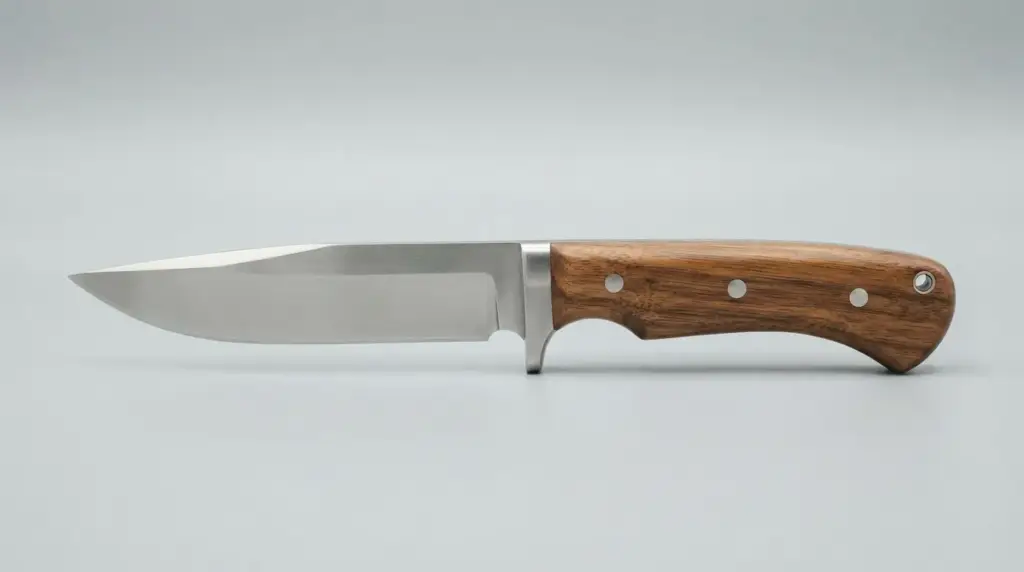
Knife Anatomy: Parts of a Knife Explained
Tip to butt, plus folder and sheath parts - the reference table for ricasso, choil, swedge, tang and the rest.
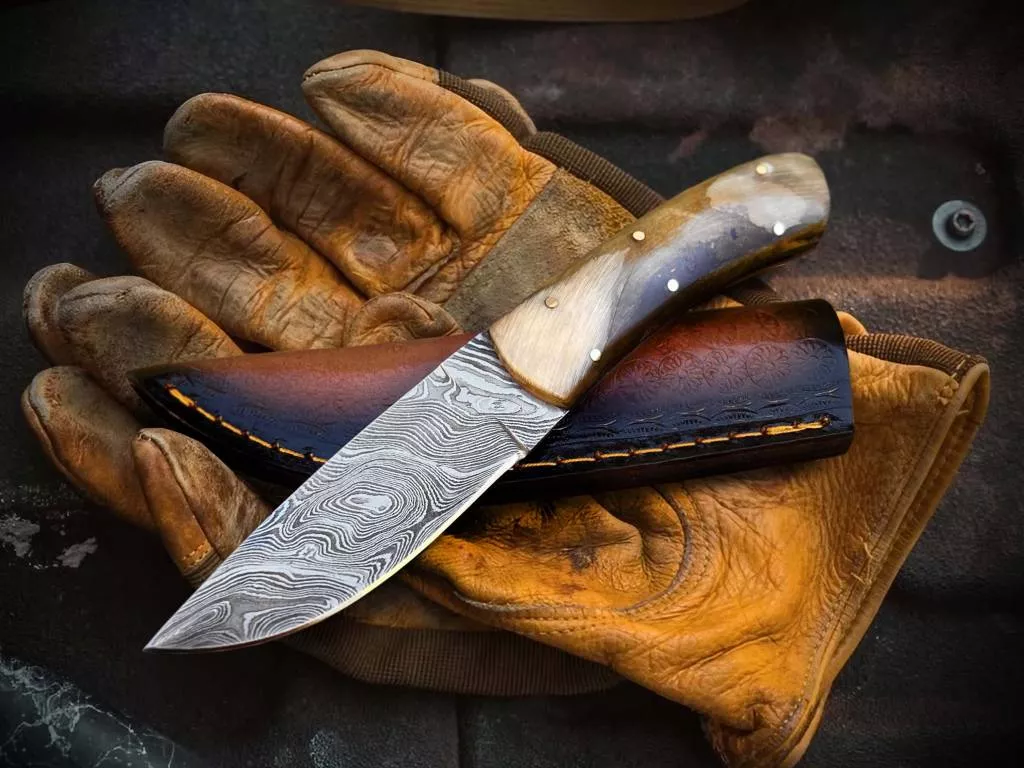
Skinning Knife Guide
Wide belly, low point, three to four inches. Why the shape looks the way it does.
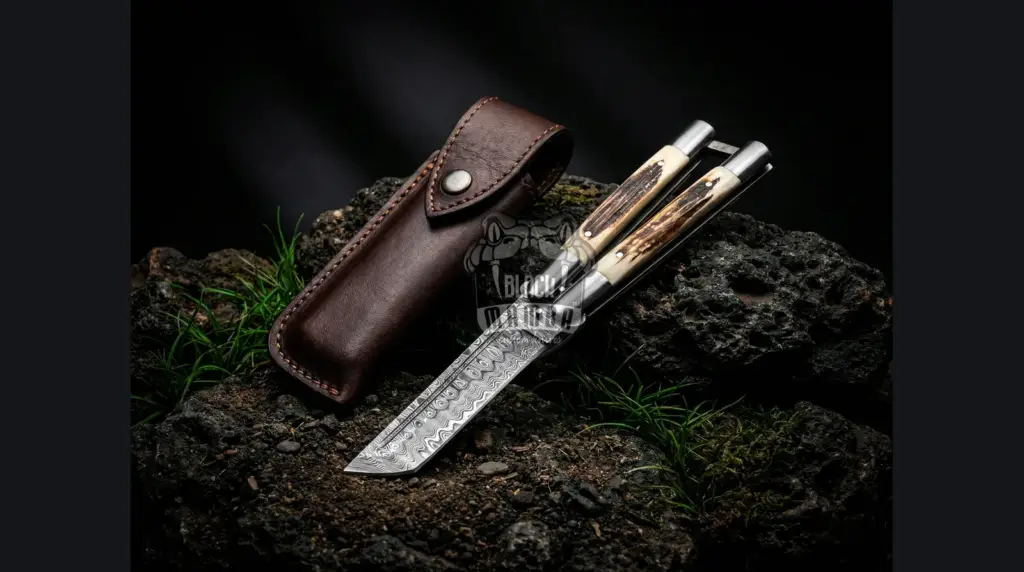
Butterfly Knife Laws in the US: How to Check Your State
Why federal law rarely applies, and how to check your own state properly.
