
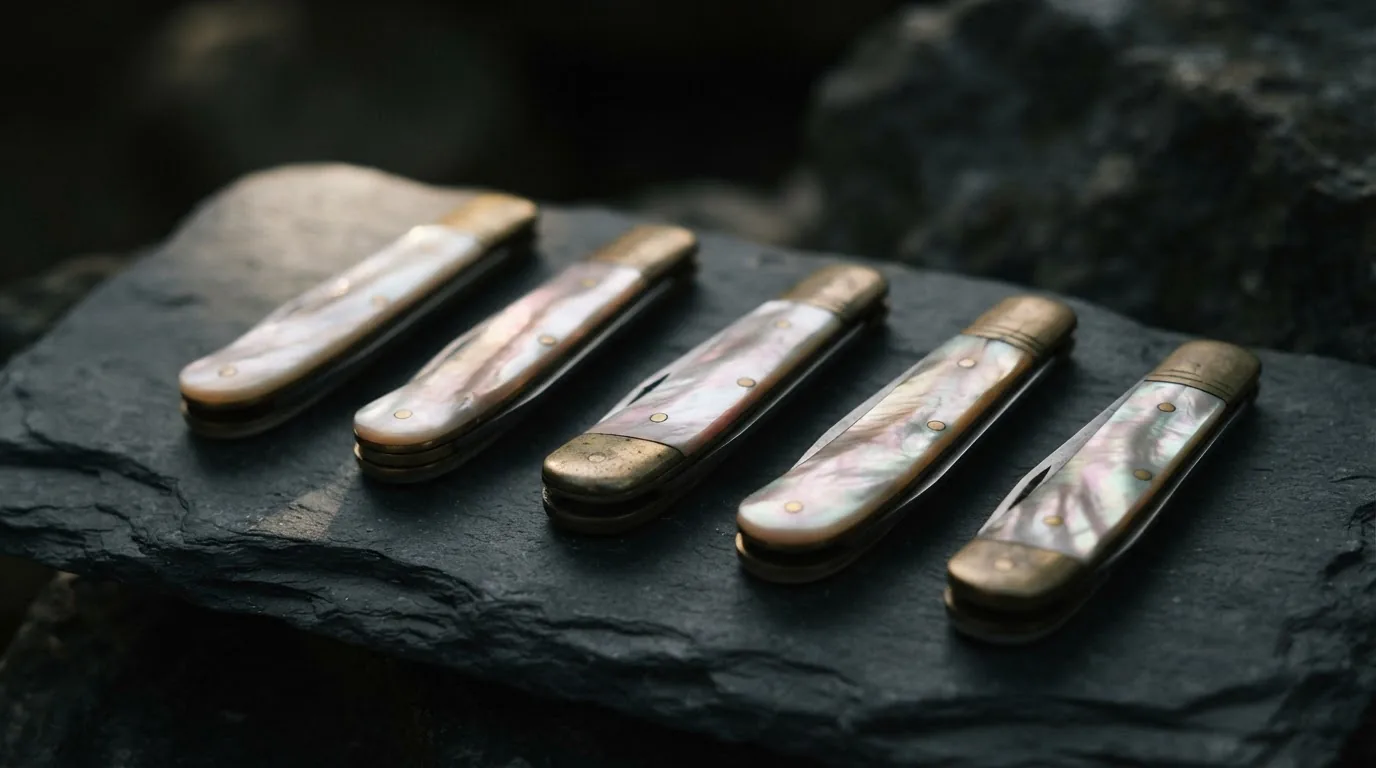
Short answer: Pearl shell, abalone, stag, bone and horn are chosen for how they look, not for how they perform. Shell is the most beautiful and the most fragile: it chips at the edges and cracks if a knife is dropped. Stag and horn move with humidity and can shrink away from steel bolsters. Bone yellows. None of that is a defect, it is the material behaving as material, and it is the reason a pearl handled knife on this site costs about twice what the same blade costs in wood.
What counts as an exotic and why people want it
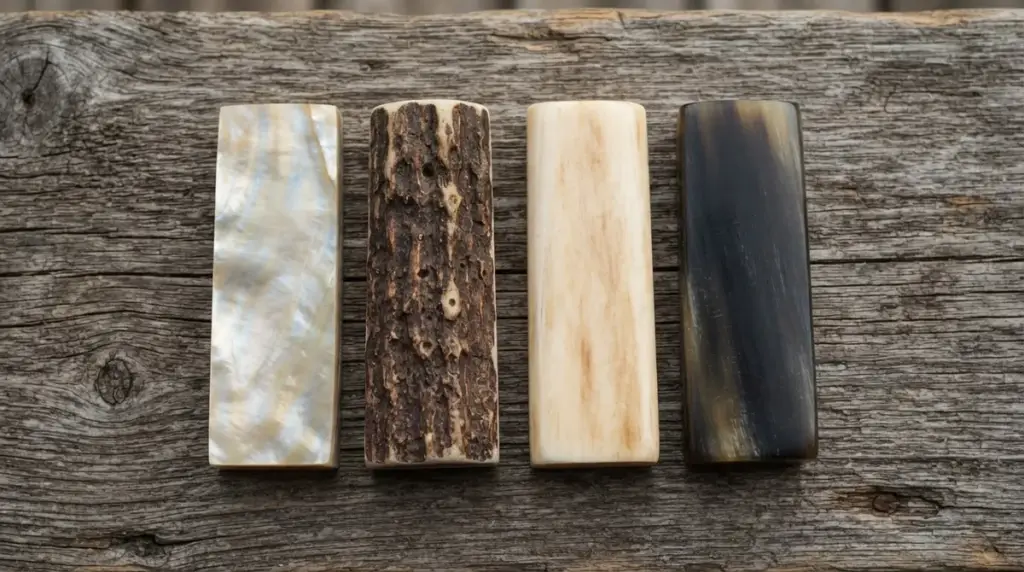
Exotic is a trade word rather than a technical one. In practice it means a handle material that is organic, visually unrepeatable and awkward to work: pearl shell, abalone, stag antler, bone, horn, and at the margins things like camel bone and mammoth. What unites them is that no two pieces are the same and none of them can be ordered by the sheet.
That last point drives everything else in this guide. Micarta and G10 arrive as flat stock in known thicknesses with known properties. A slab of black lip pearl arrives as a curved piece of a shell that grew on a reef, with a natural thickness limit, internal flaws you cannot see until you cut, and a colour that shifts across the piece. A maker who wants matched scales on both sides of a knife has to cut them from the same shell, in the same orientation, and accept a high scrap rate. You are paying for the scrap as much as for the shell.
Mother of pearl: the material and how it fails
Mother of pearl is nacre, the iridescent inner lining of certain shells. Knife makers separate it by shell: white or silver lip, mostly from Australia; gold lip from the South Pacific; and black lip from French Polynesia, which suppliers describe as increasingly difficult to obtain in usable sizes. The colour and the depth of the flash come from the shell, not from any treatment.
The practical constraints are unusually tight. Working stock thinner than about an eighth of an inch starts to look translucent and loses the visual depth people buy pearl for, and finished scales typically sit somewhere between a tenth of an inch and three sixteenths. That is thin. It is also brittle across its layers, which is why pearl fails the way it does: not by wearing out but by chipping at an exposed corner, or by cracking outright if the knife lands on a hard floor.
Two further working notes that buyers rarely hear. Shell must not be allowed to get hot while it is being ground, because heat leaves a burn mark deep in the material that cannot be polished out. And grinding shell produces a dust that shops handle with extraction and a respirator. Neither of those affects you as an owner, but both are why pearl work is slow and why the labour cost is real rather than a markup story.
Abalone and paua
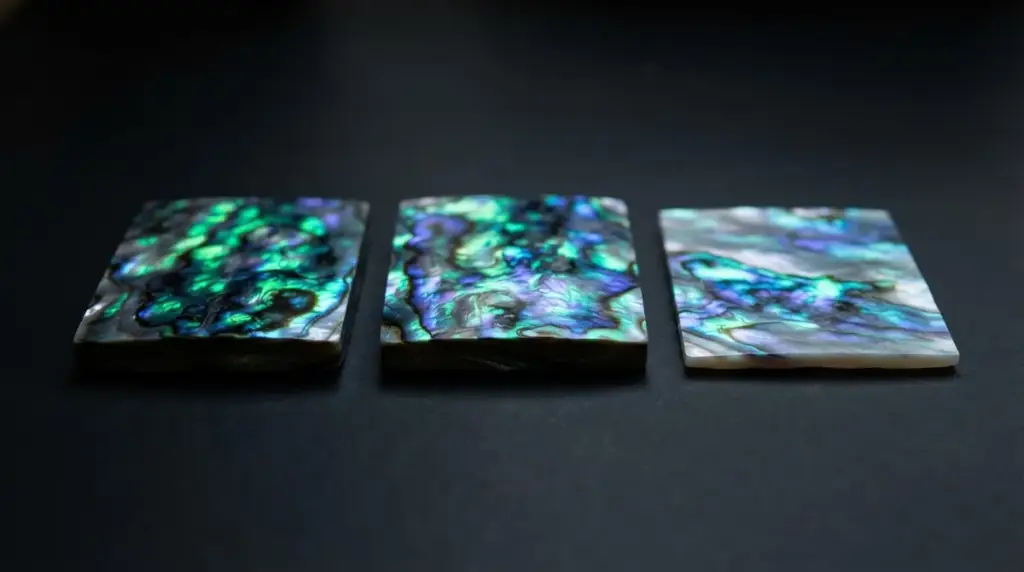
Abalone is the other shell you will meet, sold in knife circles alongside paua from New Zealand. It gives the multicoloured green and blue fire that pearl does not, and it works in smaller pieces, which is why it turns up as inlay and bolster accent more often than as a full scale. Red abalone in usable sizes is described by suppliers as getting scarce.
Abalone also carries a supply story worth knowing. South African abalone, Haliotis midae, was at one point brought under CITES trade controls and later removed from them after pressure from the fishing industry, and it remains heavily poached: published figures put illegal exports at close to thirty seven thousand tonnes between 2000 and 2016. If provenance matters to you, ask your seller which species and which country a shell came from, and expect that many sellers will not know.
Stag, and why genuine stag is scarce
Stag is antler, not horn, and it behaves differently from both horn and bone. It is denser, it takes a crown and a bark texture that no synthetic reproduces convincingly, and it is generally regarded as more stable than horn. Indian sambar stag is the material collectors mean when they say stag without qualification, and it has been in short supply for a long time.
Here is where we have to be careful. Knife trade accounts describe Indian export restrictions on sambar stag going back to the 1970s and tightening again in the late 1990s, with dealers reporting that stock ran out in the early 2000s and that what circulates now is old material. We could not verify a specific Indian legal instrument or a firm date this session, so treat the chronology as trade lore rather than established fact. What is not in doubt is the practical effect: genuine sambar stag is expensive, inconsistent and often decades old, and a great deal of what is sold as stag is dyed and textured bone.
Bone and horn
Bone is the workhorse of the traditional handle world. It is dense, it takes dye and jigging beautifully, and it is affordable. It also yellows. Bone that starts a warm cream will be a deeper amber in twenty years, and dyed bone fades unevenly where a thumb rests. Collectors of traditional pocket knives treat that patina as a feature. If you expect a knife to look identical in 2046, bone is not your material.
Horn is the least stable of the group. Buffalo horn and ram horn are prone to expansion and contraction with humidity and are generally less durable than the other natural options. A horn scale that has been kept in a dry room for a year can shrink enough that you feel a small step at the bolster with a thumbnail. Bring it back to normal humidity and it usually comes back. Keep it in a hot car and it may not.
The table below is a summary of the five paragraphs above. It is a rule of thumb sheet, not a laboratory result, and individual pieces vary more than any table can show.
| Material | Main failure mode | Movement with humidity | Grip when wet | Ages by |
|---|---|---|---|---|
| Mother of pearl | Chipping at corners, cracking on impact | Negligible | Poor | Barely changing |
| Abalone and paua | Chipping, and it is usually thinner still | Negligible | Poor | Barely changing |
| Stag antler | Cracking along an old growth line | Low | Good, the bark texture helps | Darkening in the hollows |
| Bone | Cracking at pin holes | Low to moderate | Moderate if jigged, poor if polished | Yellowing and dye fading |
| Buffalo or ram horn | Shrinking away from bolsters, delaminating | High | Poor when polished | Lightening at the thin edges |
| Stabilised wood | Cracking if very dry | Low | Moderate | Darkening |
| Micarta and G10 | Almost none in normal use | None worth measuring | Good | Not ageing visibly |
What is actually on our pearl shelf
Numbers we can stand behind, pulled from the catalogue rather than from a brochure. Our Pearl Shell Knives category holds seventeen published products.
| Figure | Value |
|---|---|
| Products in the Pearl Shell Knives category | 17 published |
| Price range | $230 to $348 |
| Median price | $278 |
| Lower and upper quartile | $239 and $295 |
| Folders | 11 |
| Fixed blades | 6 |
| Blade steel | 14 in 1095 and 15N20 Damascus, 3 in VG10 stainless |
| Folder blade lengths | 3 to 3.5 inches |
| Fixed blade lengths | 4 to 7 inches |
Put that beside the rest of the shop and the premium is obvious. Our folding pocket knife category has one hundred and eleven products with a median of one hundred and twenty eight dollars. The pearl median is two hundred and seventy eight. You are paying roughly double, and most of that difference is handle material and the labour of fitting it.
What the whole catalogue actually uses
The next table is a keyword census across all six hundred and nine published products, counting listings whose title or description names a material. It is not a clean material register, because a description that mentions bone in passing counts, and a knife with two materials counts twice. We are publishing it with that caveat rather than dressing it up as a precise inventory.
| Material named in a listing | Listings out of 609 |
|---|---|
| Resin | 121 |
| Micarta | 71 |
| Walnut | 66 |
| G10 | 58 |
| Rose wood | 57 |
| Buffalo horn | 52 |
| Pearl | 38 |
| Ram horn | 29 |
| Camel bone | 22 |
| Olive wood | 17 |
| Abalone | 5 |
| Stag horn | 5 |
Two things stand out. Stag is almost absent from our catalogue, with five listings naming it out of six hundred and nine, which is consistent with how hard the material is to source. And abalone is rarer still. Anyone telling you they have deep stock of both is worth a second question.
Movement, and what pinned scales do about it
Every organic handle material moves. Wood moves with moisture, horn moves more, bone moves a little, shell barely moves at all but is brittle instead. The problem is that a knife handle pins a moving material against materials that do not move: a steel tang, steel bolsters, brass pins.
What follows is predictable. In a dry season the scale shrinks fractionally and the pin heads and bolster edges stand slightly proud. In a humid season it swells back. Repeat that for years on a brittle material like shell and the stress concentrates at the pin holes and the corners, which is exactly where pearl chips first. Makers manage it by keeping scales thin, by bedding them properly, and by not overtightening pins. Owners manage it by not storing knives in an attic, a garage or a car.
Micarta and G10 are the honest comparison here. They do not expand or contract meaningfully, they are close to indestructible, and they cost a fraction of shell. If your knife is going to work for a living, they are the better engineering answer, and we sell plenty of them.
Grip, and the thing nobody mentions
Polished shell is slippery. So is polished horn, and so is polished bone. A pearl handled folder in a dry hand is fine. The same knife in a wet or bloody hand is a genuinely worse tool than a textured G10 handle costing eighty dollars less. Six of our seventeen pearl products are fixed blades in hunting and skinning patterns, which is precisely the use case where that matters most, and we would rather say so here than let somebody find out in the field.
If you want the look and the grip, the usual compromise is a shell inlay set into a textured or wooden frame rather than a full polished scale. Several of our pearl listings are built that way, with rose wood carrying the hand and shell doing the decoration.
Care and storage for shell, stag and horn
The rules are short. Keep humidity boring: a stable indoor room, not a basement and not an attic. Do not soak a knife with natural scales, and never leave one wet. Wipe shell with a soft damp cloth and dry it; do not use solvents, abrasive polish or ultrasonic cleaners, because all three will dull or craze a nacre surface. Horn and stag tolerate a very light wipe of mineral oil once or twice a year, which slows moisture exchange; shell does not need it.
Storage is the other half. Do not store natural handled knives in a sealed leather sheath long term, because leather holds moisture against both steel and scale. Our guides to storing knives and Damascus knife care cover the blade side of that in more detail, and fourteen of our seventeen pearl knives carry a carbon Damascus blade that has its own corrosion needs.
What we will and will not warranty
This is the inconvenient part. We warrant a handle against failures of our workmanship: a scale that lifts because it was bedded badly, a pin that was set wrong, a crack that was already in the material when we fitted it. We do not warrant a chipped pearl corner from a drop, a hairline crack from a knife left in a hot car, or a horn scale that has shrunk after a winter in a dry house. Those are the material doing what the material does, and no maker can engineer them away while still selling you shell.
Which leads to the recommendation we give in the shop. Buy pearl and abalone for a knife that will be carried gently, given as a gift, or kept. Buy stag and bone for a traditional pocket knife you will use and enjoy watching age. Buy micarta, G10 or stabilised wood for anything that will get wet, get dropped, or go to work. If you want to see the shell we currently have, it is all on the pearl shell knives category page.
Questions people ask
Is mother of pearl a fragile knife handle?
Yes, relative to everything else. It is brittle across its layers and used in thin scales, typically around a tenth to three sixteenths of an inch finished. It resists wear and scratching well, and it chips or cracks if the knife is dropped or if a corner takes a hard knock.
What is the difference between mother of pearl and abalone?
Both are nacre. Mother of pearl usually means the lining of pearl oysters, sold as white or silver lip, gold lip and black lip, and it comes in larger flatter pieces. Abalone comes from a different family of shells, shows stronger green and blue colour, and is available in smaller pieces, so it appears more often as inlay.
Does bone yellow over time?
It does. Untreated bone deepens toward amber over decades and dyed bone fades where it is handled most. Traditional knife collectors consider this desirable. If you want a handle that looks new indefinitely, choose a synthetic.
Is stag stronger than horn or bone?
Generally yes. Antler is denser and more dimensionally stable than horn, which is the least stable of the natural materials and the most prone to expanding and contracting with humidity.
Why is genuine sambar stag so expensive?
Supply. Trade accounts describe Indian export restrictions going back to the 1970s and tightening again in the late 1990s, after which dealer stocks were depleted. We could not verify a specific legal instrument for that, so treat the timeline as unverified, but the scarcity and the price are real and much material sold as stag is textured bone.
Can a chipped pearl scale be repaired?
A small chip can sometimes be blended by reshaping the whole edge of the scale, which changes the outline slightly. A crack through a pin hole normally means replacing the scale, and a matching replacement is hard to find because the original was cut from one shell.
Are pearl handles slippery?
Polished shell offers very little grip when wet. For a knife used in the field, either choose a textured material or choose a design where shell is inlaid into a wooden or textured frame rather than forming the whole gripping surface.
How should I clean a pearl or shell handle?
Soft damp cloth, then dry. No solvents, no abrasive polish, no ultrasonic cleaner. Keep the knife out of extreme humidity swings and never store it wet in a leather sheath.
What does a pearl handled knife cost?
On this site, between two hundred and thirty and three hundred and forty eight dollars, with a median of two hundred and seventy eight. The same blades in wood or micarta sit far lower, and our folding pocket knife median across one hundred and eleven products is one hundred and twenty eight dollars.
Is an exotic handle a good idea for a working knife?
Usually not. For hard use, micarta, G10 and stabilised wood are more stable, grippier when wet and much cheaper to replace. Exotic handles earn their place on knives that are carried carefully, given as gifts or collected.
More guides: read how to store knives for the humidity question in full, and Damascus knife care for the blade under most of these handles. Hand forged versus factory explains where the labour cost in a fitted scale comes from, knife anatomy parts explained names the bolsters and pins referred to above, and the pearl shell knives category lists the seventeen described here.
For handles where the colour is cast right through the resin instead of grown in a shell, read pride knives and rainbow blades.
Design your own knife with the handle material you want →
More from the workshop
The Cowboy Bull Cutter: A Ranch Pattern Nobody Explains
Why the tip is blunt, what the notched choil does, and the real prices, steels and handles across our 32 bull cutters.
How Damascus Steel Knives Are Made
Billet to blade: forge welding, folding, pattern work, heat treat and the acid etch.
KA-BAR Knife Guide: History, Markings and Value
The 1219C2 pattern explained: wartime makers, dating by markings, real values and what the Corps issues now.
